





Highlights
Key Ingredients
Skim through
| Ingredient name | what-it-does | irr., com. | ID-Rating |
|---|---|---|---|
| Water | solvent | ||
| Propanediol | solvent, moisturizer/humectant | ||
| Gluconolactone | exfoliant, chelating | superstar | |
| Niacinamide | cell-communicating ingredient, skin brightening, anti-acne, moisturizer/humectant | superstar | |
| Glycerin | skin-identical ingredient, moisturizer/humectant | 0, 0 | superstar |
| Tranexamic Acid | skin brightening, soothing | goodie | |
| Galactoarabinan | antioxidant | goodie | |
| Salicylic Acid | exfoliant, anti-acne, soothing, preservative | superstar | |
| Diglycerin | skin-identical ingredient, moisturizer/humectant | goodie | |
| Pinus Pinaster Bark Extract | antioxidant | goodie | |
| Madecassoside | antioxidant, soothing | goodie | |
| Phytic Acid | chelating | ||
| Caprylhydroxamic Acid | chelating | ||
| 1,2-Hexanediol | solvent |
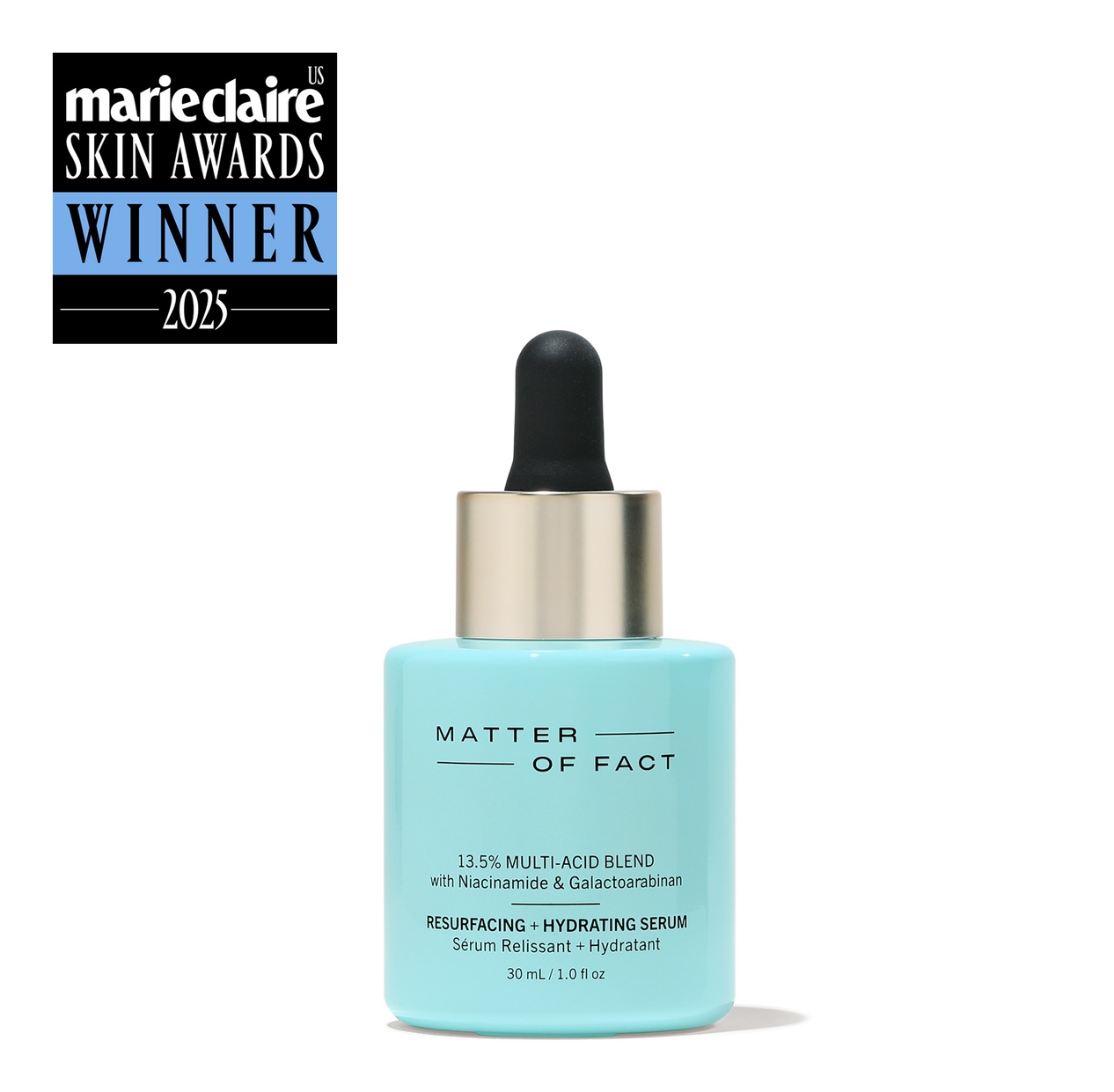
Matter of Fact Resurfacing Hydrating SerumIngredients explained
Good old water, aka H2O. The most common skincare ingredient of all. You can usually find it right in the very first spot of the ingredient list, meaning it’s the biggest thing out of all the stuff that makes up the product.
It’s mainly a solvent for ingredients that do not like to dissolve in oils but rather in water.
Once inside the skin, it hydrates, but not from the outside - putting pure water on the skin (hello long baths!) is drying.
One more thing: the water used in cosmetics is purified and deionized (it means that almost all of the mineral ions inside it is removed). Like this, the products can stay more stable over time.
Propanediol is a natural alternative for the often used and often bad-mouthed propylene glycol. It's produced sustainably from corn sugar and it's Ecocert approved.
It's quite a multi-tasker: can be used to improve skin moisturization, as a solvent, to boost preservative efficacy or to influence the sensory properties of the end formula.
- It’s a polyhydroxy acid (PHA), that is often referred to as next generation AHA
- It gently lifts off dead skin cells form the skin surface making skin smooth and even
- In the long term it provides anti-aging benefits, like increased skin thickness and decreased wrinkles (though a tad less than even more proven superstar AHAs)
- It’s a great moisturizer and even helps to repair impaired skin barrier
- It’s antioxidant, and does not make your skin more sensitive to the sun
- It can be used even if your skin is very sensitive, rosacea prone or if you are post cosmetic procedure
- A multi-functional skincare superstar with several proven benefits for the skin
- Great anti-aging, wrinkle smoothing ingredient used at 4-5% concentration
- Fades brown spots alone or in combination with amino sugar, acetyl glucosamine
- Increases ceramide synthesis that results in a stronger, healthier skin barrier and better skin hydration
- Can help to improve several skin conditions including acne, rosacea, and atopic dermatitis
- A natural moisturizer that’s also in our skin
- A super common, safe, effective and cheap molecule used for more than 50 years
- Not only a simple moisturizer but knows much more: keeps the skin lipids between our skin cells in a healthy (liquid crystal) state, protects against irritation, helps to restore barrier
- Effective from as low as 3% with even more benefits for dry skin at higher concentrations up to 20-40%
- High-glycerin moisturizers are awesome for treating severely dry skin
 We don't have description for this ingredient yet.
Galactoarabinan is a natural polysaccharide (a big carbohydrate molecule) that comes from the Larch trees.
According to the manufacturer it can do all kinds of good in a formula: it can reduce trans-epidermal-water-loss (a fancy way of saying that it's moisturizing), improve the appearance of skin’s superficial fine lines, improve the uniformity and spreadability of a formulation and provides SPF enhancement. What's more it can also help to boost the efficacy of AHA exfoliants (while not boosting the irritation side effect).
- It's one of the gold standard ingredients for treating problem skin
- It can exfoliate skin both on the surface and in the pores
- It's a potent anti-inflammatory agent
- It's more effective for treating blackheads than acne
- For acne combine it with antibacterial agents like benzoyl peroxide or azelaic acid
The big brother of glycerin. It's also a natural moisturizing factor that reduces water evaporation from the upper layer of the skin and helps to keep water in the skin so that it stays nicely hydrated.
Compared to glycerin, it has a larger molecular structure (kind of a double glycerin). Thanks to this, it penetrates slower into the skin but gives longer lasting moisture and less sticky, better skin-feel.
A natural plant extract coming from the bark of the maritime pine that grows along the coast of southwest France. The extract contains potent antioxidant molecules, mainly procyanidins and phenolic acids. Horphag Research trademarked the name 'Pycnogenol', which refers to a standardized, high-active content version of the pine bark extract.
Pycnogenol is a very well researched ingredient with more than 370 published studies and review articles. Most of these are in-vitro (made in the lab, not on real people) or analyse Pycnogenol when taken orally. It's clear from them that Pycnogenol has a load of health benefits including antioxidant, anti-inflammatory, and anticarcinogenic magical properties (and a bunch of other things such as improving cognitive function, relieving premenstrual symptoms, or enhancing microcirculation).
Regarding Pycnogenol and the skin, we found a study from 2012 that examined its effect on the skin when taken as a supplement. After 12 weeks, Pycnogenol supplements resulted in increased skin hydration and elasticity. The researchers thought this was due to the increased synthesis of extracellular matrix molecules such as hyaluronic acid and perhaps collagen.
As for topical application, the studies are also promising. A 2003 research paper, conducted on mice, showed that topical Pycnogenol (used at 0.05-0.2%) has the potential to provide photoprotection for humans in a complementary role to sunscreens. Meanwhile, a 2004 study concluded, "pine bark extract is readily absorbed by human skin and can be used for topical application".
Overall, Pycnogenol, or Pinus Pinaster Bark Extract, as it will be listed on the product label, is a well-researched and potent antioxidant that is a welcome addition to any ingredient list.
One of the main biologically active components of the famous medicinal plant, Centella Asiatica, aka Gotu Kola. It has well established wound healing, skin-soothing and antioxidant activities.
There is also a study by La Roche Posay (belongs to L'Oreal) that examined the anti-aging effects of 5% Vitamin C combined with 0.1% Madecassoside. They mention that " Madecassoside is known to induce collagen expression and ⁄ or to modulate inflammatory mediators thus might prevent and correct some signs of aging." The surprisingly long, 6-month study observed "significant improvement of the clinical score for deep and superficial wrinkles, suppleness, firmness, roughness, and skin hydration", but Vitamin C in itself is already an anti-aging superstar, so it is hard to know how much Madecassoside did.
Another promising property of Madecassoside is that it seems to inhibit UV-induced melanin synthesis (test formula with 0.05% MA, used twice a day on 23 volunteers for 8 weeks), making it a great active for hyperpigmentation-prone skin.
If that would not be enough, the French manufacturer (Seppic) also has encouraging in-vivo studies on the molecule. Used at 0.2%, Madecassoside reduces redness and peeling in skin with light atopic dermatitis as well as itching in psoriasis-prone skin.
Though its name says acid, it's not really an exfoliant. It's a plant extract with some antioxidant properties. Its main thing in cosmetic products is to neutralize the metal ions in the formula (that usually get into there from water) that would otherwise cause some not so nice changes. It's a natural alternative to sometimes bad-mouthed chelating agents, EDTAs.
A chelating agent that helps to preserve cosmetic products by neutralizing the metal ions (especially iron) in the formula (that usually get into there from water). Its special thing is that it also acts as a biostatic and fungistatic agent and remains active even at high pH.
It is often coupled with antimicrobial glycols (such as propanediol) to create a "preservative free preservative system" for cosmetic products.
A really multi-functional helper ingredient that can do several things in a skincare product: it can bring a soft and pleasant feel to the formula, it can act as a humectant and emollient, it can be a solvent for some other ingredients (for example it can help to stabilize perfumes in watery products) and it can also help to disperse pigments more evenly in makeup products. And that is still not all: it can also boost the antimicrobial activity of preservatives.
You may also want to take a look at...
| what‑it‑does | solvent |
| what‑it‑does | solvent | moisturizer/humectant |
| what‑it‑does | exfoliant | chelating |
| what‑it‑does | cell-communicating ingredient | skin brightening | anti-acne | moisturizer/humectant |
| what‑it‑does | skin-identical ingredient | moisturizer/humectant |
| irritancy, com. | 0, 0 |
| what‑it‑does | skin brightening | soothing |
| what‑it‑does | antioxidant |
| what‑it‑does | exfoliant | anti-acne | soothing | preservative |
| what‑it‑does | skin-identical ingredient | moisturizer/humectant |
| what‑it‑does | antioxidant |
| what‑it‑does | antioxidant | soothing |
| what‑it‑does | chelating |
| what‑it‑does | chelating |
| what‑it‑does | solvent |