




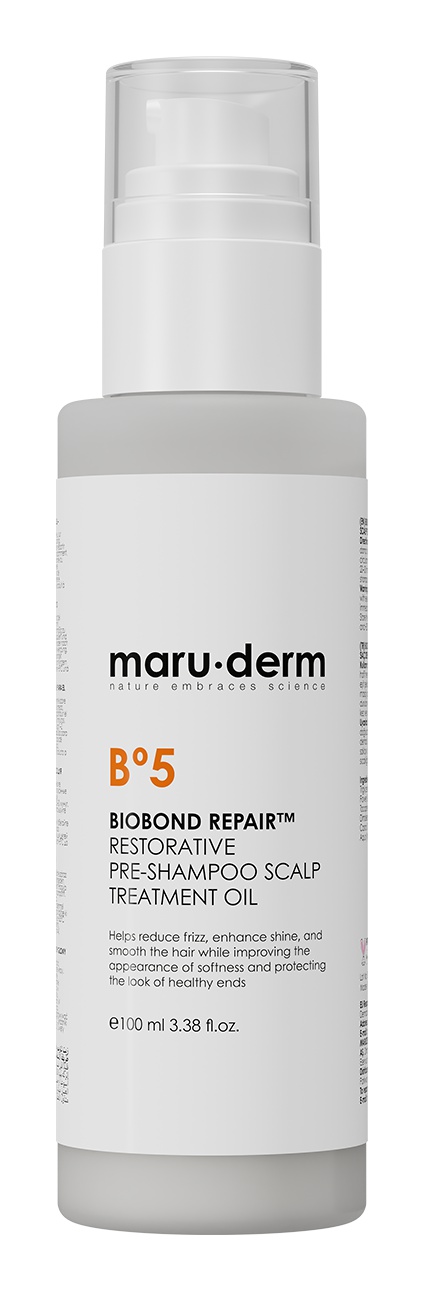
Biobond Repair™ Restorative Pre-Shampoo Scalp Treatment Oil
Ingredients overview
Highlights
Key Ingredients
Skim through
| Ingredient name | what-it-does | irr., com. | ID-Rating |
|---|---|---|---|
| C13-15 Alkane | solvent, emollient | ||
| Squalane | skin-identical ingredient, emollient | 0, 1 | goodie |
| Caprylic/Capric Triglyceride | emollient | ||
| Isoamyl Laurate | emollient | ||
| Helianthus Annuus (Sun Flower) Seed Oil | emollient | 0, 0 | goodie |
| Argania Spinosa Kernel (Argan) Oil | antioxidant, emollient | goodie | |
| Tocopheryl Acetate | antioxidant | 0, 0 | |
| Bis-Aminopropyl Diglycol Dimaleate | |||
| Coconut Alkanes | emollient, solvent | ||
| PEG-40 Hydrogenated Castor Oil | emulsifying, surfactant/cleansing | ||
| Polysorbate 20 | emulsifying, surfactant/cleansing | 0, 0 | |
| Coco-Caprylate/Caprate | emollient | ||
| Aqua (Water) | solvent | ||
| Parfum (Fragrance) | perfuming | icky |
Maruderm Biobond Repair™ Restorative Pre-Shampoo Scalp Treatment OilIngredients explained
A biodegradable emollient that gives a fresh gliding sensation and a powdery after feel. It works well with all kinds of oils including natural and silicone oils.
It seems to us that squalane is in fashion and there is a reason for it. Chemically speaking, it is a saturated (no double bonds) hydrocarbon (a molecule consisting only of carbon and hydrogen), meaning that it's a nice and stable oily liquid with a long shelf life.
It occurs naturally in certain fish and plant oils (e.g. olive), and in the sebum (the oily stuff our skin produces) of the human skin. As f.c. puts it in his awesome blog post, squalane's main things are "emolliency, surface occlusion, and TEWL prevention all with extreme cosmetic elegance". In other words, it's a superb moisturizer that makes your skin nice and smooth, without being heavy or greasy.
Another advantage of squalane is that it is pretty much compatible with all skin types and skin conditions. It is excellent for acne-prone skin and safe to use even if you have fungi-related skin issues, like seborrhea or fungal acne.
The unsaturated (with double bonds) and hence less stable version of Squalane is Squalene, you can read about it here >>
A super common emollient that makes your skin feel nice and smooth. It comes from coconut oil and glycerin, it’s light-textured, clear, odorless and non-greasy. It’s a nice ingredient that just feels good on the skin, is super well tolerated by every skin type and easy to formulate with. No wonder it’s popular.
A naturally derived (Ecocert approved) colorless to yellowish oily liquid that's touted as a natural silicone alternative. It's claimed to have great sensorial properties: light but caring, velvety, silky and non-sticky.
It's also great at dissolving UV-filters in sunscreens or dispersing pigments in makeup products. You can also bump into Isoamyl Laurate in hair care products as a hair conditioner that makes combing easier without build up.
Sunflower does not need a big intro as you probably use it in the kitchen as cooking oil, or you munch on the seeds as a healthy snack or you adore its big, beautiful yellow flower during the summer - or you do all of these and probably even more. And by even more we mean putting it all over your face as sunflower oil is one of the most commonly used plant oils in skincare.
It’s a real oldie: expressed directly from the seeds, the oil is used not for hundreds but thousands of years. According to The National Sunflower Association, there is evidence that both the plant and its oil were used by American Indians in the area of Arizona and New Mexico about 3000 BC. Do the math: it's more than 5000 years – definitely an oldie.
Our intro did get pretty big after all (sorry for that), so let's get to the point finally: sunflower oil - similar to other plant oils - is a great emollient that makes the skin smooth and nice and helps to keep it hydrated. It also protects the surface of the skin and enhances the damaged or irritated skin barrier. Leslie Bauman notes in Cosmetic Dermatology that one application of sunflower oil significantly speeds up the recovery of the skin barrier within an hour and sustains the results 5 hours after using it.
It's also loaded with fatty acids (mostly linoleic (50-74%) and oleic (14-35%)). The unrefined version (be sure to use that on your skin!) is especially high in linoleic acid that is great even for acne-prone skin. Its comedogen index is 0, meaning that it's pretty much an all skin-type oil.
Truth be told, there are many great plant oils and sunflower oil is definitely one of them.
When it comes to cosmetic oils and hype, argan oil is for sure leading the way. Dubbed as the "liquid gold of Morocco", we have to admit we have some trouble determining why this oil enjoys such a special miracle status. Not that it's not good, it is good, even great but reading the research about argan and a bunch of other plant oils we just do not see the big, unique differentiating factor (though that might be our fault not reading enough, obvs.)
So, argan oil comes from the kernel of the argan fruit that comes from the argan tree that grows only in Morocco. The tree is slow growing and getting the oil is a hard job. The traditional process is that the ripe argan fruits fall from the tree, then goats eat them up and poop out the seeds. The seeds are collected and smashed with a stone to get the kernels inside. This part is the hard one as the seeds have extremely hard shells. Once the kernels are obtained, the oil is pressed out from them (the kernels contain about 50% oil).
As for skincare, argan oil is loaded with lots of skin goodies (but so are many other plant oils): it contains 80% nourishing and moisturizing unsaturated fatty acids, mainly oleic (38-50%), linoleic (28-38%) and palmitic (10-18%). It also contains a relatively large amount of antioxidant vitamin E (600-900 mg/kg, about twice as much as olive), small amounts of antioxidant phenols (including caffeic acid, ferulic acid, and epicatechin), as well as some rare sterols with soothing and anti-inflammatory properties.
Thanks to all the above goodness in argan oil, it can greatly nourish and moisturize the skin and hair. It's also claimed to be able to neutralize collagen-damaging free radicals, help reduce scars, and revitalize and improve skin elasticity. You can even read that argan might help acne-prone skin, but being a high oleic oil, we would be careful with that.
All in all, argan oil is a real goodie but we do not fully understand the special miracle status it enjoys.
It’s the most commonly used version of pure vitamin E in cosmetics. You can read all about the pure form here. This one is the so-called esterified version.
According to famous dermatologist, Leslie Baumann while tocopheryl acetate is more stable and has a longer shelf life, it’s also more poorly absorbed by the skin and may not have the same awesome photoprotective effects as pure Vit E.
 We don't have description for this ingredient yet.
Coconut Alkanes is a volatile (something that does not absorb into the skin but evaporates from it), naturally derived vegetable alkane coming from renewable sources. It is a light, oily liquid that works as an emollient and gives a smooth skin feel.
It's often combined with another emollient called Coco-Caprylate/Caprate and the two together can serve as a great replacement for some volatile silicones, like Cyclopentasiloxane.
A mildly viscous, amber-colored liquid with fatty odor, made from Castor Oil and polyethylene glycol (PEG).
If it were a person, we’d say, it’s agile, diligent & multifunctional. It’s mostly used as an emulsifier and surfactant but most often it is used to solubilize fragrances into water-based formulas.
It's a common little helper ingredient that helps water and oil to mix together. Also, it can help to increase the solubility of some other ingredients in the formula.
A light emollient ester (C8-10 fatty acids connected to C12-18 fatty alcohols) that absorbs quickly and leaves a dry but silky finish on the skin. In terms of skin feel, it is similar to Dicaprylyl Carbonate, another commonly used light emollient.
Good old water, aka H2O. The most common skincare ingredient of all. You can usually find it right in the very first spot of the ingredient list, meaning it’s the biggest thing out of all the stuff that makes up the product.
It’s mainly a solvent for ingredients that do not like to dissolve in oils but rather in water.
Once inside the skin, it hydrates, but not from the outside - putting pure water on the skin (hello long baths!) is drying.
One more thing: the water used in cosmetics is purified and deionized (it means that almost all of the mineral ions inside it is removed). Like this, the products can stay more stable over time.
Exactly what it sounds: nice smelling stuff put into cosmetic products so that the end product also smells nice. Fragrance in the US and parfum in the EU is a generic term on the ingredient list that is made up of 30 to 50 chemicals on average (but it can have as much as 200 components!).
If you are someone who likes to know what you put on your face then fragrance is not your best friend - there's no way to know what’s really in it.
Also, if your skin is sensitive, fragrance is again not your best friend. It’s the number one cause of contact allergy to cosmetics. It’s definitely a smart thing to avoid with sensitive skin (and fragrance of any type - natural is just as allergic as synthetic, if not worse!).
You may also want to take a look at...
| what‑it‑does | solvent | emollient |
| what‑it‑does | skin-identical ingredient | emollient |
| irritancy, com. | 0, 1 |
| what‑it‑does | emollient |
| what‑it‑does | emollient |
| what‑it‑does | emollient |
| irritancy, com. | 0, 0 |
| what‑it‑does | antioxidant | emollient |
| what‑it‑does | antioxidant |
| irritancy, com. | 0, 0 |
| what‑it‑does | emollient | solvent |
| what‑it‑does | emulsifying | surfactant/cleansing |
| what‑it‑does | emulsifying | surfactant/cleansing |
| irritancy, com. | 0, 0 |
| what‑it‑does | emollient |
| what‑it‑does | solvent |
| what‑it‑does | perfuming |