




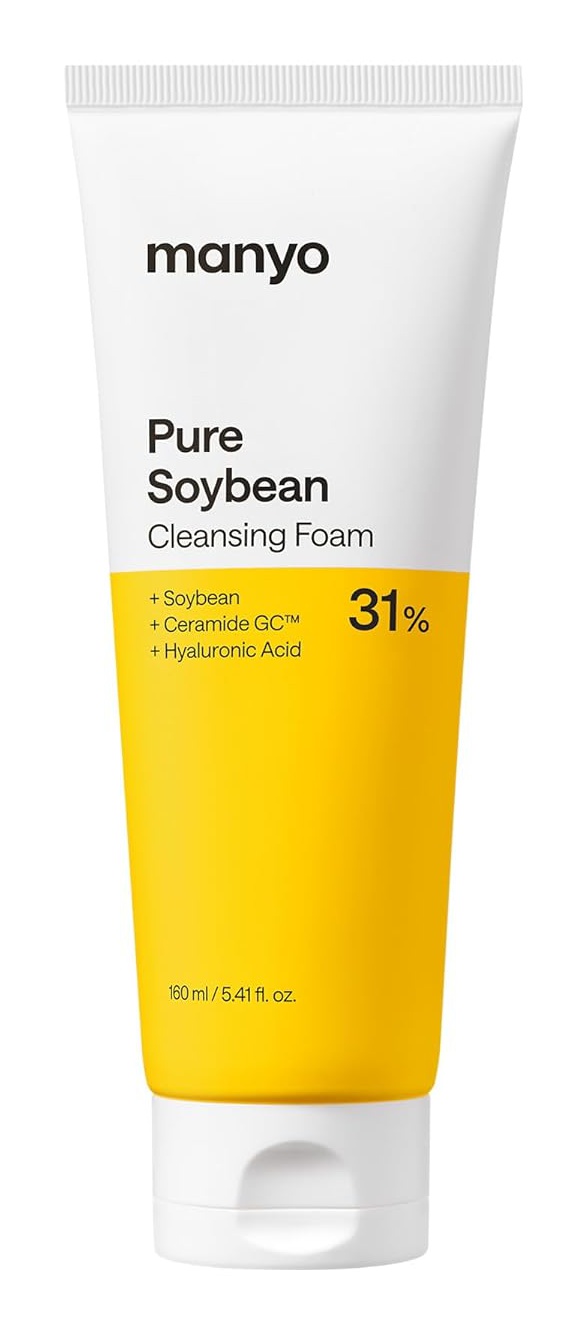
Ingredients overview
Highlights
Key Ingredients
Other Ingredients
Skim through
manyo Soybean Cleansing FoamIngredients explained
- A natural moisturizer that’s also in our skin
- A super common, safe, effective and cheap molecule used for more than 50 years
- Not only a simple moisturizer but knows much more: keeps the skin lipids between our skin cells in a healthy (liquid crystal) state, protects against irritation, helps to restore barrier
- Effective from as low as 3% with even more benefits for dry skin at higher concentrations up to 20-40%
- High-glycerin moisturizers are awesome for treating severely dry skin
Good old water, aka H2O. The most common skincare ingredient of all. You can usually find it right in the very first spot of the ingredient list, meaning it’s the biggest thing out of all the stuff that makes up the product.
It’s mainly a solvent for ingredients that do not like to dissolve in oils but rather in water.
Once inside the skin, it hydrates, but not from the outside - putting pure water on the skin (hello long baths!) is drying.
One more thing: the water used in cosmetics is purified and deionized (it means that almost all of the mineral ions inside it is removed). Like this, the products can stay more stable over time.
A common multi-tasker fatty acid. It makes your skin feel nice and smooth (emollient), gives body to cream type products and helps to stabilize water and oil mixes (aka emulsions).
A 14 carbon length fatty acid that can be naturally found in nutmeg, palm kernel oil, coconut oil and butter fat. It's used as a foam building cleansing agent. Paula Begoun writes that it can be a bit drying to the skin.
A 12 carbon length fatty acid that can be found naturally in coconut milk, coconut oil, laurel oil, and palm kernel oil. It's also in breast milk. As a skincare ingredient, it can be used as an emulsifier or as a cleansing agent.
What's more, there is emerging research about lauric acid being a good anti-acne ingredient. A 2009 study found that the lowest concentration to prevent evil acne-causing P. acnes growth of lauric acid is over 15 times lower than that of gold standard anti-acne ingredient benzoyl peroxide.
Though the studies are only in-vitro (made in the lab, not on real people), and it also has a high comedogenicity index, it might be worth a try if you are prone to inflamed acne (the type that's caused by P. acnes bacteria).
 We don't have description for this ingredient yet.
It's a very alkaline stuff that helps to set the pH of the cosmetic formula to be just right. It's similar to the more often used sodium hydroxide and pretty much the same of what we wrote there applies here too.
An amino-acid based cleansing agent that is described as extremely mild and having outstanding foamability. It can also reduce the harshness and leftover of stronger surfactants such as SLS or fatty acid soaps.
A fatty acid that can be found naturally in the skin. In fact, it's the most common saturated fatty acid found in animals and plants.
As for skincare, it can make the skin feel nice and smooth in moisturizers (emollient) or it can act as a foam building cleansing agent in cleansers. It's also a very popular ingredient in shaving foams.
A vegetable origin (coconut/palm kernel oil, glucose) cleansing agent that gives moderate to high stable foam. It's also biodegradable and mild to the skin.
A super common, waxy, white, solid stuff that helps water and oil to mix together, gives body to creams and leaves the skin feeling soft and smooth.
Chemically speaking, it is the attachment of a glycerin molecule to the fatty acid called stearic acid. It can be produced from most vegetable oils (in oils three fatty acid molecules are attached to glycerin instead of just one like here) in a pretty simple, "green" process that is similar to soap making. It's readily biodegradable.
It also occurs naturally in our body and is used as a food additive. As cosmetic chemist Colins writes it, "its safety really is beyond any doubt".
We don't have description for this ingredient yet.
Though its long name does not reveal it, this polymer molecule (big molecule from repeated subunits or monomers) is a relative to the super common, water-loving thickener, Carbomer. Both of them are big molecules that contain acrylic acid units, but Acrylates/C10-30 Alkyl Acrylate Crosspolymer also contains some other monomers that are hydrophobic, i.e. water-hating.
This means that our molecule is part water- and part oil-loving, so it not only works as a thickener but also as an emulsion stabilizer. It is very common in gel-type formulas that also contain an oil-phase as well as in cleansers as it also works with most cleansing agents (unlike a lot of other thickeners).
A cleansing agent that's claimed to be so gentle on the skin that it hardly impacts the skin barrier. It also gives a rich, creamy foam, it's based on vegetable fatty acids and is readily biodegradable.
It's an especially important and popular ingredient in "syndet bars" (or soapless soaps). Dr. Leslie Baumann says in her great Cosmetic Dermatology book that thanks to the unique molecular characteristic of Sodium Cocoyl Isethionate, it "has defined a new dimension in the mildness of cleansing bars".
Sunflower does not need a big intro as you probably use it in the kitchen as cooking oil, or you munch on the seeds as a healthy snack or you adore its big, beautiful yellow flower during the summer - or you do all of these and probably even more. And by even more we mean putting it all over your face as sunflower oil is one of the most commonly used plant oils in skincare.
It’s a real oldie: expressed directly from the seeds, the oil is used not for hundreds but thousands of years. According to The National Sunflower Association, there is evidence that both the plant and its oil were used by American Indians in the area of Arizona and New Mexico about 3000 BC. Do the math: it's more than 5000 years – definitely an oldie.
Our intro did get pretty big after all (sorry for that), so let's get to the point finally: sunflower oil - similar to other plant oils - is a great emollient that makes the skin smooth and nice and helps to keep it hydrated. It also protects the surface of the skin and enhances the damaged or irritated skin barrier. Leslie Bauman notes in Cosmetic Dermatology that one application of sunflower oil significantly speeds up the recovery of the skin barrier within an hour and sustains the results 5 hours after using it.
It's also loaded with fatty acids (mostly linoleic (50-74%) and oleic (14-35%)). The unrefined version (be sure to use that on your skin!) is especially high in linoleic acid that is great even for acne-prone skin. Its comedogen index is 0, meaning that it's pretty much an all skin-type oil.
Truth be told, there are many great plant oils and sunflower oil is definitely one of them.
It’s one of those little helper ingredients that makes sure the product stays the same over time. No color change or anything like that. It does so by neutralizing the metal ions in the formula (that usually get into there from water) that would otherwise cause some not so nice changes.
A really multi-functional helper ingredient that can do several things in a skincare product: it can bring a soft and pleasant feel to the formula, it can act as a humectant and emollient, it can be a solvent for some other ingredients (for example it can help to stabilize perfumes in watery products) and it can also help to disperse pigments more evenly in makeup products. And that is still not all: it can also boost the antimicrobial activity of preservatives.
A helper ingredient that helps to make the products stay nice longer, aka preservative. It works mainly against fungi.
It’s pH dependent and works best at acidic pH levels (3-5). It’s not strong enough to be used in itself so it’s always combined with something else, often with potassium sorbate.
We don't have description for this ingredient yet.
The fragrant essential oil coming from the flowers of Rose Geranium. Like most essential oils, it contains antioxidant and antimicrobial components, but the main ones are fragrant constituents (like citronellol and geraniol). Be careful with it, if your skin is sensitive.
The essential oil coming from the rind of the orange (the sweet one). In general, the main component of citrus peel oils is limonene (83-97% for sweet orange peel), a super common fragrant ingredient that makes everything smell nice (but counts as a frequent skin sensitizer).
Other than that, citrus peel also contains the problematic compound called furanocoumarin that makes them mildly phototoxic. Orange peel contains less of it than some other citruses (like bergamot or lime), but still, be careful with it especially if it is in a product for daytime use.
Sweet, exotic and floral, it’ no surprise that Ylang Ylang is a popular essential oil. It is coming from the yellow, fragrant flowers of the Cananga tree native to tropical Asia and, similar to other essential oils, it is a chemically complex mixture with several pros and cons.
Unfortunately, these are a bit tricky to pin down as the composition varies largely depending on where it is sourced, how the oil is extracted and the grade of it that is used in the product, but we’ll do our best!
Let’s start with the easy stuff. The main components are fragrant molecules, including super common linalool (1-19%), benzyl benzoate (2-10%) and several others adding up to a max amount of 37.6% of EU sensitizers. The most expensive Extra grade is the most fragrant (has more benzyl acetate and cresyl methyl ether) and is used in high-end perfumes, while the First and Second grades are less fragrant, and used mainly in cosmetics.
Other than smelling nice and making cosmetic formulas also smell nice, Ylang Ylang might have some antimicrobial and antioxidant benefits and also works as an insect repellent. Its nice smell is also commonly known as being relaxing and calming (also backed up by a few recent studies), but it is an aromatherapy use case (when inhaled) so this probably does not count much skincare-wise.
On the other hand, the nice smell also means allergen fragrant components and 37.6% of EU sensitizers counts as quite high and the oil is considered to have high skin sensitization potential. It is a good idea to avoid if your skin is sensitive.
The essential oil coming from the fruit (probably the rind) of the bergamot orange. It's a common top note in perfumes and contains (among others) fragrant compounds limonene (37%), linalyl acetate (30%) and linalool (8.8%).
A well-known issue with bergamot oil (apart from the fragrance allergens) is that it contains phototoxic compounds called furanocoumarins, but more and more commonly furanocoumarin-free versions are used in cosmetic products. Still, if you have sensitive skin and prefer fragrance-free products, bergamot oil is not for you.
An abbreviation that pops up on a lot of ingredient lists. It stands for EthyleneDiamineTetraacetic Acid and it's a famous molecule for being an excellent chelating agent, i.e. a molecule that can bind to metal ions (coming usually from water) and make them harmless in a cosmetic formula. With a chelating agent, cosmetic formulas stay nice longer.
EDTA is an acid molecule and its salt versions are even more often used, such as the super common Disodium EDTA.
Citric acid comes from citrus fruits and is an AHA. If these magic three letters don’t tell you anything, click here and read our detailed description on glycolic acid, the most famous AHA.
So citric acid is an exfoliant, that can - just like other AHAs - gently lift off the dead skin cells of your skin and make it more smooth and fresh.
There is also some research showing that citric acid with regular use (think three months and 20% concentration) can help sun-damaged skin, increase skin thickness and some nice hydrating things called glycosaminoglycans in the skin.
But according to a comparative study done in 1995, citric acid has less skin improving magic properties than glycolic or lactic acid. Probably that’s why citric acid is usually not used as an exfoliant but more as a helper ingredient in small amounts to adjust the pH of a formulation.
We are big fans of all kinds of roses as ornamental plants but when it comes to skincare, it is a mixed bag. Before we list out the good and the not so good, here is an interesting thing.
The oil content in rose is very, very low so distilling rose essential oil requires huge amounts of rose flowers. It has such a wonderful scent that there are no comparable synthetic alternatives. You can probably guess that this means rose essential oil is expensive.... very very expensive.
So the good things: thanks to its wonderful scent the high-end perfume industry loves rose oil. Also, we (humans :)) love rose oil. We love its scent so much that it can heal headaches, depression, stress, and even grief.
Rose oil contains more than 95 compounds, among them flavonoids, anthocyanins, vitamin C, and quercetin that are all known for their medicinal properties and great antioxidant effects. Similar to many other essential oils, it has antimicrobial properties too.
Now, the not-so-good thing? Out of the 95 compounds, the major ones are citronellol and geraniol, fragrant components that might irritate sensitive skin.
It’s the - sodium form - cousin of the famous NMF, hyaluronic acid (HA). If HA does not tell you anything we have a super detailed, geeky explanation about it here. The TL; DR version of HA is that it's a huge polymer (big molecule from repeated subunits) found in the skin that acts as a sponge helping the skin to hold onto water, being plump and elastic. HA is famous for its crazy water holding capacity as it can bind up to 1000 times its own weight in water.
As far as skincare goes, sodium hyaluronate and hyaluronic acid are pretty much the same and the two names are used interchangeably. As cosmetic chemist kindofstephen writes on reddit "sodium hyaluronate disassociates into hyaluronic acid molecule and a sodium atom in solution".
In spite of this, if you search for "hyaluronic acid vs sodium hyaluronate" you will find on multiple places that sodium hyaluronate is smaller and can penetrate the skin better. Chemically, this is definitely not true, as the two forms are almost the same, both are polymers and the subunits can be repeated in both forms as much as you like. (We also checked Prospector for sodium hyaluronate versions actually used in cosmetic products and found that the most common molecular weight was 1.5-1.8 million Da that absolutely counts as high molecular weight).
What seems to be a true difference, though, is that the salt form is more stable, easier to formulate and cheaper so it pops up more often on the ingredient lists.
If you wanna become a real HA-and-the-skin expert you can read way more about the topic at hyaluronic acid (including penetration-questions, differences between high and low molecular weight versions and a bunch of references to scientific literature).
Butylene glycol, or let’s just call it BG, is a multi-tasking colorless, syrupy liquid. It’s a great pick for creating a nice feeling product.
BG’s main job is usually to be a solvent for the other ingredients. Other tasks include helping the product to absorb faster and deeper into the skin (penetration enhancer), making the product spread nicely over the skin (slip agent), and attracting water (humectant) into the skin.
It’s an ingredient whose safety hasn’t been questioned so far by anyone (at least not that we know about). BG is approved by Ecocert and is also used enthusiastically in natural products. BTW, it’s also a food additive.
A super common emollient that makes your skin feel nice and smooth. It comes from coconut oil and glycerin, it’s light-textured, clear, odorless and non-greasy. It’s a nice ingredient that just feels good on the skin, is super well tolerated by every skin type and easy to formulate with. No wonder it’s popular.
It's the chemically chopped up version of normal lecithin. Most often it's used to create liposomes and to coat and stabilize other ingredients.
We don't have description for this ingredient yet.
We don't have description for this ingredient yet.
We don't have description for this ingredient yet.
Lonicera Japonica, or Japanese Honeysuckle as normal people call it, is a white-flowered honeysuckle known for being a traditional Chinese medicine. Modern research confirms that the plant has a super complex chemical composition with more than 140 compounds identified with possible anti-inflammatory, antibacterial, antiviral, antioxidative and hepatoprotective activities.
As for Lonicera Japonica Flower Extract in skin care, it can have two main roles. The first one is being an anti-inflammatory and soothing ingredient, probably due to chlorogenic acid, a polyphenol thought to be the main bioactive component of the flower.
The other possible role is being a natural preservative. If this is the case, it is coupled with its Italian Honeysuckle cousin to form a broad spectrum antimicrobial preservative blend. You can read about this more here.
One of the many types of ceramides that can be found naturally in the upper layer of the skin. Ceramides make up about 50% of the goopy stuff that's between our skin cells and play a super important role in having a healthy skin barrier and keeping the skin hydrated. It works even better when combined with its pal, Ceramide 1.
We wrote way more about ceramides at ceramide 1, so click here to know more.
When you hear the word Soy, you probably associate it with soy sauce or tofu, not skincare. But as it turns out, the soybean has a bunch of useful active components and soybean extract is an interesting cosmetic ingredient with a wide range of possible effects.
Its main active components are antioxidant phenolic acids and flavonoids as well as small and large soy proteins. The large proteins give soybean extract nice skin smoothing and softening properties, while the small proteins (soybean trypsin inhibitor (STI) and Bowman-Birk inhibitor (BBI)) are thought to inhibit skin pigmentation and delay hair regrowth.
Regarding skin pigmentation, the soybean extract works by hindering melanosome transfer, meaning it blocks the melanin pigment from traveling up to the surface of the skin and becoming visible there. This is useful for most pigmentation situations but, if you have melasma, soy is not for you as melasma is estrogen-mediated and soy is a well-known phytoestrogen.
The most famous and bioactive flavonoids in soybeans are the isoflavones called genistein and diadzein that have potent antioxidant and anti-inflammatory properties. Genistein is also proven to inhibit UV induced redness in human skin. These isoflavones are also the ones that make soy a phytoestrogen, meaning they have a (weak) estrogenic effect. Topical estrogen is known to decrease skin thinning and collagen loss and soy might be able to do the same, especially during and after menopause when natural estrogen levels run low.
There is also some promising, but as yet not in-vivo (done on real people), research that soybean extract can stimulate both elastin and collagen synthesis and thus lead to healthier, younger-looking skin.
Overall, soybean extract is a promising and multi-functional active, a nice addition to most ingredient lists.
We don't have description for this ingredient yet.
We don't have description for this ingredient yet.
We don't have description for this ingredient yet.
We don't have description for this ingredient yet.
In general, flower waters are diluted versions of essential oils meaning they contain pretty much the same components but in much-reduced concentrations. So lavender flower water is a highly diluted version of lavender essential oil. According to manufacturer claims, it's traditionally used as bath water or wash water and might be useful for acne-prone or oily skin thanks to lavender's antibacterial properties.
We wrote in detail about lavender essential oil and why we prefer it not to have in skincare products (in short, it not only contains fragrant components but research shows it might be cytotoxic even at low concentrations) so we would also be cautious with the lavender water. It's much more diluted - so less effect and less side effect - but why risk it?
We don't have description for this ingredient yet.
We don't have description for this ingredient yet.
We don't have description for this ingredient yet.
We don't have description for this ingredient yet.
It's one of those things that help your cosmetics not to go wrong too soon, aka a preservative. It’s not a strong one and doesn’t really work against bacteria, but more against mold and yeast. To do that it has to break down to its active form, sorbic acid. For that to happen, there has to be water in the product and the right pH value (pH 3-4).
But even if everything is right, it’s not enough on its own. If you see potassium sorbate you should see some other preservative next to it too.
BTW, it’s also a food preservative and even has an E number, E202.
If you have spotted ethylhexylglycerin on the ingredient list, most probably you will see there also the current IT-preservative, phenoxyethanol. They are good friends because ethylhexylglycerin can boost the effectiveness of phenoxyethanol (and other preservatives) and as an added bonus it feels nice on the skin too.
Also, it's an effective deodorant and a medium spreading emollient.
You may also want to take a look at...
| what‑it‑does | skin-identical ingredient | moisturizer/humectant |
| irritancy, com. | 0, 0 |
| what‑it‑does | solvent |
| what‑it‑does | emollient | viscosity controlling |
| irritancy, com. | 0, 2-3 |
| what‑it‑does | surfactant/cleansing | emulsifying | perfuming |
| irritancy, com. | 0, 3 |
| what‑it‑does | anti-acne | surfactant/cleansing | emulsifying |
| irritancy, com. | 1, 4 |
| what‑it‑does | emulsifying | surfactant/cleansing |
| what‑it‑does | buffering |
| what‑it‑does | surfactant/cleansing |
| what‑it‑does | skin-identical ingredient | emollient | emulsifying |
| irritancy, com. | 0, 2 |
| what‑it‑does | surfactant/cleansing |
| what‑it‑does | emollient | emulsifying |
| irritancy, com. | 0, 1 |
| what‑it‑does | viscosity controlling |
| what‑it‑does | surfactant/cleansing |
| what‑it‑does | emollient |
| irritancy, com. | 0, 0 |
| what‑it‑does | chelating |
| what‑it‑does | solvent |
| what‑it‑does | preservative |
| what‑it‑does | surfactant/cleansing | emulsifying | moisturizer/humectant |
| what‑it‑does | perfuming |
| what‑it‑does | perfuming |
| what‑it‑does | perfuming |
| what‑it‑does | perfuming |
| what‑it‑does | chelating |
| what‑it‑does | buffering |
| what‑it‑does | antioxidant | perfuming | antimicrobial/antibacterial |
| what‑it‑does | skin-identical ingredient | moisturizer/humectant |
| irritancy, com. | 0, 0 |
| what‑it‑does | moisturizer/humectant | solvent |
| irritancy, com. | 0, 1 |
| what‑it‑does | emollient |
| what‑it‑does | emollient | emulsifying |
| what‑it‑does | soothing | antimicrobial/antibacterial |
| what‑it‑does | skin-identical ingredient |
| what‑it‑does | antioxidant | skin brightening | soothing | emollient |
| what‑it‑does | emollient |
| what‑it‑does | antimicrobial/antibacterial |
| what‑it‑does | soothing |
| what‑it‑does | preservative |
| what‑it‑does | preservative |