




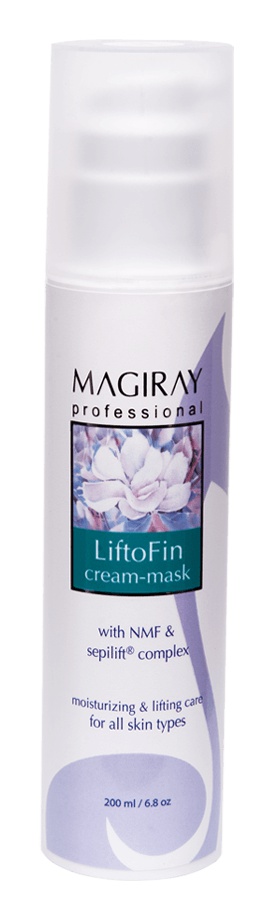
Liftofin Cream-mask
Ingredients overview
Highlights
Key Ingredients
Other Ingredients
Skim through
Magiray Liftofin Cream-maskIngredients explained
Good old water, aka H2O. The most common skincare ingredient of all. You can usually find it right in the very first spot of the ingredient list, meaning it’s the biggest thing out of all the stuff that makes up the product.
It’s mainly a solvent for ingredients that do not like to dissolve in oils but rather in water.
Once inside the skin, it hydrates, but not from the outside - putting pure water on the skin (hello long baths!) is drying.
One more thing: the water used in cosmetics is purified and deionized (it means that almost all of the mineral ions inside it is removed). Like this, the products can stay more stable over time.
A super common emollient that makes your skin feel nice and smooth. It comes from coconut oil and glycerin, it’s light-textured, clear, odorless and non-greasy. It’s a nice ingredient that just feels good on the skin, is super well tolerated by every skin type and easy to formulate with. No wonder it’s popular.
- A natural moisturizer that’s also in our skin
- A super common, safe, effective and cheap molecule used for more than 50 years
- Not only a simple moisturizer but knows much more: keeps the skin lipids between our skin cells in a healthy (liquid crystal) state, protects against irritation, helps to restore barrier
- Effective from as low as 3% with even more benefits for dry skin at higher concentrations up to 20-40%
- High-glycerin moisturizers are awesome for treating severely dry skin
Jojoba is a drought resistant evergreen shrub native to South-western North America. It's known and grown for jojoba oil, the golden yellow liquid coming from the seeds (about 50% of the weight of the seeds will be oil).
At first glance, it seems like your average emollient plant oil: it looks like an oil and it's nourishing and moisturizing to the skin but if we dig a bit deeper, it turns out that jojoba oil is really special and unique: technically - or rather chemically - it's not an oil but a wax ester (and calling it an oil is kind of sloppy).
So what the heck is a wax ester and why is that important anyway? Well, to understand what a wax ester is, you first have to know that oils are chemically triglycerides: one glycerin + three fatty acids attached to it. The fatty acids attached to the glycerin vary and thus we have many kinds of oils, but they are all triglycerides. Mother Nature created triglycerides to be easily hydrolyzed (be broken down to a glycerin + 3 fatty acid molecules) and oxidized (the fatty acid is broken down into small parts) - this happens basically when we eat fats or oils and our body generates energy from it.
Mother Nature also created wax esters but for a totally different purpose. Chemically, a wax ester is a fatty acid + a fatty alcohol, one long molecule. Wax esters are on the outer surface of several plant leaves to give them environmental protection. 25-30% of human sebum is also wax esters to give us people environmental protection.
So being a wax ester results in a couple of unique properties: First, jojoba oil is extremely stable. Like crazy stable. Even if you heat it to 370 C (698 F) for 96 hours, it does not budge. (Many plant oils tend to go off pretty quickly). If you have some pure jojoba oil at home, you should be fine using it for years.
Second, jojoba oil is the most similar to human sebum (both being wax esters), and the two are completely miscible. Acne.org has this not fully proven theory that thanks to this, jojoba might be able to "trick" the skin into thinking it has already produced enough sebum, so it might have "skin balancing" properties for oily skin.
Third, jojoba oil moisturizes the skin through a unique dual action: on the one hand, it mixes with sebum and forms a thin, non-greasy, semi-occlusive layer; on the other hand, it absorbs into the skin through pores and hair follicles then diffuses into the intercellular spaces of the outer layer of the skin to make it soft and supple.
On balance, the point is this: in contrast to real plant oils, wax esters were designed by Mother Nature to stay on the surface and form a protective, moisturizing barrier and jojoba oil being a wax ester is uniquely excellent at doing that.
A synthetic emollient oil that leaves a soft non-greasy, non-sticky feel on the skin, absorbs fast and can be emulsified (mixed with water) very easily.
A light, velvety, unique skin feel liquid that is a good solvent and also makes the skin feel nice and smooth (aka emollient). It's often used in makeup products mixed with silicones to give shine and slip to the product. It's also great for cleansing dirt and oil from the skin as well as for taking off make-up.
A clear, colorless oil-like liquid that makes the skin feel smooth and nice (aka emollient) and it does so without it being greasy.
What's more, it can even reduce the heavy, greasy feel in products with high oil content. It's also fast-spreading meaning that it gives the formula a good, nice slip. It absorbs quickly into the skin and helps other ingredients to penetrate quicker and deeper.
Thanks to all this, it's one of the most commonly used emollients out there. There is just one little drawback: it has a high comedogenic index (5 out of 5...), so it might clog pores if you're prone to it.
It's a film-forming and thickening polymer (a large molecule composed of many repeated subunits) that comes to the formula usually as part of an emulsifier, thickener trio (with C13-14 Isoparaffin and Laureth-7, trade named Sepigel 305). This trio is an easy-to-use liquid that helps to create nice, non-tacky gel formulas.
The emollient plant oil coming from the soybean. It is considered to be a nice, cost-effective base oil with moisturizing properties. As for its fatty acid profile, it contains 48-59% barrier-repairing linoleic acid, 17-30% nourishing oleic acid and also some (4.5-11%) potentially anti-inflammatory linolenic acid.
It’s pretty much the current IT-preservative. It’s safe and gentle, but even more importantly, it’s not a feared-by-everyone-mostly-without-scientific-reason paraben.
It’s not something new: it was introduced around 1950 and today it can be used up to 1% worldwide. It can be found in nature - in green tea - but the version used in cosmetics is synthetic.
Other than having a good safety profile and being quite gentle to the skin it has some other advantages too. It can be used in many types of formulations as it has great thermal stability (can be heated up to 85°C) and works on a wide range of pH levels (ph 3-10).
It’s often used together with ethylhexylglycerin as it nicely improves the preservative activity of phenoxyethanol.
It's a petroleum derived emollient and thickener. It often comes to the formula as part of an emulsifier, thickener trio (with Polyacrylamide and Laureth-7). This trio is an easy-to-use liquid that helps to create nice, non-tacky gel formulas.
Though its long name does not reveal it, this polymer molecule (big molecule from repeated subunits or monomers) is a relative to the super common, water-loving thickener, Carbomer. Both of them are big molecules that contain acrylic acid units, but Acrylates/C10-30 Alkyl Acrylate Crosspolymer also contains some other monomers that are hydrophobic, i.e. water-hating.
This means that our molecule is part water- and part oil-loving, so it not only works as a thickener but also as an emulsion stabilizer. It is very common in gel-type formulas that also contain an oil-phase as well as in cleansers as it also works with most cleansing agents (unlike a lot of other thickeners).
An easy-to-formulate, commonly used, nice to have ingredient that’s also called pro-vitamin B5. As you might guess from the “pro” part, it’s a precursor to vitamin B5 (whose fancy name is pantothenic acid).
Its main job in skincare products is to moisturise the skin. It’s a humectant meaning that it can help the skin to attract water and then hold onto it. There is also research showing that panthenol can help our skin to produce more lovely lipids that are important for a strong and healthy skin barrier.
Another great thing about panthenol is that it has anti-inflammatory and skin protecting abilities. A study shows that it can reduce the irritation caused by less-nice other ingredients (e.g. fragrance, preservatives or chemical sunscreens) in the product.
Research also shows that it might be useful for wound healing as it promotes fibroblast (nice type of cells in our skin that produce skin-firming collagen) proliferation.
If that wasn’t enough panthenol is also useful in nail and hair care products. A study shows that a nail treatment liquide with 2% panthenol could effectively get into the nail and significantly increase the hydration of it.
As for the hair the hydration effect is also true there. Panthenol might make your hair softer, more elastic and helps to comb your hair more easily.
It’s a handy multi-tasking ingredient that gives the skin a nice, soft feel. At the same time, it also boosts the effectiveness of other preservatives, such as the nowadays super commonly used phenoxyethanol.
The blend of these two (caprylyl glycol + phenoxyethanol) is called Optiphen, which not only helps to keep your cosmetics free from nasty things for a long time but also gives a good feel to the finished product. It's a popular duo.
It's a clear, slightly yellowish oil (comes from coconut or palm kernel oil) that is used as a traditional, medium spreading emollient.
A little helper ingredient that works as a preservative. It works against bacteria and some species of fungi and yeast. It's often combined with IT-preservative, phenoxyethanol.
 We don't have description for this ingredient yet.
A not-very-interesting helper ingredient that is used as an emulsifier and/or surfactant. Comes from a coconut oil derived fatty alcohol, lauryl alcohol.
A common functional ingredient that helps to keep the oil-loving and water-loving ingredients together (emulsifier), stabilizes and thickens the products.
Chemically speaking, it is ethoxylated Cetearyl alcohol, meaning that some ethylene oxide is added to the fatty alcohol to increase the water-soluble part in the molecule. The result is that the mainly oil soluble, emollient fatty alcohol is converted to an emulsifier molecule that keeps oil and water mixed in creams. The number in the name of Ceteareth emulsifiers refers to the average number of ethylene oxide molecules added and 20 makes a good emulsifier.
An extremely common multitasker ingredient that gives your skin a nice soft feel (emollient) and gives body to creams and lotions. It also helps to stabilize oil-water mixes (emulsions), though it does not function as an emulsifier in itself. Its typical use level in most cream type formulas is 2-3%.
It’s a so-called fatty alcohol, a mix of cetyl and stearyl alcohol, other two emollient fatty alcohols. Though chemically speaking, it is alcohol (as in, it has an -OH group in its molecule), its properties are totally different from the properties of low molecular weight or drying alcohols such as denat. alcohol. Fatty alcohols have a long oil-soluble (and thus emollient) tail part that makes them absolutely non-drying and non-irritating and are totally ok for the skin.
Exactly what it sounds: nice smelling stuff put into cosmetic products so that the end product also smells nice. Fragrance in the US and parfum in the EU is a generic term on the ingredient list that is made up of 30 to 50 chemicals on average (but it can have as much as 200 components!).
If you are someone who likes to know what you put on your face then fragrance is not your best friend - there's no way to know what’s really in it.
Also, if your skin is sensitive, fragrance is again not your best friend. It’s the number one cause of contact allergy to cosmetics. It’s definitely a smart thing to avoid with sensitive skin (and fragrance of any type - natural is just as allergic as synthetic, if not worse!).
The unfancy name for it is lye. It’s a solid white stuff that’s very alkaline and used in small amounts to adjust the pH of the product and make it just right.
For example, in case of AHA or BHA exfoliants, the right pH is super-duper important, and pH adjusters like sodium hydroxide are needed.
BTW, lye is not something new. It was already used by ancient Egyptians to help oil and fat magically turn into something else. Can you guess what? Yes, it’s soap. It still often shows up in the ingredient list of soaps and other cleansers.
Sodium hydroxide in itself is a potent skin irritant, but once it's reacted (as it is usually in skin care products, like exfoliants) it is totally harmless.
- Primary fat-soluble antioxidant in our skin
- Significant photoprotection against UVB rays
- Vit C + Vit E work in synergy and provide great photoprotection
- Has emollient properties
- Easy to formulate, stable and relatively inexpensive
The oil coming from the seeds of the yellow flowered safflower plant. Similar to other plant oils, it's loaded with nourishing and moisturizing fatty acids: it's a high linoleic acid oil (70%) and has only smaller amounts of oleic acid (11%) (this might be great for acne-prone skin). It also contains antioxidant vitamin E (44mg/100g alpha-tocopherol).
The famous omega-6 fatty acid, the mother of all ω-6 fatty acids in our body. It is a so-called polyunsaturated fatty acid meaning it has more than one (in this case two) double bonds and a somewhat kinky structure that makes LA and LA-rich oils a thin liquid.
It is also an essential fatty acid meaning our body cannot synthesize it and has to take it from food. This is not hard at all as plenty of nuts (such as flax, poppy or sesame seeds) and vegetable oils (such as sunflower or safflower) are rich in LA. The hard thing seems to be eating enough omega-3-s, more specifically eating a healthy ratio of omega-6 to omega-3, but that is a topic for a what-is-good-to-eat-site and not for us.
As for linoleic acid and the skin, LA is a really important little guy found naturally in our skin. It is the most abundant fatty acid in the epidermis and it serves as a structural precursor for important skin lipids called ceramides. Knowing this, it will not come as a surprise that Linoleic acid has a central role in the structure and function of stratum corneum permeability, aka healthy skin barrier. LA deficiency leads to an impaired more permeable skin barrier and the topical application of LA-rich sunflower oil can fix this issue rapidly (while oleic-rich olive oil did not have the same barrier repairing effect).
LA is not only important for dry, barrier damaged skin types but also for acne-prone skin. Research shows that problem skin has lower levels of linoleic acid (and higher levels of oleic acid) than normal skin. So LA-deficiency in the skin seems to be connected not only to an impaired skin barrier but also to acne and smearing LA all over your face might help with your problem skin. A double-blind study using a 2.5% LA gel for 4 weeks found a 25% reduction in the size of microcomedones, the tiny blocked pores that can later lead to acne.
If that was not enough, we have one more thing to report about LA. It lightens hyperpigmentation (aka UVB caused sun spots) both by blocking the melanin production of melanocytes (the skin cells that make the pigment melanin) and by enhancing the desquamation of melanin pigment from the upper layers of the skin.
Overall, linoleic acid is a multi-functional skin goodie with barrier repairing, acne-reducing, and skin-lightening magic abilities. It's a nice one to spot on the ingredient list pretty much for any skin type.
A super common, waxy, white, solid stuff that helps water and oil to mix together, gives body to creams and leaves the skin feeling soft and smooth.
Chemically speaking, it is the attachment of a glycerin molecule to the fatty acid called stearic acid. It can be produced from most vegetable oils (in oils three fatty acid molecules are attached to glycerin instead of just one like here) in a pretty simple, "green" process that is similar to soap making. It's readily biodegradable.
It also occurs naturally in our body and is used as a food additive. As cosmetic chemist Colins writes it, "its safety really is beyond any doubt".
We don't have description for this ingredient yet.
It’s the most commonly used version of pure vitamin E in cosmetics. You can read all about the pure form here. This one is the so-called esterified version.
According to famous dermatologist, Leslie Baumann while tocopheryl acetate is more stable and has a longer shelf life, it’s also more poorly absorbed by the skin and may not have the same awesome photoprotective effects as pure Vit E.
It’s one of those little helper ingredients that makes sure the product stays the same over time. No color change or anything like that. It does so by neutralizing the metal ions in the formula (that usually get into there from water) that would otherwise cause some not so nice changes.
The oil coming from the pulp of the sea buckthorn berry. It has a pretty unique fatty acid composition: 65% is a combination of the rare Omega-7, aka palmitoleic acid and the more common palmitic acid. Fatty acids give the oil nice moisturizing and skin-protecting abilities.
But that's not all the goodness of sea buckthorn oil. It contains antioxidant superstar, Vitamin E (in multiple forms), antioxidant (and orange color giving) pigments beta-carotene and lycopene, as well as skin-soothing and replenishing beta-sitosterol.
Btw, used undiluted, it will make your skin orange.
All in all, a goodie emollient plant oil.
Squalene is an oily liquid that originally comes from shark liver but luckily it can also be found in a couple of plant oils. Olive (0.6%), peanut (0.1%) and pumpkin (0.35%) oils contain it, though not in huge amounts.
What contains more of it, is the sebum (the oily stuff) that our skin produces. About 13% of human sebum is squalene, which means that it’s an important skin-identical ingredient and NMF (natural moisturizing factor).
Chemically speaking, it is an unsaturated (has double bonds) hydrocarbon (contains only carbon and hydrogen) molecule, that can undergo oxidation. On the pro side, this means that squalene can act as an antioxidant (while its no-double-bond version sister, squalane cannot), but on the con side, squalene is less stable and has a shorter shelf life.
This is probably the main reason why its no-double bond and hence more stable sister, squalane shows up more often on ingredient lists. Read about squalane here >>
Butylene glycol, or let’s just call it BG, is a multi-tasking colorless, syrupy liquid. It’s a great pick for creating a nice feeling product.
BG’s main job is usually to be a solvent for the other ingredients. Other tasks include helping the product to absorb faster and deeper into the skin (penetration enhancer), making the product spread nicely over the skin (slip agent), and attracting water (humectant) into the skin.
It’s an ingredient whose safety hasn’t been questioned so far by anyone (at least not that we know about). BG is approved by Ecocert and is also used enthusiastically in natural products. BTW, it’s also a food additive.
PCA stands for Pyrrolidone Carboxylic Acid and though it might not sound like it, it is a thing that can be found naturally in our skin. The sodium salt form of PCA is an important skin-identical ingredient and great natural moisturizer that helps the skin to hold onto water and stay nicely hydrated.
The sodium salt of lactic acid. It's a great skin moisturizer and also used to regulate the pH value of the cosmetic formula. It's a natural ingredient approved by both ECOCERT and COSMOS.
A common fragrance ingredient that smells like jasmine. It is one of the “EU 26 fragrances” that has to be labelled separately because of allergen potential. Best to avoid if your skin is sensitive.
We don't have description for this ingredient yet.
We don't have description for this ingredient yet.
A white, waxy emollient that gives "body" to skincare formulas. Comes from coconut or palm kernel oil.
Linalool is a super common fragrance ingredient. It’s kind of everywhere - both in plants and in cosmetic products. It’s part of 200 natural oils including lavender, ylang-ylang, bergamot, jasmine, geranium and it can be found in 90-95% of prestige perfumes on the market.
The problem with linalool is, that just like limonene it oxidises on air exposure and becomes allergenic. That’s why a product containing linalool that has been opened for several months is more likely to be allergenic than a fresh one.
A study made in the UK with 483 people tested the allergic reaction to 3% oxidised linalool and 2.3% had positive test results.
Citronellol is a very common fragrance ingredient with a nice rose-like odor. In the UK, it’s actually the third most often listed perfume on the ingredient lists.
It can be naturally found in geranium oil (about 30%) or rose oil (about 25%).
As with all fragrance ingredients, citronellol can also cause allergic contact dermatitis and should be avoided if you have perfume allergy. In a 2001 worldwide study with 178 people with known sensitization to fragrances citronellol tested positive in 5.6% of the cases.
There is no known anti-aging or positive skin benefits of the ingredient. It’s in our products to make it smell nice.
Geraniol is a common fragrance ingredient. It smells like rose and can be found in rose oil or in small quantities in geranium, lemon and many other essential oils.
Just like other similar fragrance ingredients (like linalool and limonene) geraniol also oxidises on air exposure and becomes allergenic. Best to avoid if you have sensitive skin.
It's an ester form of vitamin A (retinol + palmitic acid) that belongs to the "retinoid family". The retinoid family is pretty much the royal family of skincare, with the king being the FDA-approved anti-aging ingredient tretinoin. Retinol is also a very famous member of the family, but it's like Prince George, two steps away from the throne. Retinyl palmitate will be then Prince Charlotte (George's little sister), quite far (3 steps) away from the throne.
By steps, we mean metabolic steps. Tretinoin, aka retinoic acid, is the active ingredient our skin cells can understand and retinyl palmitate (RP) has to be converted by our metabolic machinery to actually do something. The conversion is a 3 step one and looks like this:
retinyl palmitate --> retinol -- > retinaldehyde --> all-trans-retinoic acid
As we wrote in our lengthy retinol description the problem is that the conversion is not terribly effective. The evidence that RP is still an effective anti-aging ingredient is not very strong, in fact, it's weak. Dr. Leslie Baumann in her fantastic Cosmetic Dermatology book writes that RP is topically ineffective.
What's more, the anti-aging effectiveness is not the only questionable thing about RP. It also exibits questionable behaviour in the presence of UV light and was the center of a debate between the non-profit group, EWG (whose intentions are no doubt good, but its credibility is often questioned by scientists) and a group of scientists and dermatologists lead by Steven Q. Wang, MD, director of dermatologic surgery at Memorial-Sloan Kettering Cancer Centre.
Dr. Leslie Baumann wrote a great review of the debate and summarized the research available about retinyl palmitate here. It seems that there is a study showing RP being photo protective against UVB rays but there is also a study showing RP causing DNA damage and cytotoxicity in association with UVA.
We think that the truth lies somewhere in the middle, and we agree with Dr. Baumann's conclusion: "sufficient evidence to establish a causal link between RP and skin cancer has not been produced. Nor, I’m afraid, are there any good reasons to recommend the use of RP". We would add especially during the day!
Bottom line: If you wanna get serious about retinoids, RP is not your ingredient (retinol or tretinoin is!). However, if you use a product that you like and it also contains RP, there is no reason to throw it away. If possible use it at night, just to be on the safe side.
A super common and cheap fragrance ingredient. It's in many plants, e.g. rosemary, eucalyptus, lavender, lemongrass, peppermint and it's the main component (about 50-90%) of the peel oil of citrus fruits.
It does smell nice but the problem is that it oxidizes on air exposure and the resulting stuff is not good for the skin. Oxidized limonene can cause allergic contact dermatitis and counts as a frequent skin sensitizer.
Limonene's nr1 function is definitely being a fragrance component, but there are several studies showing that it's also a penetration enhancer, mainly for oil-loving components.
All in all, limonene has some pros and cons, but - especially if your skin is sensitive - the cons probably outweigh the pros.
It’s the - sodium form - cousin of the famous NMF, hyaluronic acid (HA). If HA does not tell you anything we have a super detailed, geeky explanation about it here. The TL; DR version of HA is that it's a huge polymer (big molecule from repeated subunits) found in the skin that acts as a sponge helping the skin to hold onto water, being plump and elastic. HA is famous for its crazy water holding capacity as it can bind up to 1000 times its own weight in water.
As far as skincare goes, sodium hyaluronate and hyaluronic acid are pretty much the same and the two names are used interchangeably. As cosmetic chemist kindofstephen writes on reddit "sodium hyaluronate disassociates into hyaluronic acid molecule and a sodium atom in solution".
In spite of this, if you search for "hyaluronic acid vs sodium hyaluronate" you will find on multiple places that sodium hyaluronate is smaller and can penetrate the skin better. Chemically, this is definitely not true, as the two forms are almost the same, both are polymers and the subunits can be repeated in both forms as much as you like. (We also checked Prospector for sodium hyaluronate versions actually used in cosmetic products and found that the most common molecular weight was 1.5-1.8 million Da that absolutely counts as high molecular weight).
What seems to be a true difference, though, is that the salt form is more stable, easier to formulate and cheaper so it pops up more often on the ingredient lists.
If you wanna become a real HA-and-the-skin expert you can read way more about the topic at hyaluronic acid (including penetration-questions, differences between high and low molecular weight versions and a bunch of references to scientific literature).
Fancy name for fruit sugar. It has nice water-binding properties and helps to keep skin hydrated.
A non-essential amino acid (the building blocks of skin proteins, like collagen or elastin), that the body can produce itself, but its production decreases with age. When you put it all over your face, it works as a moisturizer and maybe more.
According to great skincare blog Futurederm, glycine might help with wound healing and tissue repair and when used together with other amino acids, leucine and proline it might improve wrinkles.
BTW, it's also a building block of a bunch of important and famous peptides, including copper-tripeptide-1, palmitoyl tripeptide-1 or palmitoyl hexapeptide-12.
- A multi-functional skincare superstar with several proven benefits for the skin
- Great anti-aging, wrinkle smoothing ingredient used at 4-5% concentration
- Fades brown spots alone or in combination with amino sugar, acetyl glucosamine
- Increases ceramide synthesis that results in a stronger, healthier skin barrier and better skin hydration
- Can help to improve several skin conditions including acne, rosacea, and atopic dermatitis
Yes, it's the thing that can be found naturally in pee. And in the skin. It is an awesome natural moisturizing factor, aka NMF. NMFs are important components that help the skin to hold onto water and keep it plump, elastic and hydrated. Urea makes up about 7% of NMFs next to other things such as amino acids (40%), PCA (12%) or Lactate (12%).
What makes urea special, is that it is not only a simple moisturizer, but it is thought to be a "small-molecule regulator of epidermal structure and function" meaning that it has a bunch of extra biological activities. It acts as a mild keratolytic agent (some of its moisturizing action is thought to come from urea's ability to break down bonds in the protein called filaggrin and thus freeing up amino acids in the skin), enhances antimicrobial peptide expression and improves skin barrier function.
Being a mild keratolytic agent and strong moisturizer means that high-percentage (10-40%) urea treatments are found effective in a bunch of skin disorders connected to excessive dryness and malfunctioning skin barrier such as ichthyosis, xerosis, psoriasis, eczema and seborrheic dermatitis.
Overall, just like glycerin, urea is a real oldie but a goodie, a nice ingredient in any moisturizer.
You may also want to take a look at...
| what‑it‑does | solvent |
| what‑it‑does | emollient |
| what‑it‑does | skin-identical ingredient | moisturizer/humectant |
| irritancy, com. | 0, 0 |
| what‑it‑does | emollient |
| irritancy, com. | 0, 0-2 |
| what‑it‑does | emollient |
| what‑it‑does | emollient | solvent |
| what‑it‑does | emollient | perfuming |
| irritancy, com. | 3, 3-5 |
| what‑it‑does | viscosity controlling |
| what‑it‑does | emollient | perfuming |
| irritancy, com. | 0, 3 |
| what‑it‑does | preservative |
| what‑it‑does | emollient | viscosity controlling | solvent |
| what‑it‑does | viscosity controlling |
| what‑it‑does | soothing | moisturizer/humectant |
| irritancy, com. | 0, 0 |
| what‑it‑does | moisturizer/humectant | emollient |
| what‑it‑does | emollient |
| what‑it‑does | preservative | antimicrobial/antibacterial |
| what‑it‑does | emulsifying | surfactant/cleansing |
| what‑it‑does | emulsifying | surfactant/cleansing |
| irritancy, com. | 3, 2 |
| what‑it‑does | emollient | viscosity controlling | emulsifying | surfactant/cleansing |
| irritancy, com. | 1, 2 |
| what‑it‑does | perfuming |
| what‑it‑does | buffering |
| what‑it‑does | antioxidant |
| irritancy, com. | 0-3, 0-3 |
| what‑it‑does | antioxidant | emollient |
| irritancy, com. | 0, 0-2 |
| what‑it‑does | skin-identical ingredient | emollient | surfactant/cleansing |
| what‑it‑does | emollient | emulsifying |
| irritancy, com. | 0, 1 |
| what‑it‑does | antioxidant |
| irritancy, com. | 0, 0 |
| what‑it‑does | chelating |
| what‑it‑does | antioxidant | emollient |
| what‑it‑does | skin-identical ingredient | antioxidant | emollient |
| what‑it‑does | moisturizer/humectant | solvent |
| irritancy, com. | 0, 1 |
| what‑it‑does | skin-identical ingredient | moisturizer/humectant |
| irritancy, com. | 0, 0 |
| what‑it‑does | buffering | moisturizer/humectant |
| what‑it‑does | perfuming |
| what‑it‑does | soothing | antioxidant | moisturizer/humectant |
| what‑it‑does | emulsifying | surfactant/cleansing |
| what‑it‑does | emollient |
| irritancy, com. | 0, 0 |
| what‑it‑does | perfuming |
| what‑it‑does | perfuming |
| what‑it‑does | perfuming |
| what‑it‑does | cell-communicating ingredient |
| irritancy, com. | 1-3, 1-3 |
| what‑it‑does | perfuming | solvent |
| what‑it‑does | skin-identical ingredient | moisturizer/humectant |
| irritancy, com. | 0, 0 |
| what‑it‑does | moisturizer/humectant |
| what‑it‑does | skin-identical ingredient |
| what‑it‑does | moisturizer/humectant |
| what‑it‑does | cell-communicating ingredient | skin brightening | anti-acne | moisturizer/humectant |
| what‑it‑does | skin-identical ingredient | moisturizer/humectant |