




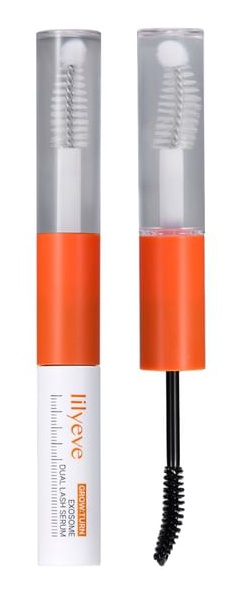
Grow Turn Exosome Dual Lash Serum
Ingredients overview
Highlights
Key Ingredients
Other Ingredients
Skim through
Lilyeve Grow Turn Exosome Dual Lash SerumIngredients explained
 We don't have description for this ingredient yet.
Good old water, aka H2O. The most common skincare ingredient of all. You can usually find it right in the very first spot of the ingredient list, meaning it’s the biggest thing out of all the stuff that makes up the product.
It’s mainly a solvent for ingredients that do not like to dissolve in oils but rather in water.
Once inside the skin, it hydrates, but not from the outside - putting pure water on the skin (hello long baths!) is drying.
One more thing: the water used in cosmetics is purified and deionized (it means that almost all of the mineral ions inside it is removed). Like this, the products can stay more stable over time.
A big polymer molecule that has a bunch of different versions and thus different uses. It can act as a film former, as a thickening agent, or it can increase the water-resistance in sunscreens. It is also used to entrap pigments/inorganic sunscreens within a micron size matrix for even coverage and easy application.
Butylene glycol, or let’s just call it BG, is a multi-tasking colorless, syrupy liquid. It’s a great pick for creating a nice feeling product.
BG’s main job is usually to be a solvent for the other ingredients. Other tasks include helping the product to absorb faster and deeper into the skin (penetration enhancer), making the product spread nicely over the skin (slip agent), and attracting water (humectant) into the skin.
It’s an ingredient whose safety hasn’t been questioned so far by anyone (at least not that we know about). BG is approved by Ecocert and is also used enthusiastically in natural products. BTW, it’s also a food additive.
A vegetable wax coming from the leaves of the Brazilian tropical palm tree, Copernicia cerifera. Similar to other waxes, it is used to stabilize and give body to products, or to keep stick type formulas solid. It is the hardest natural wax with a high melting point (around 85C) and high gloss making it a great wax choice for lip products.
A fatty acid that can be found naturally in the skin. In fact, it's the most common saturated fatty acid found in animals and plants.
As for skincare, it can make the skin feel nice and smooth in moisturizers (emollient) or it can act as a foam building cleansing agent in cleansers. It's also a very popular ingredient in shaving foams.
A really multi-functional helper ingredient that can do several things in a skincare product: it can bring a soft and pleasant feel to the formula, it can act as a humectant and emollient, it can be a solvent for some other ingredients (for example it can help to stabilize perfumes in watery products) and it can also help to disperse pigments more evenly in makeup products. And that is still not all: it can also boost the antimicrobial activity of preservatives.
A polymer (big molecule from repeated subunits) that's used as a gloss improver for lipsticks and lipglosses. Its stickiness also helps lip products to stay on longer.
Combined with polyacrylate-13 and polysorbate 20, it forms a very effective tickener-emulsifier trio.
These three letters stand for Poly Vinyl Pyrollidone, a big molecule created from repeated units of Vinyl Pyrrolidone, aka VP. Its main thing is being an important film former. It was the first synthetic polymer introduced as a hair fixative in the 1950s instead of insect-derived Shellac.
So PVP likes to attach itself to surfaces such as the hair and the skin and forms a nice, thin, even film there. The film is useful for holding a hairstyle or extending the wear of color cosmetics and sunscreens. The disadvantage of PVP is that the film is a bit brittle and that PVP loves water (hygroscopic) that tends to destroy the film. This is the reason why hair styled with a PVP based product loses its style in high humidity. To fix this problem, there are now several versions of VP containing film formers that are less sensitive to humidity, for example, the molecule called VP/VA Copolymer.
We don't have description for this ingredient yet.
Porous spherical microbeads (tiny little balls) that can give an elegant silky texture to the products. They are also used to scatter light to reduce the look of fine lines on the skin, as well as to absorb excess oil and give a matt finish.
A common multi-tasker fatty acid. It makes your skin feel nice and smooth (emollient), gives body to cream type products and helps to stabilize water and oil mixes (aka emulsions).
An extremely common multitasker ingredient that gives your skin a nice soft feel (emollient) and gives body to creams and lotions. It also helps to stabilize oil-water mixes (emulsions), though it does not function as an emulsifier in itself. Its typical use level in most cream type formulas is 2-3%.
It’s a so-called fatty alcohol, a mix of cetyl and stearyl alcohol, other two emollient fatty alcohols. Though chemically speaking, it is alcohol (as in, it has an -OH group in its molecule), its properties are totally different from the properties of low molecular weight or drying alcohols such as denat. alcohol. Fatty alcohols have a long oil-soluble (and thus emollient) tail part that makes them absolutely non-drying and non-irritating and are totally ok for the skin.
We don't have description for this ingredient yet.
A mainly oil loving molecule that helps water and oil to mix nicely, aka emulsifier. In itself, it can create water-in-oil emulsions (when water droplets are dispersed in oil), but it is used mostly next to water-loving emulsifiers to create nice and smooth oil-in-water creams. It can also function as a wetting and dispersing agent helping insoluble particles such as color pigments or inorganic sunscreens (zinc/titanium dioxide) to disperse nice and even in liquids.
Chemically speaking, this molecule is "halfway" between Sorbitan Oleate and Sorbitan Trioleate, meaning that it is also an attachment of sorbitan (a dehydrated sorbitol (sugar) molecule) with the unsaturated fatty acid Oleic Acid, but in a ratio of 2:3 hence the "Sesqui" part in the molecule's name.
Probably the most common silicone of all. It is a polymer (created from repeating subunits) molecule and has different molecular weight and thus different viscosity versions from water-light to thick liquid.
As for skincare, it makes the skin silky smooth, creates a subtle gloss and forms a protective barrier (aka occlusive). Also, works well to fill in fine lines and wrinkles and give skin a plump look (of course that is only temporary, but still, it's nice). There are also scar treatment gels out there using dimethicone as their base ingredient. It helps to soften scars and increase their elasticity.
As for hair care, it is a non-volatile silicone meaning that it stays on the hair rather than evaporates from it and smoothes the hair like no other thing. Depending on your hair type, it can be a bit difficult to wash out and might cause some build-up (btw, this is not true to all silicones, only the non-volatile types).
A liquid fatty acid created from oleic acid. It's claimed to have great odour, thermal and oxidation stability and is great for the stabilization of pigments and mineral particles in oils and solvents. It's quite popular in foundations.
A super common, waxy, white, solid stuff that helps water and oil to mix together, gives body to creams and leaves the skin feeling soft and smooth.
Chemically speaking, it is the attachment of a glycerin molecule to the fatty acid called stearic acid. It can be produced from most vegetable oils (in oils three fatty acid molecules are attached to glycerin instead of just one like here) in a pretty simple, "green" process that is similar to soap making. It's readily biodegradable.
It also occurs naturally in our body and is used as a food additive. As cosmetic chemist Colins writes it, "its safety really is beyond any doubt".
We don't have description for this ingredient yet.
It's a common little helper ingredient that helps water and oil to mix together. Also, it can help to increase the solubility of some other ingredients in the formula.
A nice little helper ingredient that can thicken up cosmetic products and create beautiful gel formulas. It's derived from cellulose, the major component of the cell wall of green plants. It is compatible with most co-ingredients and gives a very good slip to the formulas.
- A natural moisturizer that’s also in our skin
- A super common, safe, effective and cheap molecule used for more than 50 years
- Not only a simple moisturizer but knows much more: keeps the skin lipids between our skin cells in a healthy (liquid crystal) state, protects against irritation, helps to restore barrier
- Effective from as low as 3% with even more benefits for dry skin at higher concentrations up to 20-40%
- High-glycerin moisturizers are awesome for treating severely dry skin
Super common little helper ingredient that helps products to remain nice and stable for a longer time. It does so by neutralizing the metal ions in the formula (that usually get into there from water) that would otherwise cause some not so nice changes.
It is typically used in tiny amounts, around 0.1% or less.
A clear, colorless liquid that works as a solvent and viscosity decreasing ingredient. It also has great skin-moisturizing abilities.
An easy-to-formulate, commonly used, nice to have ingredient that’s also called pro-vitamin B5. As you might guess from the “pro” part, it’s a precursor to vitamin B5 (whose fancy name is pantothenic acid).
Its main job in skincare products is to moisturise the skin. It’s a humectant meaning that it can help the skin to attract water and then hold onto it. There is also research showing that panthenol can help our skin to produce more lovely lipids that are important for a strong and healthy skin barrier.
Another great thing about panthenol is that it has anti-inflammatory and skin protecting abilities. A study shows that it can reduce the irritation caused by less-nice other ingredients (e.g. fragrance, preservatives or chemical sunscreens) in the product.
Research also shows that it might be useful for wound healing as it promotes fibroblast (nice type of cells in our skin that produce skin-firming collagen) proliferation.
If that wasn’t enough panthenol is also useful in nail and hair care products. A study shows that a nail treatment liquide with 2% panthenol could effectively get into the nail and significantly increase the hydration of it.
As for the hair the hydration effect is also true there. Panthenol might make your hair softer, more elastic and helps to comb your hair more easily.
A glycerin-derived gentle cleansing agent that is described as being skin and eye-friendly, and not leaving the skin dry or tight. It's also used as a co-emulsifier or solubilizer that helps to blend small amounts of oily things into water-based products.
It's the chemically chopped up version of normal lecithin. Most often it's used to create liposomes and to coat and stabilize other ingredients.
A common little helper ingredient that helps water and oil to mix together, aka emulsifier.
Also called vitamin H, biotin is the main component of many enzymes in our body. A nice ingredient to take as a supplement for stronger nails and hair. When you do not take it as a supplement its effects are a bit more questionable but according to manufacturer info it can smooth the skin and strengthen the hair.
We don't have description for this ingredient yet.
Hydrolyzed Hyaluronic Acid is a low molecular weight, chemically chopped up version of the naturally big molecule and current IT-moisturizer, Hyaluronic Acid (HA). The TL; DR version of HA is that it's a huge polymer (big molecule from repeated subunits) found in the skin that acts as a sponge helping the skin to retain water, making it plump and elastic. As HA is a polymer, the subunits can be repeated many times (as a high-molecular-weight version), or just a few times (as a low-molecular-weight version).
We wrote in detail at HA about how different molecular weight versions do different things both as a component of the skin and as a skincare ingredient, so click here and read about all the details. Hydrolyzed Hyaluronic Acid can also come in different molecular-weight versions with different properties:
- 100-300 kDa version: apart from moisturizing, this size might also help the skin to repair itself by increasing its self-defense. It is also claimed to boost the wound healing process and is especially helpful for sensitive skin types (acne, rosacea, inflammation-related skin diseases).
- 50k Da version: this is the size that is claimed to be able to absorb into the skin and plump up wrinkles, so it is used mainly as an "anti-aging ingredient"
- below 50k, around 10k Da version: there is a Japanese version trade named Hyalo-Oligo that has only a 10k molecular weight and is claimed to penetrate the skin very well, have a unique touch and give deep and long-lasting moisturization. Based on the Evonik-research and the natural role of LMW-HA in the body working as a pro-inflammatory signal molecule, this ultra-low molecular weight version is a controversial ingredient.
If you wanna become a real HA-and-the-skin expert, you can read much more about the topic at hyaluronic acid (including penetration-questions, differences between high and low molecular weight versions and a bunch of references to scientific literature).
We don't have description for this ingredient yet.
Lactobacillus ferment is an interesting probiotic ingredient with some promising properties.
First, according to a 2009 Estee Lauder patent, it’s a DNA repair enzyme and it can help to protect the skin against environmental aggressors.
Second, still according to Estee Lauder research but now from 2012 the ingredient has anti-microbial and anti-inflammatory properties and holds promise in the treatment of acne and rosacea. For the former one 5% was needed to show effectiveness, but for reducing skin sensitivity already 1% showed results.
The anti-acne effect is confirmed also by US manufacturer, Barnet, that says that Lactobacillus ferment is helpful in killing harmful bacteria and creating a healthy balanced microflora. Compared to well-known anti-acne and anti-inflammatory salicylic acid the probiotic worked faster at reducing the size and redness of acne lesions.
It also goes by the trade name Leucidal Liquid SF and can serve in the formula as a natural preservative.
Bottom line: It’s not the most proven ingredient (yet) but definitely a very promising one especially if you have sensitive skin, acne or rosacea.
Houttuynia cordata is a flowering plant native to Southeast Asia. It is eaten as a leaf vegetable, and also has a long history of use in traditional Chinese medicine, including as an attempted treatment for SARS (it didn’t really work). Regarding cosmetics, however, houttuynia cordata extract has a good bit of potential!
The main active components in the plant are these fancy chemicals called flavonoids. Houttuynia cordata specifically has a good amount of polyphenolic flavonoids, four common ones being quercetin, quercitrin, hyperoside, and rutin. All of these exhibit anti-inflammatory, antioxidant, and antibacterial properties. Quercitrin has also been shown to decrease damage from UVB rays, which is an added bonus. One thing to keep in mind, though, is that the flavonoid content of this extract can depend on if the extract is taken from the roots or the leaves, as well as if it’s a water extraction or an alcohol extraction.
Another thing Houttuynia cordata extract contains are polysaccharides, i.e. big molecules from various sugar units (in this case it is galacturonic acid (29.4%), galactose (24.0%), rhamnose (17.2%), arabinose (13.5%), glucuronic acid (6.8%), glucose (5.3%), xylose (2.1%) and mannose (1.8%) ). Polysaccharides and sugars in skincare are excellent humectants and skin hydrators, meaning they help the skin to hold onto water.
Last but not least, we also found an in-vitro (made in test tubes) study showing that houttuynia cordata extract had strong anti-allergic effects and could be helpful in treating skin allergies such as eczema (atopic dermatitis).
Saccharomyces cerevisiae (SC) is the fancy name for common baker’s yeast.
Usually different kind of yeast extracts are used in skincare for their great hydrating, and general skin conditioning properties. We could find one research paper to back this up: It has found that SC indeed increases skin moisture and had improved skin microrelief (the small wrinkles and surface irregularities of skin).
According to manufacturer info coupled with the Mexican cactus, prickly pear it also helps to reduce neurosensory irritation that might occur from potent retinol or AHA products.
- Primary fat-soluble antioxidant in our skin
- Significant photoprotection against UVB rays
- Vit C + Vit E work in synergy and provide great photoprotection
- Has emollient properties
- Easy to formulate, stable and relatively inexpensive
- GHK-Cu is a copper-peptide complex found naturally in yucky bodily fluids (plasma, saliva, and urine)
- It has unique wound healing properties by stimulating the breakdown of unhealthy, too large collagen in scar tissue and stimulating nice and healthy collagen production afterwards
- It stimulates the production of several important skin-identical ingredients (e.g. collagen, elastin, and glycosaminoglycans)
- It has significant anti-inflammatory and antioxidant effect
- There are a few promising studies showing GHK-Cu can improve skin elasticity, clarity, firmness and reduce lines and wrinkles
- It can improve hair growth by enlarging hair follicles (and bigger follicles produce longer, thicker hair)
- There are some urban legends about possible overdosing or facial hair problems (read more in geeky details)
A bit of a sloppy ingredient name as it covers not one but three pigments: red, yellow and black iron oxide.
The trio is invaluable for "skin-colored" makeup products (think your foundation and pressed powder) as blending these three shades carefully can produce almost any shade of natural-looking flesh tones.
Good old water, aka H2O. The most common skincare ingredient of all. You can usually find it right in the very first spot of the ingredient list, meaning it’s the biggest thing out of all the stuff that makes up the product.
It’s mainly a solvent for ingredients that do not like to dissolve in oils but rather in water.
Once inside the skin, it hydrates, but not from the outside - putting pure water on the skin (hello long baths!) is drying.
One more thing: the water used in cosmetics is purified and deionized (it means that almost all of the mineral ions inside it is removed). Like this, the products can stay more stable over time.
A really multi-functional helper ingredient that can do several things in a skincare product: it can bring a soft and pleasant feel to the formula, it can act as a humectant and emollient, it can be a solvent for some other ingredients (for example it can help to stabilize perfumes in watery products) and it can also help to disperse pigments more evenly in makeup products. And that is still not all: it can also boost the antimicrobial activity of preservatives.
A kind of polymer (big molecule from repeated subunits) that helps to create beautiful gel-like textures. It's also a texturizer and thickener for oil-in-water emulsions. It gives products a good skin feel and does not make the formula tacky or sticky.
It works over a wide pH range and is used between 0.5-1.2%.
- A natural moisturizer that’s also in our skin
- A super common, safe, effective and cheap molecule used for more than 50 years
- Not only a simple moisturizer but knows much more: keeps the skin lipids between our skin cells in a healthy (liquid crystal) state, protects against irritation, helps to restore barrier
- Effective from as low as 3% with even more benefits for dry skin at higher concentrations up to 20-40%
- High-glycerin moisturizers are awesome for treating severely dry skin
We don't have description for this ingredient yet.
A clear, colorless liquid that works as a solvent and viscosity decreasing ingredient. It also has great skin-moisturizing abilities.
Super common little helper ingredient that helps products to remain nice and stable for a longer time. It does so by neutralizing the metal ions in the formula (that usually get into there from water) that would otherwise cause some not so nice changes.
It is typically used in tiny amounts, around 0.1% or less.
An easy-to-formulate, commonly used, nice to have ingredient that’s also called pro-vitamin B5. As you might guess from the “pro” part, it’s a precursor to vitamin B5 (whose fancy name is pantothenic acid).
Its main job in skincare products is to moisturise the skin. It’s a humectant meaning that it can help the skin to attract water and then hold onto it. There is also research showing that panthenol can help our skin to produce more lovely lipids that are important for a strong and healthy skin barrier.
Another great thing about panthenol is that it has anti-inflammatory and skin protecting abilities. A study shows that it can reduce the irritation caused by less-nice other ingredients (e.g. fragrance, preservatives or chemical sunscreens) in the product.
Research also shows that it might be useful for wound healing as it promotes fibroblast (nice type of cells in our skin that produce skin-firming collagen) proliferation.
If that wasn’t enough panthenol is also useful in nail and hair care products. A study shows that a nail treatment liquide with 2% panthenol could effectively get into the nail and significantly increase the hydration of it.
As for the hair the hydration effect is also true there. Panthenol might make your hair softer, more elastic and helps to comb your hair more easily.
It's a little helper ingredient that helps to set the pH of the products to be right. It has an alkaline pH and can neutralize acidic ingredients.
It's the chemically chopped up version of normal lecithin. Most often it's used to create liposomes and to coat and stabilize other ingredients.
A glycerin-derived gentle cleansing agent that is described as being skin and eye-friendly, and not leaving the skin dry or tight. It's also used as a co-emulsifier or solubilizer that helps to blend small amounts of oily things into water-based products.
Also called vitamin H, biotin is the main component of many enzymes in our body. A nice ingredient to take as a supplement for stronger nails and hair. When you do not take it as a supplement its effects are a bit more questionable but according to manufacturer info it can smooth the skin and strengthen the hair.
We don't have description for this ingredient yet.
We don't have description for this ingredient yet.
Lactobacillus ferment is an interesting probiotic ingredient with some promising properties.
First, according to a 2009 Estee Lauder patent, it’s a DNA repair enzyme and it can help to protect the skin against environmental aggressors.
Second, still according to Estee Lauder research but now from 2012 the ingredient has anti-microbial and anti-inflammatory properties and holds promise in the treatment of acne and rosacea. For the former one 5% was needed to show effectiveness, but for reducing skin sensitivity already 1% showed results.
The anti-acne effect is confirmed also by US manufacturer, Barnet, that says that Lactobacillus ferment is helpful in killing harmful bacteria and creating a healthy balanced microflora. Compared to well-known anti-acne and anti-inflammatory salicylic acid the probiotic worked faster at reducing the size and redness of acne lesions.
It also goes by the trade name Leucidal Liquid SF and can serve in the formula as a natural preservative.
Bottom line: It’s not the most proven ingredient (yet) but definitely a very promising one especially if you have sensitive skin, acne or rosacea.
Houttuynia cordata is a flowering plant native to Southeast Asia. It is eaten as a leaf vegetable, and also has a long history of use in traditional Chinese medicine, including as an attempted treatment for SARS (it didn’t really work). Regarding cosmetics, however, houttuynia cordata extract has a good bit of potential!
The main active components in the plant are these fancy chemicals called flavonoids. Houttuynia cordata specifically has a good amount of polyphenolic flavonoids, four common ones being quercetin, quercitrin, hyperoside, and rutin. All of these exhibit anti-inflammatory, antioxidant, and antibacterial properties. Quercitrin has also been shown to decrease damage from UVB rays, which is an added bonus. One thing to keep in mind, though, is that the flavonoid content of this extract can depend on if the extract is taken from the roots or the leaves, as well as if it’s a water extraction or an alcohol extraction.
Another thing Houttuynia cordata extract contains are polysaccharides, i.e. big molecules from various sugar units (in this case it is galacturonic acid (29.4%), galactose (24.0%), rhamnose (17.2%), arabinose (13.5%), glucuronic acid (6.8%), glucose (5.3%), xylose (2.1%) and mannose (1.8%) ). Polysaccharides and sugars in skincare are excellent humectants and skin hydrators, meaning they help the skin to hold onto water.
Last but not least, we also found an in-vitro (made in test tubes) study showing that houttuynia cordata extract had strong anti-allergic effects and could be helpful in treating skin allergies such as eczema (atopic dermatitis).
Saccharomyces cerevisiae (SC) is the fancy name for common baker’s yeast.
Usually different kind of yeast extracts are used in skincare for their great hydrating, and general skin conditioning properties. We could find one research paper to back this up: It has found that SC indeed increases skin moisture and had improved skin microrelief (the small wrinkles and surface irregularities of skin).
According to manufacturer info coupled with the Mexican cactus, prickly pear it also helps to reduce neurosensory irritation that might occur from potent retinol or AHA products.
Hydrolyzed Hyaluronic Acid is a low molecular weight, chemically chopped up version of the naturally big molecule and current IT-moisturizer, Hyaluronic Acid (HA). The TL; DR version of HA is that it's a huge polymer (big molecule from repeated subunits) found in the skin that acts as a sponge helping the skin to retain water, making it plump and elastic. As HA is a polymer, the subunits can be repeated many times (as a high-molecular-weight version), or just a few times (as a low-molecular-weight version).
We wrote in detail at HA about how different molecular weight versions do different things both as a component of the skin and as a skincare ingredient, so click here and read about all the details. Hydrolyzed Hyaluronic Acid can also come in different molecular-weight versions with different properties:
- 100-300 kDa version: apart from moisturizing, this size might also help the skin to repair itself by increasing its self-defense. It is also claimed to boost the wound healing process and is especially helpful for sensitive skin types (acne, rosacea, inflammation-related skin diseases).
- 50k Da version: this is the size that is claimed to be able to absorb into the skin and plump up wrinkles, so it is used mainly as an "anti-aging ingredient"
- below 50k, around 10k Da version: there is a Japanese version trade named Hyalo-Oligo that has only a 10k molecular weight and is claimed to penetrate the skin very well, have a unique touch and give deep and long-lasting moisturization. Based on the Evonik-research and the natural role of LMW-HA in the body working as a pro-inflammatory signal molecule, this ultra-low molecular weight version is a controversial ingredient.
If you wanna become a real HA-and-the-skin expert, you can read much more about the topic at hyaluronic acid (including penetration-questions, differences between high and low molecular weight versions and a bunch of references to scientific literature).
- Primary fat-soluble antioxidant in our skin
- Significant photoprotection against UVB rays
- Vit C + Vit E work in synergy and provide great photoprotection
- Has emollient properties
- Easy to formulate, stable and relatively inexpensive
- GHK-Cu is a copper-peptide complex found naturally in yucky bodily fluids (plasma, saliva, and urine)
- It has unique wound healing properties by stimulating the breakdown of unhealthy, too large collagen in scar tissue and stimulating nice and healthy collagen production afterwards
- It stimulates the production of several important skin-identical ingredients (e.g. collagen, elastin, and glycosaminoglycans)
- It has significant anti-inflammatory and antioxidant effect
- There are a few promising studies showing GHK-Cu can improve skin elasticity, clarity, firmness and reduce lines and wrinkles
- It can improve hair growth by enlarging hair follicles (and bigger follicles produce longer, thicker hair)
- There are some urban legends about possible overdosing or facial hair problems (read more in geeky details)
You may also want to take a look at...
| what‑it‑does | colorant |
| what‑it‑does | solvent |
| what‑it‑does | viscosity controlling |
| what‑it‑does | moisturizer/humectant | solvent |
| irritancy, com. | 0, 1 |
| what‑it‑does | emollient |
| irritancy, com. | 0, 1 |
| what‑it‑does | skin-identical ingredient | emollient | emulsifying |
| irritancy, com. | 0, 2 |
| what‑it‑does | solvent |
| what‑it‑does | viscosity controlling |
| what‑it‑does | viscosity controlling |
| irritancy, com. | 0, 0 |
| what‑it‑does | viscosity controlling |
| what‑it‑does | emollient | viscosity controlling |
| irritancy, com. | 0, 2-3 |
| what‑it‑does | emollient | viscosity controlling | emulsifying | surfactant/cleansing |
| irritancy, com. | 1, 2 |
| what‑it‑does | chelating |
| what‑it‑does | emulsifying |
| irritancy, com. | 0, 0-1 |
| what‑it‑does | emollient |
| irritancy, com. | 0, 1 |
| what‑it‑does | surfactant/cleansing | emulsifying |
| what‑it‑does | emollient | emulsifying |
| irritancy, com. | 0, 1 |
| what‑it‑does | viscosity controlling |
| what‑it‑does | emulsifying | surfactant/cleansing |
| irritancy, com. | 0, 0 |
| what‑it‑does | viscosity controlling |
| what‑it‑does | skin-identical ingredient | moisturizer/humectant |
| irritancy, com. | 0, 0 |
| what‑it‑does | chelating |
| what‑it‑does | solvent |
| what‑it‑does | soothing | moisturizer/humectant |
| irritancy, com. | 0, 0 |
| what‑it‑does | surfactant/cleansing | emulsifying |
| what‑it‑does | emollient | emulsifying |
| what‑it‑does | emulsifying | surfactant/cleansing |
| what‑it‑does | buffering |
| what‑it‑does | moisturizer/humectant |
| what‑it‑does | soothing | preservative |
| what‑it‑does | antioxidant | soothing |
| what‑it‑does | moisturizer/humectant |
| what‑it‑does | buffering |
| what‑it‑does | antioxidant |
| irritancy, com. | 0-3, 0-3 |
| what‑it‑does | cell-communicating ingredient | soothing | antioxidant |
| what‑it‑does | colorant |
| irritancy, com. | 0, 0 |
| what‑it‑does | solvent |
| what‑it‑does | solvent |
| what‑it‑does | viscosity controlling |
| what‑it‑does | skin-identical ingredient | moisturizer/humectant |
| irritancy, com. | 0, 0 |
| what‑it‑does | viscosity controlling |
| what‑it‑does | solvent |
| what‑it‑does | chelating |
| what‑it‑does | soothing | moisturizer/humectant |
| irritancy, com. | 0, 0 |
| what‑it‑does | buffering |
| what‑it‑does | emollient | emulsifying |
| what‑it‑does | surfactant/cleansing | emulsifying |
| what‑it‑does | soothing | preservative |
| what‑it‑does | antioxidant | soothing |
| what‑it‑does | moisturizer/humectant |
| what‑it‑does | moisturizer/humectant |
| what‑it‑does | antioxidant |
| irritancy, com. | 0-3, 0-3 |
| what‑it‑does | cell-communicating ingredient | soothing | antioxidant |