




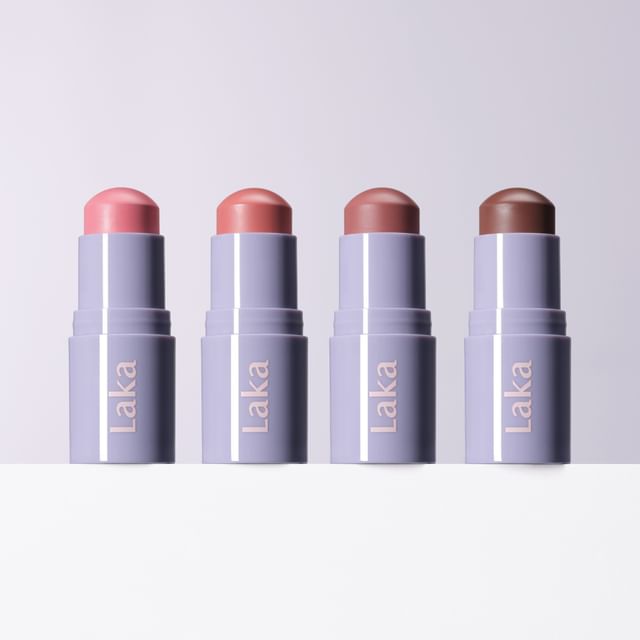
Healthy Glow Blush Balm
Ingredients overview
Highlights
Key Ingredients
Other Ingredients
Skim through
Laka Healthy Glow Blush BalmIngredients explained
 We don't have description for this ingredient yet.
A synthetic liquid oil that can replace mineral oil or silicone oils in the cosmetic formulas. There are different grades depending on the molecular weight ranging from very light, volatile, non-residue leaving ones to more substantial, slight residue leaving ones.
Apart from leaving the skin soft and smooth (emollient), it's also used as a waterproofing agent in sunscreens or makeup products and as a shine enhancer in lip gloss formulas.
An often used emollient with a light and silky feel. It's very mild to both skin and eyes and spreads nicely and easily. It's often used in sunscreens as it's also an excellent solvent for sunscreen agents.
We don't have description for this ingredient yet.
We don't have description for this ingredient yet.
A super versatile and common mineral powder that comes in different particle sizes. It is a multi-tasker used to improve skin feel, increase product slip, give the product light-reflecting properties, enhance skin adhesion or serve as an anti-caking agent.
It is also the most commonly used "base" material for layered composite pigments such as pearl-effect pigments. In this case, mica is coated with one or more metal oxides (most commonly titanium dioxide) to achieve pearl effect via the physical phenomenon known as interference.
A biodegradable emollient that gives a fresh gliding sensation and a powdery after feel. It works well with all kinds of oils including natural and silicone oils.
A plant based ingredient that helps water to mix with oil (aka W/O emulsifier). It's especially good for soft to low-viscosity water-in-oil emulsions with non-greasy, pleasant skin feel like lip balms or thick body butters.
We don't have description for this ingredient yet.
A white powdery thing that's the major component of glass and sand. In cosmetics, it’s often in products that are supposed to keep your skin matte as it has great oil-absorbing abilities. It’s also used as a helper ingredient to thicken up products or suspend insoluble particles.
A handy helper ingredient that helps water and oil to mix nicely together, aka emulsifier. It is especially recommended for protective, baby care and general purpose emollient creams.
It also helps to disperse insoluble particles (think color pigments or zinc/titanium dioxide sunscreen) nice and even in cosmetic formulas.
A silicone emulsifier that helps water and silicone oils to mix nicely together.
We don't have description for this ingredient yet.
An organic derivative of hectorite clay, Disteardimonium Hectorite is used as a viscosity controller - it thickens up formulations to make them less runny.
It’s most popular use in cosmetics is in sunscreens, under the trademarked name Bentone 38 from Elementis. According to the manufacturer info, it is a real multi-tasker, including the ability to prevent pigments settling during storage, stabilizing a formula for longer, creating a light and smooth skin feel and enhancing the water-resistance of sunscreen formulas.
Bearing a close relationship to the famous Dimethicone, Methicone is the slightly trimmed down version missing the methyl (-CH3) groups on one side of the silicone chain. Like most silicones, it has nice emollient properties and improves the spreadability of products.
But Methicone's main thing in practice is not being an emollient but a silicone fluid for hydrophobization treatment of powders, i.e. making solid powders (mineral filters & color pigments) very water resistant and easily spreadable. Methicone does this by absorbing traces of water from the surface of pigments that is very useful for mineral sunscreens and makeup products.
It’s a handy multi-tasking ingredient that gives the skin a nice, soft feel. At the same time, it also boosts the effectiveness of other preservatives, such as the nowadays super commonly used phenoxyethanol.
The blend of these two (caprylyl glycol + phenoxyethanol) is called Optiphen, which not only helps to keep your cosmetics free from nasty things for a long time but also gives a good feel to the finished product. It's a popular duo.
A clear, light yellow liquid that is used to coat pigments (such as inorganic sunscreen agents or colorants) in cosmetic products. The coating helps to stabilize pigments in the formulas and also helps them to spread easily and evenly on the skin.
We don't have description for this ingredient yet.
Officially, CosIng (the official EU ingredient database) lists Aluminum Hydroxide 's functions as opacifying (making the product white and non-transparent), as well as emollient and skin protectant.
However, with a little bit of digging, it turns out Aluminum Hyroxide often moonlights as a protective coating for UV filter superstar Titanium Dioxide. Specifically, it protects our skin from the harmful effects of nasty Reactive Oxygen Species (free radicals derived from oxygen such as Superoxide and Hydrogen Peroxide) generated when Titanium Dioxide is exposed to UV light. Btw, chlorine in swimming pool water depletes this protective coating, so one more reason to reapply your sunscreen after a dip in the pool on holiday.
Other than that, Aluminum Hydroxide also often shows up in composite pigment technologies where it is used the other way around (as the base material and not as the coating material) and helps to achieve higher color coverage with less pigment.
Good old water, aka H2O. The most common skincare ingredient of all. You can usually find it right in the very first spot of the ingredient list, meaning it’s the biggest thing out of all the stuff that makes up the product.
It’s mainly a solvent for ingredients that do not like to dissolve in oils but rather in water.
Once inside the skin, it hydrates, but not from the outside - putting pure water on the skin (hello long baths!) is drying.
One more thing: the water used in cosmetics is purified and deionized (it means that almost all of the mineral ions inside it is removed). Like this, the products can stay more stable over time.
- A natural moisturizer that’s also in our skin
- A super common, safe, effective and cheap molecule used for more than 50 years
- Not only a simple moisturizer but knows much more: keeps the skin lipids between our skin cells in a healthy (liquid crystal) state, protects against irritation, helps to restore barrier
- Effective from as low as 3% with even more benefits for dry skin at higher concentrations up to 20-40%
- High-glycerin moisturizers are awesome for treating severely dry skin
The famous tea tree oil. One of the best known essential oils which comes from Australia where it has been used for almost 100 years for its antiseptic and anti-inflammatory actions. Legend has it that the medicinal benefits of the oil were considered so important that Australian soldiers were supplied with some tea tree oil in their World War II military kit.
Similar to other essential oils, tea tree oil is a very complex chemical mixture consisting of about 100 components, the major ones being terpinen-4-ol (40%), γ-Terpinene (23%) and α-Terpinene (10%). Terpinen-4-ol is considered to be the main active component but as a great article in Clinical Microbiology Reviews states "while some TTO components may be considered less active, none can be considered inactive" and most components contribute to TTO's strong antibacterial, antiviral and antifungal effects.
Regarding skincare and tea tree oil, its most well-known effect is probably being a well established anti-acne ingredient. Multiple studies confirm that TTO is effective against the evil acne-causing bacteria called P. acnes and the effectiveness of 5% TTO gel is comparable to the gold standard anti-acne treatment, 5% Benzoyl Peroxide lotion. You need to be a bit more patient with TTO, though, as its effects come slower but also with fewer side effects.
Regarding TTO and sensitive skin, we say that you should be careful. Even if your skin is not sensitive you should never put undiluted TTO on your skin. Luckily, it contains only very small amounts of the common allergens (such as limonene), but irritant and allergic reactions still happen, especially by oxidation products that occur in older or not properly stored oil. So if you have some pure TTO at home, know that storage matters, keep it in a cool, dry, dark place and use it up in a reasonable amount of time.
Overall, we do not often give a goodie status to essential oils, but we feel that TTO's unique antibacterial and anti-acne properties with its minimal allergen content warrant an exception. If your skin is acne-prone, TTO is something to experiment with.
The oil coming from the pulp of one of the most nutritious fruits in the world, the avocado. It's loaded with the nourishing and moisturizing fatty acid, oleic (70%) and contains some others including palmitic (10%) and linoleic acid (8%). It also contains a bunch of minerals and vitamins A, E and D.
Avocado oil has extraordinary skin penetration abilities and can nourish different skin layers. It's a very rich, highly moisturizing emollient oil that makes the skin smooth and nourished. Thanks to its vitamin E content it also has some antioxidant properties. As a high-oleic plant oil, it is recommended for dry skin.
This ingredient name is not according to the INCI-standard. :( What, why?!
It’s the most commonly used version of pure vitamin E in cosmetics. You can read all about the pure form here. This one is the so-called esterified version.
According to famous dermatologist, Leslie Baumann while tocopheryl acetate is more stable and has a longer shelf life, it’s also more poorly absorbed by the skin and may not have the same awesome photoprotective effects as pure Vit E.
Butylene glycol, or let’s just call it BG, is a multi-tasking colorless, syrupy liquid. It’s a great pick for creating a nice feeling product.
BG’s main job is usually to be a solvent for the other ingredients. Other tasks include helping the product to absorb faster and deeper into the skin (penetration enhancer), making the product spread nicely over the skin (slip agent), and attracting water (humectant) into the skin.
It’s an ingredient whose safety hasn’t been questioned so far by anyone (at least not that we know about). BG is approved by Ecocert and is also used enthusiastically in natural products. BTW, it’s also a food additive.
The freeze-dried, powder form of coconut water (also called the liquid coconut endosperm) that's claimed to be loaded with all kinds of skin-nourishing things: proteins, amino acids, sugars, vitamins, minerals and growth hormones (kinetin) that support healthy cell growth and skin hydration.
According to the manufacturer's double blind placebo controlled clinical study, 8 weeks of using a 1% Cococin cream increased skin elasticity by 31.1%.
Unless you live under a rock you must have heard about shea butter. It's probably the most hyped up natural butter in skincare today. It comes from the seeds of African Shea or Karite Trees and used as a magic moisturizer and emollient.
But it's not only a simple emollient, it regenerates and soothes the skin, protects it from external factors (such as UV rays or wind) and is also rich in antioxidants (among others vitamin A, E, F, quercetin and epigallocatechin gallate). If you are looking for rich emollient benefits + more, shea is hard to beat.
The extract coming from the juice containing leaves of the Aloe vera plant. It's usually a hydroglycolic extract (though oil extract for the lipid parts also exists) that has similar moisturizing, emollient and anti-inflammatory properties as the juice itself. We have written some more about aloe here.
A really multi-functional helper ingredient that can do several things in a skincare product: it can bring a soft and pleasant feel to the formula, it can act as a humectant and emollient, it can be a solvent for some other ingredients (for example it can help to stabilize perfumes in watery products) and it can also help to disperse pigments more evenly in makeup products. And that is still not all: it can also boost the antimicrobial activity of preservatives.
Pentaerythrityl Tetra-Di-T-Butyl Hydroxyhydrocinnamate is an antioxidant molecule used in small amounts (less than 0.8%) to help products stay nice longer. More specifically, it is great at preventing discoloration or other types of oxidative degradation. It is a trendy alternative to often bad-mouthed synthetic antioxidant and stabilizer, BHT.
One of the many types of ceramides that can be found naturally in the upper layer of the skin. Ceramides make up about 50% of the goopy stuff that's between our skin cells and play a super important role in having a healthy skin barrier and keeping the skin hydrated. It works even better when combined with its pal, Ceramide 1.
We wrote way more about ceramides at ceramide 1, so click here to know more.
A multi-functional, silky feeling helper ingredient that can do quite many things. It's used as an emulsion stabilizer, solvent and a broad spectrum antimicrobial. According to manufacturer info, it's also a moisturizer and helps to make the product feel great on the skin. It works synergistically with preservatives and helps to improve water-resistance of sunscreens.
It's a type of lipid, a so-called sphingoid base that can be found naturally in the upper layer of the skin. It's found both in "free-form" and as part of famous skin lipids, ceramides.
There is emerging research about Phytosphingosine that shows that it has antimicrobial and cell-communicating properties and is considered part of the skin's natural defense system.
A 2007 study showed that Phytosphingosine even works against evil acne-causing bacteria, Propionibacterium acnes and shows promise as a complementing active ingredient in treating acne-prone skin thanks to its anti-inflammatory and antimicrobial activities.
A nice one to spot in the ingredient list. :)
We don't have description for this ingredient yet.
We don't have description for this ingredient yet.
We don't have description for this ingredient yet.
It’s the - sodium form - cousin of the famous NMF, hyaluronic acid (HA). If HA does not tell you anything we have a super detailed, geeky explanation about it here. The TL; DR version of HA is that it's a huge polymer (big molecule from repeated subunits) found in the skin that acts as a sponge helping the skin to hold onto water, being plump and elastic. HA is famous for its crazy water holding capacity as it can bind up to 1000 times its own weight in water.
As far as skincare goes, sodium hyaluronate and hyaluronic acid are pretty much the same and the two names are used interchangeably. As cosmetic chemist kindofstephen writes on reddit "sodium hyaluronate disassociates into hyaluronic acid molecule and a sodium atom in solution".
In spite of this, if you search for "hyaluronic acid vs sodium hyaluronate" you will find on multiple places that sodium hyaluronate is smaller and can penetrate the skin better. Chemically, this is definitely not true, as the two forms are almost the same, both are polymers and the subunits can be repeated in both forms as much as you like. (We also checked Prospector for sodium hyaluronate versions actually used in cosmetic products and found that the most common molecular weight was 1.5-1.8 million Da that absolutely counts as high molecular weight).
What seems to be a true difference, though, is that the salt form is more stable, easier to formulate and cheaper so it pops up more often on the ingredient lists.
If you wanna become a real HA-and-the-skin expert you can read way more about the topic at hyaluronic acid (including penetration-questions, differences between high and low molecular weight versions and a bunch of references to scientific literature).
One of the main biologically active components of the famous medicinal plant, Centella Asiatica, aka Gotu Kola. It has well established wound healing, skin-soothing and antioxidant activities.
There is also a study by La Roche Posay (belongs to L'Oreal) that examined the anti-aging effects of 5% Vitamin C combined with 0.1% Madecassoside. They mention that " Madecassoside is known to induce collagen expression and ⁄ or to modulate inflammatory mediators thus might prevent and correct some signs of aging." The surprisingly long, 6-month study observed "significant improvement of the clinical score for deep and superficial wrinkles, suppleness, firmness, roughness, and skin hydration", but Vitamin C in itself is already an anti-aging superstar, so it is hard to know how much Madecassoside did.
Another promising property of Madecassoside is that it seems to inhibit UV-induced melanin synthesis (test formula with 0.05% MA, used twice a day on 23 volunteers for 8 weeks), making it a great active for hyperpigmentation-prone skin.
If that would not be enough, the French manufacturer (Seppic) also has encouraging in-vivo studies on the molecule. Used at 0.2%, Madecassoside reduces redness and peeling in skin with light atopic dermatitis as well as itching in psoriasis-prone skin.
One of the biologically active components of Gotu Kola. It's a bit less prominent than its sister component, Asiaticoside, but in-vitro (made in the lab) studies show that Asiatic Acid also stimulates GAGs (glycosaminoglycans - polysaccharides that are part of the liquidy stuff between our skin cells) production as well as collagen I synthesis.
English translation equals that it probably contributes to the well-established moisturizing and wound healing abilities of Gotu Kola.
One of the main biologically active components of the famous medicinal plant, Centella Asiatica, aka Gotu Kola. It has well established wound healing and antioxidant activities.
In-vitro (made in the lab) studies also show that Asiaticoside stimulates GAGs (glycosaminoglycans - polysaccharides that are part of the liquidy stuff between our skin cells) production as well as collagen I synthesis. Read more at Gotu Kola >>
Centella Asiatica - or sometimes also called Gotu Kola or Cica - has been used in folk medicine for hundreds of years. It’s traditionally used to improve small wounds, burns and scratches and it’s also a well known anti-inflammatory agent for eczema.
Recently science has taken an interest in Gotu Kola as well and it turns out it really has many active compounds with several benefits. Just for hard-core geeks, the main biologically active compounds are pentacyclic triterpenoid saponins called asiaticoside, madecassoside, asiatic and madecassic acid (also called centellosides).
One of the biological activities of the centellosides is to be able to stimulate GAGs (glycosaminoglycans - polysaccharides that are part of the liquidy stuff between our skin cells), and especially hyaluronic acid synthesis in our skin. This is probably one of the reasons why Centella Asiatica Extract has nice skin moisturizing properties that was confirmed by a 25 people, four weeks study along with Centella's anti-inflammatory effects.
Madecassoside can also help in burn wound healing through increasing antioxidant activity and enhancing collagen synthesis. Asiaticoside was shown to increase antioxidant levels on rats skin when applied at 0.2%.
Centella Asiatica also often shows up in products that try to treat cellulite or striae. Of course, it cannot make a miracle but it might have some effect via regulating microcirculation and normalizing the metabolism in the cells of connective tissues.
Bottom line: Gotu Kola is a great plant ingredient with proven wound healing, anti-inflammatory, and antioxidant properties. Nice to spot on any ingredient list.
Amino acids are important natural moisturizing factors (NMFs), that can be found naturally in the skin where they help the epidermis (upper layer of the skin) to stay nice and hydrated.
Amino acids are also the building blocks of proteins, such as collagen, so when you thoroughly chop up a big collagen molecule, you end up with an amino acid mixture, like this guy we are writing about. Btw, if you chop it up less thoroughly, you get hydrolyzed collagen, a kind of peptide mixture with smallish chains of amino acids.
Amino acids have low molecular weight (about 150 Da), so they can penetrate the upper layer of the skin where they help moisture retention and enhance the skin's suppleness and flexibility. In hair care, Collagen Amino Acids are able to improve shine, texture, and manageability of the hair.
Super common little helper ingredient that helps products to remain nice and stable for a longer time. It does so by neutralizing the metal ions in the formula (that usually get into there from water) that would otherwise cause some not so nice changes.
It is typically used in tiny amounts, around 0.1% or less.
If you have spotted ethylhexylglycerin on the ingredient list, most probably you will see there also the current IT-preservative, phenoxyethanol. They are good friends because ethylhexylglycerin can boost the effectiveness of phenoxyethanol (and other preservatives) and as an added bonus it feels nice on the skin too.
Also, it's an effective deodorant and a medium spreading emollient.
One of the biologically active components of Gotu Kola that is thought to contribute to the plant extract's well-documented skin regenerating, wound healing, and moisturizing properties.
If you are into Gotu Kola we have some more info at Centella Asiatica Extract and its other biologically active components Madecassoside, Asiaticoside and Asiatic Acid.
Ci 77891 is the color code of titanium dioxide. It's a white pigment with great color consistency and dispersibility.
A bit of a sloppy ingredient name as it covers not one but three pigments: red, yellow and black iron oxide.
The trio is invaluable for "skin-colored" makeup products (think your foundation and pressed powder) as blending these three shades carefully can produce almost any shade of natural-looking flesh tones.
We don't have description for this ingredient yet.
We don't have description for this ingredient yet.
CI 42090 or Blue 1 is a super common synthetic colorant in beauty & food. Used alone, it adds a brilliant smurf-like blue color, combined with Tartrazine, it gives the fifty shades of green.
Ci 19140 or Tartrazine is a super common colorant in skincare, makeup, medicine & food. It’s a synthetic lemon yellow that's used alone or mixed with other colors for special shades.
FDA says it's possible, but rare, to have an allergic-type reaction to a color additive. As an example, it mentions that Ci 19140 may cause itching and hives in some people but the colorant is always labeled so that you can avoid it if you are sensitive.
You may also want to take a look at...
| what‑it‑does | emulsifying |
| what‑it‑does | emollient | viscosity controlling |
| what‑it‑does | emollient | viscosity controlling |
| irritancy, com. | 2, 1 |
| what‑it‑does | emollient | antimicrobial/antibacterial |
| what‑it‑does | emollient | viscosity controlling |
| what‑it‑does | colorant |
| what‑it‑does | solvent | emollient |
| what‑it‑does | emulsifying | viscosity controlling |
| what‑it‑does | viscosity controlling | perfuming |
| what‑it‑does | viscosity controlling |
| what‑it‑does | emulsifying |
| irritancy, com. | 0, 1-2 |
| what‑it‑does | emulsifying | surfactant/cleansing |
| what‑it‑does | emollient | emulsifying |
| what‑it‑does | viscosity controlling |
| what‑it‑does | emollient |
| what‑it‑does | moisturizer/humectant | emollient |
| what‑it‑does | viscosity controlling |
| what‑it‑does | emollient | moisturizer/humectant | viscosity controlling |
| what‑it‑does | solvent |
| what‑it‑does | skin-identical ingredient | moisturizer/humectant |
| irritancy, com. | 0, 0 |
| what‑it‑does | soothing | anti-acne | antioxidant | antimicrobial/antibacterial | perfuming |
| what‑it‑does | antioxidant | emollient |
| irritancy, com. | 0, 0-3 |
| what‑it‑does | antioxidant |
| irritancy, com. | 0, 0 |
| what‑it‑does | moisturizer/humectant | solvent |
| irritancy, com. | 0, 1 |
| what‑it‑does | emollient | moisturizer/humectant |
| what‑it‑does | emollient |
| what‑it‑does | soothing | emollient | moisturizer/humectant |
| what‑it‑does | solvent |
| what‑it‑does | antioxidant | preservative |
| what‑it‑does | skin-identical ingredient |
| what‑it‑does | solvent | moisturizer/humectant |
| what‑it‑does | skin-identical ingredient | cell-communicating ingredient | anti-acne | antimicrobial/antibacterial |
| what‑it‑does | skin-identical ingredient | moisturizer/humectant |
| irritancy, com. | 0, 0 |
| what‑it‑does | antioxidant | soothing |
| what‑it‑does | antioxidant | perfuming |
| what‑it‑does | soothing | antioxidant | moisturizer/humectant |
| what‑it‑does | skin-identical ingredient | moisturizer/humectant |
| what‑it‑does | chelating |
| what‑it‑does | preservative |
| what‑it‑does | colorant |
| irritancy, com. | 0, 0 |
| what‑it‑does | colorant |
| irritancy, com. | 0, 0 |
| what‑it‑does | colorant |
| irritancy, com. | 0, 1 |
| what‑it‑does | colorant |
| what‑it‑does | colorant |
| what‑it‑does | colorant |