




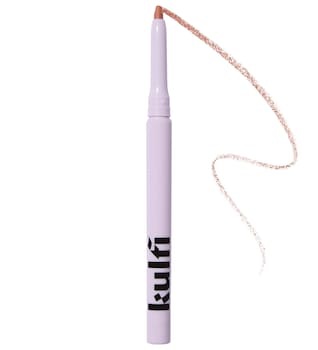
Lassi Lips Staining Lip Liner
Ingredients overview
Highlights
Other Ingredients
Skim through
Kulfi Lassi Lips Staining Lip LinerIngredients explained
Methyl Trimethicone is a very light, volatile silicone (it evaporates from the skin rather than absorbs into it) that's similar to super commonly used Cyclopentasiloxane but it dries even faster when applied to the skin.
A solid silicone resin that creates a permeable film over the skin. It makes makeup formulas more long-lasting and can enhance the water resistance of sunscreens. It leaves a non-tacky film when dried.
 We don't have description for this ingredient yet.
Polypropylsilsesquioxane is a silicone resin that forms a flexible, durable film on the skin. The film is resistant to wash-off and rub-off and is useful for creating long-lasting makeup products and sunscreens.
We don't have description for this ingredient yet.
We don't have description for this ingredient yet.
A clear, slightly yellow, odorless oil that's a very common, medium-spreading emollient. It makes the skin feel nice and smooth and works in a wide range of formulas.
We don't have description for this ingredient yet.
We don't have description for this ingredient yet.
A so-called dispersant or dispersing agent that's used in inorganic (titanium dioxide/zinc oxide based) sunscreens or in make-up products to help to distribute the pigments nicely and evenly on the skin. It's also claimed to increase the UV absorption of the sunscreen formula as well as to reduce the annoying white cast left behind by inorganic sunscreens.
- Primary fat-soluble antioxidant in our skin
- Significant photoprotection against UVB rays
- Vit C + Vit E work in synergy and provide great photoprotection
- Has emollient properties
- Easy to formulate, stable and relatively inexpensive
A really famous peptide that is part of Matrixyl 3000, the most sold peptide complex in the word. Before we go and find out what the big deal with Matrixyl 3000 is, let's just focus on Palmitoyl Tripeptide-1 itself for a bit.
It's a small three amino acid (they are the building blocks of all proteins) peptide with the amino sequence of glycine-histidine-lysine, or GHK. GHK is attached to palmitic acid (a fatty acid) to increase oil solubility and skin penetration.
The GHK part is the important one as it's a type I collagen fragment. When collagen naturally breaks down in the skin, the resulting peptide fragments signal to the skin that it should get to work and create some nice, new collagen. Adding in collagen fragment peptides, like GHK, might trick the skin into thinking that collagen has broken down and it's time to create some more.
Therefore, Palmitoyl Tripeptide-1 is believed to be able to stimulate collagen production in the skin, and more collagen means fewer wrinkles and younger looking skin.
In Matrixyl 3000, Palmitoyl Tripeptide-1 is coupled with Palmitoyl Tetrapeptide-7 and the duo works in synergy to reduce wrinkles and give younger looking skin. According to the manufacturer's in-vivo (made on real people) test, applying 3% Matrixyl 3000 twice a day for 2 months resulted in all of the following things:
- 39.4% reduction in surface occupied by deep wrinkles
- 32.9% reduction in main wrinkle density
- 19.9% reduction in main wrinkle average depth
- 16% improvement in roughness
- 16.2% in lifting effect
- 5.5% improvement in elasticity
- 15.5% improvement in skin tone
Manufacturer results, of course, always have to be taken with a pinch of salt, but if you like peptides, the Matryxil 3000 duo is one of the best-proven and most well-known ones and it's something that is worth trying.
A super common emollient that makes your skin feel nice and smooth. It comes from coconut oil and glycerin, it’s light-textured, clear, odorless and non-greasy. It’s a nice ingredient that just feels good on the skin, is super well tolerated by every skin type and easy to formulate with. No wonder it’s popular.
A liquid emollient derived from isostearic acid that gives a rich, cushiony skin-feel and unusually high levels of gloss. It also has film-forming abilities but without leaving a sticky residue and it aids long-lasting and water-resistant properties. All this makes Pentaerythrityl Tetraisostearate an ideal emollient for long-lasting protective emulsions, like lip balms.
Officially, CosIng (the official EU ingredient database) lists Aluminum Hydroxide 's functions as opacifying (making the product white and non-transparent), as well as emollient and skin protectant.
However, with a little bit of digging, it turns out Aluminum Hyroxide often moonlights as a protective coating for UV filter superstar Titanium Dioxide. Specifically, it protects our skin from the harmful effects of nasty Reactive Oxygen Species (free radicals derived from oxygen such as Superoxide and Hydrogen Peroxide) generated when Titanium Dioxide is exposed to UV light. Btw, chlorine in swimming pool water depletes this protective coating, so one more reason to reapply your sunscreen after a dip in the pool on holiday.
Other than that, Aluminum Hydroxide also often shows up in composite pigment technologies where it is used the other way around (as the base material and not as the coating material) and helps to achieve higher color coverage with less pigment.
A clear, light yellow liquid that is used to coat pigments (such as inorganic sunscreen agents or colorants) in cosmetic products. The coating helps to stabilize pigments in the formulas and also helps them to spread easily and evenly on the skin.
We don't have description for this ingredient yet.
We don't have description for this ingredient yet.
It’s pretty much the current IT-preservative. It’s safe and gentle, but even more importantly, it’s not a feared-by-everyone-mostly-without-scientific-reason paraben.
It’s not something new: it was introduced around 1950 and today it can be used up to 1% worldwide. It can be found in nature - in green tea - but the version used in cosmetics is synthetic.
Other than having a good safety profile and being quite gentle to the skin it has some other advantages too. It can be used in many types of formulations as it has great thermal stability (can be heated up to 85°C) and works on a wide range of pH levels (ph 3-10).
It’s often used together with ethylhexylglycerin as it nicely improves the preservative activity of phenoxyethanol.
Ci 77891 is the color code of titanium dioxide. It's a white pigment with great color consistency and dispersibility.
A bit of a sloppy ingredient name as it covers not one but three pigments: red, yellow and black iron oxide.
The trio is invaluable for "skin-colored" makeup products (think your foundation and pressed powder) as blending these three shades carefully can produce almost any shade of natural-looking flesh tones.
A cosmetic colorant used as a reddish pigment.
Some version of it is a pH-sensitive dye that enables a colorless lip balm to turn red/pink upon application.
You may also want to take a look at...
| what‑it‑does | solvent |
| what‑it‑does | emollient |
| what‑it‑does | emollient | viscosity controlling |
| what‑it‑does | emulsifying |
| what‑it‑does | viscosity controlling |
| what‑it‑does | emollient | perfuming |
| what‑it‑does | emollient |
| what‑it‑does | perfuming | viscosity controlling |
| what‑it‑does | emulsifying |
| what‑it‑does | antioxidant |
| irritancy, com. | 0-3, 0-3 |
| what‑it‑does | cell-communicating ingredient |
| what‑it‑does | emollient |
| what‑it‑does | emollient |
| irritancy, com. | 0, 2 |
| what‑it‑does | emollient | moisturizer/humectant | viscosity controlling |
| what‑it‑does | solvent | viscosity controlling |
| what‑it‑does | viscosity controlling |
| what‑it‑does | preservative |
| what‑it‑does | colorant |
| irritancy, com. | 0, 0 |
| what‑it‑does | colorant |
| irritancy, com. | 0, 0 |
| what‑it‑does | colorant |
| irritancy, com. | 0, 2 |