




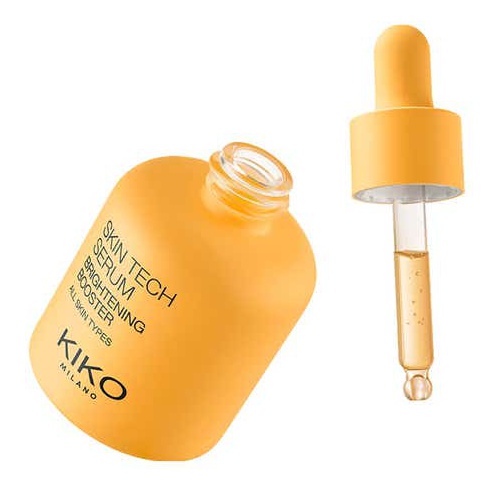
Ingredients overview
Highlights
Key Ingredients
Other Ingredients
Skim through
KIKO Milano Skin Tech Serum Brightening BoosterIngredients explained
Good old water, aka H2O. The most common skincare ingredient of all. You can usually find it right in the very first spot of the ingredient list, meaning it’s the biggest thing out of all the stuff that makes up the product.
It’s mainly a solvent for ingredients that do not like to dissolve in oils but rather in water.
Once inside the skin, it hydrates, but not from the outside - putting pure water on the skin (hello long baths!) is drying.
One more thing: the water used in cosmetics is purified and deionized (it means that almost all of the mineral ions inside it is removed). Like this, the products can stay more stable over time.
A multi-functional, silky feeling helper ingredient that can do quite many things. It's used as an emulsion stabilizer, solvent and a broad spectrum antimicrobial. According to manufacturer info, it's also a moisturizer and helps to make the product feel great on the skin. It works synergistically with preservatives and helps to improve water-resistance of sunscreens.
- A multi-functional skincare superstar with several proven benefits for the skin
- Great anti-aging, wrinkle smoothing ingredient used at 4-5% concentration
- Fades brown spots alone or in combination with amino sugar, acetyl glucosamine
- Increases ceramide synthesis that results in a stronger, healthier skin barrier and better skin hydration
- Can help to improve several skin conditions including acne, rosacea, and atopic dermatitis
A form of skincare superstar, vitamin C. If you do not know why vitamin C is such a big deal in skincare, we have a really detailed, geeky description that's good to read. :)
So now you know that because pure vitamin C is such a diva (very unstable and hard to formulate) the cosmetic industry is trying to come up with some derivatives that have the badass anti-aging properties of vitamin C (antioxidant protection + collagen boosting + fading hyperpigmentation) but without the disadvantages. This is a hard task, and there is not yet a derivative that is really proven to be better in every aspect, but Ascorbyl Glucoside is one of the best options when it comes to vitamin C derivatives. Let's see why:
First, it's really stable and easy to formulate, so the problems that come with pure vitamin C are solved here.
Second, in vitro (meaning made in the lab, not on real humans) studies show that ascorbyl glucoside can penetrate the skin. This is kind of important for an anti-aging ingredient to do the job, so this is good news, though in-vivo (made on real humans) studies are still needed.
Third, in-vitro studies show that after ascorbyl glucoside is absorbed into the skin it is converted to pure vitamin C (though the rate of conversion is still a question mark). It also shows all the three anti-aging benefits (antioxidant protection + collagen boosting + fading hyperpigmentation) that pure vitamin C does.
Bottom line: ascorbyl glucoside is one of the best and most promising vitamin C derivatives that shows similar benefits to that of pure vitamin C, but it's less proven (in vivo vs. in vitro studies) and the extent of the benefits are also not the same.
If you ever wondered what those little Listerine breath strips were made of, you found your answer! Pullulan is a polysaccharide polymer, which basically means that it’s a big molecule made up of smaller sugar molecule units.
It dissolves in water and can make a thin, elastic, and moisture-absorbing film when spread on the skin that can cause an instant tightening effect. It can also be used as a thickener to get a silicone-like feel and can be used in peel-off masks. Btw, it's made from fungus via fermentation.
Propanediol is a natural alternative for the often used and often bad-mouthed propylene glycol. It's produced sustainably from corn sugar and it's Ecocert approved.
It's quite a multi-tasker: can be used to improve skin moisturization, as a solvent, to boost preservative efficacy or to influence the sensory properties of the end formula.
A kind of polymer (big molecule from repeated subunits) that helps to create beautiful gel-like textures. It's also a texturizer and thickener for oil-in-water emulsions. It gives products a good skin feel and does not make the formula tacky or sticky.
It works over a wide pH range and is used between 0.5-1.2%.
The unfancy name for it is lye. It’s a solid white stuff that’s very alkaline and used in small amounts to adjust the pH of the product and make it just right.
For example, in case of AHA or BHA exfoliants, the right pH is super-duper important, and pH adjusters like sodium hydroxide are needed.
BTW, lye is not something new. It was already used by ancient Egyptians to help oil and fat magically turn into something else. Can you guess what? Yes, it’s soap. It still often shows up in the ingredient list of soaps and other cleansers.
Sodium hydroxide in itself is a potent skin irritant, but once it's reacted (as it is usually in skin care products, like exfoliants) it is totally harmless.
A handy multifunctional ingredient that works as a preservative booster, as well as an antioxidant and soothing agent.
The neutralized form of gluconic acid. It's a great ingredient to neutralize metal (especially iron and copper) ions in a cosmetic product. This helps to prevent discoloration of the formula over time or rancidity of cosmetic oils. It can also be a pH regulator and a humectant (helps skin to cling onto water).
It's also used in oral care products where it reduces the bitterness of other ingredients. And it's natural, both Ecocert and Cosmos approved. (source: manufacturer info)
It's one of the most commonly used thickeners and emulsion stabilizers. If the product is too runny, a little xanthan gum will make it more gel-like. Used alone, it can make the formula sticky and it is a good team player so it is usually combined with other thickeners and so-called rheology modifiers (helper ingredients that adjust the flow and thus the feel of the formula). The typical use level of Xantha Gum is below 1%, it is usually in the 0.1-0.5% range.
Btw, Xanthan gum is all natural, a chain of sugar molecules (polysaccharide) produced from individual sugar molecules (glucose and sucrose) via fermentation. It’s approved by Ecocert and also used in the food industry (E415).
Exactly what it sounds: nice smelling stuff put into cosmetic products so that the end product also smells nice. Fragrance in the US and parfum in the EU is a generic term on the ingredient list that is made up of 30 to 50 chemicals on average (but it can have as much as 200 components!).
If you are someone who likes to know what you put on your face then fragrance is not your best friend - there's no way to know what’s really in it.
Also, if your skin is sensitive, fragrance is again not your best friend. It’s the number one cause of contact allergy to cosmetics. It’s definitely a smart thing to avoid with sensitive skin (and fragrance of any type - natural is just as allergic as synthetic, if not worse!).
- It’s the second most researched AHA after glycolic acid
- It gently lifts off dead skin cells to reveal newer, fresher, smoother skin
- It also has amazing skin hydrating properties
- In higher concentration (10% and up) it improves skin firmness, thickness and wrinkles
- Choose a product where you know the concentration and pH value because these two greatly influence effectiveness
- Don’t forget to use your sunscreen (in any case but especially so next to an AHA product)
 We don't have description for this ingredient yet.
- A natural moisturizer that’s also in our skin
- A super common, safe, effective and cheap molecule used for more than 50 years
- Not only a simple moisturizer but knows much more: keeps the skin lipids between our skin cells in a healthy (liquid crystal) state, protects against irritation, helps to restore barrier
- Effective from as low as 3% with even more benefits for dry skin at higher concentrations up to 20-40%
- High-glycerin moisturizers are awesome for treating severely dry skin
We have to start by writing that there are about 900 citrus species in the world, and plenty of them are used to make different kinds of extracts used in cosmetics. This particular one, Citrus Aurantium Dulcis Fruit Extract is a very common ingredient, however, the species "Citrus Aurantium Dulcis" seem to exist only on ingredient lists and the real world calls this guy Citrus Sinensis or, you know, orange.
To complicate matters further, there are lots of varieties and lots of extraction methods, so it is a bit hard to know what you are getting with this one, but we will try our best to summarize the possibilities.
A very common scenario is that Citrus Aurantium Dulcis Fruit Extract is on the ingredient list for its mild, natural exfoliant properties. It contains mainly citric acid and some malic acid, AHA exfoliants known for their skin renewing properties. If that's the case, it is usually combined with other AHA containing fruits such as bilberry, sugar cane, lemon, and sugar maple in a super popular ingredient mix trade named ACB Fruit Mix.
But orange fruit is loaded with lots of other active compounds with a wide variety of possible effects. A well-known one is the antioxidant vitamin C, aka ascorbic acid, but the dosage will vary based on the extraction method, and it’s possible that some of the ascorbic acid content will degrade before extraction process even takes place. If you want vitamin C in your skincare, that is smart, but do not rely on orange fruit extract for it.
Flavonoids (hesperidin, naringin, luteolin, and ferulic acid) are also nice active compounds with possible antioxidant, anti-inflammatory, and vasoprotective effects. Some of them (namely hesperidin and luteolin) might even have skin brightening activity by inhibiting tyrosinase, the famous enzyme needed for melanin production.
The orange extract also contains carbohydrates, aka sugars (mostly glucose, fructose, and sucrose, but also some bigger polysaccharides such as pectin) giving the ingredient some moisturizing properties.
Some essential oil content is usually also present in citrus fruit extracts, which means a nice scent and antibacterial properties, but also some questionable compounds such as fragrance allergen limonene or phototoxic compound bergaptene. If the amount is big enough to worry about is questionable, probably not, however, the same question applies to all the nice beneficial compounds.
Overall, we think that the orange fruit extract is a very complex ingredient with lots of potentially good things in it, but we could not find proper in-vivo (made on real people) studies made with standardized extracts to validate what it really does or does not under real-world use cases.
A helper ingredient that helps to make the products stay nice longer, aka preservative. It works mainly against fungi.
It’s pH dependent and works best at acidic pH levels (3-5). It’s not strong enough to be used in itself so it’s always combined with something else, often with potassium sorbate.
It's one of those things that help your cosmetics not to go wrong too soon, aka a preservative. It’s not a strong one and doesn’t really work against bacteria, but more against mold and yeast. To do that it has to break down to its active form, sorbic acid. For that to happen, there has to be water in the product and the right pH value (pH 3-4).
But even if everything is right, it’s not enough on its own. If you see potassium sorbate you should see some other preservative next to it too.
BTW, it’s also a food preservative and even has an E number, E202.
Ci 19140 or Tartrazine is a super common colorant in skincare, makeup, medicine & food. It’s a synthetic lemon yellow that's used alone or mixed with other colors for special shades.
FDA says it's possible, but rare, to have an allergic-type reaction to a color additive. As an example, it mentions that Ci 19140 may cause itching and hives in some people but the colorant is always labeled so that you can avoid it if you are sensitive.
We don't have description for this ingredient yet.
You may also want to take a look at...
| what‑it‑does | solvent |
| what‑it‑does | solvent | moisturizer/humectant |
| what‑it‑does | cell-communicating ingredient | skin brightening | anti-acne | moisturizer/humectant |
| what‑it‑does | antioxidant | skin brightening |
| what‑it‑does | solvent | moisturizer/humectant |
| what‑it‑does | viscosity controlling |
| what‑it‑does | buffering |
| what‑it‑does | antioxidant | preservative |
| what‑it‑does | chelating | moisturizer/humectant |
| what‑it‑does | viscosity controlling |
| what‑it‑does | perfuming |
| what‑it‑does | exfoliant | moisturizer/humectant | buffering |
| what‑it‑does | skin-identical ingredient | moisturizer/humectant |
| irritancy, com. | 0, 0 |
| what‑it‑does | preservative |
| what‑it‑does | preservative |
| what‑it‑does | colorant |
| what‑it‑does | colorant |