




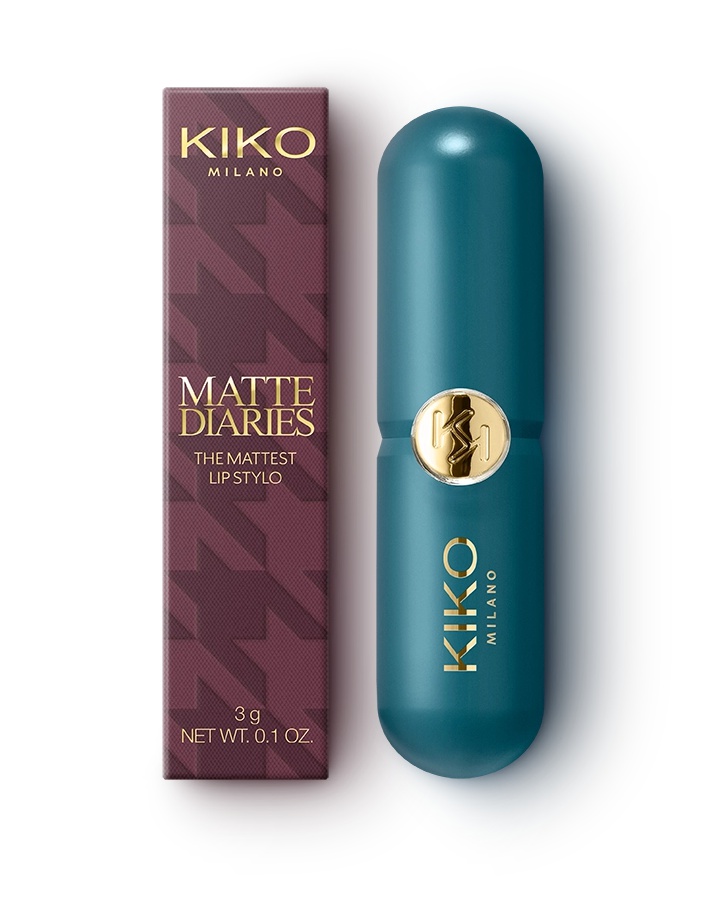
Matte Diaries The Mattest Lip Stylo
Ingredients overview
Highlights
Other Ingredients
Skim through
KIKO Milano Matte Diaries The Mattest Lip StyloIngredients explained
A clear, colorless and odorless, highly volatile (meaning it does not absorb into the skin but evaporates from it) liquid that's used as an emollient. It gives a nice non-oily light skin feel and it can improve the slip of the formula without leaving a tacky residue behind.
It's also popular in make-up products as its volatility makes mascaras and foundations last longer. If that would not be enough, it's also an excellent solvent, and it's a regular not only on the ingredients lists of make-ups but also on makeup removers.
 We don't have description for this ingredient yet.
A solid silicone resin that creates a permeable film over the skin. It makes makeup formulas more long-lasting and can enhance the water resistance of sunscreens. It leaves a non-tacky film when dried.
Polyethylene is the most common plastic in the world. It is a super versatile polymer (molecule from repeated subunits) and when it comes to cosmetics, it is often referred to as microbeads. Well, it used to be referred to as microbeads, as it was banned in 2015 in the " Microbead-Free Waters Act" due to the small plastic spheres accumulating in the waters and looking like food to fish. Well done by Obama.
But being versatile means that polyethylene does not only come as scrub particles but also as a white wax. In its wax-form, it is still well, alive and pretty popular. It thickens up water-free formulas, increases hardness and raises the melting point of emulsions and water-less balms. It is particularly common in cleansing balms and stick-type makeup products due to its ability to add body, hardness and slip to these formulas.
Kaolin is a type of clay or to be precise, a naturally occurring hydrous aluminum silicate. When you hear clay, you probably think of a muddy greenish-black mess, but that one is bentonite, and this one is a fine, white powder. It is so white that it's also often used, in small amounts, as a helper ingredient to give opacity and whiteness to the cosmetic formulas.
As a clay, it's absorbent and can suck up excess sebum and gunk from your skin, but less so than the more aggressive bentonite. As it's less absorbent, it's also less drying and gentler on the skin, so it's ideal for dry and sensitive skin types.
A clear, slightly yellow, odorless oil that's a very common, medium-spreading emollient. It makes the skin feel nice and smooth and works in a wide range of formulas.
A clear, colorless and odorless oily liquid that works as a fast-spreading emollient with a dry skin feel.
We don't have description for this ingredient yet.
We don't have description for this ingredient yet.
Jojoba-derived emollient wax esters (fatty acid + fatty alcohol) that make your skin feel nice and smooth. Chemically speaking, pure jojoba oil is also a wax ester (read our shiny explanation here), however, the ingredients called jojoba esters on the ingredient lists are made from jojoba oil and/or hydrogenated jojoba oil via interesterification.
They have multiple versions with variable fatty acid chain length and the ingredient can have a liquid, a creamy, a soft or firm paste, or even a hard wax consistency. The common thing between all versions is, that unlike most normal triglyceride oils, jojoba esters have superior stability, provide non-greasy emolliency and are readily absorbed into the skin.
We don't have description for this ingredient yet.
A vegetable wax coming from the leaves of the Brazilian tropical palm tree, Copernicia cerifera. Similar to other waxes, it is used to stabilize and give body to products, or to keep stick type formulas solid. It is the hardest natural wax with a high melting point (around 85C) and high gloss making it a great wax choice for lip products.
A hard wax coming from sunflower that has a high melting point and gives excellent thermal stability to the formulas. Similar to other waxes, it is used to stabilize products and give body to them, or to keep stick type formulas, such as lip balms, solid.
We don't have description for this ingredient yet.
Three glycerin molecules attached together. It is a humectant and moisturizer ingredient just like glycerin, but the larger molecular structure penetrates slower into the skin and gives milder, longer lasting moisture.
The flower wax coming from Mimosa that has nice skin protecting and film-forming properties. It also has a nice, sweet smell well known to perfumers.
Mimosa wax often comes to the formula together with sunflower and jojoba waxes as the three of them is trade named Acticire and form a natural texture agent that works both as an emollient bringing softness to the formula as well as an active ingredient with skin-repairing, protecting, and moisturizing properties.
Pentaerythrityl Tetra-Di-T-Butyl Hydroxyhydrocinnamate is an antioxidant molecule used in small amounts (less than 0.8%) to help products stay nice longer. More specifically, it is great at preventing discoloration or other types of oxidative degradation. It is a trendy alternative to often bad-mouthed synthetic antioxidant and stabilizer, BHT.
- Primary fat-soluble antioxidant in our skin
- Significant photoprotection against UVB rays
- Vit C + Vit E work in synergy and provide great photoprotection
- Has emollient properties
- Easy to formulate, stable and relatively inexpensive
Ci 77891 is the color code of titanium dioxide. It's a white pigment with great color consistency and dispersibility.
Red Iron Oxide is the super common pigment that gives the familiar, "rust" red color. It is also the one that gives the pink tones in your foundation. Chemically speaking, it is iron III oxide (Fe2O3).
Yellow Iron Oxide is the super common inorganic (as in no carbon atom in the molecule) pigment that gives the yellow tones in your foundation. Blended with red and black iron oxides, it is essential in all "flesh-toned" makeup products.
Chemically speaking, it is hydrated iron III oxide and depending on the conditions of manufacture, it can range from a light lemon to an orange-yellow shade.
Black Iron Oxide is the super common inorganic (as in no carbon atom in the molecule) pigment that controls the darkness of your foundation or gives the blackness to your mascara. Blended with red and black iron oxides, it is essential in all "flesh-toned" makeup products.
Chemically speaking, it is a mixture of iron II and iron III oxide. Btw, this guy, unlike the yellow and red pigments, is magnetic.
Ci 19140 or Tartrazine is a super common colorant in skincare, makeup, medicine & food. It’s a synthetic lemon yellow that's used alone or mixed with other colors for special shades.
FDA says it's possible, but rare, to have an allergic-type reaction to a color additive. As an example, it mentions that Ci 19140 may cause itching and hives in some people but the colorant is always labeled so that you can avoid it if you are sensitive.
We don't have description for this ingredient yet.
A cosmetic colorant used as a reddish pigment.
Some version of it is a pH-sensitive dye that enables a colorless lip balm to turn red/pink upon application.
We don't have description for this ingredient yet.
CI 42090 or Blue 1 is a super common synthetic colorant in beauty & food. Used alone, it adds a brilliant smurf-like blue color, combined with Tartrazine, it gives the fifty shades of green.
You may also want to take a look at...
| what‑it‑does | emollient | solvent |
| what‑it‑does | emollient | viscosity controlling |
| what‑it‑does | emollient |
| what‑it‑does | viscosity controlling |
| what‑it‑does | colorant | abrasive/scrub |
| irritancy, com. | 0, 0 |
| what‑it‑does | emollient | perfuming |
| what‑it‑does | emollient | solvent |
| what‑it‑does | viscosity controlling |
| what‑it‑does | emulsifying |
| what‑it‑does | soothing | emollient | moisturizer/humectant |
| what‑it‑does | viscosity controlling |
| what‑it‑does | emollient |
| irritancy, com. | 0, 1 |
| what‑it‑does | emollient |
| what‑it‑does | abrasive/scrub |
| what‑it‑does | solvent | viscosity controlling |
| what‑it‑does | moisturizer/humectant |
| what‑it‑does | emollient |
| what‑it‑does | antioxidant | preservative |
| what‑it‑does | antioxidant |
| irritancy, com. | 0-3, 0-3 |
| what‑it‑does | colorant |
| irritancy, com. | 0, 0 |
| what‑it‑does | colorant |
| irritancy, com. | 0, 0 |
| what‑it‑does | colorant |
| irritancy, com. | 0, 0 |
| what‑it‑does | colorant |
| irritancy, com. | 0, 0 |
| what‑it‑does | colorant |
| what‑it‑does | colorant |
| what‑it‑does | colorant |
| irritancy, com. | 0, 2 |
| what‑it‑does | colorant |
| irritancy, com. | 0, 1 |
| what‑it‑does | colorant |