




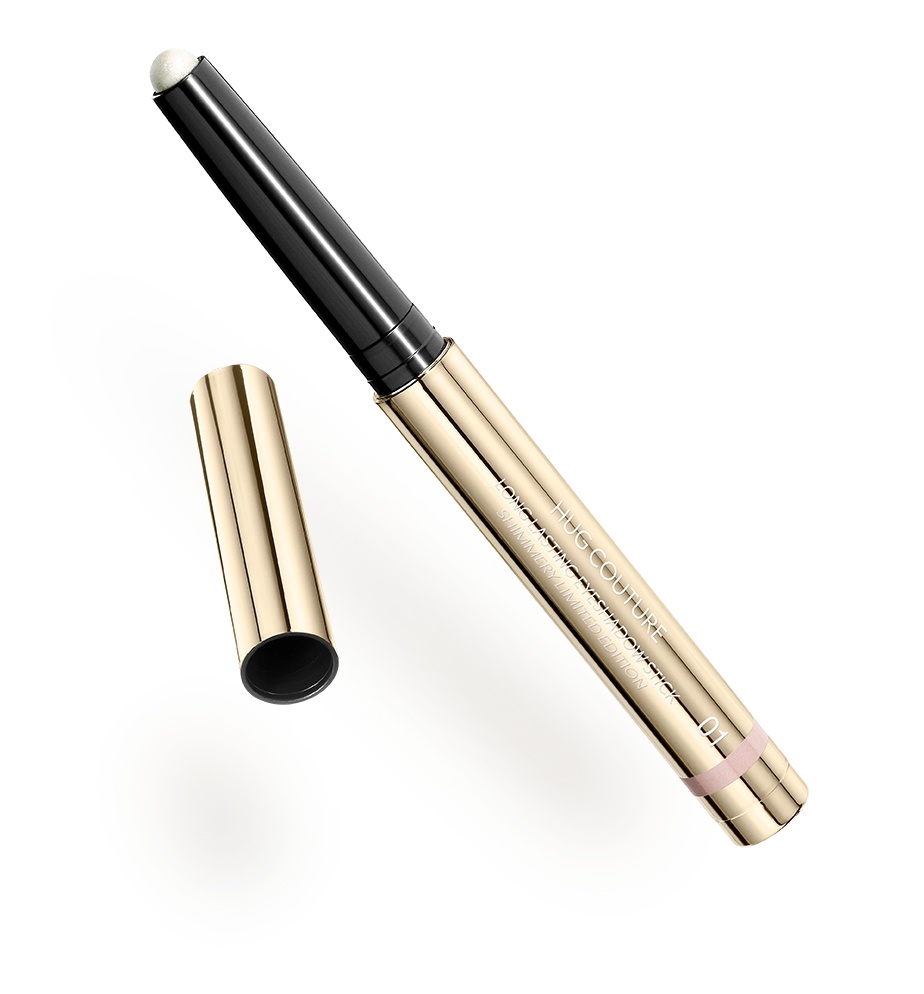
Hug Couture Long Lasting Eyeshadow Stick
Ingredients overview
Highlights
Skim through
KIKO Milano Hug Couture Long Lasting Eyeshadow StickIngredients explained
Methyl Trimethicone is a very light, volatile silicone (it evaporates from the skin rather than absorbs into it) that's similar to super commonly used Cyclopentasiloxane but it dries even faster when applied to the skin.
A solid silicone resin that creates a permeable film over the skin. It makes makeup formulas more long-lasting and can enhance the water resistance of sunscreens. It leaves a non-tacky film when dried.
Synthetic Fluorphlogopite is the synthetic version of the super commonly used mineral, Mica. The advantage of being synthetic is that it has a more consistent quality, fewer impurities and an even lower heavy metal content than Mica (not that Mica's heavy metal content is high). It is also more transparent and has improved light reflection.
The two main use cases for Synthetic Fluorphlogopite is being used neat as a superior "filler" or skin tone enhancer or it can also serve as a base for multi-layered, composite pigments such as pearl effect pigments where it is coated with one or more layers of metal oxide, most commonly titanium dioxide.
 We don't have description for this ingredient yet.
A white powdery thing that's the major component of glass and sand. In cosmetics, it’s often in products that are supposed to keep your skin matte as it has great oil-absorbing abilities. It’s also used as a helper ingredient to thicken up products or suspend insoluble particles.
A super versatile and common mineral powder that comes in different particle sizes. It is a multi-tasker used to improve skin feel, increase product slip, give the product light-reflecting properties, enhance skin adhesion or serve as an anti-caking agent.
It is also the most commonly used "base" material for layered composite pigments such as pearl-effect pigments. In this case, mica is coated with one or more metal oxides (most commonly titanium dioxide) to achieve pearl effect via the physical phenomenon known as interference.
We don't have description for this ingredient yet.
A spherical texturizing powder that's used as a texture enhancer and soft focus agent. It's claimed to give silicone type softness to the formula and also works as a (temporary) wrinkle filler.
We don't have description for this ingredient yet.
A clear, slightly yellow, odorless oil that's a very common, medium-spreading emollient. It makes the skin feel nice and smooth and works in a wide range of formulas.
A vegetable wax coming from the leaves of the Brazilian tropical palm tree, Copernicia cerifera. Similar to other waxes, it is used to stabilize and give body to products, or to keep stick type formulas solid. It is the hardest natural wax with a high melting point (around 85C) and high gloss making it a great wax choice for lip products.
Polyethylene is the most common plastic in the world. It is a super versatile polymer (molecule from repeated subunits) and when it comes to cosmetics, it is often referred to as microbeads. Well, it used to be referred to as microbeads, as it was banned in 2015 in the " Microbead-Free Waters Act" due to the small plastic spheres accumulating in the waters and looking like food to fish. Well done by Obama.
But being versatile means that polyethylene does not only come as scrub particles but also as a white wax. In its wax-form, it is still well, alive and pretty popular. It thickens up water-free formulas, increases hardness and raises the melting point of emulsions and water-less balms. It is particularly common in cleansing balms and stick-type makeup products due to its ability to add body, hardness and slip to these formulas.
An organic derivative of hectorite clay, Disteardimonium Hectorite is used as a viscosity controller - it thickens up formulations to make them less runny.
It’s most popular use in cosmetics is in sunscreens, under the trademarked name Bentone 38 from Elementis. According to the manufacturer info, it is a real multi-tasker, including the ability to prevent pigments settling during storage, stabilizing a formula for longer, creating a light and smooth skin feel and enhancing the water-resistance of sunscreen formulas.
A so-called dispersant or dispersing agent that's used in inorganic (titanium dioxide/zinc oxide based) sunscreens or in make-up products to help to distribute the pigments nicely and evenly on the skin. It's also claimed to increase the UV absorption of the sunscreen formula as well as to reduce the annoying white cast left behind by inorganic sunscreens.
A super common emollient that makes your skin feel nice and smooth. It comes from coconut oil and glycerin, it’s light-textured, clear, odorless and non-greasy. It’s a nice ingredient that just feels good on the skin, is super well tolerated by every skin type and easy to formulate with. No wonder it’s popular.
We don't have description for this ingredient yet.
Pentaerythrityl Tetra-Di-T-Butyl Hydroxyhydrocinnamate is an antioxidant molecule used in small amounts (less than 0.8%) to help products stay nice longer. More specifically, it is great at preventing discoloration or other types of oxidative degradation. It is a trendy alternative to often bad-mouthed synthetic antioxidant and stabilizer, BHT.
We don't have description for this ingredient yet.
A liquid fatty acid created from oleic acid. It's claimed to have great odour, thermal and oxidation stability and is great for the stabilization of pigments and mineral particles in oils and solvents. It's quite popular in foundations.
Far from the tin cans you find in the supermarket, Tin Oxide is mostly used when dealing with so-called effect pigments, tricky composite pigments that can do color travel (change color depending on the viewing angle) or give multiple color effect.
It's often found alongside Mica (as a base material) and Titanium Dioxide (as a coating) to give a glossy, pearlescent effect. Together, they make up a trademarked technology called RonaFlair Blanace from the German manufacturer Merck. According to their info, this combination can balance out undesirable tones in the skin, making it a popular choice for brightening products and highlighters.
Other than that, CosIng (the official EU INCI database) lists its uses as being a bulking agent (to increase the volume of products), as well as a physical exfoliant or an opacifying agent, but being part of composite effect pigments is a much more common use case.
A very common ingredient that can be found in all cell membranes. In cosmetics it's quite the multi-tasker: it's an emollient and water-binding ingredient but it's also an emulsifier and can be used for stabilization purposes. It's also often used to create liposomes.
A plant based ingredient that helps water to mix with oil (aka W/O emulsifier). It's especially good for soft to low-viscosity water-in-oil emulsions with non-greasy, pleasant skin feel like lip balms or thick body butters.
We don't have description for this ingredient yet.
We don't have description for this ingredient yet.
We don't have description for this ingredient yet.
We don't have description for this ingredient yet.
A multi-functional helper ingredient that's used mainly as a pigment carrier. The pigment can be an inorganic sunscreen (such as titanium dioxide) or a colorant that is blended with alumina platelets and then often coated with some kind of silicone (such as triethoxycaprylylsilane). This special treatment enables pigments to be evenly dispersed in the formula and to be spread out easily and evenly upon application. It is super useful both for mineral sunscreens as well as for makeup products.
Other than that, alumina can also be used as an absorbent (sometimes combined with the mattifying powder called polymethylsilsesquioxane), a viscosity controlling or an opacifying (reduces the transparency of the formula) agent.
Red Iron Oxide is the super common pigment that gives the familiar, "rust" red color. It is also the one that gives the pink tones in your foundation. Chemically speaking, it is iron III oxide (Fe2O3).
Yellow Iron Oxide is the super common inorganic (as in no carbon atom in the molecule) pigment that gives the yellow tones in your foundation. Blended with red and black iron oxides, it is essential in all "flesh-toned" makeup products.
Chemically speaking, it is hydrated iron III oxide and depending on the conditions of manufacture, it can range from a light lemon to an orange-yellow shade.
Ci 19140 or Tartrazine is a super common colorant in skincare, makeup, medicine & food. It’s a synthetic lemon yellow that's used alone or mixed with other colors for special shades.
FDA says it's possible, but rare, to have an allergic-type reaction to a color additive. As an example, it mentions that Ci 19140 may cause itching and hives in some people but the colorant is always labeled so that you can avoid it if you are sensitive.
An inorganic (as in no carbon in its molecule) pigment that has a very intense, dark blue color. It is not permitted in lip products in the US, and only the version Ferric Ammonium Ferrocyanide is permitted in the EU.
Ci 77891 is the color code of titanium dioxide. It's a white pigment with great color consistency and dispersibility.
CI 42090 or Blue 1 is a super common synthetic colorant in beauty & food. Used alone, it adds a brilliant smurf-like blue color, combined with Tartrazine, it gives the fifty shades of green.
We don't have description for this ingredient yet.
We don't have description for this ingredient yet.
You may also want to take a look at...
| what‑it‑does | solvent |
| what‑it‑does | emollient |
| what‑it‑does | viscosity controlling |
| what‑it‑does | emollient | viscosity controlling |
| what‑it‑does | viscosity controlling |
| what‑it‑does | colorant |
| what‑it‑does | abrasive/scrub |
| what‑it‑does | viscosity controlling |
| what‑it‑does | emollient | viscosity controlling |
| what‑it‑does | emollient | perfuming |
| what‑it‑does | emollient |
| irritancy, com. | 0, 1 |
| what‑it‑does | viscosity controlling |
| what‑it‑does | viscosity controlling |
| what‑it‑does | emulsifying |
| what‑it‑does | emollient |
| what‑it‑does | viscosity controlling |
| what‑it‑does | antioxidant | preservative |
| what‑it‑does | solvent | viscosity controlling |
| what‑it‑does | surfactant/cleansing | emulsifying |
| what‑it‑does | colorant | abrasive/scrub | viscosity controlling |
| what‑it‑does | emollient | emulsifying |
| what‑it‑does | emulsifying | viscosity controlling |
| what‑it‑does | abrasive/scrub |
| what‑it‑does | viscosity controlling | abrasive/scrub |
| what‑it‑does | colorant |
| irritancy, com. | 0, 0 |
| what‑it‑does | colorant |
| irritancy, com. | 0, 0 |
| what‑it‑does | colorant |
| what‑it‑does | colorant |
| what‑it‑does | colorant |
| irritancy, com. | 0, 0 |
| what‑it‑does | colorant |
| what‑it‑does | colorant |
| what‑it‑does | colorant |