




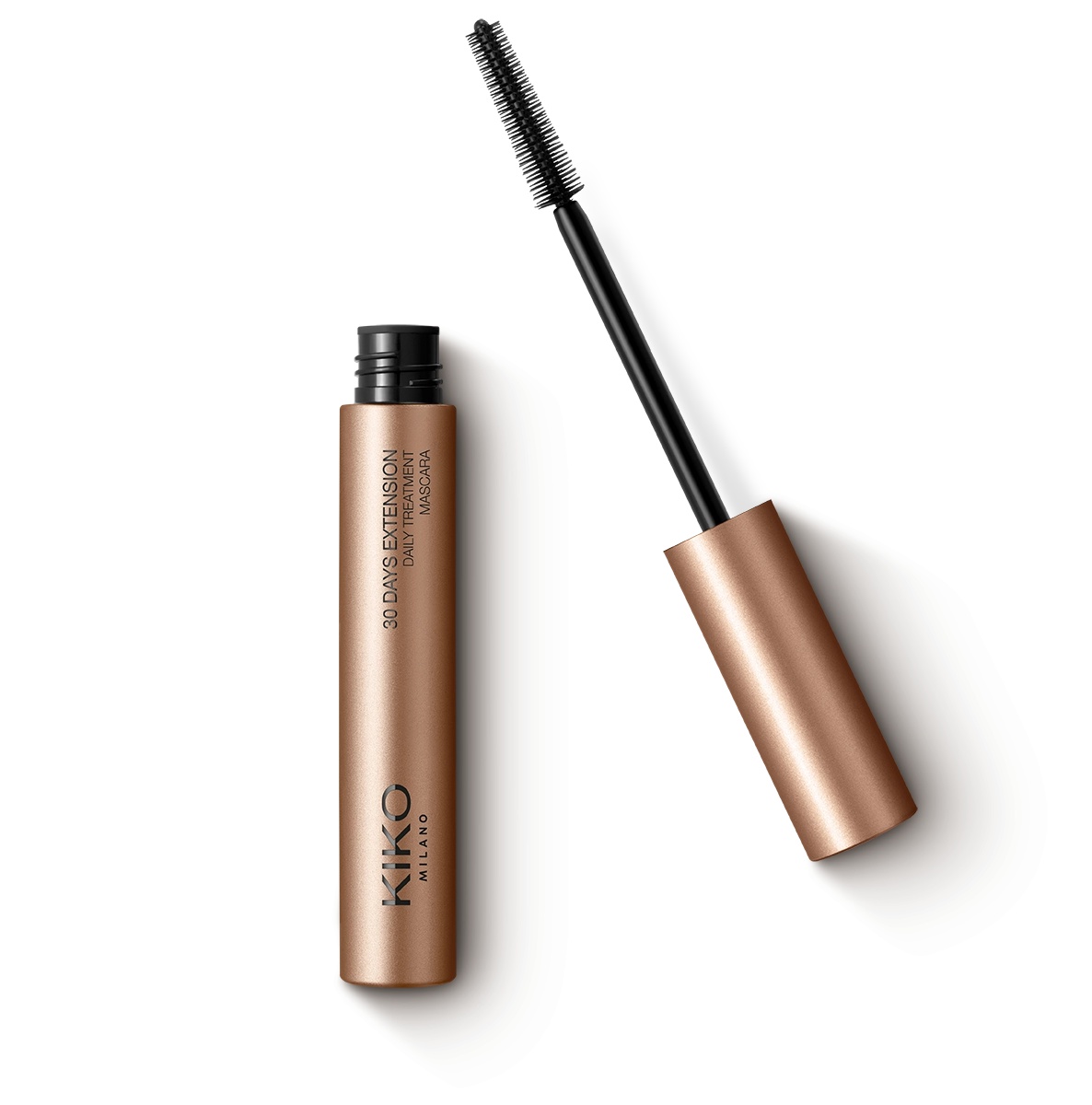
30 Days Extension Daily Treatment Mascara
Ingredients overview
Highlights
Key Ingredients
Other Ingredients
Skim through
KIKO Milano 30 Days Extension Daily Treatment MascaraIngredients explained
Good old water, aka H2O. The most common skincare ingredient of all. You can usually find it right in the very first spot of the ingredient list, meaning it’s the biggest thing out of all the stuff that makes up the product.
It’s mainly a solvent for ingredients that do not like to dissolve in oils but rather in water.
Once inside the skin, it hydrates, but not from the outside - putting pure water on the skin (hello long baths!) is drying.
One more thing: the water used in cosmetics is purified and deionized (it means that almost all of the mineral ions inside it is removed). Like this, the products can stay more stable over time.
A common multi-tasker fatty acid. It makes your skin feel nice and smooth (emollient), gives body to cream type products and helps to stabilize water and oil mixes (aka emulsions).
It's the yellow, solid stuff that you probably know from beeswax candles. It's a natural material produced by honey bees to build their honeycomb.
As for skincare, it's used as an emollient and thickening agent. It's super common in lip balms and lipsticks.
It's a type of glycol that - according to the manufacturer - is an extremely good replacement for other glycols like propylene or butylene glycol. Its main job is to be a solvent, but it has also very good antimicrobial properties and acts as a true preservative booster. Also helps with skin hydration without stickiness or tacky feel.
- A natural moisturizer that’s also in our skin
- A super common, safe, effective and cheap molecule used for more than 50 years
- Not only a simple moisturizer but knows much more: keeps the skin lipids between our skin cells in a healthy (liquid crystal) state, protects against irritation, helps to restore barrier
- Effective from as low as 3% with even more benefits for dry skin at higher concentrations up to 20-40%
- High-glycerin moisturizers are awesome for treating severely dry skin
A super common, waxy, white, solid stuff that helps water and oil to mix together, gives body to creams and leaves the skin feeling soft and smooth.
Chemically speaking, it is the attachment of a glycerin molecule to the fatty acid called stearic acid. It can be produced from most vegetable oils (in oils three fatty acid molecules are attached to glycerin instead of just one like here) in a pretty simple, "green" process that is similar to soap making. It's readily biodegradable.
It also occurs naturally in our body and is used as a food additive. As cosmetic chemist Colins writes it, "its safety really is beyond any doubt".
A white powdery thing that's the major component of glass and sand. In cosmetics, it’s often in products that are supposed to keep your skin matte as it has great oil-absorbing abilities. It’s also used as a helper ingredient to thicken up products or suspend insoluble particles.
Butylene glycol, or let’s just call it BG, is a multi-tasking colorless, syrupy liquid. It’s a great pick for creating a nice feeling product.
BG’s main job is usually to be a solvent for the other ingredients. Other tasks include helping the product to absorb faster and deeper into the skin (penetration enhancer), making the product spread nicely over the skin (slip agent), and attracting water (humectant) into the skin.
It’s an ingredient whose safety hasn’t been questioned so far by anyone (at least not that we know about). BG is approved by Ecocert and is also used enthusiastically in natural products. BTW, it’s also a food additive.
It's the triglyceride of behenic acid that works as a thickening or gelling agent, as a compacting agent for pressed powders, and improves heat stability of emulsions.
An alkaline (high pH, aka basic) material that is used to set the pH of the cosmetic formula to the right value.
Bis-PEG-18 Methyl Ether Dimethyl Silane is a silicone that is water dispersible (as opposed to most other silicones that are usually oil dispersible). It makes the skin smooth and nice (emollient), moisturizes, helps to reduce tackiness, and also has some foam boosting properties. It is often used in light, watery formulas to give them an extra silky feel.
A vegetable wax coming from the leaves of the Brazilian tropical palm tree, Copernicia cerifera. Similar to other waxes, it is used to stabilize and give body to products, or to keep stick type formulas solid. It is the hardest natural wax with a high melting point (around 85C) and high gloss making it a great wax choice for lip products.
Sodium chloride is the fancy name of salt. Normal, everyday table salt.
If (similar to us) you are in the weird habit of reading the label on your shower gel while taking a shower, you might have noticed that sodium chloride is almost always on the ingredient list. The reason for this is that salt acts as a fantastic thickener in cleansing formulas created with ionic cleansing agents (aka surfactants) such as Sodium Laureth Sulfate. A couple of percents (typically 1-3%) turns a runny surfactant solution into a nice gel texture.
If you are into chemistry (if not, we understand, just skip this paragraph), the reason is that electrolytes (you know, the Na+ and Cl- ions) screen the electrostatic repulsion between the head groups of ionic surfactants and thus support the formation of long shaped micelles (instead of spherical ones) that entangle like spaghetti, and viola, a gel is formed. However, too much of it causes the phenomenon called "salting out", and the surfactant solution goes runny again.
Other than that, salt also works as an emulsion stabilizer in water-in-oil emulsions, that is when water droplets are dispersed in the outer oil (or silicone) phase. And last but not least, when salt is right at the first spot of the ingredient list (and is not dissolved), the product is usually a body scrub where salt is the physical exfoliating agent.
 We don't have description for this ingredient yet.
A nice little helper ingredient that can thicken up cosmetic products and create beautiful gel formulas. It's derived from cellulose, the major component of the cell wall of green plants. It is compatible with most co-ingredients and gives a very good slip to the formulas.
A vegetable wax coming from the leaves of the North Mexican candelilla shrubs (Euphorbia cerifera and Euphorbia antisyphilitica). Similar to other waxes, it is used to stabilize products and give body to them, or to keep stick type formulas solid. It has a melting point around 70C and has high gloss making it a good choice for lip products.
A big polymer molecule that has a bunch of different versions and thus different uses. It can act as a film former, as a thickening agent, or it can increase the water-resistance in sunscreens. It is also used to entrap pigments/inorganic sunscreens within a micron size matrix for even coverage and easy application.
We don't have description for this ingredient yet.
It's a water-hating, fumed silica that works as a thickener for oils and it can also suspend particles in oils.
Also, increases the gloss of castor oil that can be useful for makeup products.
It's one of those things that help your cosmetics not to go wrong too soon, aka a preservative. It’s not a strong one and doesn’t really work against bacteria, but more against mold and yeast. To do that it has to break down to its active form, sorbic acid. For that to happen, there has to be water in the product and the right pH value (pH 3-4).
But even if everything is right, it’s not enough on its own. If you see potassium sorbate you should see some other preservative next to it too.
BTW, it’s also a food preservative and even has an E number, E202.
A helper ingredient that helps to make the products stay nice longer, aka preservative. It works mainly against fungi and has only milder effect against bacteria.
It is Ecocert and Cosmos approved, and is popular in natural products.
It’s the most commonly used version of pure vitamin E in cosmetics. You can read all about the pure form here. This one is the so-called esterified version.
According to famous dermatologist, Leslie Baumann while tocopheryl acetate is more stable and has a longer shelf life, it’s also more poorly absorbed by the skin and may not have the same awesome photoprotective effects as pure Vit E.
Super common little helper ingredient that helps products to remain nice and stable for a longer time. It does so by neutralizing the metal ions in the formula (that usually get into there from water) that would otherwise cause some not so nice changes.
It is typically used in tiny amounts, around 0.1% or less.
A helper ingredient that usually comes to the formula coupled with PEG-40 Hydrogenated Castor Oil. The two together work as surfactants and oil solubilizers. It's a non-sticky duo that works at low concentration and is often used to solubilize fragrance components into water-based formulas.
A mildly viscous, amber-colored liquid with fatty odor, made from Castor Oil and polyethylene glycol (PEG).
If it were a person, we’d say, it’s agile, diligent & multifunctional. It’s mostly used as an emulsifier and surfactant but most often it is used to solubilize fragrances into water-based formulas.
It’s pretty much the current IT-preservative. It’s safe and gentle, but even more importantly, it’s not a feared-by-everyone-mostly-without-scientific-reason paraben.
It’s not something new: it was introduced around 1950 and today it can be used up to 1% worldwide. It can be found in nature - in green tea - but the version used in cosmetics is synthetic.
Other than having a good safety profile and being quite gentle to the skin it has some other advantages too. It can be used in many types of formulations as it has great thermal stability (can be heated up to 85°C) and works on a wide range of pH levels (ph 3-10).
It’s often used together with ethylhexylglycerin as it nicely improves the preservative activity of phenoxyethanol.
An easy-to-formulate, commonly used, nice to have ingredient that’s also called pro-vitamin B5. As you might guess from the “pro” part, it’s a precursor to vitamin B5 (whose fancy name is pantothenic acid).
Its main job in skincare products is to moisturise the skin. It’s a humectant meaning that it can help the skin to attract water and then hold onto it. There is also research showing that panthenol can help our skin to produce more lovely lipids that are important for a strong and healthy skin barrier.
Another great thing about panthenol is that it has anti-inflammatory and skin protecting abilities. A study shows that it can reduce the irritation caused by less-nice other ingredients (e.g. fragrance, preservatives or chemical sunscreens) in the product.
Research also shows that it might be useful for wound healing as it promotes fibroblast (nice type of cells in our skin that produce skin-firming collagen) proliferation.
If that wasn’t enough panthenol is also useful in nail and hair care products. A study shows that a nail treatment liquide with 2% panthenol could effectively get into the nail and significantly increase the hydration of it.
As for the hair the hydration effect is also true there. Panthenol might make your hair softer, more elastic and helps to comb your hair more easily.
A common little helper ingredient that helps water and oil to mix together, aka emulsifier.
A three amino acid peptide where the famous collagen fragment, Tripeptide-1, aka GHK is combined with Biotin, the well-known supplement for stronger nails and hairs. The result of the combination is Biotinoyl Tripeptide-1, a peptide claimed to be helpful for reducing hair loss and for making the eyelashes appear longer, fuller, and stronger.
As for proof, the manufacturer did some in-vitro (made in test tubes) studies that show that our molecule can promote hair bulb keratinocyte proliferation and also helps optimal hair anchorage by stimulating the synthesis and organization of the adhesion molecules laminin 5 and collagen IV. This means that our peptide might help the hair to be stronger and to stay longer in its place, though these are only in vitro results that might or might not translate to real-world use.
As for a clinical, made on real people study, the manufacturer did one for eyelash growth with 30 volunteers. Using a mascara with 2% of SpecPed LashLD (trade name for the diluted, buyable version of Biotinoyl Tripeptide-1), the lashes got longer by 17% and thicker by 19% after 30 days.
We don't have description for this ingredient yet.
It's one of those things that help your cosmetics not to go wrong too soon, aka a preservative. It can be naturally found in fruits and teas but can also be made synthetically.
No matter the origin, in small amounts (up to 1%) it’s a nice, gentle preservative. Has to be combined with some other nice preservatives, like potassium sorbate to be broad spectrum enough.
In high amounts, it can be a skin irritant, but don’t worry, it’s never used in high amounts.
Black Iron Oxide is the super common inorganic (as in no carbon atom in the molecule) pigment that controls the darkness of your foundation or gives the blackness to your mascara. Blended with red and black iron oxides, it is essential in all "flesh-toned" makeup products.
Chemically speaking, it is a mixture of iron II and iron III oxide. Btw, this guy, unlike the yellow and red pigments, is magnetic.
You may also want to take a look at...
| what‑it‑does | solvent |
| what‑it‑does | emollient | viscosity controlling |
| irritancy, com. | 0, 2-3 |
| what‑it‑does | emollient | viscosity controlling | emulsifying | perfuming |
| irritancy, com. | 0, 0-2 |
| what‑it‑does | solvent |
| what‑it‑does | skin-identical ingredient | moisturizer/humectant |
| irritancy, com. | 0, 0 |
| what‑it‑does | emollient | emulsifying |
| irritancy, com. | 0, 1 |
| what‑it‑does | viscosity controlling |
| what‑it‑does | moisturizer/humectant | solvent |
| irritancy, com. | 0, 1 |
| what‑it‑does | emollient |
| what‑it‑does | buffering |
| what‑it‑does | emollient | moisturizer/humectant | surfactant/cleansing |
| what‑it‑does | emollient |
| irritancy, com. | 0, 1 |
| what‑it‑does | viscosity controlling |
| what‑it‑does | viscosity controlling |
| what‑it‑does | viscosity controlling |
| what‑it‑does | emollient |
| irritancy, com. | 0, 1 |
| what‑it‑does | viscosity controlling |
| what‑it‑does | emollient | emulsifying |
| what‑it‑does | emollient | viscosity controlling |
| what‑it‑does | preservative |
| what‑it‑does | preservative |
| what‑it‑does | antioxidant |
| irritancy, com. | 0, 0 |
| what‑it‑does | chelating |
| what‑it‑does | emulsifying | surfactant/cleansing |
| what‑it‑does | preservative |
| what‑it‑does | soothing | moisturizer/humectant |
| irritancy, com. | 0, 0 |
| what‑it‑does | buffering |
| what‑it‑does | emulsifying | surfactant/cleansing |
| what‑it‑does | antioxidant |
| what‑it‑does | cell-communicating ingredient |
| what‑it‑does | buffering |
| what‑it‑does | preservative | perfuming | solvent | viscosity controlling |
| what‑it‑does | colorant |
| irritancy, com. | 0, 0 |