




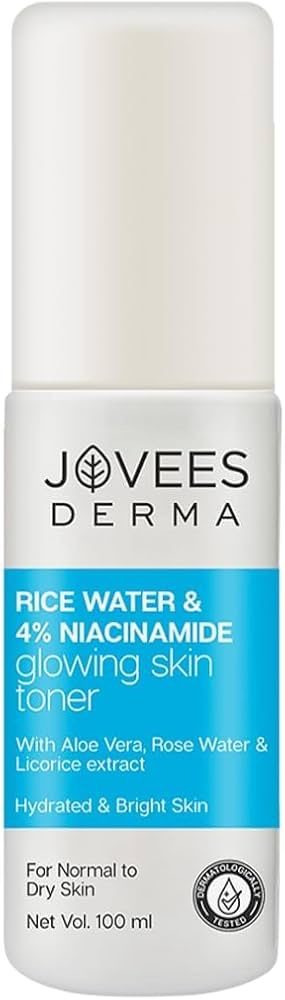
Rice Water & 4% Niacinamide Glowing Skin Toner
Ingredients overview
Highlights
Key Ingredients
Other Ingredients
Skim through
Jovees Derma Rice Water & 4% Niacinamide Glowing Skin TonerIngredients explained
Good old water, aka H2O. The most common skincare ingredient of all. You can usually find it right in the very first spot of the ingredient list, meaning it’s the biggest thing out of all the stuff that makes up the product.
It’s mainly a solvent for ingredients that do not like to dissolve in oils but rather in water.
Once inside the skin, it hydrates, but not from the outside - putting pure water on the skin (hello long baths!) is drying.
One more thing: the water used in cosmetics is purified and deionized (it means that almost all of the mineral ions inside it is removed). Like this, the products can stay more stable over time.
Propanediol is a natural alternative for the often used and often bad-mouthed propylene glycol. It's produced sustainably from corn sugar and it's Ecocert approved.
It's quite a multi-tasker: can be used to improve skin moisturization, as a solvent, to boost preservative efficacy or to influence the sensory properties of the end formula.
- A multi-functional skincare superstar with several proven benefits for the skin
- Great anti-aging, wrinkle smoothing ingredient used at 4-5% concentration
- Fades brown spots alone or in combination with amino sugar, acetyl glucosamine
- Increases ceramide synthesis that results in a stronger, healthier skin barrier and better skin hydration
- Can help to improve several skin conditions including acne, rosacea, and atopic dermatitis
The extract coming from the juice containing leaves of the Aloe vera plant. It's usually a hydroglycolic extract (though oil extract for the lipid parts also exists) that has similar moisturizing, emollient and anti-inflammatory properties as the juice itself. We have written some more about aloe here.
The flower water coming from the flowers of the Damask Rose. In general, flower waters (also called hydrosols) are diluted versions of essential oils coming from the same plant. They contain the same components but in much-reduced concentrations.
Similar to its big sister, rose oil, rose water also has a lovely, relaxing scent. It contains some antioxidant and antimicrobial compounds, as well as some fragrant components.
If your skin is super sensitive, it is a good idea to choose products without fragrant floral waters.
 We don't have description for this ingredient yet.
A corn sugar derived, water-soluble, pale yellow syrup, that nicely moisturizes the skin. It has a light and smooth skin feel, it is non-tacky, and it can improve the after-feel of the formula. It is also mild and gentle, popular in sensitive skin formulas.
An easy-to-formulate, commonly used, nice to have ingredient that’s also called pro-vitamin B5. As you might guess from the “pro” part, it’s a precursor to vitamin B5 (whose fancy name is pantothenic acid).
Its main job in skincare products is to moisturise the skin. It’s a humectant meaning that it can help the skin to attract water and then hold onto it. There is also research showing that panthenol can help our skin to produce more lovely lipids that are important for a strong and healthy skin barrier.
Another great thing about panthenol is that it has anti-inflammatory and skin protecting abilities. A study shows that it can reduce the irritation caused by less-nice other ingredients (e.g. fragrance, preservatives or chemical sunscreens) in the product.
Research also shows that it might be useful for wound healing as it promotes fibroblast (nice type of cells in our skin that produce skin-firming collagen) proliferation.
If that wasn’t enough panthenol is also useful in nail and hair care products. A study shows that a nail treatment liquide with 2% panthenol could effectively get into the nail and significantly increase the hydration of it.
As for the hair the hydration effect is also true there. Panthenol might make your hair softer, more elastic and helps to comb your hair more easily.
- Green tea is one of the most researched natural ingredients
- The active parts are called polyphenols, or more precisely catechins (EGCG being the most abundant and most active catechin)
- There can be huge quality differences between green tea extracts. The good ones contain 50-90% catechins (and often make the product brown and give it a distinctive smell)
- Green tea is proven to be a great antioxidant, UV protectant, anti-inflammatory, anticarcinogenic and antimicrobial
- Because of these awesome properties green tea is a great choice for anti-aging and also for skin diseases including rosacea, acne and atopic dermatitis
You might know licorice as a sweet treat from your childhood, but it's actually a legume that grows around the Mediterranean Sea, the Middle East, central and southern Russia. It's sweet and yellow and not only used for licorice all sorts but it's also a skincare superstar thanks to two magic properties:
Nr. 1 magic property is that it has skin-lightening or to say it another way depigmenting properties. The most active part is called glabridin. The topical application (meaning when you put it on your face) of 0.5% glabridin was shown to inhibit UVB caused pigmentation of guinea pigs. Another study even suggested that licorice is more effective than the gold standard skin-lightening agent hydroquinone. All in all, licorice is considered to be one of the safest skin lightening agents with the fewest side effects.
There is just one catch regarding glabridin and licorice: the amount of glabridin in commercial licorice extracts can vary a lot. We have seen extracts with only 4% glabridin as well as 40% glabridin. The latter one is a very-very expensive ingredient, so if you are after the depigmenting properties try to choose a product that boasts its high-quality licorice extract.
Nr. 2 magic property is that licorice is a potent anti-inflammatory. Glabridin has also some soothing properties but the main active anti-inflammatory component is glycyrrhizin. It’s used to treat several skin diseases that are connected to inflammation including atopic dermatitis, rosacea or eczema.
Oh, and one more thing: glabridin seems to be also an antioxidant, which is just one more reason to be happy about licorice root extract on an ingredient list.
Bottom line: Licorice is a great skincare ingredient with significant depigmenting, anti-inflammatory and even some antioxidant properties. Be happy if it's on the ingredient list. :)
Witch hazel is a smallish tree (up to 5m) that's native to North-America, has nice yellow flowers and is similar to the hazelnut bush (hence the name).
As for skincare, it's loaded with active components that have a bunch of magic properties, like astringent, anti-inflammatory, antioxidant and anti-bacterial. It's also a well-known vasoconstrictor (it makes the blood vessels narrower) and promotes the healing of broken skin by tightening up the skin proteins and thus creating a protective covering.
The complication, however, is that different extracts and distillates can be made from different parts of the plant (bark, twigs, and leaves are typically used) and different extraction methods from different parts produce different results. So if you see only Witch Hazel Extract or Witch Hazel Water on the ingredient list, it's a bit hard to know what you're actually getting but we will try to summarize the possibilities to give an idea.
The main biologically active components in Witch Hazel are hamamelitannin (a potent astringent and antioxidant), catechins (anti-inflammatory and antioxidant) and gallic acid (antibacterial). The bark extract contains by far the most hamamelitannin and it has the most gallic acid and catechins. The twigs contain fewer catechins, less gallic acid, and much less hamamelitannin (4.77% vs 0.18%). The leaves contain hardly any tannins (0.04%) or catechins and contain a medium amount of gallic acid (compared to the bark and twigs).
Witch Hazel also contains tiny amounts of the essential oil and fragrance component eugenol, but the amount is so small that it's probably not significant for the skin.
Apart from the differences in active components in different parts of the Witch Hazel bush, the extraction methods also vary. Witch Hazel Distillate contains 14% added alcohol according to the USP specifications and alcohol is, at best drying, and at worst skin-damaging. Luckily, there are also alcohol-free distillates, so if you prefer no alcohol check the ingredient list carefully. Witch Hazel Extracts can also be made in different ways: browsing Ulprospector, we could find hydroglycolic, hydroalcoholic and glicerine/water based extracts.
Well-known skin care expert, Paula Begoun rates witch hazel as poor and says, "depending on the form of witch hazel, you’re exposing your skin either to a sensitizing amount of alcohol or to tannins, or both." This might be the case if you are dealing with an alcoholic witch hazel bark water or extract, but looking at CosIng (the official INCI name listing of the EU), witch hazel bark water or witch hazel bark extract are not listed ingredients. Bark and leaf or bark and twig or all three are used together to create extracts, so the chance that there is too much hamamelitannin in the final cosmetic ingredient seems small. Also alcohol-free extracts and distillates exist; actually, the majority seem to be alcohol-free nowadays. So all in all, we think "Hamamelis Virginiana Extract" on the ingredient list is nothing to worry about.
We even found a German study that compared the efficacy of Hamamelis ointment to panthenol ointment for soothing the skin in children (from 27 days to 11 years old). They observed 309 children and concluded that both ointments were similarly effective but the one with Hamamelis was even better tolerated (98.2% vs. 92.3% tolerated well the ointments in the two groups).
All in all, Witch Hazel Extract is a sloppy INCI name (btw, not in the CosIng listing), and you do not really know what you're getting. Most probably though, you are getting a goody with nice astringent, soothing, antibacterial, and even antioxidant properties.
A sugar beet-derived amino acid derivative with nice skin protection and moisturization properties. Betaine's special thing is being an osmolyte, a molecule that helps to control cell-water balance. It is also a natural osmoprotectant, meaning that it attracts water away from the protein surface and thus protects them from denaturation and increases their thermodynamic stability.
It also gives sensorial benefits to the formula and when used in cleansers, it helps to make them milder and gentler.
The main part of a moisturizing complex called Aquaxyl. Comes from two water-binding plant sugars, glucose and xylitol. According to the manufacturer, Aquaxyl is close to a magic moisturizer that not only simply moisturizes, but can "harmonize the skin's hydrous flow".
This means that on the one side it can optimize water reserves by increasing important NMFs (natural moisturizing factors - things that are naturally in the skin and help to keep it hydrated) - like hyaluronic acid and chondroitin sulfate - in the skin. On the other side, it also limits water loss by improving the skin barrier with increased lipid (ceramides and cholesterol) and protein synthesis.
In vivo (made on real people) tests show that 3% Aquaxyl not only increases the water content of the outer layer instantly and in the long run but it also visibly improves cracked, dry skin and smoothes the skin surface after a month of treatment.
The hydrating effect of Aquaxyl was also examined in a comparative study in the Journal of Cosmetic Dermatology. Four humectants were examined in combination with 5% glycerin in a hydrogel formula and one with 4% Aquaxyl performed as well as the well-known moisturizer, urea and somewhat better than the formula containing NMF components or hydrating plant extract called Imperata Cylindrica.
All in all, Aquaxyl is a goodie and if you have dehydrated, dry skin it's something to look at.
A sugar derived moisturizer that's part of a moisturizing trio called Aquaxyl. You can read more about its magic properties at xylitylglucoside.
A type of sugar that's part of a moisturizing trio called Aquaxyl. You can read more about its magic properties at xylitylglucoside.
It’s pretty much the current IT-preservative. It’s safe and gentle, but even more importantly, it’s not a feared-by-everyone-mostly-without-scientific-reason paraben.
It’s not something new: it was introduced around 1950 and today it can be used up to 1% worldwide. It can be found in nature - in green tea - but the version used in cosmetics is synthetic.
Other than having a good safety profile and being quite gentle to the skin it has some other advantages too. It can be used in many types of formulations as it has great thermal stability (can be heated up to 85°C) and works on a wide range of pH levels (ph 3-10).
It’s often used together with ethylhexylglycerin as it nicely improves the preservative activity of phenoxyethanol.
If you have spotted ethylhexylglycerin on the ingredient list, most probably you will see there also the current IT-preservative, phenoxyethanol. They are good friends because ethylhexylglycerin can boost the effectiveness of phenoxyethanol (and other preservatives) and as an added bonus it feels nice on the skin too.
Also, it's an effective deodorant and a medium spreading emollient.
It's one of the most commonly used thickeners and emulsion stabilizers. If the product is too runny, a little xanthan gum will make it more gel-like. Used alone, it can make the formula sticky and it is a good team player so it is usually combined with other thickeners and so-called rheology modifiers (helper ingredients that adjust the flow and thus the feel of the formula). The typical use level of Xantha Gum is below 1%, it is usually in the 0.1-0.5% range.
Btw, Xanthan gum is all natural, a chain of sugar molecules (polysaccharide) produced from individual sugar molecules (glucose and sucrose) via fermentation. It’s approved by Ecocert and also used in the food industry (E415).
The neutralized form of gluconic acid. It's a great ingredient to neutralize metal (especially iron and copper) ions in a cosmetic product. This helps to prevent discoloration of the formula over time or rancidity of cosmetic oils. It can also be a pH regulator and a humectant (helps skin to cling onto water).
It's also used in oral care products where it reduces the bitterness of other ingredients. And it's natural, both Ecocert and Cosmos approved. (source: manufacturer info)
You may also want to take a look at...
| what‑it‑does | solvent |
| what‑it‑does | solvent | moisturizer/humectant |
| what‑it‑does | cell-communicating ingredient | skin brightening | anti-acne | moisturizer/humectant |
| what‑it‑does | soothing | emollient | moisturizer/humectant |
| what‑it‑does | moisturizer/humectant |
| what‑it‑does | soothing | moisturizer/humectant |
| irritancy, com. | 0, 0 |
| what‑it‑does | antioxidant | soothing |
| what‑it‑does | soothing | skin brightening |
| what‑it‑does | soothing | antioxidant | antimicrobial/antibacterial |
| what‑it‑does | moisturizer/humectant |
| what‑it‑does | moisturizer/humectant |
| what‑it‑does | moisturizer/humectant |
| what‑it‑does | moisturizer/humectant |
| what‑it‑does | moisturizer/humectant |
| what‑it‑does | moisturizer/humectant |
| what‑it‑does | moisturizer/humectant |
| what‑it‑does | preservative |
| what‑it‑does | preservative |
| what‑it‑does | viscosity controlling |
| what‑it‑does | chelating | moisturizer/humectant |