




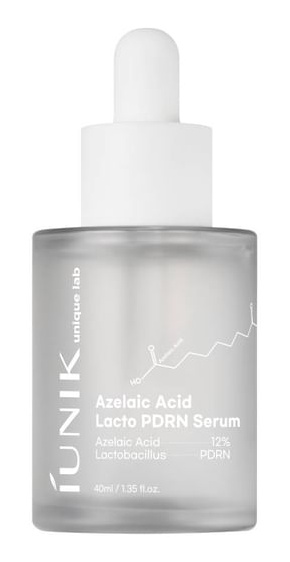
Azelaic Acid Lacto Pdrn Serum
Ingredients overview
Highlights
Key Ingredients
Skim through
iUnik Azelaic Acid Lacto Pdrn SerumIngredients explained
Good old water, aka H2O. The most common skincare ingredient of all. You can usually find it right in the very first spot of the ingredient list, meaning it’s the biggest thing out of all the stuff that makes up the product.
It’s mainly a solvent for ingredients that do not like to dissolve in oils but rather in water.
Once inside the skin, it hydrates, but not from the outside - putting pure water on the skin (hello long baths!) is drying.
One more thing: the water used in cosmetics is purified and deionized (it means that almost all of the mineral ions inside it is removed). Like this, the products can stay more stable over time.
- Superstar ingredient with antibacterial, skin cell regulating, anti-inflammatory and skin-lightening magic properties
- It is especially useful for acne-prone or rosacea-prone skin types (in concentration 10% and up)
- It is a prescription drug in the US but can be freely purchased in the EU in an up to 10% concentration
- It's a helper ingredient that improves the freeze-thaw stability of products
- It's also a solvent, humectant and to some extent a penetration enhancer
- It has a bad reputation among natural cosmetics advocates but cosmetic scientists and toxicology experts do not agree (read more in the geeky details section)
The unfancy name for it is lye. It’s a solid white stuff that’s very alkaline and used in small amounts to adjust the pH of the product and make it just right.
For example, in case of AHA or BHA exfoliants, the right pH is super-duper important, and pH adjusters like sodium hydroxide are needed.
BTW, lye is not something new. It was already used by ancient Egyptians to help oil and fat magically turn into something else. Can you guess what? Yes, it’s soap. It still often shows up in the ingredient list of soaps and other cleansers.
Sodium hydroxide in itself is a potent skin irritant, but once it's reacted (as it is usually in skin care products, like exfoliants) it is totally harmless.
A nice odorless liquid used mainly as a superior solubilizer and efficacy booster for cosmetic active ingredients such as skincare bigshot vitamin C, self-tanning active DHA or the anti-acne gold standard, benzoyl peroxide.
Other than that it can also be used in hair care products where it gives a longer-lasting and more uniform coloring. According to a manufacturer, it might even prevent the formation of split ends.
A multi-functional, silky feeling helper ingredient that can do quite many things. It's used as an emulsion stabilizer, solvent and a broad spectrum antimicrobial. According to manufacturer info, it's also a moisturizer and helps to make the product feel great on the skin. It works synergistically with preservatives and helps to improve water-resistance of sunscreens.
An easy-to-formulate, commonly used, nice to have ingredient that’s also called pro-vitamin B5. As you might guess from the “pro” part, it’s a precursor to vitamin B5 (whose fancy name is pantothenic acid).
Its main job in skincare products is to moisturise the skin. It’s a humectant meaning that it can help the skin to attract water and then hold onto it. There is also research showing that panthenol can help our skin to produce more lovely lipids that are important for a strong and healthy skin barrier.
Another great thing about panthenol is that it has anti-inflammatory and skin protecting abilities. A study shows that it can reduce the irritation caused by less-nice other ingredients (e.g. fragrance, preservatives or chemical sunscreens) in the product.
Research also shows that it might be useful for wound healing as it promotes fibroblast (nice type of cells in our skin that produce skin-firming collagen) proliferation.
If that wasn’t enough panthenol is also useful in nail and hair care products. A study shows that a nail treatment liquide with 2% panthenol could effectively get into the nail and significantly increase the hydration of it.
As for the hair the hydration effect is also true there. Panthenol might make your hair softer, more elastic and helps to comb your hair more easily.
- A natural moisturizer that’s also in our skin
- A super common, safe, effective and cheap molecule used for more than 50 years
- Not only a simple moisturizer but knows much more: keeps the skin lipids between our skin cells in a healthy (liquid crystal) state, protects against irritation, helps to restore barrier
- Effective from as low as 3% with even more benefits for dry skin at higher concentrations up to 20-40%
- High-glycerin moisturizers are awesome for treating severely dry skin
A nice little helper ingredient that can thicken up cosmetic products and create beautiful gel formulas. It's derived from cellulose, the major component of the cell wall of green plants. It is compatible with most co-ingredients and gives a very good slip to the formulas.
A really multi-functional helper ingredient that can do several things in a skincare product: it can bring a soft and pleasant feel to the formula, it can act as a humectant and emollient, it can be a solvent for some other ingredients (for example it can help to stabilize perfumes in watery products) and it can also help to disperse pigments more evenly in makeup products. And that is still not all: it can also boost the antimicrobial activity of preservatives.
If you have spotted ethylhexylglycerin on the ingredient list, most probably you will see there also the current IT-preservative, phenoxyethanol. They are good friends because ethylhexylglycerin can boost the effectiveness of phenoxyethanol (and other preservatives) and as an added bonus it feels nice on the skin too.
Also, it's an effective deodorant and a medium spreading emollient.
Super common soothing ingredient. It can be found naturally in the roots & leaves of the comfrey plant, but more often than not what's in the cosmetic products is produced synthetically.
It's not only soothing but it' also skin-softening and protecting and can promote wound healing.
Biosaccharide Gum-1 is a pretty interesting kind of sugar ingredient that is created from sorbitol via bacterial fermentation.
According to the manufacturer it’s a “S.M.A.R.T.” sugar: it has Soothing, Moisturizing, Anti-aging, Restructuring and Touch properties. Let’s look at them quickly one by one.
Soothing: the manufacturer tested out the soothing effect in vivo (meaning on humans that is always a good thing!) by measuring how 3% Biosaccharide Gum-1 decreased the tingling sensation caused by 10% lactic acid. The result was good: the tingling was decreased by 47%.
Moisturizing: Compared to famous hyaluronic acid, it turns out that the two are great together. HA has a quicker effect and provides more instant hydration (much more hydration was measured after 1h of application), while our nice sugar has a somewhat delayed effect demonstrating stronger hydration after 3h of application. After 8 hours both had similar moisturizing effect.
Anti-aging: According to ex-vivo tests (meaning not on humans, so do not trust it too much) Biosaccharide Gum-1 can stimulate a protein in our skin called sirtuin-1. This is supposed to help our skin cells to live longer, and function better.
Resurfacing: The sirtuin-1 stimulation also results in quicker cell renewal - something that happens anyway but slows down as we age. And the quicker cell renewal is good because it helps the regeneration of the barrier function. That is especially nice for fragile, sensitive skin.
Touch: our fermented sugar is not only good to the skin, but it also feels great on the skin. It gives a nice “soft touch” feeling and makes the products pleasant to use.
The bottom line is that the above info is from the manufacturer (and we could not find any relevant independent research) so obviously take it with a grain of salt. But Biosaccharide Gum-1 does look as an interesting and promising ingredient that’s why it earned our goodie rating.
Butylene glycol, or let’s just call it BG, is a multi-tasking colorless, syrupy liquid. It’s a great pick for creating a nice feeling product.
BG’s main job is usually to be a solvent for the other ingredients. Other tasks include helping the product to absorb faster and deeper into the skin (penetration enhancer), making the product spread nicely over the skin (slip agent), and attracting water (humectant) into the skin.
It’s an ingredient whose safety hasn’t been questioned so far by anyone (at least not that we know about). BG is approved by Ecocert and is also used enthusiastically in natural products. BTW, it’s also a food additive.
Beta-Glucan is a nice big molecule composed of many smaller sugar molecules (called polysaccharide). It’s in the cell walls of yeast, some mushrooms, seaweeds, and cereals.
It’s a real goodie no matter if you eat it or put it on your face. Eating it is anti-diabetic, anti-cancer, and even lowers blood cholesterol.
Putting it on your face also does a bunch of good things: it‘s shown to have intensive skin repairing & wound healing properties, it’s a mild antioxidant, a great skin soother, and moisturizer, and it even shows promising anti-aging benefits.
The manufacturer of the ingredient did a published study with 27 people and examined the effect of 0.1% beta-glucan. They found that despite the large molecular size the smaller factions of beta-glucan penetrate into the skin, even into the dermis (the middle layer of the skin where wrinkles form). After 8 weeks there was a significant reduction of wrinkle depth and height and skin roughness has also improved greatly.
Bottom line: Beta-glucan is a great ingredient, especially for sensitive or damaged skin. It soothes, moisturizes, and has some anti-aging magic properties.
 We don't have description for this ingredient yet.
- Primary fat-soluble antioxidant in our skin
- Significant photoprotection against UVB rays
- Vit C + Vit E work in synergy and provide great photoprotection
- Has emollient properties
- Easy to formulate, stable and relatively inexpensive
A semi-essential (infants cannot synthesize it, but adults can) amino acid that is one of the primary building blocks of hair keratin and skin collagen. It's a natural moisturizing factor, a skin hydrator and might also help to speed up wound healing.
Arginine usually has a positive charge (cationic) that makes it substantive to skin and hair (those are more negatively charged surfaces) and an excellent film former. Thanks to the positive charge, it also creates a complex with AHAs (AHAs like to lose a hydrogen ion and be negatively charged, so the positive and the negative ions attract each other) that causes a "time-release AHA effect" and reduces the irritation associated with AHAs.
A sugar beet-derived amino acid derivative with nice skin protection and moisturization properties. Betaine's special thing is being an osmolyte, a molecule that helps to control cell-water balance. It is also a natural osmoprotectant, meaning that it attracts water away from the protein surface and thus protects them from denaturation and increases their thermodynamic stability.
It also gives sensorial benefits to the formula and when used in cleansers, it helps to make them milder and gentler.
We don't have description for this ingredient yet.
If you have oily, acne-prone skin, Zinc PCA is one of the actives to put on your "TO TRY" list.
It's a synergistic association of two great things: Zinc and L-PCA. The Zinc part is there to help normalize sebum production and limit the proliferation of evil acne-causing bacteria. L-PCA stands for pyrrolidone carboxylic acid and it's a key molecule in the skin that helps with processes of hydration and energy (it's actually an NMF, a natural moisturizing factor).
L-PCA is not only there to hydrate the skin, but it also helps to increase the efficacy and bioavailability of zinc. An in-vivo (done on real people) test done by the manufacturer shows that Zinc PCA reduces sebum production statistically significantly after 28 days of application (1% was used in the test), and in-vitro (made in the lab) measurements show that Zinc PCA has strong anti-microbial activity against P. acnes (between 0.1-0.25%) and other bacterial strains.
If that would not be enough there is also a 2011 research paper saying that based on in-vitro (made in the lab, not on real people) findings Zinc PCA might be a promising anti-aging active that helps with the production of type I collagen (and we all know more collagen = firmer skin).
All in all, definitely a goodie for oily, acne-prone skin.
We don't have description for this ingredient yet.
A super common emollient that makes your skin feel nice and smooth. It comes from coconut oil and glycerin, it’s light-textured, clear, odorless and non-greasy. It’s a nice ingredient that just feels good on the skin, is super well tolerated by every skin type and easy to formulate with. No wonder it’s popular.
One of the many types of ceramides that can be found naturally in the upper layer of the skin. Ceramides make up about 50% of the goopy stuff that's between our skin cells and play a super important role in having a healthy skin barrier and keeping the skin hydrated. It works even better when combined with its pal, Ceramide 1.
We wrote way more about ceramides at ceramide 1, so click here to know more.
A non-essential amino acid (the building blocks of skin proteins, like collagen or elastin), that the body can produce itself, but its production decreases with age. When you put it all over your face, it works as a moisturizer and maybe more.
According to great skincare blog Futurederm, glycine might help with wound healing and tissue repair and when used together with other amino acids, leucine and proline it might improve wrinkles.
BTW, it's also a building block of a bunch of important and famous peptides, including copper-tripeptide-1, palmitoyl tripeptide-1 or palmitoyl hexapeptide-12.
Glutamic acid is a little molecule and non-essential (our body can synthesize it) amino acid with the important job of being a neurotransmitter in the human body meaning that it helps your nervous system work correctly.
As for what it's doing in cosmetics, Glutamic acids' main thing (similar to other amino acids) is being a humectant moisturizer and skin-conditioning agent (sidenote: if you attach lots of glutamic acid molecules, you get polyglutamic acid that is claimed to be a better than hyaluronic acid humectant). It also seems to affect skin barrier repair, however, it is not clear-cut in which direction.
The complication is that glutamic acid has two distinct forms, L-glutamic acid and D-glutamic acid, that are the mirror images of each other (think of it like your left and right hand). Studies show that a topical application of L-glutamic acid on damaged skin delayed skin repair, while D-glutamic acid application sped up skin repair. As both forms are used by the industry, it is a bit uncertain what you are getting with just glutamic acid on the ingredient list (but if it is a Shiseido group product, it is probably the goodie D-form :)).
Other than that, Glutamic acid can also be used as a pH adjuster and can be processed via biological pathways into pyrrolidone carboxylic acid, the sodium salt of which is a goodie and one of your skin’s natural moisturizing factors.
Serine is an amino acid that most often comes to the formula as part of a moisturizing complex. It's a non-essential amino acid (meaning that our body can synthesize it) and serves as a water-binding ingredient.
In general, amino acids are great skincare ingredients that play an important role in proper skin hydration but there is not much info out there about what specifically serine can do for the skin.
A non-essential amino acid (a building block of skin proteins like collagen or elastin) that hydrates the skin.
We don't have description for this ingredient yet.
A non-essential amino acid (meaning that our body can produce it) that's also one of the major building blocks of collagen. According to the Futurederm blog, it might be able to improve wrinkles when combined with other amino acids, glycine and leucine
An essential amino acid that's also a key building block of collagen and elastin. When taken orally, it helps the digestive and intestinal tracts function more smoothly and also helps the absorption of nutrients. As for skincare, it is not clear what it does other than being a skin hydrator.
You may also want to take a look at...
| what‑it‑does | solvent |
| what‑it‑does | anti-acne | soothing | buffering |
| what‑it‑does | moisturizer/humectant | solvent |
| irritancy, com. | 0, 0 |
| what‑it‑does | buffering |
| what‑it‑does | solvent | moisturizer/humectant | perfuming |
| irritancy, com. | 0, 0 |
| what‑it‑does | solvent | moisturizer/humectant |
| what‑it‑does | soothing | moisturizer/humectant |
| irritancy, com. | 0, 0 |
| what‑it‑does | skin-identical ingredient | moisturizer/humectant |
| irritancy, com. | 0, 0 |
| what‑it‑does | viscosity controlling |
| what‑it‑does | solvent |
| what‑it‑does | preservative |
| what‑it‑does | soothing |
| irritancy, com. | 0, 0 |
| what‑it‑does | soothing | moisturizer/humectant |
| what‑it‑does | moisturizer/humectant | solvent |
| irritancy, com. | 0, 1 |
| what‑it‑does | soothing | moisturizer/humectant |
| what‑it‑does | antioxidant |
| irritancy, com. | 0-3, 0-3 |
| what‑it‑does | skin-identical ingredient |
| what‑it‑does | moisturizer/humectant |
| what‑it‑does | moisturizer/humectant |
| what‑it‑does | anti-acne | moisturizer/humectant |
| what‑it‑does | emollient |
| what‑it‑does | emulsifying |
| what‑it‑does | skin-identical ingredient |
| what‑it‑does | skin-identical ingredient |
| what‑it‑does | moisturizer/humectant |
| what‑it‑does | skin-identical ingredient |
| what‑it‑does | skin-identical ingredient |
| what‑it‑does | skin-identical ingredient |
| what‑it‑does | skin-identical ingredient |