




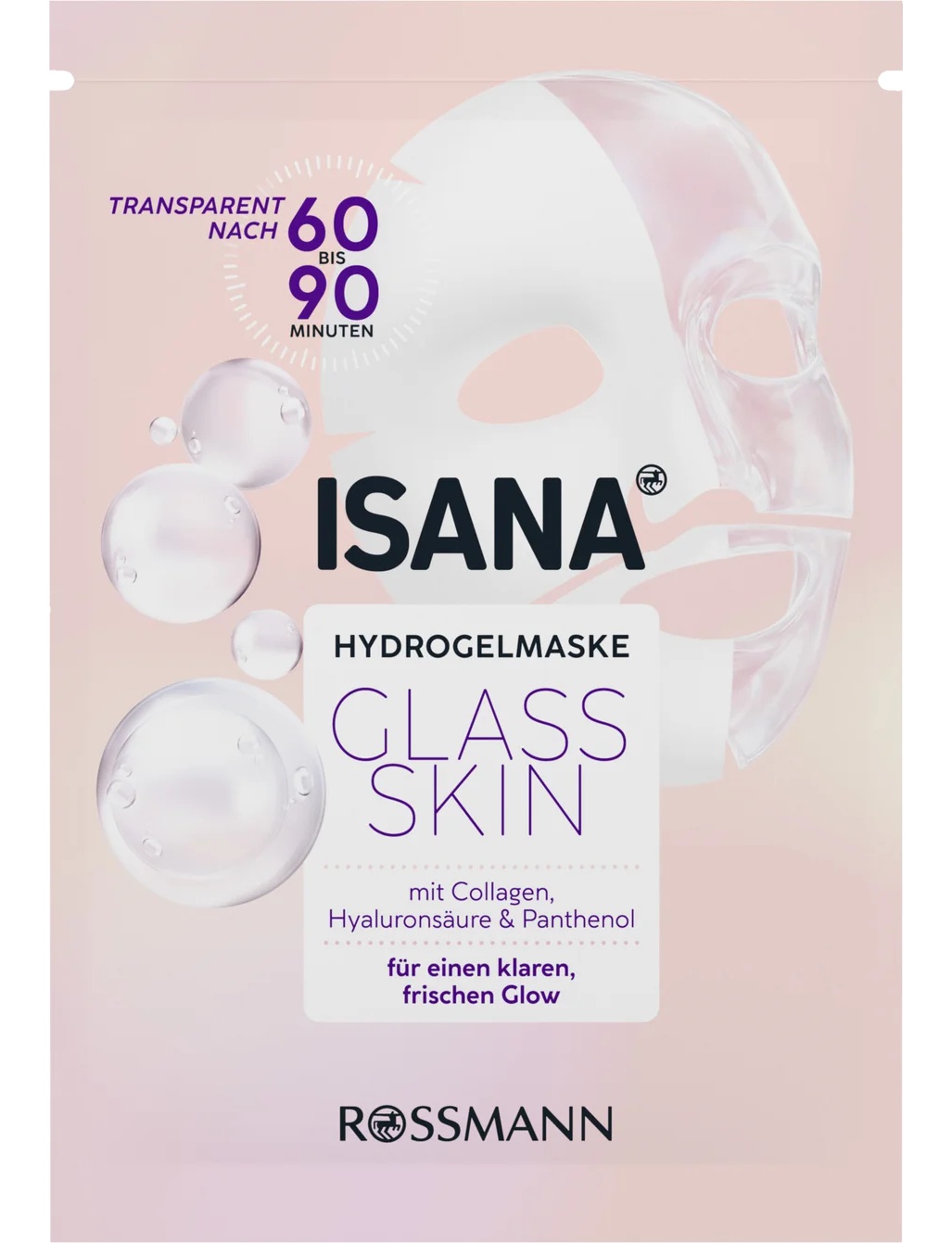
Glass Skin Hydrogelmaske
Ingredients overview
Highlights
Key Ingredients
Skim through
Isana Glass Skin HydrogelmaskeIngredients explained
Good old water, aka H2O. The most common skincare ingredient of all. You can usually find it right in the very first spot of the ingredient list, meaning it’s the biggest thing out of all the stuff that makes up the product.
It’s mainly a solvent for ingredients that do not like to dissolve in oils but rather in water.
Once inside the skin, it hydrates, but not from the outside - putting pure water on the skin (hello long baths!) is drying.
One more thing: the water used in cosmetics is purified and deionized (it means that almost all of the mineral ions inside it is removed). Like this, the products can stay more stable over time.
Butylene glycol, or let’s just call it BG, is a multi-tasking colorless, syrupy liquid. It’s a great pick for creating a nice feeling product.
BG’s main job is usually to be a solvent for the other ingredients. Other tasks include helping the product to absorb faster and deeper into the skin (penetration enhancer), making the product spread nicely over the skin (slip agent), and attracting water (humectant) into the skin.
It’s an ingredient whose safety hasn’t been questioned so far by anyone (at least not that we know about). BG is approved by Ecocert and is also used enthusiastically in natural products. BTW, it’s also a food additive.
- A natural moisturizer that’s also in our skin
- A super common, safe, effective and cheap molecule used for more than 50 years
- Not only a simple moisturizer but knows much more: keeps the skin lipids between our skin cells in a healthy (liquid crystal) state, protects against irritation, helps to restore barrier
- Effective from as low as 3% with even more benefits for dry skin at higher concentrations up to 20-40%
- High-glycerin moisturizers are awesome for treating severely dry skin
- It's a helper ingredient that improves the freeze-thaw stability of products
- It's also a solvent, humectant and to some extent a penetration enhancer
- It has a bad reputation among natural cosmetics advocates but cosmetic scientists and toxicology experts do not agree (read more in the geeky details section)
A super common, medium-spreading emollient ester that gives richness to the formula and a mild feel during rubout. It can be a replacement for mineral oil and is often combined with other emollients to achieve different sensorial properties.
A super common emollient that makes your skin feel nice and smooth. It comes from coconut oil and glycerin, it’s light-textured, clear, odorless and non-greasy. It’s a nice ingredient that just feels good on the skin, is super well tolerated by every skin type and easy to formulate with. No wonder it’s popular.
A really multi-functional helper ingredient that can do several things in a skincare product: it can bring a soft and pleasant feel to the formula, it can act as a humectant and emollient, it can be a solvent for some other ingredients (for example it can help to stabilize perfumes in watery products) and it can also help to disperse pigments more evenly in makeup products. And that is still not all: it can also boost the antimicrobial activity of preservatives.
It is a type of algae extract coming from the algae commonly called Irish moss or red seaweed. It is rich in carrageenan, a natural polymer (big molecules from repeated subunits) that acts as a gelling, thickening and stabilizing agent.
Glucomannan is a polysaccharide (a big sugar molecule) coming from the Konjac plant. It has great water-absorbing capacity and is one of the key ingredients in the plumping and smoothing active called Ultra Filling Spheres by BASF.
The magic filling spheres have two active parts: a kind of LMW hyaluronic acid (<40 kDa) and the konjac root powder or glucomannan. The latter one is a big molecule (> 200 kDa) that has outstanding water-absorbing capacities. These two combined form small spheres which after drying, are transformed into the active spheres.
Thanks to their high hygroscopic properties, the spheres can expand rapidly in the presence of the skin’s water reserve and they can plump up the skin and reduce the appearance of fine lines and wrinkles.
A handy multifunctional ingredient that works as a preservative booster, as well as an antioxidant and soothing agent.
It's one of the most commonly used thickeners and emulsion stabilizers. If the product is too runny, a little xanthan gum will make it more gel-like. Used alone, it can make the formula sticky and it is a good team player so it is usually combined with other thickeners and so-called rheology modifiers (helper ingredients that adjust the flow and thus the feel of the formula). The typical use level of Xantha Gum is below 1%, it is usually in the 0.1-0.5% range.
Btw, Xanthan gum is all natural, a chain of sugar molecules (polysaccharide) produced from individual sugar molecules (glucose and sucrose) via fermentation. It’s approved by Ecocert and also used in the food industry (E415).
Glyceryl stearate citrate is similar to the super common skincare ingredient glyceryl stearate, and is similarly used to help combine waters and oils (emulsifier) and to make your skin feel nice and soft (emollient).
The main difference between glyceryl stearate citrate and its cousin glyceryl stearate is that this one has a citric acid molecule also attached to its glycerin. This makes it what chemists call a diacylglycerol, which is a fancy word for two acids (in this case, citric acid and stearic acid) attached together with a glycerin bridge. But when it comes to cosmetics, all you need to know is that both glyceryl stearate citrate and glyceryl stearate are safe, tried and true emulsifiers. Expect to see them in formulas with both water-based and oil-based ingredients (think moisturizers and lotions).
It's a common little helper ingredient that helps water and oil to mix together. Also, it can help to increase the solubility of some other ingredients in the formula.
 We don't have description for this ingredient yet.
A nice little helper ingredient that can thicken up cosmetic products and create beautiful gel formulas. It's derived from cellulose, the major component of the cell wall of green plants. It is compatible with most co-ingredients and gives a very good slip to the formulas.
An easy-to-formulate, commonly used, nice to have ingredient that’s also called pro-vitamin B5. As you might guess from the “pro” part, it’s a precursor to vitamin B5 (whose fancy name is pantothenic acid).
Its main job in skincare products is to moisturise the skin. It’s a humectant meaning that it can help the skin to attract water and then hold onto it. There is also research showing that panthenol can help our skin to produce more lovely lipids that are important for a strong and healthy skin barrier.
Another great thing about panthenol is that it has anti-inflammatory and skin protecting abilities. A study shows that it can reduce the irritation caused by less-nice other ingredients (e.g. fragrance, preservatives or chemical sunscreens) in the product.
Research also shows that it might be useful for wound healing as it promotes fibroblast (nice type of cells in our skin that produce skin-firming collagen) proliferation.
If that wasn’t enough panthenol is also useful in nail and hair care products. A study shows that a nail treatment liquide with 2% panthenol could effectively get into the nail and significantly increase the hydration of it.
As for the hair the hydration effect is also true there. Panthenol might make your hair softer, more elastic and helps to comb your hair more easily.
Super common soothing ingredient. It can be found naturally in the roots & leaves of the comfrey plant, but more often than not what's in the cosmetic products is produced synthetically.
It's not only soothing but it' also skin-softening and protecting and can promote wound healing.
The chemically chopped up version of the big protein molecule, collagen. It is often derived from fish or bovine sources and works as a nice moisturizer and humectant that helps the skin to hold onto water.
To understand a bit more what Hydrolyzed Collagen is, you have to know that proteins are large chains of amino acids connected with so-called peptide bonds. These bonds can be broken up when a water molecule is added and the resulting thing is a mix of shorter length amino acids, also called peptides. So Hydrolyzed Collagen is not really collagen, it is rather an undefined and varying mix of largish peptides. Based on a manufacturer's data, the whole, soluble collagen has an average molecular weight of 300 000 Da, while this chopped up mixture has an average MW of 12 000 Da (still pretty big).
The main thing of these largish peptides is to act as water-binding agents, and to make the skin nice and smooth (aka emollient). Hydrolyzed Collagen is also often used in cleansers as it can make harsh surfactants milder and in hair conditioners as it improves the flexibility and manageability of hair.
If you wanna know more about collagen in cosmetics, we have a shiny explanation about soluble collagen here >>
It’s the - sodium form - cousin of the famous NMF, hyaluronic acid (HA). If HA does not tell you anything we have a super detailed, geeky explanation about it here. The TL; DR version of HA is that it's a huge polymer (big molecule from repeated subunits) found in the skin that acts as a sponge helping the skin to hold onto water, being plump and elastic. HA is famous for its crazy water holding capacity as it can bind up to 1000 times its own weight in water.
As far as skincare goes, sodium hyaluronate and hyaluronic acid are pretty much the same and the two names are used interchangeably. As cosmetic chemist kindofstephen writes on reddit "sodium hyaluronate disassociates into hyaluronic acid molecule and a sodium atom in solution".
In spite of this, if you search for "hyaluronic acid vs sodium hyaluronate" you will find on multiple places that sodium hyaluronate is smaller and can penetrate the skin better. Chemically, this is definitely not true, as the two forms are almost the same, both are polymers and the subunits can be repeated in both forms as much as you like. (We also checked Prospector for sodium hyaluronate versions actually used in cosmetic products and found that the most common molecular weight was 1.5-1.8 million Da that absolutely counts as high molecular weight).
What seems to be a true difference, though, is that the salt form is more stable, easier to formulate and cheaper so it pops up more often on the ingredient lists.
If you wanna become a real HA-and-the-skin expert you can read way more about the topic at hyaluronic acid (including penetration-questions, differences between high and low molecular weight versions and a bunch of references to scientific literature).
We don't have description for this ingredient yet.
A common little helper ingredient that helps water and oil to mix together, aka emulsifier.
You may also want to take a look at...
| what‑it‑does | solvent |
| what‑it‑does | moisturizer/humectant | solvent |
| irritancy, com. | 0, 1 |
| what‑it‑does | skin-identical ingredient | moisturizer/humectant |
| irritancy, com. | 0, 0 |
| what‑it‑does | moisturizer/humectant | solvent |
| irritancy, com. | 0, 0 |
| what‑it‑does | emollient |
| irritancy, com. | 0, 2-4 |
| what‑it‑does | emollient |
| what‑it‑does | solvent |
| what‑it‑does | viscosity controlling |
| what‑it‑does | moisturizer/humectant |
| what‑it‑does | antioxidant | preservative |
| what‑it‑does | viscosity controlling |
| what‑it‑does | emollient | emulsifying |
| what‑it‑does | emulsifying | surfactant/cleansing |
| irritancy, com. | 0, 0 |
| what‑it‑does | viscosity controlling |
| what‑it‑does | viscosity controlling |
| what‑it‑does | soothing | moisturizer/humectant |
| irritancy, com. | 0, 0 |
| what‑it‑does | soothing |
| irritancy, com. | 0, 0 |
| what‑it‑does | emollient | moisturizer/humectant |
| what‑it‑does | skin-identical ingredient | moisturizer/humectant |
| irritancy, com. | 0, 0 |
| what‑it‑does | moisturizer/humectant |
| what‑it‑does | buffering |
| what‑it‑does | emulsifying | surfactant/cleansing |
| what‑it‑does | buffering |