




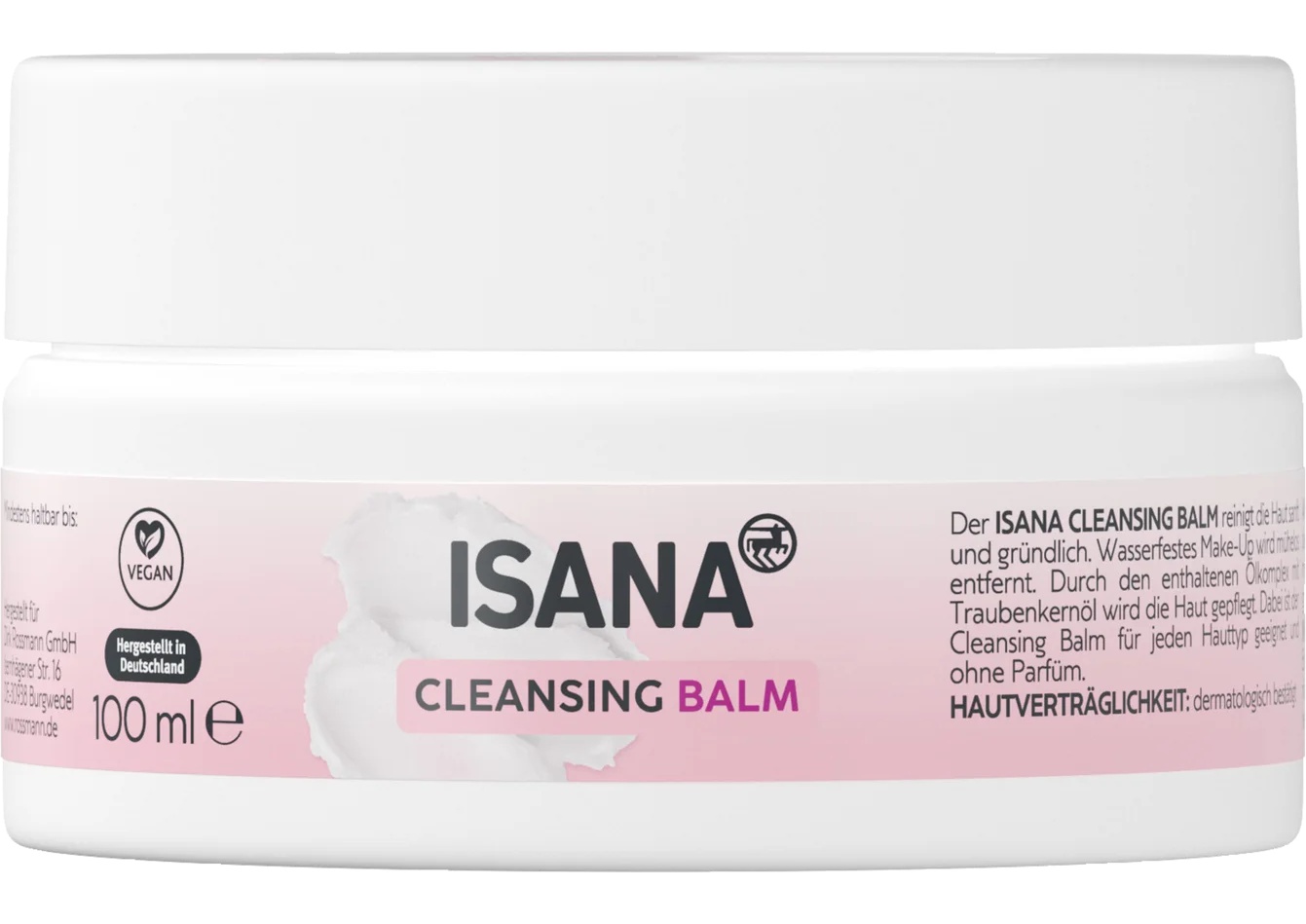
Highlights
Key Ingredients
Skim through
| Ingredient name | what-it-does | irr., com. | ID-Rating |
|---|---|---|---|
| Ethylhexyl Palmitate | emollient | 0, 2-4 | |
| Olive Oil PEG-7 Esters | emollient, emulsifying | ||
| Oleyl Erucate | emollient | ||
| PEG-20 | moisturizer/humectant, solvent | ||
| Synthetic Wax | emollient, viscosity controlling | ||
| Vitis Vinifera Seed Oil | antioxidant, emollient | goodie | |
| Tocopherol | antioxidant | 0-3, 0-3 | goodie |
| Phenoxyethanol | preservative | ||
| Ethylhexylglycerin | preservative | ||
| Hydrogenated Palm Glycerides Citrate | emollient |
Isana Cleansing BalmIngredients explained
A super common, medium-spreading emollient ester that gives richness to the formula and a mild feel during rubout. It can be a replacement for mineral oil and is often combined with other emollients to achieve different sensorial properties.
An olive oil-derived, water-soluble, but "oily" liquid that works both as an emollient (makes skin nice and smooth) and as a co-emulsifier.
It's claimed to offer a distinctive skin smoothness and long-term moisturizing effects while also being great at solubilizing fragrances into water-based products or being a co-emulsifier in oil-in-water emulsions.
A vegetable-based emollient ester (oleyl alcohol + erucic acid) that makes your skin feel nice and smooth. It has a rich and caring skin feel, very similar to jojoba oil.
 We don't have description for this ingredient yet.
A goodie plant oil coming from the polyphenol-rich seeds of the grape. It's a light emollient oil that makes your skin feel smooth and nice and also contains a bunch of good-for-the-skin stuff. It's a great source of antioxidant polyphenols, barrier repair fatty acid linoleic acid (about 55-77%, while oleic acid is about 12-27%) and antioxidant, skin-protectant vitamin E.
- Primary fat-soluble antioxidant in our skin
- Significant photoprotection against UVB rays
- Vit C + Vit E work in synergy and provide great photoprotection
- Has emollient properties
- Easy to formulate, stable and relatively inexpensive
It’s pretty much the current IT-preservative. It’s safe and gentle, but even more importantly, it’s not a feared-by-everyone-mostly-without-scientific-reason paraben.
It’s not something new: it was introduced around 1950 and today it can be used up to 1% worldwide. It can be found in nature - in green tea - but the version used in cosmetics is synthetic.
Other than having a good safety profile and being quite gentle to the skin it has some other advantages too. It can be used in many types of formulations as it has great thermal stability (can be heated up to 85°C) and works on a wide range of pH levels (ph 3-10).
It’s often used together with ethylhexylglycerin as it nicely improves the preservative activity of phenoxyethanol.
If you have spotted ethylhexylglycerin on the ingredient list, most probably you will see there also the current IT-preservative, phenoxyethanol. They are good friends because ethylhexylglycerin can boost the effectiveness of phenoxyethanol (and other preservatives) and as an added bonus it feels nice on the skin too.
Also, it's an effective deodorant and a medium spreading emollient.
We don't have description for this ingredient yet.
You may also want to take a look at...
| what‑it‑does | emollient |
| irritancy, com. | 0, 2-4 |
| what‑it‑does | emollient | emulsifying |
| what‑it‑does | emollient |
| what‑it‑does | moisturizer/humectant | solvent |
| what‑it‑does | emollient | viscosity controlling |
| what‑it‑does | antioxidant | emollient |
| what‑it‑does | antioxidant |
| irritancy, com. | 0-3, 0-3 |
| what‑it‑does | preservative |
| what‑it‑does | preservative |
| what‑it‑does | emollient |