




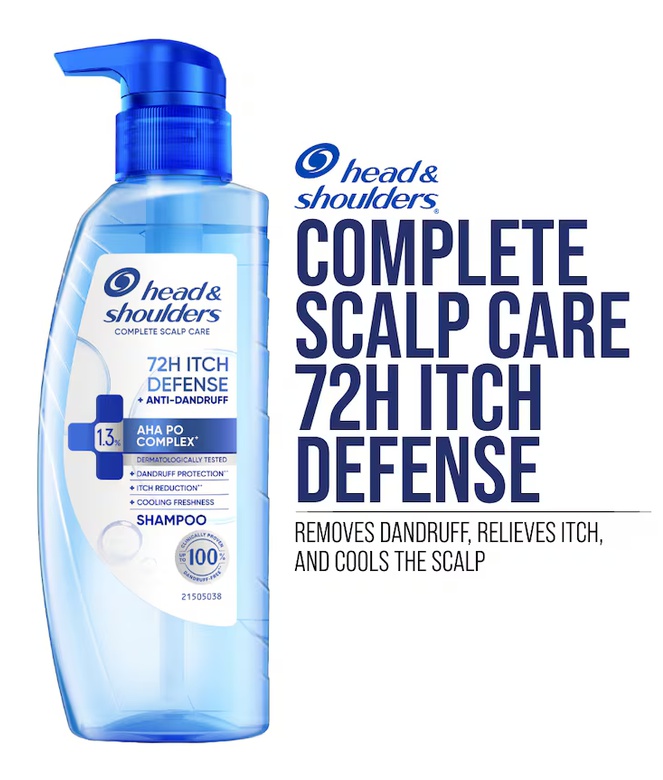
Complete Scalp Care 72h Itch Defense Shampoo
Ingredients overview
Highlights
Key Ingredients
Other Ingredients
Skim through
Head & Shoulders Complete Scalp Care 72h Itch Defense ShampooIngredients explained
Good old water, aka H2O. The most common skincare ingredient of all. You can usually find it right in the very first spot of the ingredient list, meaning it’s the biggest thing out of all the stuff that makes up the product.
It’s mainly a solvent for ingredients that do not like to dissolve in oils but rather in water.
Once inside the skin, it hydrates, but not from the outside - putting pure water on the skin (hello long baths!) is drying.
One more thing: the water used in cosmetics is purified and deionized (it means that almost all of the mineral ions inside it is removed). Like this, the products can stay more stable over time.
It’s probably the most common cleansing ingredient of all. It’s usually the Chief Bubble Officer responsible for big bubbles in cleansing products through the foam it creates is a bit airy and loose and not as dense and luxurious as the foam created by infamous SLS.
As for mildness, it goes somewhere in the middle. It’s often confused with sodium lauryl sulfate (SLS), but they are absolutely not the same. The SLES molecule has a bigger water-soluble head part that makes it milder and much less irritating. It is considered absolutely ok in the amount used in cosmetic products, though if you are looking for a mild facial cleanser, you have better chances with a formula without SLES. For an average shower gel? SLES works just fine.
 We don't have description for this ingredient yet.
Exactly what it sounds: nice smelling stuff put into cosmetic products so that the end product also smells nice. Fragrance in the US and parfum in the EU is a generic term on the ingredient list that is made up of 30 to 50 chemicals on average (but it can have as much as 200 components!).
If you are someone who likes to know what you put on your face then fragrance is not your best friend - there's no way to know what’s really in it.
Also, if your skin is sensitive, fragrance is again not your best friend. It’s the number one cause of contact allergy to cosmetics. It’s definitely a smart thing to avoid with sensitive skin (and fragrance of any type - natural is just as allergic as synthetic, if not worse!).
Sodium chloride is the fancy name of salt. Normal, everyday table salt.
If (similar to us) you are in the weird habit of reading the label on your shower gel while taking a shower, you might have noticed that sodium chloride is almost always on the ingredient list. The reason for this is that salt acts as a fantastic thickener in cleansing formulas created with ionic cleansing agents (aka surfactants) such as Sodium Laureth Sulfate. A couple of percents (typically 1-3%) turns a runny surfactant solution into a nice gel texture.
If you are into chemistry (if not, we understand, just skip this paragraph), the reason is that electrolytes (you know, the Na+ and Cl- ions) screen the electrostatic repulsion between the head groups of ionic surfactants and thus support the formation of long shaped micelles (instead of spherical ones) that entangle like spaghetti, and viola, a gel is formed. However, too much of it causes the phenomenon called "salting out", and the surfactant solution goes runny again.
Other than that, salt also works as an emulsion stabilizer in water-in-oil emulsions, that is when water droplets are dispersed in the outer oil (or silicone) phase. And last but not least, when salt is right at the first spot of the ingredient list (and is not dissolved), the product is usually a body scrub where salt is the physical exfoliating agent.
We don't have description for this ingredient yet.
A little helper ingredient that is used to adjust the pH of the product. It also helps to keep products stay nice longer by neutralizing the metal ions in the formula (they usually come from water).
A big polymer molecule that has a bunch of different versions and thus different uses. It can act as a film former, as a thickening agent, or it can increase the water-resistance in sunscreens. It is also used to entrap pigments/inorganic sunscreens within a micron size matrix for even coverage and easy application.
Menthol needs no introduction: it's the thing that causes the cooling sensation so well-known both from cosmetic products as well as a bunch of other things like chocolate, chewing gum, toothpaste or cigarette. It's a natural compound that comes from the essential oil of Mentha species (peppermint oil contains 40-50% menthol) and it gives them their typical minty smell and flavor.
As for skincare, menthol seems to be a mixed bag. Apart from the cool cooling sensation (that might last up to 70 mins!), it also has painkilling, itch reducing, antibacterial, antifungal and even penetration enhancing properties. On the other hand, it also seems to act as a skin irritant that increases trans-epidermal water loss (the water that evaporates from the outer layer of the skin) and thus contributes to drying out the skin.
We don't have description for this ingredient yet.
Citric acid comes from citrus fruits and is an AHA. If these magic three letters don’t tell you anything, click here and read our detailed description on glycolic acid, the most famous AHA.
So citric acid is an exfoliant, that can - just like other AHAs - gently lift off the dead skin cells of your skin and make it more smooth and fresh.
There is also some research showing that citric acid with regular use (think three months and 20% concentration) can help sun-damaged skin, increase skin thickness and some nice hydrating things called glycosaminoglycans in the skin.
But according to a comparative study done in 1995, citric acid has less skin improving magic properties than glycolic or lactic acid. Probably that’s why citric acid is usually not used as an exfoliant but more as a helper ingredient in small amounts to adjust the pH of a formulation.
A cleansing agent whose main thing is adding viscosity and foam to cleansing formulas.
Chemically speaking, it is the little sister of Cocamide DEA and has similar properties to that guy. However, being a monoethanolamine instead of diethanolamine has the advantage that the nitrosamine-concern does not apply for Cocamide MEA.
A helper ingredient that helps to make the products stay nice longer, aka preservative. It works mainly against fungi.
It’s pH dependent and works best at acidic pH levels (3-5). It’s not strong enough to be used in itself so it’s always combined with something else, often with potassium sorbate.
The sodium salt of salicylic acid. CosIng (the official EU cosmetic ingredient database) says that it's a preservative and helps to make the product taste bad (called denaturant), while some manufacturer claims that it has exfoliating properties and is antimicrobial. It's good to know, that the salt of an exfoliant is a neutralized form, so if you want to go for exfoliation stick to the pure acid.
A handy helper ingredient that helps products to remain nice and stable for a longer time. It does so by neutralizing the metal ions in the formula (that usually get into there from water) that would otherwise cause some not so nice changes.
- It's one of the gold standard ingredients for treating problem skin
- It can exfoliate skin both on the surface and in the pores
- It's a potent anti-inflammatory agent
- It's more effective for treating blackheads than acne
- For acne combine it with antibacterial agents like benzoyl peroxide or azelaic acid
You may also want to take a look at...
| what‑it‑does | solvent |
| what‑it‑does | surfactant/cleansing | emulsifying |
| what‑it‑does | perfuming |
| what‑it‑does | viscosity controlling |
| what‑it‑does | chelating | buffering |
| what‑it‑does | viscosity controlling |
| what‑it‑does | soothing |
| what‑it‑does | preservative |
| what‑it‑does | viscosity controlling |
| what‑it‑does | buffering |
| what‑it‑does | surfactant/cleansing | viscosity controlling | emulsifying |
| what‑it‑does | preservative |
| what‑it‑does | preservative |
| what‑it‑does | chelating |
| what‑it‑does | exfoliant | anti-acne | soothing | preservative |