




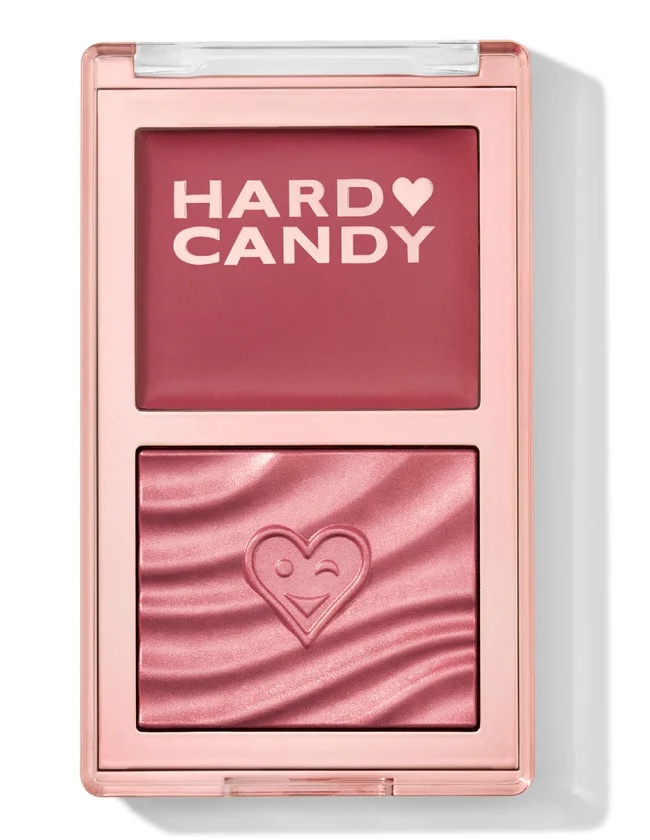
Blush On Lock
Ingredients overview
Highlights
Key Ingredients
Other Ingredients
Skim through
Hard Candy Blush On LockIngredients explained
An emollient ester with a rich and creamy but non-greasy skin feel. It makes skin supple and protects dry skin.
 We don't have description for this ingredient yet.
We don't have description for this ingredient yet.
We don't have description for this ingredient yet.
A super common, medium-spreading emollient ester that gives richness to the formula and a mild feel during rubout. It can be a replacement for mineral oil and is often combined with other emollients to achieve different sensorial properties.
Synthetic Fluorphlogopite is the synthetic version of the super commonly used mineral, Mica. The advantage of being synthetic is that it has a more consistent quality, fewer impurities and an even lower heavy metal content than Mica (not that Mica's heavy metal content is high). It is also more transparent and has improved light reflection.
The two main use cases for Synthetic Fluorphlogopite is being used neat as a superior "filler" or skin tone enhancer or it can also serve as a base for multi-layered, composite pigments such as pearl effect pigments where it is coated with one or more layers of metal oxide, most commonly titanium dioxide.
A silicone fluid that gives a nonoily, easy to spread emolliency to the formulas. It is also used as a water repellent additive and to reduce the tackiness and stickiness of other ingredients. It also imparts gloss, softness and better manageability to hair.
We don't have description for this ingredient yet.
Probably the most common silicone of all. It is a polymer (created from repeating subunits) molecule and has different molecular weight and thus different viscosity versions from water-light to thick liquid.
As for skincare, it makes the skin silky smooth, creates a subtle gloss and forms a protective barrier (aka occlusive). Also, works well to fill in fine lines and wrinkles and give skin a plump look (of course that is only temporary, but still, it's nice). There are also scar treatment gels out there using dimethicone as their base ingredient. It helps to soften scars and increase their elasticity.
As for hair care, it is a non-volatile silicone meaning that it stays on the hair rather than evaporates from it and smoothes the hair like no other thing. Depending on your hair type, it can be a bit difficult to wash out and might cause some build-up (btw, this is not true to all silicones, only the non-volatile types).
An odorless and colorless emollient ester (cetyl alcohol + ethylhexanoic acid) that gives a velvety and silky feel to the skin. It has great spreadability and a non-oily feel. It's a popular ingredient in makeup removers.
We don't have description for this ingredient yet.
A thick, paste-like emollient ester that is touted as a vegetable-derived lanolin alternative. It has a smooth spreadability and touch, and it gives a substantive film to protect and moisturize the skin.
A spherical texturizing powder that's used as a texture enhancer and soft focus agent. It's claimed to give silicone type softness to the formula and also works as a (temporary) wrinkle filler.
A white powdery thing that's the major component of glass and sand. In cosmetics, it’s often in products that are supposed to keep your skin matte as it has great oil-absorbing abilities. It’s also used as a helper ingredient to thicken up products or suspend insoluble particles.
A high-molecular-weight silicone elastomer (rubber-like elastic material) that is usually blended with a base silicone fluid (such as dimethicone or cyclopentasiloxane) to give the formula a silky smooth feel and to act as a thickening agent.
This bamboozling INCI name is given to a spherical silicone powder that has an elastic silicone rubber inner part and a harder silicone resin outer part.
It gives formulas a uniquely soft, silky feeling, and has a mattifying and soft focus effect. It is available in different particle sizes and the larger the particle the more line/pore filling effect the powder has.
It seems to us that squalane is in fashion and there is a reason for it. Chemically speaking, it is a saturated (no double bonds) hydrocarbon (a molecule consisting only of carbon and hydrogen), meaning that it's a nice and stable oily liquid with a long shelf life.
It occurs naturally in certain fish and plant oils (e.g. olive), and in the sebum (the oily stuff our skin produces) of the human skin. As f.c. puts it in his awesome blog post, squalane's main things are "emolliency, surface occlusion, and TEWL prevention all with extreme cosmetic elegance". In other words, it's a superb moisturizer that makes your skin nice and smooth, without being heavy or greasy.
Another advantage of squalane is that it is pretty much compatible with all skin types and skin conditions. It is excellent for acne-prone skin and safe to use even if you have fungi-related skin issues, like seborrhea or fungal acne.
The unsaturated (with double bonds) and hence less stable version of Squalane is Squalene, you can read about it here >>
A super versatile and common mineral powder that comes in different particle sizes. It is a multi-tasker used to improve skin feel, increase product slip, give the product light-reflecting properties, enhance skin adhesion or serve as an anti-caking agent.
It is also the most commonly used "base" material for layered composite pigments such as pearl-effect pigments. In this case, mica is coated with one or more metal oxides (most commonly titanium dioxide) to achieve pearl effect via the physical phenomenon known as interference.
It’s the most commonly used version of pure vitamin E in cosmetics. You can read all about the pure form here. This one is the so-called esterified version.
According to famous dermatologist, Leslie Baumann while tocopheryl acetate is more stable and has a longer shelf life, it’s also more poorly absorbed by the skin and may not have the same awesome photoprotective effects as pure Vit E.
We don't have description for this ingredient yet.
It’s pretty much the current IT-preservative. It’s safe and gentle, but even more importantly, it’s not a feared-by-everyone-mostly-without-scientific-reason paraben.
It’s not something new: it was introduced around 1950 and today it can be used up to 1% worldwide. It can be found in nature - in green tea - but the version used in cosmetics is synthetic.
Other than having a good safety profile and being quite gentle to the skin it has some other advantages too. It can be used in many types of formulations as it has great thermal stability (can be heated up to 85°C) and works on a wide range of pH levels (ph 3-10).
It’s often used together with ethylhexylglycerin as it nicely improves the preservative activity of phenoxyethanol.
- A natural moisturizer that’s also in our skin
- A super common, safe, effective and cheap molecule used for more than 50 years
- Not only a simple moisturizer but knows much more: keeps the skin lipids between our skin cells in a healthy (liquid crystal) state, protects against irritation, helps to restore barrier
- Effective from as low as 3% with even more benefits for dry skin at higher concentrations up to 20-40%
- High-glycerin moisturizers are awesome for treating severely dry skin
The emollient plant oil coming from the seeds of the white flowering plant called meadowfoam. Meadowfoam Oil has a unique fatty acid composition with 95% of it being long chain fatty acids (eicosenoic acid C20:1 - 61%, docosenoic acid C22:1 - 16% and docosadienoic acid C22:2 - 18%) that make the oil extraordinarily stable. It also contains antioxidant components such as vitamin E as well as phytosterols.
Apart from Meadowfoam Oil's crazy stability, the oil is described as non-greasy, rapidly absorbed and having a similar skin feel to more often used jojoba oil. The oil is ideal for products where a soft, smooth, silky feel is required whether it be on skin or hair.
It’s a handy multi-tasking ingredient that gives the skin a nice, soft feel. At the same time, it also boosts the effectiveness of other preservatives, such as the nowadays super commonly used phenoxyethanol.
The blend of these two (caprylyl glycol + phenoxyethanol) is called Optiphen, which not only helps to keep your cosmetics free from nasty things for a long time but also gives a good feel to the finished product. It's a popular duo.
We don't have description for this ingredient yet.
A very common ingredient that can be found in all cell membranes. In cosmetics it's quite the multi-tasker: it's an emollient and water-binding ingredient but it's also an emulsifier and can be used for stabilization purposes. It's also often used to create liposomes.
A so-called dispersant or dispersing agent that's used in inorganic (titanium dioxide/zinc oxide based) sunscreens or in make-up products to help to distribute the pigments nicely and evenly on the skin. It's also claimed to increase the UV absorption of the sunscreen formula as well as to reduce the annoying white cast left behind by inorganic sunscreens.
Bearing a close relationship to the famous Dimethicone, Methicone is the slightly trimmed down version missing the methyl (-CH3) groups on one side of the silicone chain. Like most silicones, it has nice emollient properties and improves the spreadability of products.
But Methicone's main thing in practice is not being an emollient but a silicone fluid for hydrophobization treatment of powders, i.e. making solid powders (mineral filters & color pigments) very water resistant and easily spreadable. Methicone does this by absorbing traces of water from the surface of pigments that is very useful for mineral sunscreens and makeup products.
Good old water, aka H2O. The most common skincare ingredient of all. You can usually find it right in the very first spot of the ingredient list, meaning it’s the biggest thing out of all the stuff that makes up the product.
It’s mainly a solvent for ingredients that do not like to dissolve in oils but rather in water.
Once inside the skin, it hydrates, but not from the outside - putting pure water on the skin (hello long baths!) is drying.
One more thing: the water used in cosmetics is purified and deionized (it means that almost all of the mineral ions inside it is removed). Like this, the products can stay more stable over time.
It’s the - sodium form - cousin of the famous NMF, hyaluronic acid (HA). If HA does not tell you anything we have a super detailed, geeky explanation about it here. The TL; DR version of HA is that it's a huge polymer (big molecule from repeated subunits) found in the skin that acts as a sponge helping the skin to hold onto water, being plump and elastic. HA is famous for its crazy water holding capacity as it can bind up to 1000 times its own weight in water.
As far as skincare goes, sodium hyaluronate and hyaluronic acid are pretty much the same and the two names are used interchangeably. As cosmetic chemist kindofstephen writes on reddit "sodium hyaluronate disassociates into hyaluronic acid molecule and a sodium atom in solution".
In spite of this, if you search for "hyaluronic acid vs sodium hyaluronate" you will find on multiple places that sodium hyaluronate is smaller and can penetrate the skin better. Chemically, this is definitely not true, as the two forms are almost the same, both are polymers and the subunits can be repeated in both forms as much as you like. (We also checked Prospector for sodium hyaluronate versions actually used in cosmetic products and found that the most common molecular weight was 1.5-1.8 million Da that absolutely counts as high molecular weight).
What seems to be a true difference, though, is that the salt form is more stable, easier to formulate and cheaper so it pops up more often on the ingredient lists.
If you wanna become a real HA-and-the-skin expert you can read way more about the topic at hyaluronic acid (including penetration-questions, differences between high and low molecular weight versions and a bunch of references to scientific literature).
The combination of glycerin + behenic acid that comes either in a fine powder or waxy solid form. Together with the di- and triglyceride of behenic acid, the trio has remarkable gelling properties helping cosmetic chemists to create ultra-soft and non-tacky waterfree gels. They also have great emulsion stabilizing properties, and work as high-performance compacting agents for makeup products that come in the form of pressed powders.
It's also vegetable origin, and Ecocert certified.
A clear, colorless oil-like liquid that makes the skin feel smooth and nice (aka emollient) and it does so without it being greasy.
What's more, it can even reduce the heavy, greasy feel in products with high oil content. It's also fast-spreading meaning that it gives the formula a good, nice slip. It absorbs quickly into the skin and helps other ingredients to penetrate quicker and deeper.
Thanks to all this, it's one of the most commonly used emollients out there. There is just one little drawback: it has a high comedogenic index (5 out of 5...), so it might clog pores if you're prone to it.
A liquid fatty acid created from oleic acid. It's claimed to have great odour, thermal and oxidation stability and is great for the stabilization of pigments and mineral particles in oils and solvents. It's quite popular in foundations.
A plant based ingredient that helps water to mix with oil (aka W/O emulsifier). It's especially good for soft to low-viscosity water-in-oil emulsions with non-greasy, pleasant skin feel like lip balms or thick body butters.
It's the triglyceride of behenic acid that works as a thickening or gelling agent, as a compacting agent for pressed powders, and improves heat stability of emulsions.
A super common emollient that makes your skin feel nice and smooth. It comes from coconut oil and glycerin, it’s light-textured, clear, odorless and non-greasy. It’s a nice ingredient that just feels good on the skin, is super well tolerated by every skin type and easy to formulate with. No wonder it’s popular.
It's the chemically chopped up version of normal lecithin. Most often it's used to create liposomes and to coat and stabilize other ingredients.
A handy helper ingredient that helps water and oil to mix nicely together, aka emulsifier. It is especially recommended for protective, baby care and general purpose emollient creams.
It also helps to disperse insoluble particles (think color pigments or zinc/titanium dioxide sunscreen) nice and even in cosmetic formulas.
One of the many types of ceramides that can be found naturally in the upper layer of the skin. Ceramides make up about 50% of the goopy stuff that's between our skin cells and play a super important role in having a healthy skin barrier and keeping the skin hydrated. It works even better when combined with its pal, Ceramide 1.
We wrote way more about ceramides at ceramide 1, so click here to know more.
A clear, slightly yellow, odorless oil that's a very common, medium-spreading emollient. It makes the skin feel nice and smooth and works in a wide range of formulas.
A fatty alcohol (the non-drying type with a long oil loving chain of 22 carbon atoms) that is used to increase the viscosity of the formula and it also helps the oily and the watery parts to stay nicely mixed together (called emulsion stabilizing).
We don't have description for this ingredient yet.
One of the 9 types of ceramides that can be found naturally in the upper layer of the skin. Ceramides make up a big part (about 50%) of the goopy stuff that's between our skin cells (called extracellular matrix) and play a super important role in having a healthy skin barrier and keeping the skin hydrated.
We wrote way more about ceramides at ceramide 1, so click here to know more.
A type of ceramide that can be found naturally in the upper layer of the skin. Ceramides make up 50% of the goopy stuff that's between our skin cells and play a super important role in having a healthy skin barrier and keeping the skin hydrated.
We have written way more about ceramides at ceramide 1, so click here to know more.
A really famous peptide that is part of Matrixyl 3000, the most sold peptide complex in the word. Before we go and find out what the big deal with Matrixyl 3000 is, let's just focus on Palmitoyl Tripeptide-1 itself for a bit.
It's a small three amino acid (they are the building blocks of all proteins) peptide with the amino sequence of glycine-histidine-lysine, or GHK. GHK is attached to palmitic acid (a fatty acid) to increase oil solubility and skin penetration.
The GHK part is the important one as it's a type I collagen fragment. When collagen naturally breaks down in the skin, the resulting peptide fragments signal to the skin that it should get to work and create some nice, new collagen. Adding in collagen fragment peptides, like GHK, might trick the skin into thinking that collagen has broken down and it's time to create some more.
Therefore, Palmitoyl Tripeptide-1 is believed to be able to stimulate collagen production in the skin, and more collagen means fewer wrinkles and younger looking skin.
In Matrixyl 3000, Palmitoyl Tripeptide-1 is coupled with Palmitoyl Tetrapeptide-7 and the duo works in synergy to reduce wrinkles and give younger looking skin. According to the manufacturer's in-vivo (made on real people) test, applying 3% Matrixyl 3000 twice a day for 2 months resulted in all of the following things:
- 39.4% reduction in surface occupied by deep wrinkles
- 32.9% reduction in main wrinkle density
- 19.9% reduction in main wrinkle average depth
- 16% improvement in roughness
- 16.2% in lifting effect
- 5.5% improvement in elasticity
- 15.5% improvement in skin tone
Manufacturer results, of course, always have to be taken with a pinch of salt, but if you like peptides, the Matryxil 3000 duo is one of the best-proven and most well-known ones and it's something that is worth trying.
Ci 77891 is the color code of titanium dioxide. It's a white pigment with great color consistency and dispersibility.
A bit of a sloppy ingredient name as it covers not one but three pigments: red, yellow and black iron oxide.
The trio is invaluable for "skin-colored" makeup products (think your foundation and pressed powder) as blending these three shades carefully can produce almost any shade of natural-looking flesh tones.
A bit of a sloppy ingredient name as it covers not one but three pigments: red, yellow and black iron oxide.
The trio is invaluable for "skin-colored" makeup products (think your foundation and pressed powder) as blending these three shades carefully can produce almost any shade of natural-looking flesh tones.
A bit of a sloppy ingredient name as it covers not one but three pigments: red, yellow and black iron oxide.
The trio is invaluable for "skin-colored" makeup products (think your foundation and pressed powder) as blending these three shades carefully can produce almost any shade of natural-looking flesh tones.
We don't have description for this ingredient yet.
We don't have description for this ingredient yet.
Ci 19140 or Tartrazine is a super common colorant in skincare, makeup, medicine & food. It’s a synthetic lemon yellow that's used alone or mixed with other colors for special shades.
FDA says it's possible, but rare, to have an allergic-type reaction to a color additive. As an example, it mentions that Ci 19140 may cause itching and hives in some people but the colorant is always labeled so that you can avoid it if you are sensitive.
CI 42090 or Blue 1 is a super common synthetic colorant in beauty & food. Used alone, it adds a brilliant smurf-like blue color, combined with Tartrazine, it gives the fifty shades of green.
A cosmetic colorant used as a reddish pigment.
Some version of it is a pH-sensitive dye that enables a colorless lip balm to turn red/pink upon application.
We don't have description for this ingredient yet.
We don't have description for this ingredient yet.
We don't have description for this ingredient yet.
You may also want to take a look at...
| what‑it‑does | emollient |
| what‑it‑does | emollient |
| what‑it‑does | emollient | surfactant/cleansing |
| what‑it‑does | emollient | viscosity controlling |
| irritancy, com. | 0, 0 |
| what‑it‑does | emollient | viscosity controlling |
| what‑it‑does | emollient |
| irritancy, com. | 0, 2-4 |
| what‑it‑does | viscosity controlling |
| what‑it‑does | emollient |
| what‑it‑does | emulsifying |
| what‑it‑does | emollient |
| irritancy, com. | 0, 1 |
| what‑it‑does | emollient |
| what‑it‑does | viscosity controlling |
| what‑it‑does | emollient |
| what‑it‑does | viscosity controlling |
| what‑it‑does | viscosity controlling |
| what‑it‑does | viscosity controlling |
| what‑it‑does | skin-identical ingredient | emollient |
| irritancy, com. | 0, 1 |
| what‑it‑does | colorant |
| what‑it‑does | antioxidant |
| irritancy, com. | 0, 0 |
| what‑it‑does | viscosity controlling |
| what‑it‑does | preservative |
| what‑it‑does | skin-identical ingredient | moisturizer/humectant |
| irritancy, com. | 0, 0 |
| what‑it‑does | emollient |
| what‑it‑does | moisturizer/humectant | emollient |
| what‑it‑does | solvent | viscosity controlling |
| what‑it‑does | emollient | emulsifying |
| what‑it‑does | emulsifying |
| what‑it‑does | emollient |
| what‑it‑does | solvent |
| what‑it‑does | skin-identical ingredient | moisturizer/humectant |
| irritancy, com. | 0, 0 |
| what‑it‑does | emollient | emulsifying |
| what‑it‑does | emollient | perfuming |
| irritancy, com. | 3, 3-5 |
| what‑it‑does | surfactant/cleansing | emulsifying |
| what‑it‑does | emulsifying | viscosity controlling |
| what‑it‑does | emollient |
| what‑it‑does | emollient |
| what‑it‑does | emollient | emulsifying |
| what‑it‑does | emulsifying |
| irritancy, com. | 0, 1-2 |
| what‑it‑does | skin-identical ingredient |
| what‑it‑does | emollient | perfuming |
| what‑it‑does | emollient | viscosity controlling |
| what‑it‑does | skin-identical ingredient |
| what‑it‑does | skin-identical ingredient |
| what‑it‑does | skin-identical ingredient |
| what‑it‑does | cell-communicating ingredient |
| what‑it‑does | colorant |
| irritancy, com. | 0, 0 |
| what‑it‑does | colorant |
| irritancy, com. | 0, 0 |
| what‑it‑does | colorant |
| irritancy, com. | 0, 0 |
| what‑it‑does | colorant |
| irritancy, com. | 0, 0 |
| what‑it‑does | colorant |
| irritancy, com. | 2, 2 |
| what‑it‑does | colorant |
| what‑it‑does | colorant |
| what‑it‑does | colorant |
| what‑it‑does | colorant |
| irritancy, com. | 0, 2 |
| what‑it‑does | colorant |
| irritancy, com. | 0, 1 |
| what‑it‑does | colorant |
| irritancy, com. | 0, 1 |
| what‑it‑does | colorant |
| irritancy, com. | 0, 1 |