




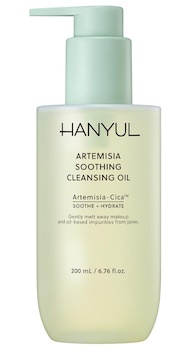
Artemisia Soothing Cleansing Oil
Ingredients overview
Highlights
Key Ingredients
Skim through
Hanyul Artemisia Soothing Cleansing OilIngredients explained
A super common emollient that makes your skin feel nice and smooth. It comes from coconut oil and glycerin, it’s light-textured, clear, odorless and non-greasy. It’s a nice ingredient that just feels good on the skin, is super well tolerated by every skin type and easy to formulate with. No wonder it’s popular.
A clear, colorless emollient ester (oily liquid from isopropyl alcohol + palmitic acid) that makes the skin nice and smooth. It has very good spreading properties and gives a silky touch to the products.
A super common, medium-spreading emollient ester that gives richness to the formula and a mild feel during rubout. It can be a replacement for mineral oil and is often combined with other emollients to achieve different sensorial properties.
 We don't have description for this ingredient yet.
We don't have description for this ingredient yet.
Good old water, aka H2O. The most common skincare ingredient of all. You can usually find it right in the very first spot of the ingredient list, meaning it’s the biggest thing out of all the stuff that makes up the product.
It’s mainly a solvent for ingredients that do not like to dissolve in oils but rather in water.
Once inside the skin, it hydrates, but not from the outside - putting pure water on the skin (hello long baths!) is drying.
One more thing: the water used in cosmetics is purified and deionized (it means that almost all of the mineral ions inside it is removed). Like this, the products can stay more stable over time.
Exactly what it sounds: nice smelling stuff put into cosmetic products so that the end product also smells nice. Fragrance in the US and parfum in the EU is a generic term on the ingredient list that is made up of 30 to 50 chemicals on average (but it can have as much as 200 components!).
If you are someone who likes to know what you put on your face then fragrance is not your best friend - there's no way to know what’s really in it.
Also, if your skin is sensitive, fragrance is again not your best friend. It’s the number one cause of contact allergy to cosmetics. It’s definitely a smart thing to avoid with sensitive skin (and fragrance of any type - natural is just as allergic as synthetic, if not worse!).
We don't have description for this ingredient yet.
Sunflower does not need a big intro as you probably use it in the kitchen as cooking oil, or you munch on the seeds as a healthy snack or you adore its big, beautiful yellow flower during the summer - or you do all of these and probably even more. And by even more we mean putting it all over your face as sunflower oil is one of the most commonly used plant oils in skincare.
It’s a real oldie: expressed directly from the seeds, the oil is used not for hundreds but thousands of years. According to The National Sunflower Association, there is evidence that both the plant and its oil were used by American Indians in the area of Arizona and New Mexico about 3000 BC. Do the math: it's more than 5000 years – definitely an oldie.
Our intro did get pretty big after all (sorry for that), so let's get to the point finally: sunflower oil - similar to other plant oils - is a great emollient that makes the skin smooth and nice and helps to keep it hydrated. It also protects the surface of the skin and enhances the damaged or irritated skin barrier. Leslie Bauman notes in Cosmetic Dermatology that one application of sunflower oil significantly speeds up the recovery of the skin barrier within an hour and sustains the results 5 hours after using it.
It's also loaded with fatty acids (mostly linoleic (50-74%) and oleic (14-35%)). The unrefined version (be sure to use that on your skin!) is especially high in linoleic acid that is great even for acne-prone skin. Its comedogen index is 0, meaning that it's pretty much an all skin-type oil.
Truth be told, there are many great plant oils and sunflower oil is definitely one of them.
Propanediol is a natural alternative for the often used and often bad-mouthed propylene glycol. It's produced sustainably from corn sugar and it's Ecocert approved.
It's quite a multi-tasker: can be used to improve skin moisturization, as a solvent, to boost preservative efficacy or to influence the sensory properties of the end formula.
A very common ingredient that can be found in all cell membranes. In cosmetics it's quite the multi-tasker: it's an emollient and water-binding ingredient but it's also an emulsifier and can be used for stabilization purposes. It's also often used to create liposomes.
The oil-soluble extract coming from the edible, orange part of the carrot. It is created by macerating the carrot root in a carrier oil such as sunflower or olive oil, and the resulting thing (base oil + carrot root extract) is often called carrot oil or carrot root oil. (Not to be confused with carrot seed oil, that can be fixed or essential and comes from the seeds.)
The root extract is known for containing the orange pigment beta-carotene, aka provitamin A. It is a famous molecule for being a potent antioxidant, suntan accelerator and having skin-regenerative abilities. Carrot oil also contains vitamin E and some fatty acids that give the oil further antioxidant and barrier repairing properties.
Lactobacillus ferment is an interesting probiotic ingredient with some promising properties.
First, according to a 2009 Estee Lauder patent, it’s a DNA repair enzyme and it can help to protect the skin against environmental aggressors.
Second, still according to Estee Lauder research but now from 2012 the ingredient has anti-microbial and anti-inflammatory properties and holds promise in the treatment of acne and rosacea. For the former one 5% was needed to show effectiveness, but for reducing skin sensitivity already 1% showed results.
The anti-acne effect is confirmed also by US manufacturer, Barnet, that says that Lactobacillus ferment is helpful in killing harmful bacteria and creating a healthy balanced microflora. Compared to well-known anti-acne and anti-inflammatory salicylic acid the probiotic worked faster at reducing the size and redness of acne lesions.
It also goes by the trade name Leucidal Liquid SF and can serve in the formula as a natural preservative.
Bottom line: It’s not the most proven ingredient (yet) but definitely a very promising one especially if you have sensitive skin, acne or rosacea.
A really multi-functional helper ingredient that can do several things in a skincare product: it can bring a soft and pleasant feel to the formula, it can act as a humectant and emollient, it can be a solvent for some other ingredients (for example it can help to stabilize perfumes in watery products) and it can also help to disperse pigments more evenly in makeup products. And that is still not all: it can also boost the antimicrobial activity of preservatives.
A semi-essential (infants cannot synthesize it, but adults can) amino acid that is one of the primary building blocks of hair keratin and skin collagen. It's a natural moisturizing factor, a skin hydrator and might also help to speed up wound healing.
Arginine usually has a positive charge (cationic) that makes it substantive to skin and hair (those are more negatively charged surfaces) and an excellent film former. Thanks to the positive charge, it also creates a complex with AHAs (AHAs like to lose a hydrogen ion and be negatively charged, so the positive and the negative ions attract each other) that causes a "time-release AHA effect" and reduces the irritation associated with AHAs.
We don't have description for this ingredient yet.
Butylene glycol, or let’s just call it BG, is a multi-tasking colorless, syrupy liquid. It’s a great pick for creating a nice feeling product.
BG’s main job is usually to be a solvent for the other ingredients. Other tasks include helping the product to absorb faster and deeper into the skin (penetration enhancer), making the product spread nicely over the skin (slip agent), and attracting water (humectant) into the skin.
It’s an ingredient whose safety hasn’t been questioned so far by anyone (at least not that we know about). BG is approved by Ecocert and is also used enthusiastically in natural products. BTW, it’s also a food additive.
- A natural moisturizer that’s also in our skin
- A super common, safe, effective and cheap molecule used for more than 50 years
- Not only a simple moisturizer but knows much more: keeps the skin lipids between our skin cells in a healthy (liquid crystal) state, protects against irritation, helps to restore barrier
- Effective from as low as 3% with even more benefits for dry skin at higher concentrations up to 20-40%
- High-glycerin moisturizers are awesome for treating severely dry skin
A polymeric (big molecule from repeated subunits) emulsifier that comes from Inulin, a naturally occurring polysaccharide found in the roots and rhizomes of several plants. The emulsifier is obtained by adding oil-loving chains onto inulin. The resulting copolymer can emulsify high amounts of oil and can stabilize oil droplets or non-water soluble particles so that they do not clump together in the formula.
Citric acid comes from citrus fruits and is an AHA. If these magic three letters don’t tell you anything, click here and read our detailed description on glycolic acid, the most famous AHA.
So citric acid is an exfoliant, that can - just like other AHAs - gently lift off the dead skin cells of your skin and make it more smooth and fresh.
There is also some research showing that citric acid with regular use (think three months and 20% concentration) can help sun-damaged skin, increase skin thickness and some nice hydrating things called glycosaminoglycans in the skin.
But according to a comparative study done in 1995, citric acid has less skin improving magic properties than glycolic or lactic acid. Probably that’s why citric acid is usually not used as an exfoliant but more as a helper ingredient in small amounts to adjust the pH of a formulation.
- It's one of the gold standard ingredients for treating problem skin
- It can exfoliate skin both on the surface and in the pores
- It's a potent anti-inflammatory agent
- It's more effective for treating blackheads than acne
- For acne combine it with antibacterial agents like benzoyl peroxide or azelaic acid
- It’s a polyhydroxy acid (PHA), that is often referred to as next generation AHA
- It gently lifts off dead skin cells form the skin surface making skin smooth and even
- In the long term it provides anti-aging benefits, like increased skin thickness and decreased wrinkles (though a tad less than even more proven superstar AHAs)
- It’s a great moisturizer and even helps to repair impaired skin barrier
- It’s antioxidant, and does not make your skin more sensitive to the sun
- It can be used even if your skin is very sensitive, rosacea prone or if you are post cosmetic procedure
We don't have description for this ingredient yet.
We don't have description for this ingredient yet.
We don't have description for this ingredient yet.
- Primary fat-soluble antioxidant in our skin
- Significant photoprotection against UVB rays
- Vit C + Vit E work in synergy and provide great photoprotection
- Has emollient properties
- Easy to formulate, stable and relatively inexpensive
If you have spotted ethylhexylglycerin on the ingredient list, most probably you will see there also the current IT-preservative, phenoxyethanol. They are good friends because ethylhexylglycerin can boost the effectiveness of phenoxyethanol (and other preservatives) and as an added bonus it feels nice on the skin too.
Also, it's an effective deodorant and a medium spreading emollient.
We don't have description for this ingredient yet.
You may also want to take a look at...
| what‑it‑does | emollient |
| what‑it‑does | emollient |
| irritancy, com. | 1, 3-4 |
| what‑it‑does | emollient |
| irritancy, com. | 0, 2-4 |
| what‑it‑does | emulsifying |
| what‑it‑does | emulsifying |
| what‑it‑does | solvent |
| what‑it‑does | perfuming |
| what‑it‑does | moisturizer/humectant | solvent |
| what‑it‑does | emollient |
| irritancy, com. | 0, 0 |
| what‑it‑does | solvent | moisturizer/humectant |
| what‑it‑does | emollient | emulsifying |
| what‑it‑does | antioxidant | emollient |
| what‑it‑does | soothing | preservative |
| what‑it‑does | solvent |
| what‑it‑does | skin-identical ingredient |
| what‑it‑does | moisturizer/humectant | solvent |
| irritancy, com. | 0, 1 |
| what‑it‑does | skin-identical ingredient | moisturizer/humectant |
| irritancy, com. | 0, 0 |
| what‑it‑does | surfactant/cleansing | emulsifying |
| what‑it‑does | buffering |
| what‑it‑does | exfoliant | anti-acne | soothing | preservative |
| what‑it‑does | exfoliant | chelating |
| what‑it‑does | antioxidant |
| irritancy, com. | 0-3, 0-3 |
| what‑it‑does | preservative |