




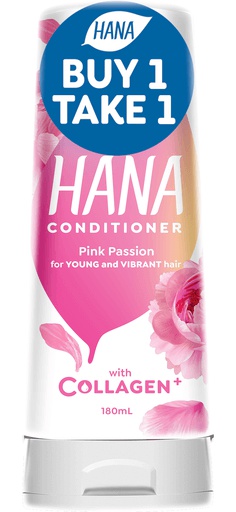
Conditioner Pink Passion
Ingredients overview
Highlights
Key Ingredients
Skim through
HANA Conditioner Pink PassionIngredients explained
Good old water, aka H2O. The most common skincare ingredient of all. You can usually find it right in the very first spot of the ingredient list, meaning it’s the biggest thing out of all the stuff that makes up the product.
It’s mainly a solvent for ingredients that do not like to dissolve in oils but rather in water.
Once inside the skin, it hydrates, but not from the outside - putting pure water on the skin (hello long baths!) is drying.
One more thing: the water used in cosmetics is purified and deionized (it means that almost all of the mineral ions inside it is removed). Like this, the products can stay more stable over time.
It's a sweet tasting sugar substitute that helps your skin to hold onto water when used in cosmetic products. It also helps to thicken up products and give them a bit more slip.
An extremely common multitasker ingredient that gives your skin a nice soft feel (emollient) and gives body to creams and lotions. It also helps to stabilize oil-water mixes (emulsions), though it does not function as an emulsifier in itself. Its typical use level in most cream type formulas is 2-3%.
It’s a so-called fatty alcohol, a mix of cetyl and stearyl alcohol, other two emollient fatty alcohols. Though chemically speaking, it is alcohol (as in, it has an -OH group in its molecule), its properties are totally different from the properties of low molecular weight or drying alcohols such as denat. alcohol. Fatty alcohols have a long oil-soluble (and thus emollient) tail part that makes them absolutely non-drying and non-irritating and are totally ok for the skin.
Probably the most common silicone of all. It is a polymer (created from repeating subunits) molecule and has different molecular weight and thus different viscosity versions from water-light to thick liquid.
As for skincare, it makes the skin silky smooth, creates a subtle gloss and forms a protective barrier (aka occlusive). Also, works well to fill in fine lines and wrinkles and give skin a plump look (of course that is only temporary, but still, it's nice). There are also scar treatment gels out there using dimethicone as their base ingredient. It helps to soften scars and increase their elasticity.
As for hair care, it is a non-volatile silicone meaning that it stays on the hair rather than evaporates from it and smoothes the hair like no other thing. Depending on your hair type, it can be a bit difficult to wash out and might cause some build-up (btw, this is not true to all silicones, only the non-volatile types).
 We don't have description for this ingredient yet.
We don't have description for this ingredient yet.
A modified dimethicone-type silicone molecule that also contains amino-groups. Having amino-groups means that Amodimethicone also has Nitrogen in its molecule that likes to have a positive charge. Positively charged (or quaternised) molecules are substantive to skin and hair as those are negatively charged surfaces and are excellent film formers. Amodiemthcone is no exception and it is especially recommended for hair-care products for its long-lasting hair conditioning benefits.
Exactly what it sounds: nice smelling stuff put into cosmetic products so that the end product also smells nice. Fragrance in the US and parfum in the EU is a generic term on the ingredient list that is made up of 30 to 50 chemicals on average (but it can have as much as 200 components!).
If you are someone who likes to know what you put on your face then fragrance is not your best friend - there's no way to know what’s really in it.
Also, if your skin is sensitive, fragrance is again not your best friend. It’s the number one cause of contact allergy to cosmetics. It’s definitely a smart thing to avoid with sensitive skin (and fragrance of any type - natural is just as allergic as synthetic, if not worse!).
We don't have description for this ingredient yet.
Citric acid comes from citrus fruits and is an AHA. If these magic three letters don’t tell you anything, click here and read our detailed description on glycolic acid, the most famous AHA.
So citric acid is an exfoliant, that can - just like other AHAs - gently lift off the dead skin cells of your skin and make it more smooth and fresh.
There is also some research showing that citric acid with regular use (think three months and 20% concentration) can help sun-damaged skin, increase skin thickness and some nice hydrating things called glycosaminoglycans in the skin.
But according to a comparative study done in 1995, citric acid has less skin improving magic properties than glycolic or lactic acid. Probably that’s why citric acid is usually not used as an exfoliant but more as a helper ingredient in small amounts to adjust the pH of a formulation.
We don't have description for this ingredient yet.
We don't have description for this ingredient yet.
We don't have description for this ingredient yet.
A nice little helper ingredient that can thicken up cosmetic products and create beautiful gel formulas. It's derived from cellulose, the major component of the cell wall of green plants. It is compatible with most co-ingredients and gives a very good slip to the formulas.
We don't have description for this ingredient yet.
A fluid silicone that reduces surface tension. It can improve oil (or silicone) in water emulsions with faster absorption, better spreading, and a lighter feel.
The most common type of feared-by-everyone-mostly-without-scientific-reason parabens. It's a cheap, effective and well-tolerated ingredient to make sure the cosmetic formula does not go wrong too soon.
Apart from the general controversy around parabens (we wrote about it more here), there is a 2006 in-vitro (made in the lab not on real people) research about methylparaben (MP) showing that when exposed to sunlight, MP treated skin cells suffered more harm than non-MP treated skin cells. The study was not done with real people on real skin but still - using a good sunscreen next to MP containing products is a good idea. (Well, in fact using a sunscreen is always a good idea. :))
An Ecocert-approved, natural preservative that counts as gentle and non-irritating to the skin. Usually, it comes to the formula as part of a preservative blend as it's not enough on its own.
A super common emollient that makes your skin feel nice and smooth. It comes from coconut oil and glycerin, it’s light-textured, clear, odorless and non-greasy. It’s a nice ingredient that just feels good on the skin, is super well tolerated by every skin type and easy to formulate with. No wonder it’s popular.
We don't have description for this ingredient yet.
Unless you live under a rock you must have heard about shea butter. It's probably the most hyped up natural butter in skincare today. It comes from the seeds of African Shea or Karite Trees and used as a magic moisturizer and emollient.
But it's not only a simple emollient, it regenerates and soothes the skin, protects it from external factors (such as UV rays or wind) and is also rich in antioxidants (among others vitamin A, E, F, quercetin and epigallocatechin gallate). If you are looking for rich emollient benefits + more, shea is hard to beat.
- A natural moisturizer that’s also in our skin
- A super common, safe, effective and cheap molecule used for more than 50 years
- Not only a simple moisturizer but knows much more: keeps the skin lipids between our skin cells in a healthy (liquid crystal) state, protects against irritation, helps to restore barrier
- Effective from as low as 3% with even more benefits for dry skin at higher concentrations up to 20-40%
- High-glycerin moisturizers are awesome for treating severely dry skin
We don't have description for this ingredient yet.
A 100% plant derived, natural (Ecocert approved) multi-functional ingredient that has emollient and moisturizing properties, can work as a co-emulsifier (meaning that next to other emulsifiers it can help water and oil to mix) and even more importantly has a strong antimicrobial activity.
Thanks to this last thing, it allows a lower percentage of traditional preservative or it might even be able to completely replace them.
One of the many types of ceramides that can be found naturally in the upper layer of the skin. Ceramides make up about 50% of the goopy stuff that's between our skin cells and play a super important role in having a healthy skin barrier and keeping the skin hydrated. It works even better when combined with its pal, Ceramide 1.
We wrote way more about ceramides at ceramide 1, so click here to know more.
The chemically chopped up version of the big protein molecule, collagen. It is often derived from fish or bovine sources and works as a nice moisturizer and humectant that helps the skin to hold onto water.
To understand a bit more what Hydrolyzed Collagen is, you have to know that proteins are large chains of amino acids connected with so-called peptide bonds. These bonds can be broken up when a water molecule is added and the resulting thing is a mix of shorter length amino acids, also called peptides. So Hydrolyzed Collagen is not really collagen, it is rather an undefined and varying mix of largish peptides. Based on a manufacturer's data, the whole, soluble collagen has an average molecular weight of 300 000 Da, while this chopped up mixture has an average MW of 12 000 Da (still pretty big).
The main thing of these largish peptides is to act as water-binding agents, and to make the skin nice and smooth (aka emollient). Hydrolyzed Collagen is also often used in cleansers as it can make harsh surfactants milder and in hair conditioners as it improves the flexibility and manageability of hair.
If you wanna know more about collagen in cosmetics, we have a shiny explanation about soluble collagen here >>
You may also want to take a look at...
| what‑it‑does | solvent |
| what‑it‑does | moisturizer/humectant |
| irritancy, com. | 0, 0 |
| what‑it‑does | emollient | viscosity controlling | emulsifying | surfactant/cleansing |
| irritancy, com. | 1, 2 |
| what‑it‑does | emollient |
| irritancy, com. | 0, 1 |
| what‑it‑does | preservative |
| what‑it‑does | emulsifying | surfactant/cleansing |
| what‑it‑does | emollient |
| what‑it‑does | perfuming |
| what‑it‑does | buffering |
| what‑it‑does | surfactant/cleansing |
| what‑it‑does | emulsifying |
| what‑it‑does | viscosity controlling |
| what‑it‑does | preservative |
| irritancy, com. | 0, 0 |
| what‑it‑does | preservative |
| what‑it‑does | emollient |
| what‑it‑does | emulsifying |
| what‑it‑does | emollient |
| what‑it‑does | skin-identical ingredient | moisturizer/humectant |
| irritancy, com. | 0, 0 |
| what‑it‑does | preservative |
| what‑it‑does | skin-identical ingredient |
| what‑it‑does | emollient | moisturizer/humectant |
| what‑it‑does | colorant |