




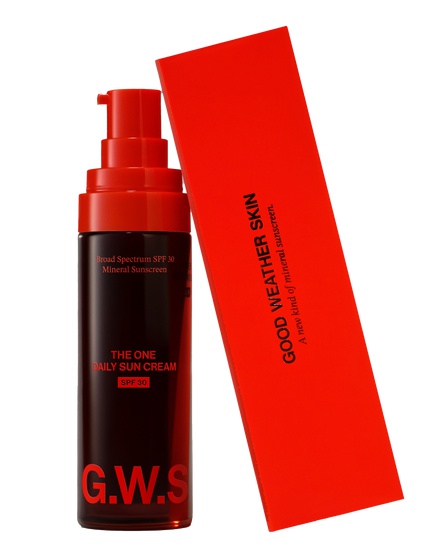
The One Daily Sun Cream (SPF 30)
Ingredients overview
Highlights
Key Ingredients
Other Ingredients
Skim through
Good Weather Skin (G.W.S) The One Daily Sun Cream (SPF 30)Ingredients explained
When it comes to sunscreen agents, Zinc Oxide is pretty much in a league of its own. It's a physical (or inorganic) sunscreen that has a lot in common with fellow inorganic sunscreen Titanium Dioxide (TiO2) but a couple of things make it superior even to TiO2.
If physical sunscreens don't tell you anything, go ahead and read about the basics here. Most of what we wrote about Titanium Dioxide is also true for Zinc Oxide so we will focus here on the differences.
The first main difference is that while TiO2 gives a nice broad spectrum protection, Zinc Oxide has an even nicer and even broader spectrum protection. It protects against UVB, UVA II, and UVA I almost uniformly, and is considered to be the broadest range sunscreen available today.
It's also highly stable and non-irritating. So much so that Zinc Oxide also counts as a skin protectant and anti-irritant. It's also often used to treat skin irritations such as diaper rash.
As for the disadvantages, Zinc Oxide is also not cosmetically elegant. It leaves a disturbing whitish tint on the skin, although, according to a 2000 research paper by Dr. Pinnell, it's slightly less white than TiO2. Still, it's white and disturbing enough to use Zinc Oxide nanoparticles more and more often.
We wrote more about nanoparticles and the concerns around them here, but the gist is that if nanoparticles were absorbed into the skin that would be a reason for legitimate health concerns. But luckily, so far research shows that sunscreen nanoparticles are not absorbed but remain on the surface of the skin or in the uppermost (dead) layer of the skin. This seems to be true even if the skin is damaged, for example, sunburnt.
All in all, if you've found a Zinc Oxide sunscreen that you are happy to use every single day, that's fantastic and we suggest you stick with it. It's definitely one of the best, or probably even the best option out there for sun protection available worldwide.
Good old water, aka H2O. The most common skincare ingredient of all. You can usually find it right in the very first spot of the ingredient list, meaning it’s the biggest thing out of all the stuff that makes up the product.
It’s mainly a solvent for ingredients that do not like to dissolve in oils but rather in water.
Once inside the skin, it hydrates, but not from the outside - putting pure water on the skin (hello long baths!) is drying.
One more thing: the water used in cosmetics is purified and deionized (it means that almost all of the mineral ions inside it is removed). Like this, the products can stay more stable over time.
A super common emollient that makes your skin feel nice and smooth. It comes from coconut oil and glycerin, it’s light-textured, clear, odorless and non-greasy. It’s a nice ingredient that just feels good on the skin, is super well tolerated by every skin type and easy to formulate with. No wonder it’s popular.
- A natural moisturizer that’s also in our skin
- A super common, safe, effective and cheap molecule used for more than 50 years
- Not only a simple moisturizer but knows much more: keeps the skin lipids between our skin cells in a healthy (liquid crystal) state, protects against irritation, helps to restore barrier
- Effective from as low as 3% with even more benefits for dry skin at higher concentrations up to 20-40%
- High-glycerin moisturizers are awesome for treating severely dry skin
It seems to us that squalane is in fashion and there is a reason for it. Chemically speaking, it is a saturated (no double bonds) hydrocarbon (a molecule consisting only of carbon and hydrogen), meaning that it's a nice and stable oily liquid with a long shelf life.
It occurs naturally in certain fish and plant oils (e.g. olive), and in the sebum (the oily stuff our skin produces) of the human skin. As f.c. puts it in his awesome blog post, squalane's main things are "emolliency, surface occlusion, and TEWL prevention all with extreme cosmetic elegance". In other words, it's a superb moisturizer that makes your skin nice and smooth, without being heavy or greasy.
Another advantage of squalane is that it is pretty much compatible with all skin types and skin conditions. It is excellent for acne-prone skin and safe to use even if you have fungi-related skin issues, like seborrhea or fungal acne.
The unsaturated (with double bonds) and hence less stable version of Squalane is Squalene, you can read about it here >>
A nice, multi-functional helper ingredient that's especially useful in sunscreens. It can solubilize some commonly used UV-filters like Oxybenzone or Avobenzone and it can also help to increase the SPF rating of sunscreens. It's also cosmetically elegant, has excellent spreadability and a pleasant, moisturizing skin feel. Oh, and according to Wikipedia, it even helps to stabilize famously unstable UVA-filter, Avobenzone.
A clear, colorless, almost odorless oil that spreads nicely and easily and gives a velvet dry skin feel. It is good friends with sunscreen agents and helps to solubilize them. Also, it makes sunscreens feel lighter and spread easier.
 We don't have description for this ingredient yet.
A multi-functional, silky feeling helper ingredient that can do quite many things. It's used as an emulsion stabilizer, solvent and a broad spectrum antimicrobial. According to manufacturer info, it's also a moisturizer and helps to make the product feel great on the skin. It works synergistically with preservatives and helps to improve water-resistance of sunscreens.
An ester that comes from Cetearyl alcohol and the fatty acids of olive oil. It often comes to the formula coupled with Sorbitan Olivate as the two together form the well-known, natural emulsifier trade named Olivem 1000.
Other than helping oil and water to blend, the main thing of Olivem 1000 is generating liquid crystal structures that are similar to the lipid structures of the stratum corneum (the outermost layer of the skin). Thanks to this, Olivem 1000 doubles as an active ingredient with significant moisturizing, barrier-repairing and soothing properties.
It also helps to deliver water-soluble actives such as caffeine more effectively, and can even boost SPF in sunscreen formulas. Its typical use level is 1-5% and has wide compatibility with other actives and oils.
Overall, a real multi-tasker with nice sensorial properties. No wonder it is so popular.
A so-called dispersant or dispersing agent that's used in inorganic (titanium dioxide/zinc oxide based) sunscreens or in make-up products to help to distribute the pigments nicely and evenly on the skin. It's also claimed to increase the UV absorption of the sunscreen formula as well as to reduce the annoying white cast left behind by inorganic sunscreens.
Glyceryl stearate citrate is similar to the super common skincare ingredient glyceryl stearate, and is similarly used to help combine waters and oils (emulsifier) and to make your skin feel nice and soft (emollient).
The main difference between glyceryl stearate citrate and its cousin glyceryl stearate is that this one has a citric acid molecule also attached to its glycerin. This makes it what chemists call a diacylglycerol, which is a fancy word for two acids (in this case, citric acid and stearic acid) attached together with a glycerin bridge. But when it comes to cosmetics, all you need to know is that both glyceryl stearate citrate and glyceryl stearate are safe, tried and true emulsifiers. Expect to see them in formulas with both water-based and oil-based ingredients (think moisturizers and lotions).
The oil coming from the pulp of the sea buckthorn berry. It has a pretty unique fatty acid composition: 65% is a combination of the rare Omega-7, aka palmitoleic acid and the more common palmitic acid. Fatty acids give the oil nice moisturizing and skin-protecting abilities.
But that's not all the goodness of sea buckthorn oil. It contains antioxidant superstar, Vitamin E (in multiple forms), antioxidant (and orange color giving) pigments beta-carotene and lycopene, as well as skin-soothing and replenishing beta-sitosterol.
Btw, used undiluted, it will make your skin orange.
All in all, a goodie emollient plant oil.
- A multi-functional skincare superstar with several proven benefits for the skin
- Great anti-aging, wrinkle smoothing ingredient used at 4-5% concentration
- Fades brown spots alone or in combination with amino sugar, acetyl glucosamine
- Increases ceramide synthesis that results in a stronger, healthier skin barrier and better skin hydration
- Can help to improve several skin conditions including acne, rosacea, and atopic dermatitis
A white to beige powder that is described as the golden standard emulsifier for emulsions (oil+water mixtures) that are difficult to stabilize. It is especially popular in sunscreens as it can boost SPF protection and increase the water-resistance of the formula.
An ester coming from sorbitol and the fatty acids of olive oil. It is part of the popular emulsifier trade named Olivem 1000 that is well-known for generating biomimetic liquid crystal structures. We have more info on Olivem 1000 at Cetearyl Olivate >>
A really famous peptide that is part of Matrixyl 3000, the most sold peptide complex in the word. Before we go and find out what the big deal with Matrixyl 3000 is, let's just focus on Palmitoyl Tripeptide-1 itself for a bit.
It's a small three amino acid (they are the building blocks of all proteins) peptide with the amino sequence of glycine-histidine-lysine, or GHK. GHK is attached to palmitic acid (a fatty acid) to increase oil solubility and skin penetration.
The GHK part is the important one as it's a type I collagen fragment. When collagen naturally breaks down in the skin, the resulting peptide fragments signal to the skin that it should get to work and create some nice, new collagen. Adding in collagen fragment peptides, like GHK, might trick the skin into thinking that collagen has broken down and it's time to create some more.
Therefore, Palmitoyl Tripeptide-1 is believed to be able to stimulate collagen production in the skin, and more collagen means fewer wrinkles and younger looking skin.
In Matrixyl 3000, Palmitoyl Tripeptide-1 is coupled with Palmitoyl Tetrapeptide-7 and the duo works in synergy to reduce wrinkles and give younger looking skin. According to the manufacturer's in-vivo (made on real people) test, applying 3% Matrixyl 3000 twice a day for 2 months resulted in all of the following things:
- 39.4% reduction in surface occupied by deep wrinkles
- 32.9% reduction in main wrinkle density
- 19.9% reduction in main wrinkle average depth
- 16% improvement in roughness
- 16.2% in lifting effect
- 5.5% improvement in elasticity
- 15.5% improvement in skin tone
Manufacturer results, of course, always have to be taken with a pinch of salt, but if you like peptides, the Matryxil 3000 duo is one of the best-proven and most well-known ones and it's something that is worth trying.
We don't have description for this ingredient yet.
A clear, light yellow liquid that is used to coat pigments (such as inorganic sunscreen agents or colorants) in cosmetic products. The coating helps to stabilize pigments in the formulas and also helps them to spread easily and evenly on the skin.
A handy multifunctional ingredient that works as a preservative booster, as well as an antioxidant and soothing agent.
A polymeric (big molecule from repeated subunits) emulsifier that comes from Inulin, a naturally occurring polysaccharide found in the roots and rhizomes of several plants. The emulsifier is obtained by adding oil-loving chains onto inulin. The resulting copolymer can emulsify high amounts of oil and can stabilize oil droplets or non-water soluble particles so that they do not clump together in the formula.
A vegetable-based emulsifier that helps the oily and watery parts of the formula to mix nicely together. It is compatible with a bunch of cosmetic oils as well as active ingredients and its specialty is creating emulsions with super high heat and freeze stability (from -25 °C and +50 °C).
It's one of the most commonly used thickeners and emulsion stabilizers. If the product is too runny, a little xanthan gum will make it more gel-like. Used alone, it can make the formula sticky and it is a good team player so it is usually combined with other thickeners and so-called rheology modifiers (helper ingredients that adjust the flow and thus the feel of the formula). The typical use level of Xantha Gum is below 1%, it is usually in the 0.1-0.5% range.
Btw, Xanthan gum is all natural, a chain of sugar molecules (polysaccharide) produced from individual sugar molecules (glucose and sucrose) via fermentation. It’s approved by Ecocert and also used in the food industry (E415).
A handy helper ingredient that has photostabilizer properties. It is useful both for color-protecting products so that they do not change color for a long time as well as for stabilizing unstable sunscreen agents, such as famous UVA filter avobenzone.
DESM can also increase critical wavelength (the higher value means more UVA protection) in sunscreens and it can boost SPF by about 5 units in high-SPF products.
Citric acid comes from citrus fruits and is an AHA. If these magic three letters don’t tell you anything, click here and read our detailed description on glycolic acid, the most famous AHA.
So citric acid is an exfoliant, that can - just like other AHAs - gently lift off the dead skin cells of your skin and make it more smooth and fresh.
There is also some research showing that citric acid with regular use (think three months and 20% concentration) can help sun-damaged skin, increase skin thickness and some nice hydrating things called glycosaminoglycans in the skin.
But according to a comparative study done in 1995, citric acid has less skin improving magic properties than glycolic or lactic acid. Probably that’s why citric acid is usually not used as an exfoliant but more as a helper ingredient in small amounts to adjust the pH of a formulation.
A helper ingredient that helps to neutralize the metal ions in the formula (they usually come from water) so it stays nice longer. The special property of this particular ingredient is that it's more effective against more problematic ions, like Cu (copper) and Fe (iron) compared to less problematic ones like Ca (calcium) and Mg (magnesium).
A natural polymer (big molecules from repeated subunits) that is harvested from the Acacia tree in the sub-Saharan region in Africa. It's a great thickening and binding agent. Often coupled with xanthan gum, as it helps to reduce its unpleasant stickiness.
Cellulose is an important component of the cell walls of green plants and it's the most abundant natural polymer (big molecule from repeated subunits) on Earth. If the polymer structure is not too big (less than 200 repeated units), cellulose becomes microcrystalline cellulose.
In skin care, it comes as a fine or less fine white powder. The less fine (bigger particle size) version is used as a gentle scrubbing agent (a nice natural, biodegradable alternative to now banned plastic polyethylene) and the ultra fine version is used as a helper ingredient that gives a super-silky, soft touch, reduces tackiness or greasiness and can also be used as a mattifying agent.
Combined with Cellulose Gum, it also works as a nice gelling agent.
We don't have description for this ingredient yet.
An amino acid-based emulsifier that helps water and oil to mix and stay that way. It is considered as natural, environmentally friendly, and hypoallergenic.
If you have spotted ethylhexylglycerin on the ingredient list, most probably you will see there also the current IT-preservative, phenoxyethanol. They are good friends because ethylhexylglycerin can boost the effectiveness of phenoxyethanol (and other preservatives) and as an added bonus it feels nice on the skin too.
Also, it's an effective deodorant and a medium spreading emollient.
A little helper ingredient that is used to adjust the pH of the product. It also helps to keep products stay nice longer by neutralizing the metal ions in the formula (they usually come from water).
It’s the most commonly used version of pure vitamin E in cosmetics. You can read all about the pure form here. This one is the so-called esterified version.
According to famous dermatologist, Leslie Baumann while tocopheryl acetate is more stable and has a longer shelf life, it’s also more poorly absorbed by the skin and may not have the same awesome photoprotective effects as pure Vit E.
It’s pretty much the current IT-preservative. It’s safe and gentle, but even more importantly, it’s not a feared-by-everyone-mostly-without-scientific-reason paraben.
It’s not something new: it was introduced around 1950 and today it can be used up to 1% worldwide. It can be found in nature - in green tea - but the version used in cosmetics is synthetic.
Other than having a good safety profile and being quite gentle to the skin it has some other advantages too. It can be used in many types of formulations as it has great thermal stability (can be heated up to 85°C) and works on a wide range of pH levels (ph 3-10).
It’s often used together with ethylhexylglycerin as it nicely improves the preservative activity of phenoxyethanol.
A cellulose (the big molecule found in the cell wall of green plants) derivative that is used as an emulsion stabilizer and thickener.
You may also want to take a look at...
| what‑it‑does | sunscreen |
| irritancy, com. | 0, 1 |
| what‑it‑does | solvent |
| what‑it‑does | emollient |
| what‑it‑does | skin-identical ingredient | moisturizer/humectant |
| irritancy, com. | 0, 0 |
| what‑it‑does | skin-identical ingredient | emollient |
| irritancy, com. | 0, 1 |
| what‑it‑does | solvent |
| what‑it‑does | emollient |
| what‑it‑does | solvent | moisturizer/humectant |
| what‑it‑does | emulsifying |
| what‑it‑does | emulsifying |
| what‑it‑does | emollient | emulsifying |
| what‑it‑does | antioxidant | emollient |
| what‑it‑does | cell-communicating ingredient | skin brightening | anti-acne | moisturizer/humectant |
| what‑it‑does | emulsifying | surfactant/cleansing |
| what‑it‑does | emulsifying |
| what‑it‑does | cell-communicating ingredient |
| what‑it‑does | antioxidant | preservative |
| what‑it‑does | surfactant/cleansing | emulsifying |
| what‑it‑does | emulsifying |
| what‑it‑does | viscosity controlling |
| what‑it‑does | buffering |
| what‑it‑does | chelating |
| what‑it‑does | viscosity controlling |
| what‑it‑does | viscosity controlling |
| what‑it‑does | emulsifying | surfactant/cleansing |
| what‑it‑does | preservative |
| what‑it‑does | chelating | buffering |
| what‑it‑does | antioxidant |
| irritancy, com. | 0, 0 |
| what‑it‑does | preservative |
| what‑it‑does | viscosity controlling |
| irritancy, com. | 0, 0 |