




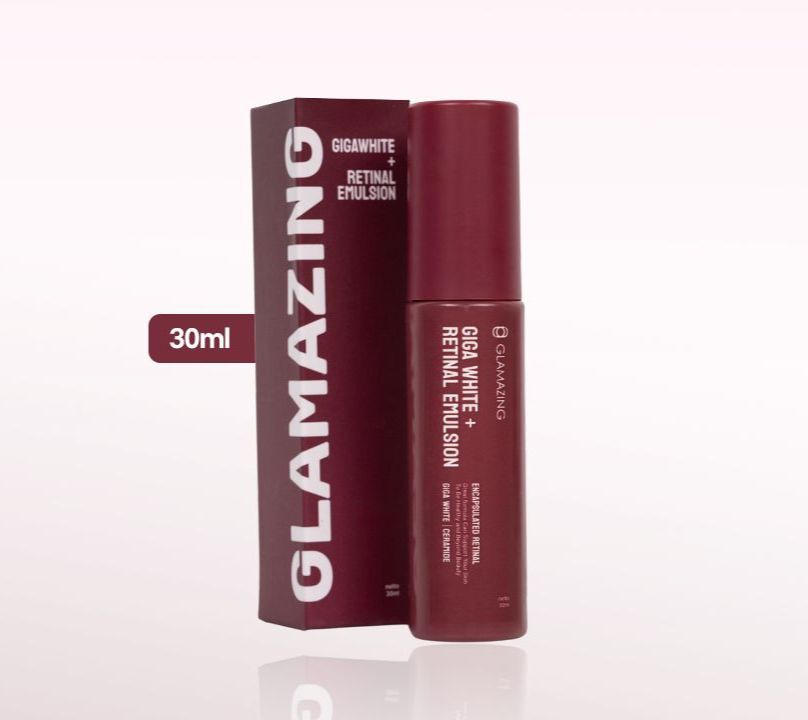
Giga White + Retinal Emulsion
Ingredients overview
 INCI photo pending approval
Highlights
Key Ingredients
Other Ingredients
Skim through
Glamazing Giga White + Retinal EmulsionIngredients explained
Good old water, aka H2O. The most common skincare ingredient of all. You can usually find it right in the very first spot of the ingredient list, meaning it’s the biggest thing out of all the stuff that makes up the product.
It’s mainly a solvent for ingredients that do not like to dissolve in oils but rather in water.
Once inside the skin, it hydrates, but not from the outside - putting pure water on the skin (hello long baths!) is drying.
One more thing: the water used in cosmetics is purified and deionized (it means that almost all of the mineral ions inside it is removed). Like this, the products can stay more stable over time.
- A multi-functional skincare superstar with several proven benefits for the skin
- Great anti-aging, wrinkle smoothing ingredient used at 4-5% concentration
- Fades brown spots alone or in combination with amino sugar, acetyl glucosamine
- Increases ceramide synthesis that results in a stronger, healthier skin barrier and better skin hydration
- Can help to improve several skin conditions including acne, rosacea, and atopic dermatitis
A silicone fluid that gives a nonoily, easy to spread emolliency to the formulas. It is also used as a water repellent additive and to reduce the tackiness and stickiness of other ingredients. It also imparts gloss, softness and better manageability to hair.
- A natural moisturizer that’s also in our skin
- A super common, safe, effective and cheap molecule used for more than 50 years
- Not only a simple moisturizer but knows much more: keeps the skin lipids between our skin cells in a healthy (liquid crystal) state, protects against irritation, helps to restore barrier
- Effective from as low as 3% with even more benefits for dry skin at higher concentrations up to 20-40%
- High-glycerin moisturizers are awesome for treating severely dry skin
It's a film-forming and thickening polymer (a large molecule composed of many repeated subunits) that comes to the formula usually as part of an emulsifier, thickener trio (with C13-14 Isoparaffin and Laureth-7, trade named Sepigel 305). This trio is an easy-to-use liquid that helps to create nice, non-tacky gel formulas.
Butylene glycol, or let’s just call it BG, is a multi-tasking colorless, syrupy liquid. It’s a great pick for creating a nice feeling product.
BG’s main job is usually to be a solvent for the other ingredients. Other tasks include helping the product to absorb faster and deeper into the skin (penetration enhancer), making the product spread nicely over the skin (slip agent), and attracting water (humectant) into the skin.
It’s an ingredient whose safety hasn’t been questioned so far by anyone (at least not that we know about). BG is approved by Ecocert and is also used enthusiastically in natural products. BTW, it’s also a food additive.
It's a petroleum derived emollient and thickener. It often comes to the formula as part of an emulsifier, thickener trio (with Polyacrylamide and Laureth-7). This trio is an easy-to-use liquid that helps to create nice, non-tacky gel formulas.
It’s pretty much the current IT-preservative. It’s safe and gentle, but even more importantly, it’s not a feared-by-everyone-mostly-without-scientific-reason paraben.
It’s not something new: it was introduced around 1950 and today it can be used up to 1% worldwide. It can be found in nature - in green tea - but the version used in cosmetics is synthetic.
Other than having a good safety profile and being quite gentle to the skin it has some other advantages too. It can be used in many types of formulations as it has great thermal stability (can be heated up to 85°C) and works on a wide range of pH levels (ph 3-10).
It’s often used together with ethylhexylglycerin as it nicely improves the preservative activity of phenoxyethanol.
Probably the most common silicone of all. It is a polymer (created from repeating subunits) molecule and has different molecular weight and thus different viscosity versions from water-light to thick liquid.
As for skincare, it makes the skin silky smooth, creates a subtle gloss and forms a protective barrier (aka occlusive). Also, works well to fill in fine lines and wrinkles and give skin a plump look (of course that is only temporary, but still, it's nice). There are also scar treatment gels out there using dimethicone as their base ingredient. It helps to soften scars and increase their elasticity.
As for hair care, it is a non-volatile silicone meaning that it stays on the hair rather than evaporates from it and smoothes the hair like no other thing. Depending on your hair type, it can be a bit difficult to wash out and might cause some build-up (btw, this is not true to all silicones, only the non-volatile types).
Super common soothing ingredient. It can be found naturally in the roots & leaves of the comfrey plant, but more often than not what's in the cosmetic products is produced synthetically.
It's not only soothing but it' also skin-softening and protecting and can promote wound healing.
An optical isomer of naturally occurring arbutin (or beta-arbutin). Just like its sibling, alpha-arbutin is also a skin-brightening, depigmenting agent.
Researching the difference between the two kinds of arbutin, you can read in multiple places on the internet that alpha-arbutin is stronger in effect. Unfortunately, it's never backed up with a credible source. :( Our own research resulted in conflicting results: a study from 1995 found that alpha-arbutin is 10x as effective on mouse melanoma as beta-arbutin. On the other hand, a more recent study from 2015 found that beta-arbutin is more effective both on mouse melanoma cells and on human melanoma cells (btw, kojic acid was the most effective on human melanoma cells).
None of the studies we could find is in-vivo (made on real people) anyways, so who knows. We think you cannot go wrong with trying both beta- and alpha-arbutin and see if one works better for you than the other.
A little helper ingredient that works as a preservative. It works against bacteria and some species of fungi and yeast. It's often combined with IT-preservative, phenoxyethanol.
 We don't have description for this ingredient yet.
It’s the most commonly used version of pure vitamin E in cosmetics. You can read all about the pure form here. This one is the so-called esterified version.
According to famous dermatologist, Leslie Baumann while tocopheryl acetate is more stable and has a longer shelf life, it’s also more poorly absorbed by the skin and may not have the same awesome photoprotective effects as pure Vit E.
A super common emollient that makes your skin feel nice and smooth. It comes from coconut oil and glycerin, it’s light-textured, clear, odorless and non-greasy. It’s a nice ingredient that just feels good on the skin, is super well tolerated by every skin type and easy to formulate with. No wonder it’s popular.
We don't have description for this ingredient yet.
We don't have description for this ingredient yet.
We don't have description for this ingredient yet.
We don't have description for this ingredient yet.
We don't have description for this ingredient yet.
We don't have description for this ingredient yet.
We don't have description for this ingredient yet.
We don't have description for this ingredient yet.
It’s the - sodium form - cousin of the famous NMF, hyaluronic acid (HA). If HA does not tell you anything we have a super detailed, geeky explanation about it here. The TL; DR version of HA is that it's a huge polymer (big molecule from repeated subunits) found in the skin that acts as a sponge helping the skin to hold onto water, being plump and elastic. HA is famous for its crazy water holding capacity as it can bind up to 1000 times its own weight in water.
As far as skincare goes, sodium hyaluronate and hyaluronic acid are pretty much the same and the two names are used interchangeably. As cosmetic chemist kindofstephen writes on reddit "sodium hyaluronate disassociates into hyaluronic acid molecule and a sodium atom in solution".
In spite of this, if you search for "hyaluronic acid vs sodium hyaluronate" you will find on multiple places that sodium hyaluronate is smaller and can penetrate the skin better. Chemically, this is definitely not true, as the two forms are almost the same, both are polymers and the subunits can be repeated in both forms as much as you like. (We also checked Prospector for sodium hyaluronate versions actually used in cosmetic products and found that the most common molecular weight was 1.5-1.8 million Da that absolutely counts as high molecular weight).
What seems to be a true difference, though, is that the salt form is more stable, easier to formulate and cheaper so it pops up more often on the ingredient lists.
If you wanna become a real HA-and-the-skin expert you can read way more about the topic at hyaluronic acid (including penetration-questions, differences between high and low molecular weight versions and a bunch of references to scientific literature).
A handy helper ingredient that helps products to remain nice and stable for a longer time. It does so by neutralizing the metal ions in the formula (that usually get into there from water) that would otherwise cause some not so nice changes.
Citric acid comes from citrus fruits and is an AHA. If these magic three letters don’t tell you anything, click here and read our detailed description on glycolic acid, the most famous AHA.
So citric acid is an exfoliant, that can - just like other AHAs - gently lift off the dead skin cells of your skin and make it more smooth and fresh.
There is also some research showing that citric acid with regular use (think three months and 20% concentration) can help sun-damaged skin, increase skin thickness and some nice hydrating things called glycosaminoglycans in the skin.
But according to a comparative study done in 1995, citric acid has less skin improving magic properties than glycolic or lactic acid. Probably that’s why citric acid is usually not used as an exfoliant but more as a helper ingredient in small amounts to adjust the pH of a formulation.
It's the chemically chopped up version of normal lecithin. Most often it's used to create liposomes and to coat and stabilize other ingredients.
A very common ingredient that can be found in all cell membranes. In cosmetics it's quite the multi-tasker: it's an emollient and water-binding ingredient but it's also an emulsifier and can be used for stabilization purposes. It's also often used to create liposomes.
If you are reading here, we are pretty sure the words retinoids and retinol ring a bell, but if not, you are seriously missing out, please click here immediately to catch up. The TL;DR version is that retinoids are the royal family of skincare with tretinoin being the king, the only FDA-approved ingredient to treat the signs of photoaging. Retinol is like a grandkid, it has to be converted (through two steps) in the skin to become retinoic acid. The conversion means retinol is both less effective and less harsh on the skin.
So where does our current molecule, Retinal, aka Retinaldehyde fit into the family (btw, here is a nice visual family tree about who is who)? Remember that retinol needed two conversion steps to become retinoic acid? Yes, you are right, Retinal is the intermediate step between retinoic acid and retinol, meaning it needs only one conversion step to become active in the skin. If we go with our royal family analogy, Retinal is Prince William, directly next in line to the throne.
Once retinal is converted, it becomes retinoic acid and does the same things we detailed in our tretinoin description. In a nutshell, it is everything you expect from an anti-aging superstar such as decreased wrinkles, smoother, firmer and more elastic skin.
This sounds good, but how does Retinal compare to retinoic acid? Good question! We found a study (a pretty good one with 125 patients) that compared 0.05% retinal with 0.05% retinoic acid (and vehicle). They concluded that "at week 18, a significant reduction of the wrinkle and roughness features was observed with both retinaldehyde and retinoic acid." and the difference between the two was not statistically significant. (Interestingly, in both groups, the results were less significant at week 44, so it might be a good idea to have a retinoid break from time to time?) Also, our guy, Retinal was much better tolerated than retinoic acid known for its harshness.
The good tolerability of retinal was also confirmed by another study that compared retinol (ROL), retinal (RAL) and retinoic acid (RA). They found that "the natural retinoids ROL and RAL do have a good tolerance profile, in contrast with the irritating potential of RA", meaning retinal is an awesome alternative if you have irritation and flaking issues with prescription products, such as Retin-A.
Last, but not least, we want to mention a pretty big (but subjectively evaluated), Avene (the French pharmacy brand famous for its Retinal products) sponsored study that examined the tolerability and efficacy of a 0.1 Retinal + 6% glycolic acid product in the treatment of acne. The product was added next to the standard anti-acne regimen of 1,709 patients for 90 days and the study concluded that the formula was both very well tolerated as well as effective next to other standard anti-acne medications such as benzoyl peroxide and antibiotics.
Overall, if you are into retinoids, Retinal is a really awesome and well-proven member of the family that is absolutely worth trying.
One of the many types of ceramides that can be found naturally in the upper layer of the skin. Ceramides make up about 50% of the goopy stuff that's between our skin cells and play a super important role in having a healthy skin barrier and keeping the skin hydrated. It works even better when combined with its pal, Ceramide 1.
We wrote way more about ceramides at ceramide 1, so click here to know more.
It's one of the important lipids that can be found naturally in the outer layer of the skin. About 25% of the goopy stuff between our skin cells consists of cholesterol. Together with ceramides and fatty acids, they play a vital role in having a healthy skin barrier and keeping the skin hydrated.
Apart from being an important skin-identical ingredient, it's also an emollient and stabilizer.
- Works best between a concentration of 5-20%
- Boosts the skin’s own collagen production
- Fades pigmentation and brown spots
- If used under sunscreen it boosts its UV protection
- Extremely unstable and oxidizes very easily in presence of light or air
- Stable in solutions with water only if pH is less than 3.5 or in waterless formulations
- Vit E + C work in synergy and provide superb photoprotection
- Ferulic acid doubles the photoprotection effect of Vit C+E and helps to stabilize Vit C
- Potent Vit. C serums might cause a slight tingling on sensitive skin
You may also want to take a look at...
| what‑it‑does | solvent |
| what‑it‑does | cell-communicating ingredient | skin brightening | anti-acne | moisturizer/humectant |
| what‑it‑does | emollient |
| what‑it‑does | skin-identical ingredient | moisturizer/humectant |
| irritancy, com. | 0, 0 |
| what‑it‑does | viscosity controlling |
| what‑it‑does | moisturizer/humectant | solvent |
| irritancy, com. | 0, 1 |
| what‑it‑does | emollient | viscosity controlling | solvent |
| what‑it‑does | preservative |
| what‑it‑does | emollient |
| irritancy, com. | 0, 1 |
| what‑it‑does | soothing |
| irritancy, com. | 0, 0 |
| what‑it‑does | antioxidant | skin brightening |
| what‑it‑does | preservative | antimicrobial/antibacterial |
| what‑it‑does | emulsifying | surfactant/cleansing |
| what‑it‑does | antioxidant |
| irritancy, com. | 0, 0 |
| what‑it‑does | emollient |
| what‑it‑does | skin-identical ingredient | moisturizer/humectant |
| irritancy, com. | 0, 0 |
| what‑it‑does | chelating |
| what‑it‑does | buffering |
| what‑it‑does | emollient | emulsifying |
| what‑it‑does | emollient | emulsifying |
| what‑it‑does | cell-communicating ingredient |
| what‑it‑does | skin-identical ingredient |
| what‑it‑does | skin-identical ingredient | emollient |
| irritancy, com. | 0, 0 |
| what‑it‑does | antioxidant | skin brightening | buffering |
| what‑it‑does | colorant |