




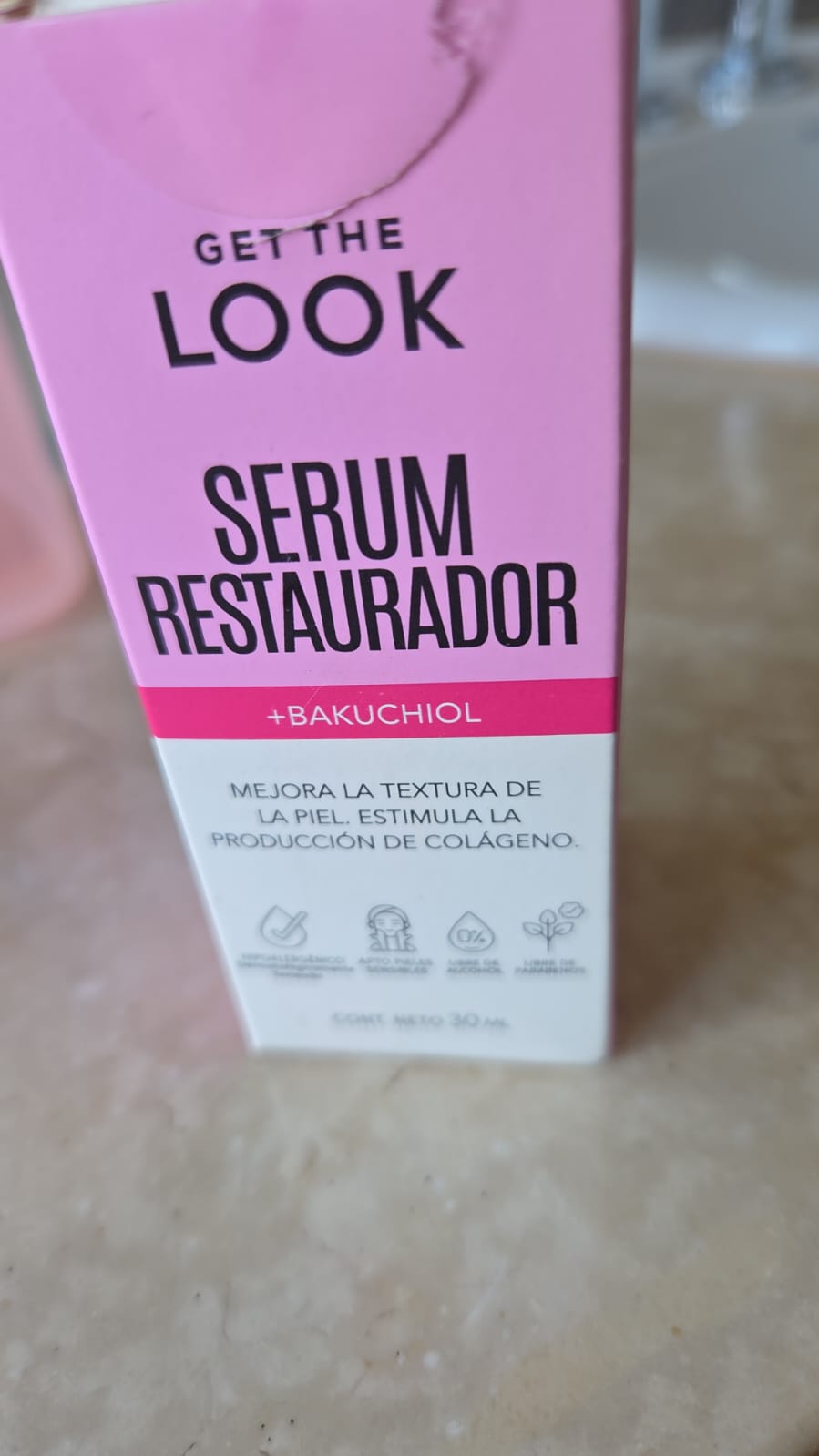
Ingredients overview
 INCI photo pending approval
Highlights
Key Ingredients
Other Ingredients
Skim through
Get the look Serum RestauradorIngredients explained
Good old water, aka H2O. The most common skincare ingredient of all. You can usually find it right in the very first spot of the ingredient list, meaning it’s the biggest thing out of all the stuff that makes up the product.
It’s mainly a solvent for ingredients that do not like to dissolve in oils but rather in water.
Once inside the skin, it hydrates, but not from the outside - putting pure water on the skin (hello long baths!) is drying.
One more thing: the water used in cosmetics is purified and deionized (it means that almost all of the mineral ions inside it is removed). Like this, the products can stay more stable over time.
- A natural moisturizer that’s also in our skin
- A super common, safe, effective and cheap molecule used for more than 50 years
- Not only a simple moisturizer but knows much more: keeps the skin lipids between our skin cells in a healthy (liquid crystal) state, protects against irritation, helps to restore barrier
- Effective from as low as 3% with even more benefits for dry skin at higher concentrations up to 20-40%
- High-glycerin moisturizers are awesome for treating severely dry skin
- It's a helper ingredient that improves the freeze-thaw stability of products
- It's also a solvent, humectant and to some extent a penetration enhancer
- It has a bad reputation among natural cosmetics advocates but cosmetic scientists and toxicology experts do not agree (read more in the geeky details section)
A nice little helper ingredient that can thicken up cosmetic products and create beautiful gel formulas. It's derived from cellulose, the major component of the cell wall of green plants. It is compatible with most co-ingredients and gives a very good slip to the formulas.
- It's a helper ingredient that improves the freeze-thaw stability of products
- It's also a solvent, humectant and to some extent a penetration enhancer
- It has a bad reputation among natural cosmetics advocates but cosmetic scientists and toxicology experts do not agree (read more in the geeky details section)
Good old water, aka H2O. The most common skincare ingredient of all. You can usually find it right in the very first spot of the ingredient list, meaning it’s the biggest thing out of all the stuff that makes up the product.
It’s mainly a solvent for ingredients that do not like to dissolve in oils but rather in water.
Once inside the skin, it hydrates, but not from the outside - putting pure water on the skin (hello long baths!) is drying.
One more thing: the water used in cosmetics is purified and deionized (it means that almost all of the mineral ions inside it is removed). Like this, the products can stay more stable over time.
It’s pretty much the current IT-preservative. It’s safe and gentle, but even more importantly, it’s not a feared-by-everyone-mostly-without-scientific-reason paraben.
It’s not something new: it was introduced around 1950 and today it can be used up to 1% worldwide. It can be found in nature - in green tea - but the version used in cosmetics is synthetic.
Other than having a good safety profile and being quite gentle to the skin it has some other advantages too. It can be used in many types of formulations as it has great thermal stability (can be heated up to 85°C) and works on a wide range of pH levels (ph 3-10).
It’s often used together with ethylhexylglycerin as it nicely improves the preservative activity of phenoxyethanol.
 We don't have description for this ingredient yet.
If you have spotted ethylhexylglycerin on the ingredient list, most probably you will see there also the current IT-preservative, phenoxyethanol. They are good friends because ethylhexylglycerin can boost the effectiveness of phenoxyethanol (and other preservatives) and as an added bonus it feels nice on the skin too.
Also, it's an effective deodorant and a medium spreading emollient.
It's one of those things that help your cosmetics not to go wrong too soon, aka a preservative. Its strong point is being effective against yeasts and molds, and as a nice bonus seems to be non-comedogenic as well.
It is safe in concentrations of less than 0.1% but is acutely toxic when inhaled, so it's not the proper preservative choice for aerosol formulas like hairsprays. Used at 0.1%, Iodopropynyl Butylcarbamate has an extremely low rate of skin-irritation when applied directly for 24 hours (around 0.1% of 4,883 participants) and after 48 hours that figure was 0.5%, so it counts as mild and safe unless your skin is super-duper sensitive.
Super common soothing ingredient. It can be found naturally in the roots & leaves of the comfrey plant, but more often than not what's in the cosmetic products is produced synthetically.
It's not only soothing but it' also skin-softening and protecting and can promote wound healing.
With a sweet, light and floral scent, Farnesol is a popular fragrancing ingredient to make your cosmetics that bit nicer to use. It starts its life as a colorless liquid that can either be synthetically created or extracted from loads of plants like citronella, neroli, ylang-ylang, and tuberose.
The reason we list it as icky is because Farnesol is one of the “EU 26 fragrances” that has to be labeled separately (and cannot be simply included in the term “fragrance/perfume” on the label) because of allergen potential, so it is best avoided if you have super sensitive skin.
We don't have description for this ingredient yet.
A synthetic big copolymer molecule that is used mainly as a solubilizer (make small amounts of oil-loving things soluble in water-based formulas) and gelling agent.
In general, poloxamers are interesting big molecules composed of three blocks: the middle block is an oil-loving part (from propylene oxide units, if you're into chemistry), while the left and right blocks are two water-loving parts (from ethylene oxide units). This means that poloxamers are partly water and partly oil soluble and thus they are surface active agents acting as emulsifiers and/or cleansers. The size of both the oil and water-soluble part can vary, and the numbers in the name of the molecule refer to both the overall size of the whole molecule and to the ratio of the water-soluble part.
This particular guy, Poloxamer 407, is a big one with significant water-soluble part (70%) hence it works as a solubilizer to make small amounts of oil-loving ingredients (such as essential oils) soluble in water-based formulas. It is also the best gelling and body giving agent out of the poloxamers commonly used in cosmetic products.
At first glance, you could think that Bakuchiol is your average plant extract. It is derived from the seeds of Psoralea Corylifolia, aka Babchi, a plant important in Indian and Chinese medicine. The molecule was first isolated in 1973 and several anti-something properties are known about it: it has anti-inflammatory, antioxidant, anti-tumor, anti-bacterial and hepatoprotective magical abilities like plenty of other Ayurvedic plant extracts.
What makes Bakuchiol a special snowflake is the recent discovery that it behaves on the skin in a way very similar to well-known skincare superstar, retinol. While chemically, it has nothing to do with the vitamin-A family, aka retinoids, comparative gene expression profiling (a fancy way of saying that they compared how retinol and bakuchiol modify the way skin cells behave and produce important skin proteins such as collagen) shows that retinol and bakuchiol regulate skin cell behavior in a similar way.
To be more specific, both Bakuchiol and retinol upregulate collagen I, III and IV production and downregulate MMP, the evil collagen attacking enzyme in our skin. This means more collagen stays in our skin and we all know that more collagen equals firmer, more wrinkle-free skin. A 12-week clinical study using a 0.5% Bakuchiol formula with 17 people using it twice a day confirmed a significant improvement in lines and wrinkles, elasticity, firmness and an overall reduction in photo-damage. Also, the test formula was very well tolerated, without any retinol-like side effects.
What's more, a 2018 double-blind study with 44 people compared 0.5% Bakuchiol with 0.5% retinol cream and found that "bakuchiol is comparable to retinol in its ability to improve photoaging and is better tolerated than retinol". A super promising result after 12 weeks.
If you are not a daredevil-type who doesn't want to stop using a super well-proven retinol for a newbie like Bakuchiol, we have good news. The two also work very nicely together and Bakuchiol can actually help to stabilize the otherwise unstable and hard to formulate retinol.
And we are still not done, as Bakuchiol shows not only anti-aging properties but also nice anti-acne effects. 1% Bakuchiol seems to be very effective in itself (57% reduction in acne after 6 weeks treatment) and even better when combined with 2% salicylic acid (67% reduction in acne after 6 weeks). We like that Bakuchiol is such a good team player! The molecule works against acne in multiple ways: It downregulates 5α-reductase (a sebum-controlling enzyme), it is antibacterial (including P. acnes), anti-inflammatory and it inhibits lipid-peroxidation, an evil oxidative process that is recently thought to be a very early trigger in the acne process.
We feel that this description is becoming very long so we will just mention that Bakuchiol also seems to positively regulate hydration-related genes such as Aquaporin 3 and also shows some melanin-inhibiting properties.
Overall, we think Bakuchiol is an awesome molecule with lots of promise both for anti-aging and anti-acne. But the proof compared to the well-established superstars is far from solid, so in a skincare routine, we would rather add Bakuchiol next to retinol than straight up replace it. Unless you are a gimme-the-newest-shiny-thing-under-the-sun-type.
An Ecocert-approved, natural preservative that counts as gentle and non-irritating to the skin. Usually, it comes to the formula as part of a preservative blend as it's not enough on its own.
It’s a handy multi-tasking ingredient that gives the skin a nice, soft feel. At the same time, it also boosts the effectiveness of other preservatives, such as the nowadays super commonly used phenoxyethanol.
The blend of these two (caprylyl glycol + phenoxyethanol) is called Optiphen, which not only helps to keep your cosmetics free from nasty things for a long time but also gives a good feel to the finished product. It's a popular duo.
- A natural moisturizer that’s also in our skin
- A super common, safe, effective and cheap molecule used for more than 50 years
- Not only a simple moisturizer but knows much more: keeps the skin lipids between our skin cells in a healthy (liquid crystal) state, protects against irritation, helps to restore barrier
- Effective from as low as 3% with even more benefits for dry skin at higher concentrations up to 20-40%
- High-glycerin moisturizers are awesome for treating severely dry skin
Good old water, aka H2O. The most common skincare ingredient of all. You can usually find it right in the very first spot of the ingredient list, meaning it’s the biggest thing out of all the stuff that makes up the product.
It’s mainly a solvent for ingredients that do not like to dissolve in oils but rather in water.
Once inside the skin, it hydrates, but not from the outside - putting pure water on the skin (hello long baths!) is drying.
One more thing: the water used in cosmetics is purified and deionized (it means that almost all of the mineral ions inside it is removed). Like this, the products can stay more stable over time.
It's one of the most commonly used thickeners and emulsion stabilizers. If the product is too runny, a little xanthan gum will make it more gel-like. Used alone, it can make the formula sticky and it is a good team player so it is usually combined with other thickeners and so-called rheology modifiers (helper ingredients that adjust the flow and thus the feel of the formula). The typical use level of Xantha Gum is below 1%, it is usually in the 0.1-0.5% range.
Btw, Xanthan gum is all natural, a chain of sugar molecules (polysaccharide) produced from individual sugar molecules (glucose and sucrose) via fermentation. It’s approved by Ecocert and also used in the food industry (E415).
Exactly what it sounds: nice smelling stuff put into cosmetic products so that the end product also smells nice. Fragrance in the US and parfum in the EU is a generic term on the ingredient list that is made up of 30 to 50 chemicals on average (but it can have as much as 200 components!).
If you are someone who likes to know what you put on your face then fragrance is not your best friend - there's no way to know what’s really in it.
Also, if your skin is sensitive, fragrance is again not your best friend. It’s the number one cause of contact allergy to cosmetics. It’s definitely a smart thing to avoid with sensitive skin (and fragrance of any type - natural is just as allergic as synthetic, if not worse!).
You may also want to take a look at...
| what‑it‑does | solvent |
| what‑it‑does | skin-identical ingredient | moisturizer/humectant |
| irritancy, com. | 0, 0 |
| what‑it‑does | moisturizer/humectant | solvent |
| irritancy, com. | 0, 0 |
| what‑it‑does | viscosity controlling |
| what‑it‑does | moisturizer/humectant | solvent |
| irritancy, com. | 0, 0 |
| what‑it‑does | solvent |
| what‑it‑does | preservative |
| what‑it‑does | preservative |
| what‑it‑does | antimicrobial/antibacterial | preservative |
| what‑it‑does | preservative |
| what‑it‑does | preservative |
| what‑it‑does | soothing |
| irritancy, com. | 0, 0 |
| what‑it‑does | perfuming |
| what‑it‑does | moisturizer/humectant |
| irritancy, com. | 2, 2 |
| what‑it‑does | emulsifying | viscosity controlling | surfactant/cleansing |
| what‑it‑does | cell-communicating ingredient | antioxidant | antimicrobial/antibacterial |
| what‑it‑does | preservative |
| what‑it‑does | moisturizer/humectant | emollient |
| what‑it‑does | skin-identical ingredient | moisturizer/humectant |
| irritancy, com. | 0, 0 |
| what‑it‑does | solvent |
| what‑it‑does | viscosity controlling |
| what‑it‑does | perfuming |
| what‑it‑does | perfuming |