




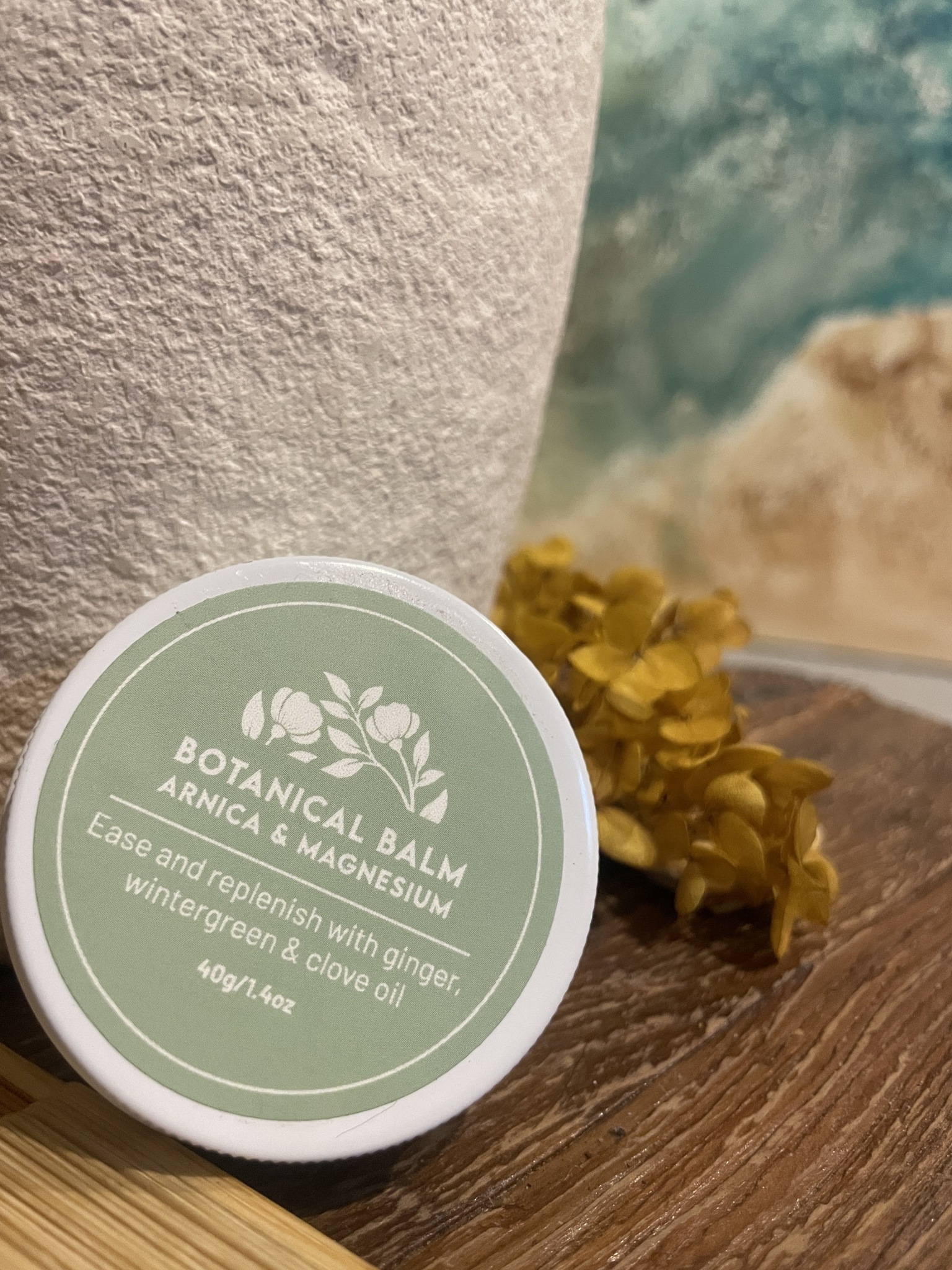
Botanical Balm

Highlights
Key Ingredients
Skim through
| Ingredient name | what-it-does | irr., com. | ID-Rating |
|---|---|---|---|
| Olive Fruit Oil | antioxidant, emollient | 0, 0-2 | goodie |
| Beeswax | emollient, viscosity controlling, emulsifying, perfuming | 0, 0-2 | |
| Magnesium Chloride | viscosity controlling | ||
| Arnica Montana Flower Extract | perfuming | icky | |
| Aqua | solvent | ||
| Ginger Root Extract | antioxidant, soothing | goodie | |
| Eucalyptus Dives Leaf Oil | perfuming | ||
| Terpenes | |||
| Rosemary Leaf Oil | antioxidant, antimicrobial/antibacterial | icky | |
| Wintergreen Leaf Oil | perfuming | ||
| Clove Bud Oil | perfuming | ||
| Oregano Leaf | |||
| Oil | |||
| Rosemary Leaf Extract | antioxidant, soothing, antimicrobial/antibacterial | goodie | |
| Vitamin E | antioxidant | 0-3, 0-3 | goodie |
| Ginger Root Oil | perfuming | ||
| Tea Tree Leaf Oil | soothing, anti-acne, antioxidant, antimicrobial/antibacterial, perfuming | goodie |
Gathered Blends Botanical BalmIngredients explained
You probably know olive oil from the kitchen as a great and healthy option for salad dressing but it's also a great and healthy option to moisturize and nourish the skin, especially if it's on the dry side.
Similar to other emollient plant oils, it's loaded with nourishing fatty acids: oleic is the main component (55-83%), and also contains linoleic (3.5-20%) and palmitic acids (7-20%). It also contains antioxidant polyphenols, tocopherols (types of vitamin E) and carotenoids and it's one of the best plant sources of skin-identical emollient, Squalene.
Overall, a great option for dry skin but less so for acne-prone or damaged skin.
It's the yellow, solid stuff that you probably know from beeswax candles. It's a natural material produced by honey bees to build their honeycomb.
As for skincare, it's used as an emollient and thickening agent. It's super common in lip balms and lipsticks.
A kind of salt that's used as a thickener in cosmetic products.
A nice yellow flower living in the mountains. It has been used as a herbal medicine for centuries, though its effect on skin is rather questionable. It's most famously used to treat bruisings, but there are some studies that show that it's not better than placebo (source: wikipedia). Also, some consider it to be anti-inflammatory, while other research shows that it can cause skin irritation.
Good old water, aka H2O. The most common skincare ingredient of all. You can usually find it right in the very first spot of the ingredient list, meaning it’s the biggest thing out of all the stuff that makes up the product.
It’s mainly a solvent for ingredients that do not like to dissolve in oils but rather in water.
Once inside the skin, it hydrates, but not from the outside - putting pure water on the skin (hello long baths!) is drying.
One more thing: the water used in cosmetics is purified and deionized (it means that almost all of the mineral ions inside it is removed). Like this, the products can stay more stable over time.
The extract coming from ginger, the lovely spice that we all know from the kitchen. It is also a medicinal plant used both in Chinese and Ayurvedic medicine for pretty much everything you can imagine (muscular pain, sore throat, nausea, fever or cramps, just to give a few examples).
As for ginger and skincare, the root extract contains the biologically active component called gingerol that has potent antioxidant and anti-inflammatory properties. Combined with Bisabolol, the duo works synergistically to sooth the skin and take down redness.
Other than that, ginger also contains moisturizing polysaccharides, amino acids, and sugars, and it is also quite well known to increase blood circulation and have a toning effect.
Last but not least, Ginger also has some volatile, essential oil compounds (1-3%). Those are mostly present in ginger oil, but small amounts might be in the extract as well (around 0.5% based on manufacturer info).
 We don't have description for this ingredient yet.
The essential oil coming from the leafs of the lovely herb, rosemary. It contains several fragrant components, including the well-known irritant, camphor (around 15%). It has a nice smell, is a potent antioxidant and it's also an antimicrobial agent.
If your skin is sensitive, it's probably a good idea to avoid it.
We don't have description for this ingredient yet.
This ingredient name is not according to the INCI-standard. :( What, why?!
The extract coming from the lovely herb, rosemary. It contains lots of chemicals, including flavonoids, phenolic acids, and diterpenes. Its main active is rosmarinic acid, a potent antioxidant, and anti-inflammatory. It has also anti-bacterial, astringent and toning properties.
The leaves contain a small amount of essential oil (1-2%) with fragrant components, so if you are allergic to fragrance, it might be better to avoid it.
- Primary fat-soluble antioxidant in our skin
- Significant photoprotection against UVB rays
- Vit C + Vit E work in synergy and provide great photoprotection
- Has emollient properties
- Easy to formulate, stable and relatively inexpensive
The famous tea tree oil. One of the best known essential oils which comes from Australia where it has been used for almost 100 years for its antiseptic and anti-inflammatory actions. Legend has it that the medicinal benefits of the oil were considered so important that Australian soldiers were supplied with some tea tree oil in their World War II military kit.
Similar to other essential oils, tea tree oil is a very complex chemical mixture consisting of about 100 components, the major ones being terpinen-4-ol (40%), γ-Terpinene (23%) and α-Terpinene (10%). Terpinen-4-ol is considered to be the main active component but as a great article in Clinical Microbiology Reviews states "while some TTO components may be considered less active, none can be considered inactive" and most components contribute to TTO's strong antibacterial, antiviral and antifungal effects.
Regarding skincare and tea tree oil, its most well-known effect is probably being a well established anti-acne ingredient. Multiple studies confirm that TTO is effective against the evil acne-causing bacteria called P. acnes and the effectiveness of 5% TTO gel is comparable to the gold standard anti-acne treatment, 5% Benzoyl Peroxide lotion. You need to be a bit more patient with TTO, though, as its effects come slower but also with fewer side effects.
Regarding TTO and sensitive skin, we say that you should be careful. Even if your skin is not sensitive you should never put undiluted TTO on your skin. Luckily, it contains only very small amounts of the common allergens (such as limonene), but irritant and allergic reactions still happen, especially by oxidation products that occur in older or not properly stored oil. So if you have some pure TTO at home, know that storage matters, keep it in a cool, dry, dark place and use it up in a reasonable amount of time.
Overall, we do not often give a goodie status to essential oils, but we feel that TTO's unique antibacterial and anti-acne properties with its minimal allergen content warrant an exception. If your skin is acne-prone, TTO is something to experiment with.
You may also want to take a look at...
| what‑it‑does | antioxidant | emollient |
| irritancy, com. | 0, 0-2 |
| what‑it‑does | emollient | viscosity controlling | emulsifying | perfuming |
| irritancy, com. | 0, 0-2 |
| what‑it‑does | viscosity controlling |
| what‑it‑does | perfuming |
| what‑it‑does | solvent |
| what‑it‑does | antioxidant | soothing |
| what‑it‑does | perfuming |
| what‑it‑does | antioxidant | antimicrobial/antibacterial |
| what‑it‑does | perfuming |
| what‑it‑does | perfuming |
| what‑it‑does | antioxidant | soothing | antimicrobial/antibacterial |
| what‑it‑does | antioxidant |
| irritancy, com. | 0-3, 0-3 |
| what‑it‑does | perfuming |
| what‑it‑does | soothing | anti-acne | antioxidant | antimicrobial/antibacterial | perfuming |