




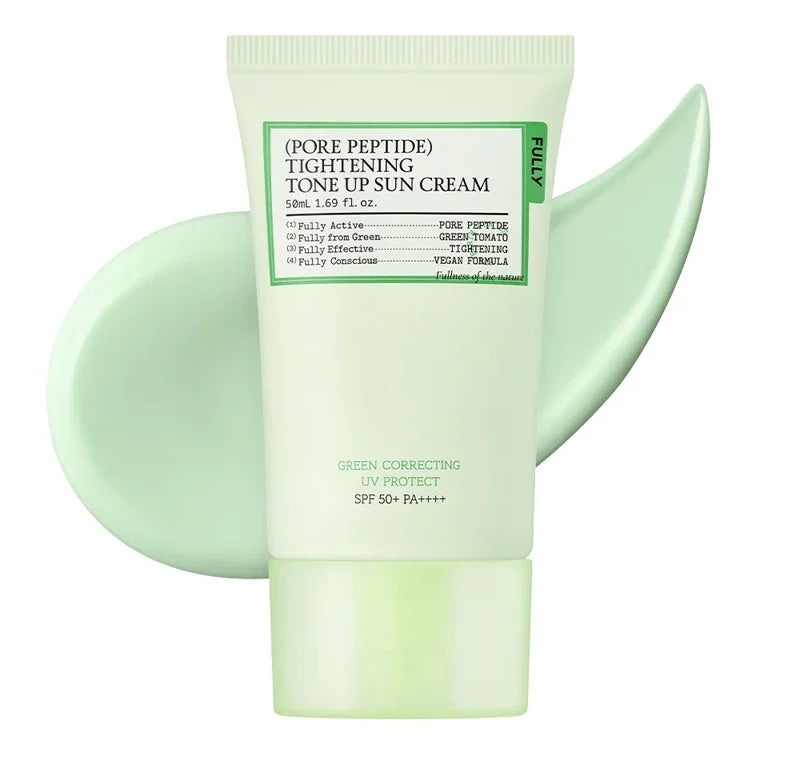
Pore Peptide Tightening Tone Up Sun Cream Green
Ingredients overview
Highlights
Key Ingredients
Other Ingredients
Skim through
Fully Pore Peptide Tightening Tone Up Sun Cream GreenIngredients explained
Good old water, aka H2O. The most common skincare ingredient of all. You can usually find it right in the very first spot of the ingredient list, meaning it’s the biggest thing out of all the stuff that makes up the product.
It’s mainly a solvent for ingredients that do not like to dissolve in oils but rather in water.
Once inside the skin, it hydrates, but not from the outside - putting pure water on the skin (hello long baths!) is drying.
One more thing: the water used in cosmetics is purified and deionized (it means that almost all of the mineral ions inside it is removed). Like this, the products can stay more stable over time.
A clear, colorless, odorless oily liquid that makes the formula easily spreadable and also makes the skin nice and smooth (emollient). It's especially helpful in sunscreens as it can help to solubilize UV filters.
A nice, multi-functional helper ingredient that's especially useful in sunscreens. It can solubilize some commonly used UV-filters like Oxybenzone or Avobenzone and it can also help to increase the SPF rating of sunscreens. It's also cosmetically elegant, has excellent spreadability and a pleasant, moisturizing skin feel. Oh, and according to Wikipedia, it even helps to stabilize famously unstable UVA-filter, Avobenzone.
Diethylamino Hydroxybenzoyl Hexyl Benzoate is a new generation, chemical sunscreen agent (not available in the US due to impossible FDA regulations) that's designed for high UVA protection and high photostability. It gives sun protection in the whole UVA range (320-400 nm) with peak protection at 354nm. It can be used up to 10% worldwide except for the US and Canada.
Ethylhexyl Triazone is a new generation, chemical sunscreen (not available in the US due to impossible FDA regulations) that gives the highest photo-stable absorption of all available UVB filters today. It protects in the UVB range (280-320nm) with a peak protection of 314nm. It is an oil soluble, odorless, colorless powder that works well in fragrance-free formulas. It can be used up to 5% worldwide except for the US and Canada.
Ci 77891 is the color code of titanium dioxide. It's a white pigment with great color consistency and dispersibility.
The long name covers a nice sunscreen agent and quite a special one at that: It's a "hybrid" sunscreen meaning it's half-way between physical (the ones that, at least partly, reflect the sun) and chemical agents (that absorb the rays, which most sunscreens do). It is a new generation UV filter and, just like its sister, Trinosorb S, it is not available in the US.
It gives nice broad-spectrum coverage (280-400 nm, meaning UVB as well as UVA protecion) with peak protection at 305 nm and 360 nm and it is highly photostable. It can also help to stabilize other less stable sunscreens, like Octinoxate and is generally happy to work together with other UV-filters.
Its hybrid nature means that it is organic like the chemical agents, but it is neither water nor oil soluble and works as a suspension of micro fine particles. If the small particles scare you, we have good news: the safety profile of Tinosorb M is great. It is not absorbed into the skin and unlike some other chemical sunscreens, it does not show estrogenic activity.
The downside of its hybrid nature is that - similar to the inorganic sunscreens zinc and titanium dioxide - Tinosorb M also leaves a white cast on the skin that can be bothersome on darker skin tones.
A L'Oréal-group exclusive sunscreen agent that was invented in 1999 and is commonly called Mexoryl XL. It is an oil-soluble, photostable chemical sunscreen with both UVB and UVA protection with peak absorbance at 303 nm (UVB) and at 344 nm (UVA).
- A multi-functional skincare superstar with several proven benefits for the skin
- Great anti-aging, wrinkle smoothing ingredient used at 4-5% concentration
- Fades brown spots alone or in combination with amino sugar, acetyl glucosamine
- Increases ceramide synthesis that results in a stronger, healthier skin barrier and better skin hydration
- Can help to improve several skin conditions including acne, rosacea, and atopic dermatitis
A spherical texturizing powder that's used as a texture enhancer and soft focus agent. It's claimed to give silicone type softness to the formula and also works as a (temporary) wrinkle filler.
Simply alcohol refers to ethanol and it's a pretty controversial ingredient. It has many instant benefits: it's a great solvent, penetration enhancer, creates cosmetically elegant, light formulas, great astringent and antimicrobial. No wonder it's popular in toners and oily skin formulas.
The downside is that it can be very drying if it's in the first few ingredients on an ingredient list.
Some experts even think that regular exposure to alcohol damages skin barrier and causes inflammation though it's a debated opinion. If you wanna know more, we wrote a more detailed explanation about what's the deal with alcohol in skincare products at alcohol denat. (it's also alcohol, but with some additives to make sure no one drinks it).
- A natural moisturizer that’s also in our skin
- A super common, safe, effective and cheap molecule used for more than 50 years
- Not only a simple moisturizer but knows much more: keeps the skin lipids between our skin cells in a healthy (liquid crystal) state, protects against irritation, helps to restore barrier
- Effective from as low as 3% with even more benefits for dry skin at higher concentrations up to 20-40%
- High-glycerin moisturizers are awesome for treating severely dry skin
A really multi-functional helper ingredient that can do several things in a skincare product: it can bring a soft and pleasant feel to the formula, it can act as a humectant and emollient, it can be a solvent for some other ingredients (for example it can help to stabilize perfumes in watery products) and it can also help to disperse pigments more evenly in makeup products. And that is still not all: it can also boost the antimicrobial activity of preservatives.
A multi-functional, silky feeling helper ingredient that can do quite many things. It's used as an emulsion stabilizer, solvent and a broad spectrum antimicrobial. According to manufacturer info, it's also a moisturizer and helps to make the product feel great on the skin. It works synergistically with preservatives and helps to improve water-resistance of sunscreens.
A clear, slightly yellow, odorless oil that's a very common, medium-spreading emollient. It makes the skin feel nice and smooth and works in a wide range of formulas.
A clear, colorless and odorless, highly volatile (meaning it does not absorb into the skin but evaporates from it) liquid that's used as an emollient. It gives a nice non-oily light skin feel and it can improve the slip of the formula without leaving a tacky residue behind.
It's also popular in make-up products as its volatility makes mascaras and foundations last longer. If that would not be enough, it's also an excellent solvent, and it's a regular not only on the ingredients lists of make-ups but also on makeup removers.
 We don't have description for this ingredient yet.
A vegetable-based emulsifier that helps the oily and watery parts of the formula to mix nicely together. It is compatible with a bunch of cosmetic oils as well as active ingredients and its specialty is creating emulsions with super high heat and freeze stability (from -25 °C and +50 °C).
An extremely common multitasker ingredient that gives your skin a nice soft feel (emollient) and gives body to creams and lotions. It also helps to stabilize oil-water mixes (emulsions), though it does not function as an emulsifier in itself. Its typical use level in most cream type formulas is 2-3%.
It’s a so-called fatty alcohol, a mix of cetyl and stearyl alcohol, other two emollient fatty alcohols. Though chemically speaking, it is alcohol (as in, it has an -OH group in its molecule), its properties are totally different from the properties of low molecular weight or drying alcohols such as denat. alcohol. Fatty alcohols have a long oil-soluble (and thus emollient) tail part that makes them absolutely non-drying and non-irritating and are totally ok for the skin.
A vegetable origin (coconut or palm kernel oil and glucose) cleansing agent with great foaming abilities. It's also mild to the skin and readily biodegradable.
A super common, waxy, white, solid stuff that helps water and oil to mix together, gives body to creams and leaves the skin feeling soft and smooth.
Chemically speaking, it is the attachment of a glycerin molecule to the fatty acid called stearic acid. It can be produced from most vegetable oils (in oils three fatty acid molecules are attached to glycerin instead of just one like here) in a pretty simple, "green" process that is similar to soap making. It's readily biodegradable.
It also occurs naturally in our body and is used as a food additive. As cosmetic chemist Colins writes it, "its safety really is beyond any doubt".
It's a type of glycol that - according to the manufacturer - is an extremely good replacement for other glycols like propylene or butylene glycol. Its main job is to be a solvent, but it has also very good antimicrobial properties and acts as a true preservative booster. Also helps with skin hydration without stickiness or tacky feel.
A versatile polymer that helps to thicken up products and can also act as an emulsifier, enabling gel-cream-like textures. It works over a wide pH range and is electrolyte tolerant.
We don't have description for this ingredient yet.
Though its long name does not reveal it, this polymer molecule (big molecule from repeated subunits or monomers) is a relative to the super common, water-loving thickener, Carbomer. Both of them are big molecules that contain acrylic acid units, but Acrylates/C10-30 Alkyl Acrylate Crosspolymer also contains some other monomers that are hydrophobic, i.e. water-hating.
This means that our molecule is part water- and part oil-loving, so it not only works as a thickener but also as an emulsion stabilizer. It is very common in gel-type formulas that also contain an oil-phase as well as in cleansers as it also works with most cleansing agents (unlike a lot of other thickeners).
It's a little helper ingredient that helps to set the pH of the products to be right. It has an alkaline pH and can neutralize acidic ingredients.
We don't have description for this ingredient yet.
Officially, CosIng (the official EU ingredient database) lists Aluminum Hydroxide 's functions as opacifying (making the product white and non-transparent), as well as emollient and skin protectant.
However, with a little bit of digging, it turns out Aluminum Hyroxide often moonlights as a protective coating for UV filter superstar Titanium Dioxide. Specifically, it protects our skin from the harmful effects of nasty Reactive Oxygen Species (free radicals derived from oxygen such as Superoxide and Hydrogen Peroxide) generated when Titanium Dioxide is exposed to UV light. Btw, chlorine in swimming pool water depletes this protective coating, so one more reason to reapply your sunscreen after a dip in the pool on holiday.
Other than that, Aluminum Hydroxide also often shows up in composite pigment technologies where it is used the other way around (as the base material and not as the coating material) and helps to achieve higher color coverage with less pigment.
An amino acid-based emulsifier that helps water and oil to mix and stay that way. It is considered as natural, environmentally friendly, and hypoallergenic.
If you have spotted ethylhexylglycerin on the ingredient list, most probably you will see there also the current IT-preservative, phenoxyethanol. They are good friends because ethylhexylglycerin can boost the effectiveness of phenoxyethanol (and other preservatives) and as an added bonus it feels nice on the skin too.
Also, it's an effective deodorant and a medium spreading emollient.
Adenosine is an important little compound in our body that has a vital cell-signalling role. Research on smearing it on our face is also promising and shows so far a couple of things:
- It can help with wound healing
- It’s a good anti-inflammatory agent
- It might even help with skin’s own collagen production and improve skin firmness and elasticity
- It helps with barrier repair and protection
- It might be even useful for the hair helping with hair thickness and hair growth
We don't have description for this ingredient yet.
An inorganic (as in no carbon in its molecule, it is Cr2O3) pigment that gives dull olive green shades. It is not permitted in lip products in the US.
It's a helper ingredient that helps to thicken up formulas and form a nice gel texture. It leaves a rich, elegant feel with a velvety finish on the skin and works over a wide pH range.
It's one of the most commonly used thickeners and emulsion stabilizers. If the product is too runny, a little xanthan gum will make it more gel-like. Used alone, it can make the formula sticky and it is a good team player so it is usually combined with other thickeners and so-called rheology modifiers (helper ingredients that adjust the flow and thus the feel of the formula). The typical use level of Xantha Gum is below 1%, it is usually in the 0.1-0.5% range.
Btw, Xanthan gum is all natural, a chain of sugar molecules (polysaccharide) produced from individual sugar molecules (glucose and sucrose) via fermentation. It’s approved by Ecocert and also used in the food industry (E415).
A cellulose-derived helper ingredient that is created by attaching a water-hating part (cetyl group) to the water-loving thickener, Hydroxyethylcellulose. The resulting thing, Cetyl Hydroxyethylcellulose is also a thickener but with some surface active properties (as part of the molecule is water-loving and part of it is oil loving). Thanks to its surface-active properties, it also works as an emulsion stabilizer.
We don't have description for this ingredient yet.
A so-called dispersant or dispersing agent that's used in inorganic (titanium dioxide/zinc oxide based) sunscreens or in make-up products to help to distribute the pigments nicely and evenly on the skin. It's also claimed to increase the UV absorption of the sunscreen formula as well as to reduce the annoying white cast left behind by inorganic sunscreens.
A clear, light yellow liquid that is used to coat pigments (such as inorganic sunscreen agents or colorants) in cosmetic products. The coating helps to stabilize pigments in the formulas and also helps them to spread easily and evenly on the skin.
We don't have description for this ingredient yet.
- Primary fat-soluble antioxidant in our skin
- Significant photoprotection against UVB rays
- Vit C + Vit E work in synergy and provide great photoprotection
- Has emollient properties
- Easy to formulate, stable and relatively inexpensive
You probably know olive oil from the kitchen as a great and healthy option for salad dressing but it's also a great and healthy option to moisturize and nourish the skin, especially if it's on the dry side.
Similar to other emollient plant oils, it's loaded with nourishing fatty acids: oleic is the main component (55-83%), and also contains linoleic (3.5-20%) and palmitic acids (7-20%). It also contains antioxidant polyphenols, tocopherols (types of vitamin E) and carotenoids and it's one of the best plant sources of skin-identical emollient, Squalene.
Overall, a great option for dry skin but less so for acne-prone or damaged skin.
We don't have description for this ingredient yet.
We don't have description for this ingredient yet.
It’s a handy multi-tasking ingredient that gives the skin a nice, soft feel. At the same time, it also boosts the effectiveness of other preservatives, such as the nowadays super commonly used phenoxyethanol.
The blend of these two (caprylyl glycol + phenoxyethanol) is called Optiphen, which not only helps to keep your cosmetics free from nasty things for a long time but also gives a good feel to the finished product. It's a popular duo.
Acetyl Hexapeptide-1 is a bit of a special snowflake among peptides as it's not a wrinkle-smoothing, anti-aging active like most of the other ones but it can stimulate pigmentation and melanin production (by interacting with a skin cell receptor called MC1R).
As melanin not only gives the skin its nice tanned color but also works as a natural protection factor, Acetyl Hexapeptide-1, aka Melitane does the same. It not only boosts a natural or an artificial tan but gives extra protection against UV-induced DNA and free radical damage and protects the skin against UV-caused redness.
You may also want to take a look at...
| what‑it‑does | solvent |
| what‑it‑does | emollient | solvent |
| what‑it‑does | solvent |
| what‑it‑does | sunscreen |
| what‑it‑does | sunscreen |
| what‑it‑does | colorant |
| irritancy, com. | 0, 0 |
| what‑it‑does | sunscreen |
| what‑it‑does | sunscreen |
| what‑it‑does | cell-communicating ingredient | skin brightening | anti-acne | moisturizer/humectant |
| what‑it‑does | antimicrobial/antibacterial | solvent | viscosity controlling |
| what‑it‑does | skin-identical ingredient | moisturizer/humectant |
| irritancy, com. | 0, 0 |
| what‑it‑does | solvent |
| what‑it‑does | solvent | moisturizer/humectant |
| what‑it‑does | emollient | perfuming |
| what‑it‑does | emollient | solvent |
| what‑it‑does | viscosity controlling |
| what‑it‑does | emulsifying |
| what‑it‑does | emollient | viscosity controlling | emulsifying | surfactant/cleansing |
| irritancy, com. | 1, 2 |
| what‑it‑does | surfactant/cleansing |
| what‑it‑does | emollient | emulsifying |
| irritancy, com. | 0, 1 |
| what‑it‑does | solvent |
| what‑it‑does | viscosity controlling |
| what‑it‑does | viscosity controlling |
| what‑it‑does | emulsifying |
| what‑it‑does | viscosity controlling |
| what‑it‑does | buffering |
| what‑it‑does | emollient | emulsifying |
| what‑it‑does | emollient | moisturizer/humectant | viscosity controlling |
| what‑it‑does | emulsifying | surfactant/cleansing |
| what‑it‑does | preservative |
| what‑it‑does | cell-communicating ingredient |
| what‑it‑does | viscosity controlling |
| what‑it‑does | colorant |
| what‑it‑does | viscosity controlling |
| what‑it‑does | viscosity controlling |
| what‑it‑does | viscosity controlling |
| what‑it‑does | viscosity controlling |
| what‑it‑does | emulsifying |
| what‑it‑does | emollient |
| what‑it‑does | antioxidant |
| irritancy, com. | 0-3, 0-3 |
| what‑it‑does | antioxidant | emollient |
| irritancy, com. | 0, 0-2 |
| what‑it‑does | emollient |
| what‑it‑does | antioxidant |
| what‑it‑does | moisturizer/humectant | emollient |