




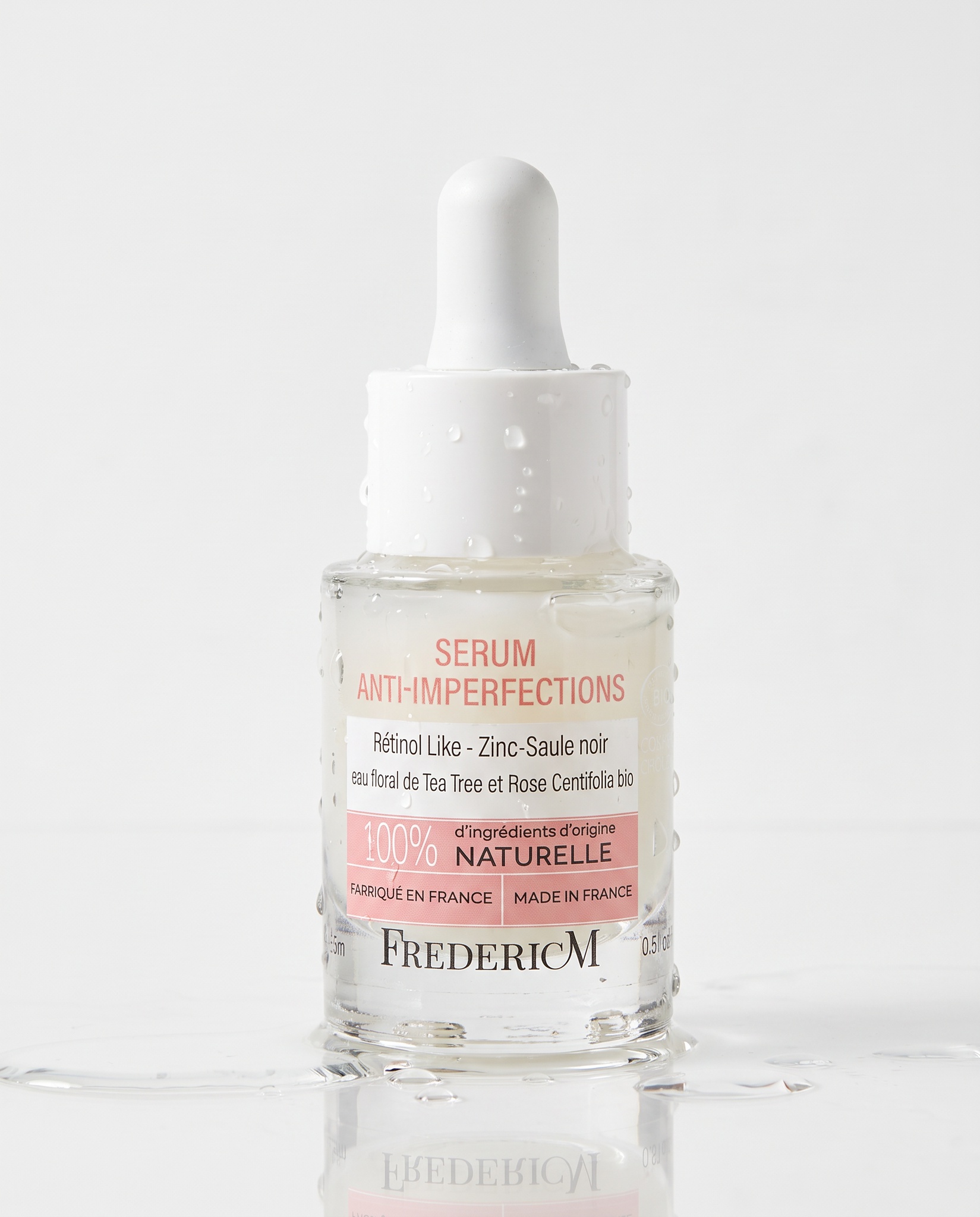
Serum-anti Imperfections
Ingredients overview
Highlights
Key Ingredients
Other Ingredients
Skim through
FREDERIC M Serum-anti ImperfectionsIngredients explained
The much-much diluted version of the famous Tea Tree Essential Oil, the so-called hydrosol that is created as a by-product of steam-distillation used for producing essential oils. In general, hydrosols contain the same components as their big sister essential oil but in way-reduced concentrations. We have seen a specification saying 99% of the tea tree water is water, and about 1% consists of very small amounts of the dissolved essential oil and the water-soluble parts of the tea tree leaves.
So tea tree water might have some soothing, antibacterial and anti-acne properties but much less strong than the essential oil.
 We don't have description for this ingredient yet.
This ingredient name is not according to the INCI-standard. :( What, why?!
Propanediol is a natural alternative for the often used and often bad-mouthed propylene glycol. It's produced sustainably from corn sugar and it's Ecocert approved.
It's quite a multi-tasker: can be used to improve skin moisturization, as a solvent, to boost preservative efficacy or to influence the sensory properties of the end formula.
Good old water, aka H2O. The most common skincare ingredient of all. You can usually find it right in the very first spot of the ingredient list, meaning it’s the biggest thing out of all the stuff that makes up the product.
It’s mainly a solvent for ingredients that do not like to dissolve in oils but rather in water.
Once inside the skin, it hydrates, but not from the outside - putting pure water on the skin (hello long baths!) is drying.
One more thing: the water used in cosmetics is purified and deionized (it means that almost all of the mineral ions inside it is removed). Like this, the products can stay more stable over time.
- A natural moisturizer that’s also in our skin
- A super common, safe, effective and cheap molecule used for more than 50 years
- Not only a simple moisturizer but knows much more: keeps the skin lipids between our skin cells in a healthy (liquid crystal) state, protects against irritation, helps to restore barrier
- Effective from as low as 3% with even more benefits for dry skin at higher concentrations up to 20-40%
- High-glycerin moisturizers are awesome for treating severely dry skin
If you have oily, acne-prone skin, Zinc PCA is one of the actives to put on your "TO TRY" list.
It's a synergistic association of two great things: Zinc and L-PCA. The Zinc part is there to help normalize sebum production and limit the proliferation of evil acne-causing bacteria. L-PCA stands for pyrrolidone carboxylic acid and it's a key molecule in the skin that helps with processes of hydration and energy (it's actually an NMF, a natural moisturizing factor).
L-PCA is not only there to hydrate the skin, but it also helps to increase the efficacy and bioavailability of zinc. An in-vivo (done on real people) test done by the manufacturer shows that Zinc PCA reduces sebum production statistically significantly after 28 days of application (1% was used in the test), and in-vitro (made in the lab) measurements show that Zinc PCA has strong anti-microbial activity against P. acnes (between 0.1-0.25%) and other bacterial strains.
If that would not be enough there is also a 2011 research paper saying that based on in-vitro (made in the lab, not on real people) findings Zinc PCA might be a promising anti-aging active that helps with the production of type I collagen (and we all know more collagen = firmer skin).
All in all, definitely a goodie for oily, acne-prone skin.
It's one of the most commonly used thickeners and emulsion stabilizers. If the product is too runny, a little xanthan gum will make it more gel-like. Used alone, it can make the formula sticky and it is a good team player so it is usually combined with other thickeners and so-called rheology modifiers (helper ingredients that adjust the flow and thus the feel of the formula). The typical use level of Xantha Gum is below 1%, it is usually in the 0.1-0.5% range.
Btw, Xanthan gum is all natural, a chain of sugar molecules (polysaccharide) produced from individual sugar molecules (glucose and sucrose) via fermentation. It’s approved by Ecocert and also used in the food industry (E415).
We don't have description for this ingredient yet.
We don't have description for this ingredient yet.
A super common emollient that makes your skin feel nice and smooth. It comes from coconut oil and glycerin, it’s light-textured, clear, odorless and non-greasy. It’s a nice ingredient that just feels good on the skin, is super well tolerated by every skin type and easy to formulate with. No wonder it’s popular.
A natural polysaccharide (big sugar molecule) coming from red edible seaweeds. It is used as a helper ingredient for its gelling, thickening and stabilizing properties.
We don't have description for this ingredient yet.
- It’s the second most researched AHA after glycolic acid
- It gently lifts off dead skin cells to reveal newer, fresher, smoother skin
- It also has amazing skin hydrating properties
- In higher concentration (10% and up) it improves skin firmness, thickness and wrinkles
- Choose a product where you know the concentration and pH value because these two greatly influence effectiveness
- Don’t forget to use your sunscreen (in any case but especially so next to an AHA product)
The extract coming from the bark of the White Willow, a big (25 m/80 ft.) tree that likes to live on riverbanks. It's famous for containing anti-inflammatory natural salicylates (this powder, for example, is standardized to contain 53-65%), a close chemical relative to famous exfoliant salicylic acid.
Thanks to its salicin content, willow bark is often touted as a natural alternative to salicylic acid, though it's quite questionable how effective it is as a chemical exfoliant in the tiny amounts used in cosmetics. Apart from soothing salicin, it also contains flavonoids and phenolic acids that give willow bark tonic, astringent, and antiseptic properties.
A multi-functional, silky feeling helper ingredient that can do quite many things. It's used as an emulsion stabilizer, solvent and a broad spectrum antimicrobial. According to manufacturer info, it's also a moisturizer and helps to make the product feel great on the skin. It works synergistically with preservatives and helps to improve water-resistance of sunscreens.
Mustic gum is an aromatic resin coming from the bark of a tree that grows on the Greek island of Chios. It was traditionally used as a chewing gum to clean the teeth and freshen the breath thanks to its anti-microbial properties.
As for modern skincare, it is the active ingredient in a skin care complex trade named PoreAway, that is claimed to tighten dilated pores and reduce shine. It works by blocking 5α reductase type I, an enzyme that has an important role in the sebum-producing process (by converting testosterone to dihydrotestosterone, aka DHT, that is the main sebum producing hormone in the skin).
Do not expect miracles though: according to the in-vivo test conducted by the manufacturer, 2% PoreAway refined pores only by 8% after 14 days and 15% after 28 days. We are not sure if this is a change that you can really feel and see on your skin, or if it's just a "statistically significant change" that can be measured in the lab.
A very common ingredient that can be found in all cell membranes. In cosmetics it's quite the multi-tasker: it's an emollient and water-binding ingredient but it's also an emulsifier and can be used for stabilization purposes. It's also often used to create liposomes.
We don't have description for this ingredient yet.
A super common and cheap fragrance ingredient. It's in many plants, e.g. rosemary, eucalyptus, lavender, lemongrass, peppermint and it's the main component (about 50-90%) of the peel oil of citrus fruits.
It does smell nice but the problem is that it oxidizes on air exposure and the resulting stuff is not good for the skin. Oxidized limonene can cause allergic contact dermatitis and counts as a frequent skin sensitizer.
Limonene's nr1 function is definitely being a fragrance component, but there are several studies showing that it's also a penetration enhancer, mainly for oil-loving components.
All in all, limonene has some pros and cons, but - especially if your skin is sensitive - the cons probably outweigh the pros.
Geraniol is a common fragrance ingredient. It smells like rose and can be found in rose oil or in small quantities in geranium, lemon and many other essential oils.
Just like other similar fragrance ingredients (like linalool and limonene) geraniol also oxidises on air exposure and becomes allergenic. Best to avoid if you have sensitive skin.
Citronellol is a very common fragrance ingredient with a nice rose-like odor. In the UK, it’s actually the third most often listed perfume on the ingredient lists.
It can be naturally found in geranium oil (about 30%) or rose oil (about 25%).
As with all fragrance ingredients, citronellol can also cause allergic contact dermatitis and should be avoided if you have perfume allergy. In a 2001 worldwide study with 178 people with known sensitization to fragrances citronellol tested positive in 5.6% of the cases.
There is no known anti-aging or positive skin benefits of the ingredient. It’s in our products to make it smell nice.
You may also want to take a look at...
| what‑it‑does | antimicrobial/antibacterial |
| what‑it‑does | solvent | moisturizer/humectant |
| what‑it‑does | solvent |
| what‑it‑does | skin-identical ingredient | moisturizer/humectant |
| irritancy, com. | 0, 0 |
| what‑it‑does | anti-acne | moisturizer/humectant |
| what‑it‑does | viscosity controlling |
| what‑it‑does | emollient |
| what‑it‑does | viscosity controlling |
| what‑it‑does | antimicrobial/antibacterial |
| what‑it‑does | exfoliant | moisturizer/humectant | buffering |
| what‑it‑does | soothing |
| what‑it‑does | solvent | moisturizer/humectant |
| what‑it‑does | emollient | emulsifying |
| what‑it‑does | emollient | emulsifying |
| what‑it‑does | perfuming | solvent |
| what‑it‑does | perfuming |
| what‑it‑does | perfuming |