




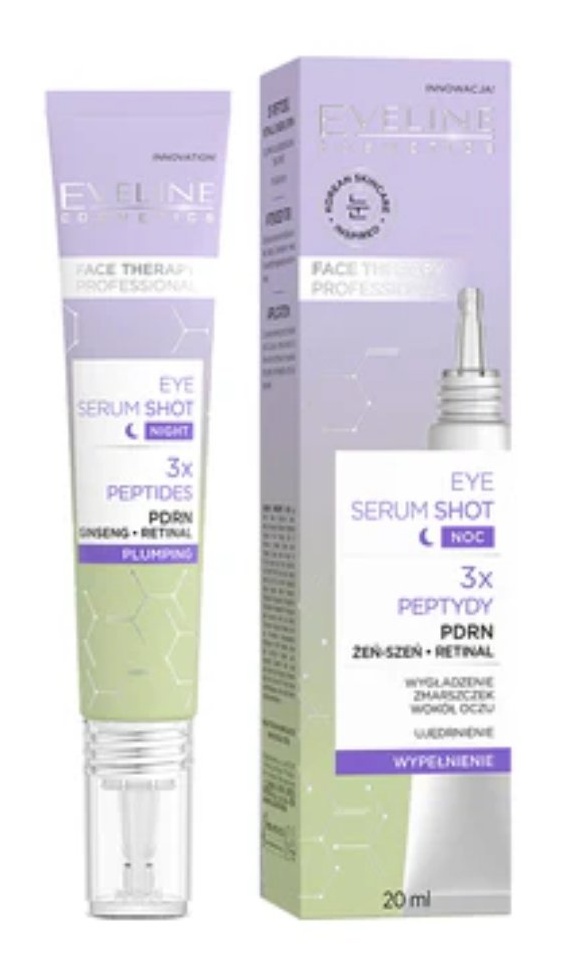
Eye Serum Shot Plumping And Regenerating Eye Area Treatment
Ingredients overview
Highlights
Key Ingredients
Other Ingredients
Skim through
Eveline Eye Serum Shot Plumping And Regenerating Eye Area TreatmentIngredients explained
Good old water, aka H2O. The most common skincare ingredient of all. You can usually find it right in the very first spot of the ingredient list, meaning it’s the biggest thing out of all the stuff that makes up the product.
It’s mainly a solvent for ingredients that do not like to dissolve in oils but rather in water.
Once inside the skin, it hydrates, but not from the outside - putting pure water on the skin (hello long baths!) is drying.
One more thing: the water used in cosmetics is purified and deionized (it means that almost all of the mineral ions inside it is removed). Like this, the products can stay more stable over time.
- A natural moisturizer that’s also in our skin
- A super common, safe, effective and cheap molecule used for more than 50 years
- Not only a simple moisturizer but knows much more: keeps the skin lipids between our skin cells in a healthy (liquid crystal) state, protects against irritation, helps to restore barrier
- Effective from as low as 3% with even more benefits for dry skin at higher concentrations up to 20-40%
- High-glycerin moisturizers are awesome for treating severely dry skin
A glycerin and stearic acid based ingredient that helps oil and water to mix nicely together, aka emulsifier. It is PEG-free and based on renewable raw materials.
It usually comes to the formula with its emulsifier buddy, Polyglyceryl-6 Behenate, and the duo is especially recommended for formulating low-viscous serums, lotions, and sprays. As an added bonus, the duo is also described as providing "outstanding moisturization properties".
An emollient ester with a rich and creamy but non-greasy skin feel. It makes skin supple and protects dry skin.
A hydrocarbon-based emollient that can come in different viscosities from silky-light through satiny-smooth to luxurious, rich. It forms a non-occlusive film on the surface of the skin and brings gloss without greasiness to the formula. It's a very pure and hypoallergenic emollient that's also ideal for baby care products.
The emollient plant oil that comes from almonds. Similar to other plant oils, it is loaded with skin-nourishing fatty acids (oleic acid - 55-86% and linoleic acid 7-35%) and contains several other skin goodies such as antioxidant vitamin E and vitamin B versions.
It's a nice, basic oil that is often used due to its great smoothing, softening and moisturizing properties. It's also particularly good at treating dry brittle nails (source).
Probably the most common silicone of all. It is a polymer (created from repeating subunits) molecule and has different molecular weight and thus different viscosity versions from water-light to thick liquid.
As for skincare, it makes the skin silky smooth, creates a subtle gloss and forms a protective barrier (aka occlusive). Also, works well to fill in fine lines and wrinkles and give skin a plump look (of course that is only temporary, but still, it's nice). There are also scar treatment gels out there using dimethicone as their base ingredient. It helps to soften scars and increase their elasticity.
As for hair care, it is a non-volatile silicone meaning that it stays on the hair rather than evaporates from it and smoothes the hair like no other thing. Depending on your hair type, it can be a bit difficult to wash out and might cause some build-up (btw, this is not true to all silicones, only the non-volatile types).
Propanediol is a natural alternative for the often used and often bad-mouthed propylene glycol. It's produced sustainably from corn sugar and it's Ecocert approved.
It's quite a multi-tasker: can be used to improve skin moisturization, as a solvent, to boost preservative efficacy or to influence the sensory properties of the end formula.
A fatty alcohol (the non-drying type with a long oil loving chain of 22 carbon atoms) that is used to increase the viscosity of the formula and it also helps the oily and the watery parts to stay nicely mixed together (called emulsion stabilizing).
 We don't have description for this ingredient yet.
It seems to us that squalane is in fashion and there is a reason for it. Chemically speaking, it is a saturated (no double bonds) hydrocarbon (a molecule consisting only of carbon and hydrogen), meaning that it's a nice and stable oily liquid with a long shelf life.
It occurs naturally in certain fish and plant oils (e.g. olive), and in the sebum (the oily stuff our skin produces) of the human skin. As f.c. puts it in his awesome blog post, squalane's main things are "emolliency, surface occlusion, and TEWL prevention all with extreme cosmetic elegance". In other words, it's a superb moisturizer that makes your skin nice and smooth, without being heavy or greasy.
Another advantage of squalane is that it is pretty much compatible with all skin types and skin conditions. It is excellent for acne-prone skin and safe to use even if you have fungi-related skin issues, like seborrhea or fungal acne.
The unsaturated (with double bonds) and hence less stable version of Squalane is Squalene, you can read about it here >>
We don't have description for this ingredient yet.
A traditional Korean medicine used for more than 2000 years. Regarding skin care, its main thing seems to be enhancing skin nutrition and metabolism as a result of improving blood circulation.
It also contains biologically active components referred to as ginseng saponins (ginsenosides) that have potent antioxidant properties.
We don't have description for this ingredient yet.
If you are reading here, we are pretty sure the words retinoids and retinol ring a bell, but if not, you are seriously missing out, please click here immediately to catch up. The TL;DR version is that retinoids are the royal family of skincare with tretinoin being the king, the only FDA-approved ingredient to treat the signs of photoaging. Retinol is like a grandkid, it has to be converted (through two steps) in the skin to become retinoic acid. The conversion means retinol is both less effective and less harsh on the skin.
So where does our current molecule, Retinal, aka Retinaldehyde fit into the family (btw, here is a nice visual family tree about who is who)? Remember that retinol needed two conversion steps to become retinoic acid? Yes, you are right, Retinal is the intermediate step between retinoic acid and retinol, meaning it needs only one conversion step to become active in the skin. If we go with our royal family analogy, Retinal is Prince William, directly next in line to the throne.
Once retinal is converted, it becomes retinoic acid and does the same things we detailed in our tretinoin description. In a nutshell, it is everything you expect from an anti-aging superstar such as decreased wrinkles, smoother, firmer and more elastic skin.
This sounds good, but how does Retinal compare to retinoic acid? Good question! We found a study (a pretty good one with 125 patients) that compared 0.05% retinal with 0.05% retinoic acid (and vehicle). They concluded that "at week 18, a significant reduction of the wrinkle and roughness features was observed with both retinaldehyde and retinoic acid." and the difference between the two was not statistically significant. (Interestingly, in both groups, the results were less significant at week 44, so it might be a good idea to have a retinoid break from time to time?) Also, our guy, Retinal was much better tolerated than retinoic acid known for its harshness.
The good tolerability of retinal was also confirmed by another study that compared retinol (ROL), retinal (RAL) and retinoic acid (RA). They found that "the natural retinoids ROL and RAL do have a good tolerance profile, in contrast with the irritating potential of RA", meaning retinal is an awesome alternative if you have irritation and flaking issues with prescription products, such as Retin-A.
Last, but not least, we want to mention a pretty big (but subjectively evaluated), Avene (the French pharmacy brand famous for its Retinal products) sponsored study that examined the tolerability and efficacy of a 0.1 Retinal + 6% glycolic acid product in the treatment of acne. The product was added next to the standard anti-acne regimen of 1,709 patients for 90 days and the study concluded that the formula was both very well tolerated as well as effective next to other standard anti-acne medications such as benzoyl peroxide and antibiotics.
Overall, if you are into retinoids, Retinal is a really awesome and well-proven member of the family that is absolutely worth trying.
It’s the most commonly used version of pure vitamin E in cosmetics. You can read all about the pure form here. This one is the so-called esterified version.
According to famous dermatologist, Leslie Baumann while tocopheryl acetate is more stable and has a longer shelf life, it’s also more poorly absorbed by the skin and may not have the same awesome photoprotective effects as pure Vit E.
We don't have description for this ingredient yet.
It's a pretty new peptide trade-named MATRIXYL™ synthe’6. The manufacturer claims that it can boost the production of 6 major components of the skin matrix (collagen I, III, IV, fibronectin, hyaluronic acid and laminin 5) that result in more even skin and fewer wrinkles particularly on the forehead and crow's feet. Using 2% of the active for two months daily, women reported a decrease in wrinkles by 31% up to 100%.
A really famous peptide that is part of Matrixyl 3000, the most sold peptide complex in the word. Before we go and find out what the big deal with Matrixyl 3000 is, let's just focus on Palmitoyl Tripeptide-1 itself for a bit.
It's a small three amino acid (they are the building blocks of all proteins) peptide with the amino sequence of glycine-histidine-lysine, or GHK. GHK is attached to palmitic acid (a fatty acid) to increase oil solubility and skin penetration.
The GHK part is the important one as it's a type I collagen fragment. When collagen naturally breaks down in the skin, the resulting peptide fragments signal to the skin that it should get to work and create some nice, new collagen. Adding in collagen fragment peptides, like GHK, might trick the skin into thinking that collagen has broken down and it's time to create some more.
Therefore, Palmitoyl Tripeptide-1 is believed to be able to stimulate collagen production in the skin, and more collagen means fewer wrinkles and younger looking skin.
In Matrixyl 3000, Palmitoyl Tripeptide-1 is coupled with Palmitoyl Tetrapeptide-7 and the duo works in synergy to reduce wrinkles and give younger looking skin. According to the manufacturer's in-vivo (made on real people) test, applying 3% Matrixyl 3000 twice a day for 2 months resulted in all of the following things:
- 39.4% reduction in surface occupied by deep wrinkles
- 32.9% reduction in main wrinkle density
- 19.9% reduction in main wrinkle average depth
- 16% improvement in roughness
- 16.2% in lifting effect
- 5.5% improvement in elasticity
- 15.5% improvement in skin tone
Manufacturer results, of course, always have to be taken with a pinch of salt, but if you like peptides, the Matryxil 3000 duo is one of the best-proven and most well-known ones and it's something that is worth trying.
A four amino acid peptide with the amino sequence of glycine-glutamine-proline-arginine. It is attached to palmitic acid (a fatty acid) to increase oil solubility and skin penetration.
It works by reducing the production of the signal molecule, interleukin-6 (IL-6) which promotes inflammation in the skin and less inflammation means slower degradation of important things (like collagen) that results in younger looking skin for a longer time.
It works in synergy with its pal, Palmitoyl Tripeptide-1 in the famous Matrixyl 3000 complex. You can read some more about the famous duo here.
A type of lipid that's the major (about 75%) component of all cell membranes. As for skincare, it works as an emollient and skin-identical ingredient.
It has a water-loving head with two water-hating tails and this structure gives the molecule emulsifying properties. It is also often used to create liposomes, small spheres surrounded by phospholipid bi-layer designed to carry some active ingredient and help its absorption.
Sh-Oligopeptide-1 is the famous molecule, which is also called Epidermal Growth Factor or EGF. Chemically speaking, Growth Factors are largish peptides or smallish proteins, or to put it in another way, medium-length amino acid sequences (EGF consists of 53 amino acids). Biologically speaking, Growth Factors are cellular signal molecules that can stimulate cell growth, proliferation, healing and/or differentiation.
There are lots of Growth Factors and EGF is just one of them. The topic of "Growth Factors and skincare" is a big, confusing and controversial one and we will try our best to summarize the story for you, including the pros and the cons.
EGF is a special snowflake when it comes to skincare as it was the first Growth Factor that made its way into cosmetic products and it is also the most common one. The American biochemist, Stanley Cohen discovered EGF and was awarded a Noble prize in 1986 for it. As the Noble prize may signify, the molecule is significant and powerful and directly stimulates the proliferation of epidermal cells.
When it comes to Sh-Oligopeptide-1 in a cosmetic product, it has pretty well-established wound healing and skin renewal properties. It might even do more than that. According to a 2012 study on a serum containing barley bioengineered epidermal growth factor, "clinical evaluations showed statistically significant improvement in the appearance of fine lines and rhytids, skin texture, pore size, and various dyschromatic conditions apparent within the first month of use, and continuing improvement trends for the duration of the study" (which was 3 months).
This all sounds amazing, "give me some EGF Serum", we can hear you say! But as we wrote in the intro, the topic is complex and controversial so here are some of the questions that keep coming up around slathering EGF all over our face.
The first and biggest concern is that if EGF is so good at stimulating cell proliferation, how does it relate to cancer? Is the definition of cancer not "cells proliferating out of control"? Most experts agree on this answer: EGF is mitogenic (= stimulates cell proliferation) but not mutagenic (= does not alter the cell to make it cancerous). If you do not have cancer, you will not get cancer from EGF. However, if you have cancerous cells, EGF will help them to spread, just like it helps healthy cells. So if you have a lot of moles, excessive UV exposure in the past, or if you have any of the skin cancer risk factors, we suggest you should think twice about using EGF products. The same is true if you have psoriasis, a skin disease related to the abnormal growth of epidermal skin cells. You do not want to add fuel to the fire with EGF.
Other (less serious) concerns are if EGF can properly penetrate the skin (as it is a medium-sized, polar molecule, so a special delivery system is probably needed), if it can affect collagen synthesis (or just works on the surface plumping up only the upmost layers of the skin) and if it has beneficial effects at all when used in isolation versus when used in a "conditioned media" that contains lots of growth factors resembling the synergistic balance found in the skin.
Overall, our impression is that EGF is definitely a potent molecule. Some EGF products have a cult-like following adding anecdotal evidence to the clinical studies showing EGF has a beneficial effect on the skin. If you like experimenting, by all means, go ahead (unless you have psoriasis or high skin cancer risk factors), but if you are a better safe than sorry type, stick to daily SPF + a good retinoid product. This duo is still the golden standard of anti-aging.
Are you interested in Growth Factors and skincare? We have some more here:
- Human Fibroblast Conditioned Media - a growth factor cocktail used in some cosmetic products
- Insulin-like growth factor 1, aka sh-Oligopeptide -2 - a pal of EGF composed of 70 amino acids
- Vascular Endothelial Growth Factor, aka Sh-Polypeptide-9 - part of a GF cocktail trade named BIO-Placenta
Sh-Oligopeptide-2 is also called Insulin-like growth factor 1 and it belongs to the same group of ingredients (Growth Factors) as its better-known sister, Epidermal Growth Factor or Sh-Oligopeptide-1. This guy consists of 70 amino acids and, similar to EGF, it is also claimed to stimulate cell proliferation and wound healing. There is also a study that indicates EGF and IGF1 work in synergy to promote keratinocyte (skin cell) proliferation.
The topic of Growth Factors in skincare is complex and controversial. If you are new to it, read our shiny explanation on EGF to get a (hopefully) balanced impression about the pros and cons.
Sh-Polypeptide-1 is a cell signaling protein also called Basic Fibroblast Growth Factor and is twin sister to Acidic Fibroblast Growth Factor. We can write here pretty much the same things as we did on aFGF: it is a mitogenic (= stimulates cell proliferation) ingredient that stimulates fibroblast cell growth and proliferation. According to manufacturer info, it also stimulates the synthesis of collagen and other extracellular-matrix (the gooey stuff between cells) components.
Growth Factors and skincare is a big, complicated and controversial topic, so if you wanna know more, we have a more detailed explanation on Epidermal Growth Factor, the most common one used in skincare.
Sh-Polypeptide-11 is a medium sized cell signaling molecule also called Acidic Fibroblast Growth Factor. It belongs to the same group of ingredients (Growth Factors) as its better-known sister, Epidermal Growth Factor or Sh-Oligopeptide-1. As its name suggests, FGF can stimulate the growth and proliferation of fibroblast cells (VIP cells that produce among other things collagen). According to manufacturer info, it also stimulates skin regeneration, wound healing and collagen and elastin synthesis.
As for research, we could find an in-vitro study that proved that "Recombinant FGF-1 strongly stimulated fibroblast and keratinocyte proliferation. However, the transition of this protein through the SC required an appropriate carrier system - lipid spheres."
It's also good to know that slathering mitogenic (= stimulates cell proliferation) ingredients on yourself is somewhat controversial. If you are new to the "Growth Factors and skincare" topic, we have a more detailed explanation of Epidermal Growth Factor, so click here and read all about it.
Sh-Polypeptide-9 is a cell signaling protein also called Vascular Endothelial Growth Factor. As its name suggests, its main function is to stimulate the formation of blood vessels. As to what it does in cosmetic products, we found manufacturers info claiming that it plays a role in supplying fibroblast cells (VIP skin cells that make collagen) with nutrients, in the growth and migration of cells and in wound healing.
It usually comes to the formula as part of a Growth Factor mix trade named BIO-Placenta, that combines EGF, IGF-1, FGF1, FGF2 and this guy to form a synergistic growth factor cocktail. BIO Placenta is claimed to do pretty much everything you would want from an anti-aging active including anti-wrinkle, skin rejuvenation, elasticity enhancement, moisturizing and cell vitalization properties.
This all sounds great and Growth Factors are for sure potent cell signaling molecules, but the use of them in cosmetic products is somewhat controversial, so if you are new to the topic, read our explanation at EGF to get a (hopefully) balanced view.
It’s the - sodium form - cousin of the famous NMF, hyaluronic acid (HA). If HA does not tell you anything we have a super detailed, geeky explanation about it here. The TL; DR version of HA is that it's a huge polymer (big molecule from repeated subunits) found in the skin that acts as a sponge helping the skin to hold onto water, being plump and elastic. HA is famous for its crazy water holding capacity as it can bind up to 1000 times its own weight in water.
As far as skincare goes, sodium hyaluronate and hyaluronic acid are pretty much the same and the two names are used interchangeably. As cosmetic chemist kindofstephen writes on reddit "sodium hyaluronate disassociates into hyaluronic acid molecule and a sodium atom in solution".
In spite of this, if you search for "hyaluronic acid vs sodium hyaluronate" you will find on multiple places that sodium hyaluronate is smaller and can penetrate the skin better. Chemically, this is definitely not true, as the two forms are almost the same, both are polymers and the subunits can be repeated in both forms as much as you like. (We also checked Prospector for sodium hyaluronate versions actually used in cosmetic products and found that the most common molecular weight was 1.5-1.8 million Da that absolutely counts as high molecular weight).
What seems to be a true difference, though, is that the salt form is more stable, easier to formulate and cheaper so it pops up more often on the ingredient lists.
If you wanna become a real HA-and-the-skin expert you can read way more about the topic at hyaluronic acid (including penetration-questions, differences between high and low molecular weight versions and a bunch of references to scientific literature).
- Works best between a concentration of 5-20%
- Boosts the skin’s own collagen production
- Fades pigmentation and brown spots
- If used under sunscreen it boosts its UV protection
- Extremely unstable and oxidizes very easily in presence of light or air
- Stable in solutions with water only if pH is less than 3.5 or in waterless formulations
- Vit E + C work in synergy and provide superb photoprotection
- Ferulic acid doubles the photoprotection effect of Vit C+E and helps to stabilize Vit C
- Potent Vit. C serums might cause a slight tingling on sensitive skin
A big molecule created from repeated subunits (a polymer of acrylic acid) that magically converts a liquid into a nice gel formula. It usually has to be neutralized with a base (such as sodium hydroxide) for the thickening to occur and it creates viscous, clear gels that also feel nice and non-tacky on the skin. No wonder, it is a very popular and common ingredient. Typically used at 1% or less in most formulations.
It’s a little helper ingredient that helps to set the pH of a cosmetic formulation to be just right. It’s very alkaline (you know the opposite of being very acidic): a 1% solution has a pH of around 10.
It does not have the very best safety reputation but in general, you do not have to worry about it.
What is true is that if a product contains so-called N-nitrogenating agents (e.g.: preservatives like 2-Bromo-2-Nitropropane-1,3-Diol, 5-Bromo-5-Nitro- 1,3-Dioxane or sodium nitrate - so look out for things with nitro, nitra in the name) that together with TEA can form some not nice carcinogenic stuff (that is called nitrosamines). But with proper formulation that does not happen, TEA in itself is not a bad guy.
But let’s assume a bad combination of ingredients were used and the nitrosamines formed. :( Even in that case you are probably fine because as far as we know it cannot penetrate the skin.
But to be on the safe side, if you see Triethanolamine in an INCI and also something with nitra, nitro in the name of it just skip the product, that cannot hurt.
A glycerin and behenic acid based ingredient that stabilizes oil-water mixes, aka emulsions. It usually comes to the formula with Polyglyceryl-6 Stearate, and the duo is helpful for making light serums and lotions. As an added bonus, they also work as a nice emollient and moisturizer.
It's one of the most commonly used thickeners and emulsion stabilizers. If the product is too runny, a little xanthan gum will make it more gel-like. Used alone, it can make the formula sticky and it is a good team player so it is usually combined with other thickeners and so-called rheology modifiers (helper ingredients that adjust the flow and thus the feel of the formula). The typical use level of Xantha Gum is below 1%, it is usually in the 0.1-0.5% range.
Btw, Xanthan gum is all natural, a chain of sugar molecules (polysaccharide) produced from individual sugar molecules (glucose and sucrose) via fermentation. It’s approved by Ecocert and also used in the food industry (E415).
It’s pretty much the current IT-preservative. It’s safe and gentle, but even more importantly, it’s not a feared-by-everyone-mostly-without-scientific-reason paraben.
It’s not something new: it was introduced around 1950 and today it can be used up to 1% worldwide. It can be found in nature - in green tea - but the version used in cosmetics is synthetic.
Other than having a good safety profile and being quite gentle to the skin it has some other advantages too. It can be used in many types of formulations as it has great thermal stability (can be heated up to 85°C) and works on a wide range of pH levels (ph 3-10).
It’s often used together with ethylhexylglycerin as it nicely improves the preservative activity of phenoxyethanol.
A handy multifunctional ingredient that works as a preservative booster, as well as an antioxidant and soothing agent.
If you have spotted ethylhexylglycerin on the ingredient list, most probably you will see there also the current IT-preservative, phenoxyethanol. They are good friends because ethylhexylglycerin can boost the effectiveness of phenoxyethanol (and other preservatives) and as an added bonus it feels nice on the skin too.
Also, it's an effective deodorant and a medium spreading emollient.
Exactly what it sounds: nice smelling stuff put into cosmetic products so that the end product also smells nice. Fragrance in the US and parfum in the EU is a generic term on the ingredient list that is made up of 30 to 50 chemicals on average (but it can have as much as 200 components!).
If you are someone who likes to know what you put on your face then fragrance is not your best friend - there's no way to know what’s really in it.
Also, if your skin is sensitive, fragrance is again not your best friend. It’s the number one cause of contact allergy to cosmetics. It’s definitely a smart thing to avoid with sensitive skin (and fragrance of any type - natural is just as allergic as synthetic, if not worse!).
Butylene glycol, or let’s just call it BG, is a multi-tasking colorless, syrupy liquid. It’s a great pick for creating a nice feeling product.
BG’s main job is usually to be a solvent for the other ingredients. Other tasks include helping the product to absorb faster and deeper into the skin (penetration enhancer), making the product spread nicely over the skin (slip agent), and attracting water (humectant) into the skin.
It’s an ingredient whose safety hasn’t been questioned so far by anyone (at least not that we know about). BG is approved by Ecocert and is also used enthusiastically in natural products. BTW, it’s also a food additive.
A super common emollient that makes your skin feel nice and smooth. It comes from coconut oil and glycerin, it’s light-textured, clear, odorless and non-greasy. It’s a nice ingredient that just feels good on the skin, is super well tolerated by every skin type and easy to formulate with. No wonder it’s popular.
A very common ingredient that can be found in all cell membranes. In cosmetics it's quite the multi-tasker: it's an emollient and water-binding ingredient but it's also an emulsifier and can be used for stabilization purposes. It's also often used to create liposomes.
A type of bucket or donut-shaped molecule with a water-loving outer side and an oil-loving inner side that is used mostly to encapsulate other actives in cosmetics.
The sodium salt of lactic acid. It's a great skin moisturizer and also used to regulate the pH value of the cosmetic formula. It's a natural ingredient approved by both ECOCERT and COSMOS.
We don't have description for this ingredient yet.
A helper ingredient that helps to make the products stay nice longer, aka preservative. It works mainly against fungi.
It’s pH dependent and works best at acidic pH levels (3-5). It’s not strong enough to be used in itself so it’s always combined with something else, often with potassium sorbate.
A really multi-functional helper ingredient that can do several things in a skincare product: it can bring a soft and pleasant feel to the formula, it can act as a humectant and emollient, it can be a solvent for some other ingredients (for example it can help to stabilize perfumes in watery products) and it can also help to disperse pigments more evenly in makeup products. And that is still not all: it can also boost the antimicrobial activity of preservatives.
It’s a handy multi-tasking ingredient that gives the skin a nice, soft feel. At the same time, it also boosts the effectiveness of other preservatives, such as the nowadays super commonly used phenoxyethanol.
The blend of these two (caprylyl glycol + phenoxyethanol) is called Optiphen, which not only helps to keep your cosmetics free from nasty things for a long time but also gives a good feel to the finished product. It's a popular duo.
Super common little helper ingredient that helps products to remain nice and stable for a longer time. It does so by neutralizing the metal ions in the formula (that usually get into there from water) that would otherwise cause some not so nice changes.
It is typically used in tiny amounts, around 0.1% or less.
We don't have description for this ingredient yet.
We don't have description for this ingredient yet.
You may also want to take a look at...
| what‑it‑does | solvent |
| what‑it‑does | skin-identical ingredient | moisturizer/humectant |
| irritancy, com. | 0, 0 |
| what‑it‑does | emulsifying |
| what‑it‑does | emollient |
| what‑it‑does | viscosity controlling |
| what‑it‑does | emollient | perfuming | solvent |
| what‑it‑does | emollient |
| irritancy, com. | 0, 1-3 |
| what‑it‑does | emollient |
| irritancy, com. | 0, 1 |
| what‑it‑does | solvent | moisturizer/humectant |
| what‑it‑does | emollient | viscosity controlling |
| what‑it‑does | viscosity controlling |
| what‑it‑does | skin-identical ingredient | emollient |
| irritancy, com. | 0, 1 |
| what‑it‑does | antioxidant | emollient |
| what‑it‑does | antioxidant | moisturizer/humectant |
| what‑it‑does | cell-communicating ingredient |
| what‑it‑does | antioxidant |
| irritancy, com. | 0, 0 |
| what‑it‑does | cell-communicating ingredient |
| what‑it‑does | cell-communicating ingredient |
| what‑it‑does | cell-communicating ingredient |
| what‑it‑does | skin-identical ingredient | emollient |
| what‑it‑does | cell-communicating ingredient |
| what‑it‑does | cell-communicating ingredient |
| what‑it‑does | cell-communicating ingredient |
| what‑it‑does | cell-communicating ingredient |
| what‑it‑does | cell-communicating ingredient |
| what‑it‑does | skin-identical ingredient | moisturizer/humectant |
| irritancy, com. | 0, 0 |
| what‑it‑does | antioxidant | skin brightening | buffering |
| what‑it‑does | viscosity controlling |
| irritancy, com. | 0, 1 |
| what‑it‑does | buffering |
| irritancy, com. | 0, 2 |
| what‑it‑does | viscosity controlling |
| what‑it‑does | preservative |
| what‑it‑does | antioxidant | preservative |
| what‑it‑does | preservative |
| what‑it‑does | perfuming |
| what‑it‑does | moisturizer/humectant | solvent |
| irritancy, com. | 0, 1 |
| what‑it‑does | emollient |
| what‑it‑does | emollient | emulsifying |
| what‑it‑does | buffering | moisturizer/humectant |
| what‑it‑does | preservative |
| what‑it‑does | solvent |
| what‑it‑does | moisturizer/humectant | emollient |
| what‑it‑does | chelating |
| what‑it‑does | perfuming |
| what‑it‑does | perfuming |
| what‑it‑does | perfuming |