




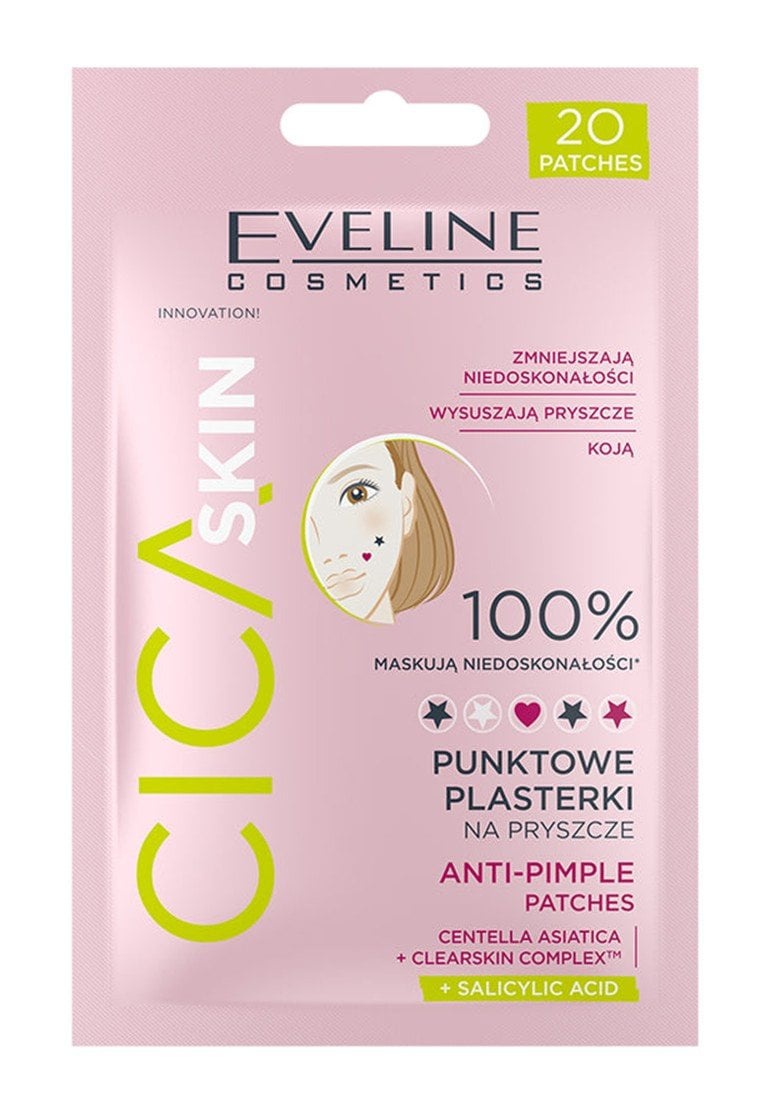
Cica Skin Anti-Pimple Patches
Highlights
Key Ingredients
Other Ingredients
Skim through
| Ingredient name | what-it-does | irr., com. | ID-Rating |
|---|---|---|---|
| Cellulose Gum | viscosity controlling | 0, 0 | |
| Paraffinum Liquidum | emollient, solvent | 0, 0-2 | |
| Hydrogenated Poly(C6-20 Olefin) | abrasive/scrub, viscosity controlling | ||
| Styrene/Isoprene Copolymer | |||
| Polyisobutene | viscosity controlling | ||
| Salicylic Acid | exfoliant, anti-acne, soothing, preservative | superstar | |
| Ricinus Communis Seed Oil | emollient, perfuming | 0, 0-1 | |
| Chrysanthellum Indicum Extract | |||
| Centella Asiatica Leaf Extract | soothing, antioxidant, moisturizer/humectant | goodie | |
| Pentaerythrityl Tetra-Di-T-Butyl Hydroxyhydrocinnamate | antioxidant, preservative |
Eveline Cica Skin Anti-Pimple PatchesIngredients explained
A cellulose (the big molecule found in the cell wall of green plants) derivative that is used as an emulsion stabilizer and thickener.
The famous or maybe rather infamous mineral oil. The clear oily liquid that is the "cheap by-product" of refining crude oil and the one that gets a lot of heat for its poor provenance. It is a very controversial ingredient with pros and cons and plenty of myths around it. So let us see them:
The pros of mineral oil
Trust us, if something is used for more than 100 years in cosmetic products, it has advantages. Chemically speaking, cosmetic grade mineral oil is a complex mixture of highly refined saturated hydrocarbons with C15-50 chain length. It is not merely a "by-product" but rather a specifically isolated part of petroleum that is very pure and inert.
It is a great emollient and moisturizer working mainly by occlusivity. Occlusivity is one of the basic mechanisms of how moisturizers work and it means that mineral oil sits on top of the skin and hinders so-called trans-epidermal water loss, i.e water evaporating out of your skin. When compared to heavy-duty plant oil, extra virgin coconut oil, the two of them were equally efficient and safe as moisturizers in treating xerosis, a skin condition connected to very dry skin.
The other thing that mineral oil is really good at is being non-irritating to the skin. The chemical composition of plant oils is more complex with many more possible allergens or irritating components, while mineral oil is simple, pure and sensitivity to it is extremely rare. If you check out the classic French pharmacy brands and their moisturizers for the most sensitive, allergy prone skin, they usually contain mineral oil. This is no coincidence.
The cons of mineral oil
The pros of mineral oil can be interpreted as cons if we look at them from another perspective. Not penetrating the skin but mostly just sitting on top of it and not containing biologically active components, like nice fatty acids and vitamins mean that mineral oil does not "nourish" the skin in the way plant oils do. Mineral oil does not give the skin any extra goodness, it is simply a non-irritating moisturizer working mainly by occlusivity.
The myths around mineral oil
Badmouthing mineral oil is a favorite sport of many, it is a cheap material and being connected to petrolatum makes it fairly easy to demonize.
While it is true that industrial grade mineral oil contains carcinogenic components (so-called polycyclic compounds), these are completely removed from cosmetic and food grade mineral oil and there is no scientific data showing that the pure, cosmetic grade version is carcinogenic.
What is more, in terms of the general health effects of mineral oils used in cosmetics, a 2017 study reviewed the data on their skin penetration and concluded that "the cosmetic use of mineral oils and waxes does not present a risk to consumers due to a lack of systemic exposure."
Another super common myth surrounding mineral oil is that it is comedogenic. A 2005 study titled "Is mineral oil comedogenic?" examined this very question and guess what happened? The study concluded that "based on the animal and human data reported, along with the AAD recommendation, it would appear reasonable to conclude that mineral oil is noncomedogenic in humans."
Overall, we feel that the scaremongering around mineral oil is not justified. For dry and super-sensitive skin types it is a great option. However, if you do not like its origin or its heavy feeling or anything else about it, avoiding it has never been easier. Mineral oil has such a bad reputation nowadays that cosmetic companies hardly dare to use it anymore.
 We don't have description for this ingredient yet.
We don't have description for this ingredient yet.
A polymer (big molecule from repeated subunits) that's used as a gloss improver for lipsticks and lipglosses. Its stickiness also helps lip products to stay on longer.
Combined with polyacrylate-13 and polysorbate 20, it forms a very effective tickener-emulsifier trio.
- It's one of the gold standard ingredients for treating problem skin
- It can exfoliate skin both on the surface and in the pores
- It's a potent anti-inflammatory agent
- It's more effective for treating blackheads than acne
- For acne combine it with antibacterial agents like benzoyl peroxide or azelaic acid
Castor oil is sourced from the castor bean plant native to tropical areas in Eastern Africa and the Mediterranean Basin. It is an age-old ingredient (it’s over 4,000 years old!) with many uses including as a shoe polish, food additive and motor lubricant. You would be reasonable to think that putting shoe polish on your face wouldn’t be the best idea, but it turns out castor oil has some unique properties that make it a stalwart in thick and gloss-giving formulas (think lipsticks and highlighters).
So what is so special about it? The answer is its main fatty acid, called ricinoleic acid (85-95%). Unlike other fatty acids, ricinoleic acid has an extra water-loving part (aka -OH group) on its fatty chain that gives Castor Oil several unique properties. First, it is thicker than other oils, then its solubility is different (e.g. dissolves in alcohol but not in mineral oil), and it allows all kinds of chemical modifications other oils do not, hence the lots of Castor oil-derived ingredients. It is also more glossy than other oils, in fact, it creates the highest gloss of all natural oils when applied to the skin. Other than that, it is a very effective emollient and occlusive that reduces skin moisture loss so it is quite common in smaller amounts in moisturizers.
While it is very unlikely (and this is true for pretty much every ingredient), cases of reactions to castor oil have been reported, so if your skin is sensitive, it never hurts to patch test.
We don't have description for this ingredient yet.
We don't have description for this ingredient yet.
Pentaerythrityl Tetra-Di-T-Butyl Hydroxyhydrocinnamate is an antioxidant molecule used in small amounts (less than 0.8%) to help products stay nice longer. More specifically, it is great at preventing discoloration or other types of oxidative degradation. It is a trendy alternative to often bad-mouthed synthetic antioxidant and stabilizer, BHT.
You may also want to take a look at...
| what‑it‑does | viscosity controlling |
| irritancy, com. | 0, 0 |
| what‑it‑does | emollient | solvent |
| irritancy, com. | 0, 0-2 |
| what‑it‑does | abrasive/scrub | viscosity controlling |
| what‑it‑does | viscosity controlling |
| what‑it‑does | exfoliant | anti-acne | soothing | preservative |
| what‑it‑does | emollient | perfuming |
| irritancy, com. | 0, 0-1 |
| what‑it‑does | soothing | antioxidant | moisturizer/humectant |
| what‑it‑does | antioxidant | preservative |