




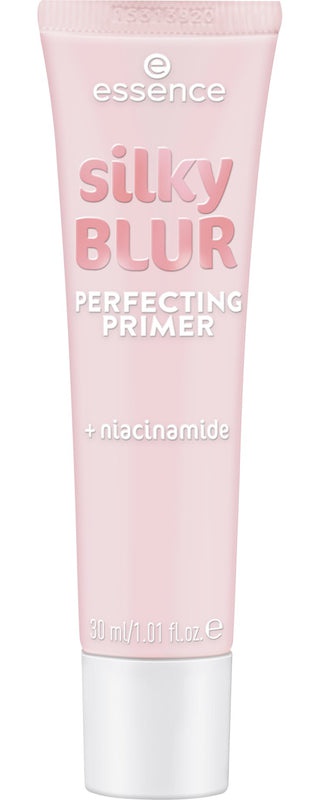
Silky Blur Perfecting Primer
Ingredients overview
Highlights
Key Ingredients
Skim through
Essence Silky Blur Perfecting PrimerIngredients explained
Good old water, aka H2O. The most common skincare ingredient of all. You can usually find it right in the very first spot of the ingredient list, meaning it’s the biggest thing out of all the stuff that makes up the product.
It’s mainly a solvent for ingredients that do not like to dissolve in oils but rather in water.
Once inside the skin, it hydrates, but not from the outside - putting pure water on the skin (hello long baths!) is drying.
One more thing: the water used in cosmetics is purified and deionized (it means that almost all of the mineral ions inside it is removed). Like this, the products can stay more stable over time.
Probably the most common silicone of all. It is a polymer (created from repeating subunits) molecule and has different molecular weight and thus different viscosity versions from water-light to thick liquid.
As for skincare, it makes the skin silky smooth, creates a subtle gloss and forms a protective barrier (aka occlusive). Also, works well to fill in fine lines and wrinkles and give skin a plump look (of course that is only temporary, but still, it's nice). There are also scar treatment gels out there using dimethicone as their base ingredient. It helps to soften scars and increase their elasticity.
As for hair care, it is a non-volatile silicone meaning that it stays on the hair rather than evaporates from it and smoothes the hair like no other thing. Depending on your hair type, it can be a bit difficult to wash out and might cause some build-up (btw, this is not true to all silicones, only the non-volatile types).
- A multi-functional skincare superstar with several proven benefits for the skin
- Great anti-aging, wrinkle smoothing ingredient used at 4-5% concentration
- Fades brown spots alone or in combination with amino sugar, acetyl glucosamine
- Increases ceramide synthesis that results in a stronger, healthier skin barrier and better skin hydration
- Can help to improve several skin conditions including acne, rosacea, and atopic dermatitis
- A natural moisturizer that’s also in our skin
- A super common, safe, effective and cheap molecule used for more than 50 years
- Not only a simple moisturizer but knows much more: keeps the skin lipids between our skin cells in a healthy (liquid crystal) state, protects against irritation, helps to restore barrier
- Effective from as low as 3% with even more benefits for dry skin at higher concentrations up to 20-40%
- High-glycerin moisturizers are awesome for treating severely dry skin
A high-molecular-weight silicone elastomer (rubber-like elastic material) that is usually blended with a base silicone fluid (such as dimethicone or cyclopentasiloxane) to give the formula a silky smooth feel and to act as a thickening agent.
A natural polymer (big molecule from repeated subunits) that can be found in the cell wall of green plants. It is a natural and sustainable helper ingredient that can improve the absorption of the formula and it also reduces oiliness on the skin. It is also used as a sensory additive and thickening agent.
An ingredient that helps water and oil to mix together, aka emulsifier. Chemically speaking, it comes from the attachment of sorbitan (a dehydrated sorbitol (sugar) molecule) with the fatty acid Lauric Acid, that creates a partly water (the sorbitan part) and partly oil soluble (lauric part) molecule.
Sorbitan Laurate is a good team player that likes to work with many other emulsifiers and is compatible with a wide range of other ingredients.
A kind of polymer (big molecule from repeated subunits) that helps to thicken up and stabilize products. It usually comes to the formula as part of some thickener complex. For example, coupled with isohexadecane and polysorbate 80, the trio helps to create soft and supple textures.
A white powdery thing that's the major component of glass and sand. In cosmetics, it’s often in products that are supposed to keep your skin matte as it has great oil-absorbing abilities. It’s also used as a helper ingredient to thicken up products or suspend insoluble particles.
Sunflower does not need a big intro as you probably use it in the kitchen as cooking oil, or you munch on the seeds as a healthy snack or you adore its big, beautiful yellow flower during the summer - or you do all of these and probably even more. And by even more we mean putting it all over your face as sunflower oil is one of the most commonly used plant oils in skincare.
It’s a real oldie: expressed directly from the seeds, the oil is used not for hundreds but thousands of years. According to The National Sunflower Association, there is evidence that both the plant and its oil were used by American Indians in the area of Arizona and New Mexico about 3000 BC. Do the math: it's more than 5000 years – definitely an oldie.
Our intro did get pretty big after all (sorry for that), so let's get to the point finally: sunflower oil - similar to other plant oils - is a great emollient that makes the skin smooth and nice and helps to keep it hydrated. It also protects the surface of the skin and enhances the damaged or irritated skin barrier. Leslie Bauman notes in Cosmetic Dermatology that one application of sunflower oil significantly speeds up the recovery of the skin barrier within an hour and sustains the results 5 hours after using it.
It's also loaded with fatty acids (mostly linoleic (50-74%) and oleic (14-35%)). The unrefined version (be sure to use that on your skin!) is especially high in linoleic acid that is great even for acne-prone skin. Its comedogen index is 0, meaning that it's pretty much an all skin-type oil.
Truth be told, there are many great plant oils and sunflower oil is definitely one of them.
A super common emollient that makes your skin feel nice and smooth. It comes from coconut oil and glycerin, it’s light-textured, clear, odorless and non-greasy. It’s a nice ingredient that just feels good on the skin, is super well tolerated by every skin type and easy to formulate with. No wonder it’s popular.
- Primary fat-soluble antioxidant in our skin
- Significant photoprotection against UVB rays
- Vit C + Vit E work in synergy and provide great photoprotection
- Has emollient properties
- Easy to formulate, stable and relatively inexpensive
A nice-feeling, light emollient that makes the skin soft and smooth. It gives a fresh and gliding sensation with a powdery or soft after-feel depending on the exact grade used. It is a popular alternative to replace silicones.
Chemically speaking, it is an alkane (stable, non-reacting hydrocarbon) that used to be produced from petrochemicals, but today's versions are typically vegetable based. It is readily biodegradable.
A superabsorbent polymer (big molecule from repeated subunits) that has crazy water binding abilities. Sometimes its referred to as "waterlock" and can absorb 100 to 1000 times its mass in water.
As for its use in cosmetic products, it is a handy multi-tasker that thickens up water-based formulas and also has some emulsifying and emulsion stabilizing properties.
The neutralized form of gluconic acid. It's a great ingredient to neutralize metal (especially iron and copper) ions in a cosmetic product. This helps to prevent discoloration of the formula over time or rancidity of cosmetic oils. It can also be a pH regulator and a humectant (helps skin to cling onto water).
It's also used in oral care products where it reduces the bitterness of other ingredients. And it's natural, both Ecocert and Cosmos approved. (source: manufacturer info)
A handy helper ingredient that has photostabilizer properties. It is useful both for color-protecting products so that they do not change color for a long time as well as for stabilizing unstable sunscreen agents, such as famous UVA filter avobenzone.
DESM can also increase critical wavelength (the higher value means more UVA protection) in sunscreens and it can boost SPF by about 5 units in high-SPF products.
If you have spotted ethylhexylglycerin on the ingredient list, most probably you will see there also the current IT-preservative, phenoxyethanol. They are good friends because ethylhexylglycerin can boost the effectiveness of phenoxyethanol (and other preservatives) and as an added bonus it feels nice on the skin too.
Also, it's an effective deodorant and a medium spreading emollient.
A glycerin-derived gentle cleansing agent that is described as being skin and eye-friendly, and not leaving the skin dry or tight. It's also used as a co-emulsifier or solubilizer that helps to blend small amounts of oily things into water-based products.
A mainly oil-loving, vegetable raw material based ingredient that helps water and oil to mix together, aka emulsifier. It can also function as a wetting and dispersing agent helping insoluble particles such as color pigments or inorganic sunscreens (zinc/titanium dioxide) to disperse nice and even in liquids.
Chemically speaking, it comes from the attachment of sorbitan (a dehydrated sorbitol (sugar) molecule) with the unsaturated fatty acid Oleic Acid, that creates a partly water (the sorbitan part) and partly oil soluble (oleic part) molecule.
 We don't have description for this ingredient yet.
We don't have description for this ingredient yet.
The caramel in cosmetics is pretty much the same one that you know from the kitchen. It is derived by controlled heat treatment of food-grade carbohydrates (sugars) and works as a brown colorant.
Squalene is an oily liquid that originally comes from shark liver but luckily it can also be found in a couple of plant oils. Olive (0.6%), peanut (0.1%) and pumpkin (0.35%) oils contain it, though not in huge amounts.
What contains more of it, is the sebum (the oily stuff) that our skin produces. About 13% of human sebum is squalene, which means that it’s an important skin-identical ingredient and NMF (natural moisturizing factor).
Chemically speaking, it is an unsaturated (has double bonds) hydrocarbon (contains only carbon and hydrogen) molecule, that can undergo oxidation. On the pro side, this means that squalene can act as an antioxidant (while its no-double-bond version sister, squalane cannot), but on the con side, squalene is less stable and has a shorter shelf life.
This is probably the main reason why its no-double bond and hence more stable sister, squalane shows up more often on ingredient lists. Read about squalane here >>
It’s pretty much the current IT-preservative. It’s safe and gentle, but even more importantly, it’s not a feared-by-everyone-mostly-without-scientific-reason paraben.
It’s not something new: it was introduced around 1950 and today it can be used up to 1% worldwide. It can be found in nature - in green tea - but the version used in cosmetics is synthetic.
Other than having a good safety profile and being quite gentle to the skin it has some other advantages too. It can be used in many types of formulations as it has great thermal stability (can be heated up to 85°C) and works on a wide range of pH levels (ph 3-10).
It’s often used together with ethylhexylglycerin as it nicely improves the preservative activity of phenoxyethanol.
Exactly what it sounds: nice smelling stuff put into cosmetic products so that the end product also smells nice. Fragrance in the US and parfum in the EU is a generic term on the ingredient list that is made up of 30 to 50 chemicals on average (but it can have as much as 200 components!).
If you are someone who likes to know what you put on your face then fragrance is not your best friend - there's no way to know what’s really in it.
Also, if your skin is sensitive, fragrance is again not your best friend. It’s the number one cause of contact allergy to cosmetics. It’s definitely a smart thing to avoid with sensitive skin (and fragrance of any type - natural is just as allergic as synthetic, if not worse!).
Far from the tin cans you find in the supermarket, Tin Oxide is mostly used when dealing with so-called effect pigments, tricky composite pigments that can do color travel (change color depending on the viewing angle) or give multiple color effect.
It's often found alongside Mica (as a base material) and Titanium Dioxide (as a coating) to give a glossy, pearlescent effect. Together, they make up a trademarked technology called RonaFlair Blanace from the German manufacturer Merck. According to their info, this combination can balance out undesirable tones in the skin, making it a popular choice for brightening products and highlighters.
Other than that, CosIng (the official EU INCI database) lists its uses as being a bulking agent (to increase the volume of products), as well as a physical exfoliant or an opacifying agent, but being part of composite effect pigments is a much more common use case.
We don't have description for this ingredient yet.
We don't have description for this ingredient yet.
Ci 77891 is the color code of titanium dioxide. It's a white pigment with great color consistency and dispersibility.
You may also want to take a look at...
| what‑it‑does | solvent |
| what‑it‑does | emollient |
| irritancy, com. | 0, 1 |
| what‑it‑does | cell-communicating ingredient | skin brightening | anti-acne | moisturizer/humectant |
| what‑it‑does | skin-identical ingredient | moisturizer/humectant |
| irritancy, com. | 0, 0 |
| what‑it‑does | viscosity controlling |
| what‑it‑does | viscosity controlling |
| what‑it‑does | emulsifying |
| irritancy, com. | 1-2, 1-2 |
| what‑it‑does | viscosity controlling |
| what‑it‑does | viscosity controlling |
| what‑it‑does | emollient |
| irritancy, com. | 0, 0 |
| what‑it‑does | emollient |
| what‑it‑does | antioxidant |
| irritancy, com. | 0-3, 0-3 |
| what‑it‑does | emollient |
| what‑it‑does | viscosity controlling |
| what‑it‑does | emulsifying |
| what‑it‑does | chelating | moisturizer/humectant |
| what‑it‑does | preservative |
| what‑it‑does | surfactant/cleansing | emulsifying |
| what‑it‑does | emulsifying |
| irritancy, com. | 0, 3 |
| what‑it‑does | emollient |
| what‑it‑does | moisturizer/humectant |
| what‑it‑does | colorant |
| what‑it‑does | skin-identical ingredient | antioxidant | emollient |
| what‑it‑does | preservative |
| what‑it‑does | perfuming |
| what‑it‑does | colorant | abrasive/scrub | viscosity controlling |
| what‑it‑does | colorant |
| what‑it‑does | colorant |
| irritancy, com. | 2, 2 |
| what‑it‑does | colorant |
| irritancy, com. | 0, 0 |