




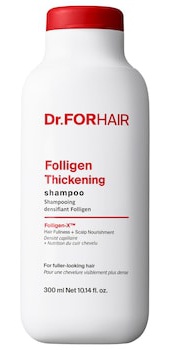
Folligen Thickening Shampoo For Thinning Hair
Ingredients overview
 INCI photo pending approval
Highlights
Key Ingredients
Other Ingredients
Skim through
Dr.ForHair Folligen Thickening Shampoo For Thinning HairIngredients explained
Good old water, aka H2O. The most common skincare ingredient of all. You can usually find it right in the very first spot of the ingredient list, meaning it’s the biggest thing out of all the stuff that makes up the product.
It’s mainly a solvent for ingredients that do not like to dissolve in oils but rather in water.
Once inside the skin, it hydrates, but not from the outside - putting pure water on the skin (hello long baths!) is drying.
One more thing: the water used in cosmetics is purified and deionized (it means that almost all of the mineral ions inside it is removed). Like this, the products can stay more stable over time.
A versatile and biodegradable cleansing agent with high cleaning power and strong foaming properties. Unfortunately, these two properties for a surfactant usually mean that it is harsh on the skin, which is the case here as well.
Super common ingredient in all kinds of cleansing products: face and body washes, shampoos and foam baths.
Number one reason for its popularity has to do with bubbles. Everyone loves bubbles. And cocamidopropyl betaine is great at stabilizing them.
The other reason is that it’s mild and works very well combined with other cleansing agents and surfactants. The art of cleansing is usually to balance between properly cleansing but not over-cleansing and cocamidopropyl betaine is helpful in pulling off this balance right.
Oh, and one more nice thing: even though it’s synthetic it’s highly biodegradable.
More info on CAPB on Collins Beaty Pages.
Sodium chloride is the fancy name of salt. Normal, everyday table salt.
If (similar to us) you are in the weird habit of reading the label on your shower gel while taking a shower, you might have noticed that sodium chloride is almost always on the ingredient list. The reason for this is that salt acts as a fantastic thickener in cleansing formulas created with ionic cleansing agents (aka surfactants) such as Sodium Laureth Sulfate. A couple of percents (typically 1-3%) turns a runny surfactant solution into a nice gel texture.
If you are into chemistry (if not, we understand, just skip this paragraph), the reason is that electrolytes (you know, the Na+ and Cl- ions) screen the electrostatic repulsion between the head groups of ionic surfactants and thus support the formation of long shaped micelles (instead of spherical ones) that entangle like spaghetti, and viola, a gel is formed. However, too much of it causes the phenomenon called "salting out", and the surfactant solution goes runny again.
Other than that, salt also works as an emulsion stabilizer in water-in-oil emulsions, that is when water droplets are dispersed in the outer oil (or silicone) phase. And last but not least, when salt is right at the first spot of the ingredient list (and is not dissolved), the product is usually a body scrub where salt is the physical exfoliating agent.
A helper ingredient that helps to make the products stay nice longer, aka preservative. It works mainly against fungi.
It’s pH dependent and works best at acidic pH levels (3-5). It’s not strong enough to be used in itself so it’s always combined with something else, often with potassium sorbate.
A mild and non-drying cleanser that gives skin a nice and soft after-feel. It also has great foaming properties, comes from coconuts and it's biodegradable.
 We don't have description for this ingredient yet.
Menthol needs no introduction: it's the thing that causes the cooling sensation so well-known both from cosmetic products as well as a bunch of other things like chocolate, chewing gum, toothpaste or cigarette. It's a natural compound that comes from the essential oil of Mentha species (peppermint oil contains 40-50% menthol) and it gives them their typical minty smell and flavor.
As for skincare, menthol seems to be a mixed bag. Apart from the cool cooling sensation (that might last up to 70 mins!), it also has painkilling, itch reducing, antibacterial, antifungal and even penetration enhancing properties. On the other hand, it also seems to act as a skin irritant that increases trans-epidermal water loss (the water that evaporates from the outer layer of the skin) and thus contributes to drying out the skin.
We don't have description for this ingredient yet.
It’s a handy multi-tasking ingredient that gives the skin a nice, soft feel. At the same time, it also boosts the effectiveness of other preservatives, such as the nowadays super commonly used phenoxyethanol.
The blend of these two (caprylyl glycol + phenoxyethanol) is called Optiphen, which not only helps to keep your cosmetics free from nasty things for a long time but also gives a good feel to the finished product. It's a popular duo.
A cellulose derived polymer (a big molecule that consists of many parts) that can help to thicken up products, form a nice film on the skin or hair and is considered to be an excellent hair conditioner.
Ci 77891 is the color code of titanium dioxide. It's a white pigment with great color consistency and dispersibility.
We don't have description for this ingredient yet.
An easy-to-formulate, commonly used, nice to have ingredient that’s also called pro-vitamin B5. As you might guess from the “pro” part, it’s a precursor to vitamin B5 (whose fancy name is pantothenic acid).
Its main job in skincare products is to moisturise the skin. It’s a humectant meaning that it can help the skin to attract water and then hold onto it. There is also research showing that panthenol can help our skin to produce more lovely lipids that are important for a strong and healthy skin barrier.
Another great thing about panthenol is that it has anti-inflammatory and skin protecting abilities. A study shows that it can reduce the irritation caused by less-nice other ingredients (e.g. fragrance, preservatives or chemical sunscreens) in the product.
Research also shows that it might be useful for wound healing as it promotes fibroblast (nice type of cells in our skin that produce skin-firming collagen) proliferation.
If that wasn’t enough panthenol is also useful in nail and hair care products. A study shows that a nail treatment liquide with 2% panthenol could effectively get into the nail and significantly increase the hydration of it.
As for the hair the hydration effect is also true there. Panthenol might make your hair softer, more elastic and helps to comb your hair more easily.
A menthol-derived cooling agent that is claimed to give a long-lasting cooling effect (similar to menthol itself) while also being moisturizing and less irritating than menthol thanks to the lactic acid part. It's recommended to be used at 0.5-1%.
- It's one of the gold standard ingredients for treating problem skin
- It can exfoliate skin both on the surface and in the pores
- It's a potent anti-inflammatory agent
- It's more effective for treating blackheads than acne
- For acne combine it with antibacterial agents like benzoyl peroxide or azelaic acid
Citric acid comes from citrus fruits and is an AHA. If these magic three letters don’t tell you anything, click here and read our detailed description on glycolic acid, the most famous AHA.
So citric acid is an exfoliant, that can - just like other AHAs - gently lift off the dead skin cells of your skin and make it more smooth and fresh.
There is also some research showing that citric acid with regular use (think three months and 20% concentration) can help sun-damaged skin, increase skin thickness and some nice hydrating things called glycosaminoglycans in the skin.
But according to a comparative study done in 1995, citric acid has less skin improving magic properties than glycolic or lactic acid. Probably that’s why citric acid is usually not used as an exfoliant but more as a helper ingredient in small amounts to adjust the pH of a formulation.
Butylene glycol, or let’s just call it BG, is a multi-tasking colorless, syrupy liquid. It’s a great pick for creating a nice feeling product.
BG’s main job is usually to be a solvent for the other ingredients. Other tasks include helping the product to absorb faster and deeper into the skin (penetration enhancer), making the product spread nicely over the skin (slip agent), and attracting water (humectant) into the skin.
It’s an ingredient whose safety hasn’t been questioned so far by anyone (at least not that we know about). BG is approved by Ecocert and is also used enthusiastically in natural products. BTW, it’s also a food additive.
- A multi-functional skincare superstar with several proven benefits for the skin
- Great anti-aging, wrinkle smoothing ingredient used at 4-5% concentration
- Fades brown spots alone or in combination with amino sugar, acetyl glucosamine
- Increases ceramide synthesis that results in a stronger, healthier skin barrier and better skin hydration
- Can help to improve several skin conditions including acne, rosacea, and atopic dermatitis
Super common little helper ingredient that helps products to remain nice and stable for a longer time. It does so by neutralizing the metal ions in the formula (that usually get into there from water) that would otherwise cause some not so nice changes.
It is typically used in tiny amounts, around 0.1% or less.
A hydrogenated castor oil derivative that is used as an oil gelling agent. It can thicken up both oils as well as silicones.
A film-forming polymer (big molecule from repeated subunits) to create water-resistant sunscreen formulas. It also improves the SPF value of sunscreen formulas (approx. 11-18% boost in SPF per 1% Styrene/Acrylates Copolymer).
It's a type of glycol that - according to the manufacturer - is an extremely good replacement for other glycols like propylene or butylene glycol. Its main job is to be a solvent, but it has also very good antimicrobial properties and acts as a true preservative booster. Also helps with skin hydration without stickiness or tacky feel.
- A natural moisturizer that’s also in our skin
- A super common, safe, effective and cheap molecule used for more than 50 years
- Not only a simple moisturizer but knows much more: keeps the skin lipids between our skin cells in a healthy (liquid crystal) state, protects against irritation, helps to restore barrier
- Effective from as low as 3% with even more benefits for dry skin at higher concentrations up to 20-40%
- High-glycerin moisturizers are awesome for treating severely dry skin
Though its name says acid, it's not really an exfoliant. It's a plant extract with some antioxidant properties. Its main thing in cosmetic products is to neutralize the metal ions in the formula (that usually get into there from water) that would otherwise cause some not so nice changes. It's a natural alternative to sometimes bad-mouthed chelating agents, EDTAs.
A clear, colorless liquid that works as a solvent and viscosity decreasing ingredient. It also has great skin-moisturizing abilities.
Lactobacillus ferment is an interesting probiotic ingredient with some promising properties.
First, according to a 2009 Estee Lauder patent, it’s a DNA repair enzyme and it can help to protect the skin against environmental aggressors.
Second, still according to Estee Lauder research but now from 2012 the ingredient has anti-microbial and anti-inflammatory properties and holds promise in the treatment of acne and rosacea. For the former one 5% was needed to show effectiveness, but for reducing skin sensitivity already 1% showed results.
The anti-acne effect is confirmed also by US manufacturer, Barnet, that says that Lactobacillus ferment is helpful in killing harmful bacteria and creating a healthy balanced microflora. Compared to well-known anti-acne and anti-inflammatory salicylic acid the probiotic worked faster at reducing the size and redness of acne lesions.
It also goes by the trade name Leucidal Liquid SF and can serve in the formula as a natural preservative.
Bottom line: It’s not the most proven ingredient (yet) but definitely a very promising one especially if you have sensitive skin, acne or rosacea.
The unfancy name for it is lye. It’s a solid white stuff that’s very alkaline and used in small amounts to adjust the pH of the product and make it just right.
For example, in case of AHA or BHA exfoliants, the right pH is super-duper important, and pH adjusters like sodium hydroxide are needed.
BTW, lye is not something new. It was already used by ancient Egyptians to help oil and fat magically turn into something else. Can you guess what? Yes, it’s soap. It still often shows up in the ingredient list of soaps and other cleansers.
Sodium hydroxide in itself is a potent skin irritant, but once it's reacted (as it is usually in skin care products, like exfoliants) it is totally harmless.
We don't have description for this ingredient yet.
Lonicera Japonica, or Japanese Honeysuckle as normal people call it, is a white-flowered honeysuckle known for being a traditional Chinese medicine. Modern research confirms that the plant has a super complex chemical composition with more than 140 compounds identified with possible anti-inflammatory, antibacterial, antiviral, antioxidative and hepatoprotective activities.
As for Lonicera Japonica Flower Extract in skin care, it can have two main roles. The first one is being an anti-inflammatory and soothing ingredient, probably due to chlorogenic acid, a polyphenol thought to be the main bioactive component of the flower.
The other possible role is being a natural preservative. If this is the case, it is coupled with its Italian Honeysuckle cousin to form a broad spectrum antimicrobial preservative blend. You can read about this more here.
A traditional Chinese herbal medicine loaded with potent antioxidant and anti-inflammatory flavonoids such as baicalin, baicalein, and wogonin.
If that would not be enough, Skullcap Root is also claimed to have antimicrobial and antifungal properties (also against P.acnes and Malassezia furfur) as well as some skin-brightening activity. A multi-functional skin-goodie.
A handy helper ingredient that helps products to remain nice and stable for a longer time. It does so by neutralizing the metal ions in the formula (that usually get into there from water) that would otherwise cause some not so nice changes.
A really multi-functional helper ingredient that can do several things in a skincare product: it can bring a soft and pleasant feel to the formula, it can act as a humectant and emollient, it can be a solvent for some other ingredients (for example it can help to stabilize perfumes in watery products) and it can also help to disperse pigments more evenly in makeup products. And that is still not all: it can also boost the antimicrobial activity of preservatives.
A semi-essential (infants cannot synthesize it, but adults can) amino acid that is one of the primary building blocks of hair keratin and skin collagen. It's a natural moisturizing factor, a skin hydrator and might also help to speed up wound healing.
Arginine usually has a positive charge (cationic) that makes it substantive to skin and hair (those are more negatively charged surfaces) and an excellent film former. Thanks to the positive charge, it also creates a complex with AHAs (AHAs like to lose a hydrogen ion and be negatively charged, so the positive and the negative ions attract each other) that causes a "time-release AHA effect" and reduces the irritation associated with AHAs.
Also called vitamin H, biotin is the main component of many enzymes in our body. A nice ingredient to take as a supplement for stronger nails and hair. When you do not take it as a supplement its effects are a bit more questionable but according to manufacturer info it can smooth the skin and strengthen the hair.
We don't have description for this ingredient yet.
One of the many types of ceramides that can be found naturally in the upper layer of the skin. Ceramides make up about 50% of the goopy stuff that's between our skin cells and play a super important role in having a healthy skin barrier and keeping the skin hydrated. It works even better when combined with its pal, Ceramide 1.
We wrote way more about ceramides at ceramide 1, so click here to know more.
We don't have description for this ingredient yet.
Hello, our favorite molecule that helps us wake up in the morning and then keeps us going through the day. As a super well-known stimulant from coffee, tea and plenty of other soft drinks, Caffeine needs no introduction. So we will skip right to the part where we talk about what the hell it does in so-so many cosmetic products.
Looking at the research, we were surprised to find how versatile Caffeine is. It is a small, water-loving molecule with pretty good skin penetration abilties. Once in the skin, it has nice antioxidant properties, meaning that it reduces the formation of evil free radicals and it might even be useful in preventing UV-induced skin cancers.
A well-known thing about Caffeine is that it improves the microcirculation of the blood vessels. Though conventional wisdom and anecdotal evidence says that this property is helpful for dark under-eye circles and puffy eyes, we have to mention that the double-blind research we have found about a 3% caffeine gel concluded that "the overall efficacy of the selected caffeine gel in reducing puffy eyes was not significantly different from that of its gel base." But you know, the proof is in the pudding.
Another thing Caffeine is used for in body care products is its anti-cellulite effects. In theory, it can speed up the lipolysis process (the "fat burning" by our cells) and stimulate the draining lymph system that might lead to the improvement of cellulite. But here again, the evidence that it actually makes a measurable, let alone visible, improvement on actual human beings is limited (we could find only some animal skin studies or caffeine being combined with other actives).
Last, but not least, we have to write about caffeine and hair growth. The theory is that it can inhibit the activity of the 5-α-reductase enzyme that plays an important role in hair loss and allows a renewed growth phase of the hair. We have found some recent and promising research to back this up. A 2017 study compared a 0.2% caffeine liquid with a 5% Minoxidil (an FDA approved active to treat baldness) solution and found that "a caffeine-based topical liquid should be considered as not inferior to minoxidil 5% solution in men with androgenetic alopecia", or English translation means that the caffeine liquid was pretty much as good as the FDA-approved Minoxidil stuff. Not bad!
Overall, we think that caffeine is a very versatile and biologically active ingredient. Even though some of its effects are more hyped up than backed up, it is still a nice to have on many ingredient lists.
The essential oil coming from the leafs of the lovely herb, rosemary. It contains several fragrant components, including the well-known irritant, camphor (around 15%). It has a nice smell, is a potent antioxidant and it's also an antimicrobial agent.
If your skin is sensitive, it's probably a good idea to avoid it.
A relatively new, four amino acid peptide that promises to help combat hair loss alongside red clover extract as part of the trademarked technology Capixyl.
The main thing of Acetyl Tetrapeptide-3 is to stimulate the synthesis of key Extra Cellular Matrix (aka ECM, the gooey stuff between cells that make up the framework of our skin) components in the scalp. According to the manufacturer’s lab studies, the expression of type III collagen increased by 65% and the expression of laminins (anchoring proteins found in the ECM) was up a massive 285%, resulting in a stronger ECM bed for hair anchoring.
Together with red clover extract, the duo has a synergistic action and works to combat hair loss thanks to a neat multi-faceted approach: it not only stimulates important ECM components but also inhibits the DHT-causing 5-a-reductase enzyme (DHT is the annoying hormone largely responsible for male pattern baldness) and reduces micro-inflammation around hair follicles. The manufacturer’s study over 4 months showed the total impact of Capixyl was an increased anagen (growth phase)/telogen (resting phase) ratio of +46%, resulting in significantly denser hair.
All in all, Acetyl Tetrapeptide-3 is a promising ingredient in the fight against hair loss, but as the only results we could find were from the manufacturer, take these claims with a pinch of salt until more research is done.
- GHK-Cu is a copper-peptide complex found naturally in yucky bodily fluids (plasma, saliva, and urine)
- It has unique wound healing properties by stimulating the breakdown of unhealthy, too large collagen in scar tissue and stimulating nice and healthy collagen production afterwards
- It stimulates the production of several important skin-identical ingredients (e.g. collagen, elastin, and glycosaminoglycans)
- It has significant anti-inflammatory and antioxidant effect
- There are a few promising studies showing GHK-Cu can improve skin elasticity, clarity, firmness and reduce lines and wrinkles
- It can improve hair growth by enlarging hair follicles (and bigger follicles produce longer, thicker hair)
- There are some urban legends about possible overdosing or facial hair problems (read more in geeky details)
Exactly what it sounds: nice smelling stuff put into cosmetic products so that the end product also smells nice. Fragrance in the US and parfum in the EU is a generic term on the ingredient list that is made up of 30 to 50 chemicals on average (but it can have as much as 200 components!).
If you are someone who likes to know what you put on your face then fragrance is not your best friend - there's no way to know what’s really in it.
Also, if your skin is sensitive, fragrance is again not your best friend. It’s the number one cause of contact allergy to cosmetics. It’s definitely a smart thing to avoid with sensitive skin (and fragrance of any type - natural is just as allergic as synthetic, if not worse!).
Linalool is a super common fragrance ingredient. It’s kind of everywhere - both in plants and in cosmetic products. It’s part of 200 natural oils including lavender, ylang-ylang, bergamot, jasmine, geranium and it can be found in 90-95% of prestige perfumes on the market.
The problem with linalool is, that just like limonene it oxidises on air exposure and becomes allergenic. That’s why a product containing linalool that has been opened for several months is more likely to be allergenic than a fresh one.
A study made in the UK with 483 people tested the allergic reaction to 3% oxidised linalool and 2.3% had positive test results.
A common fragrance ingredient that smells like jasmine. It is one of the “EU 26 fragrances” that has to be labelled separately because of allergen potential. Best to avoid if your skin is sensitive.
It’s a common fragrance ingredient that is one of the “EU 26 fragrances” that has to be labelled separately (and cannot be simply included in the term “fragrance/perfume” on the label) because of allergen potential. Best to avoid if your skin is sensitive.
A super common and cheap fragrance ingredient. It's in many plants, e.g. rosemary, eucalyptus, lavender, lemongrass, peppermint and it's the main component (about 50-90%) of the peel oil of citrus fruits.
It does smell nice but the problem is that it oxidizes on air exposure and the resulting stuff is not good for the skin. Oxidized limonene can cause allergic contact dermatitis and counts as a frequent skin sensitizer.
Limonene's nr1 function is definitely being a fragrance component, but there are several studies showing that it's also a penetration enhancer, mainly for oil-loving components.
All in all, limonene has some pros and cons, but - especially if your skin is sensitive - the cons probably outweigh the pros.
Citronellol is a very common fragrance ingredient with a nice rose-like odor. In the UK, it’s actually the third most often listed perfume on the ingredient lists.
It can be naturally found in geranium oil (about 30%) or rose oil (about 25%).
As with all fragrance ingredients, citronellol can also cause allergic contact dermatitis and should be avoided if you have perfume allergy. In a 2001 worldwide study with 178 people with known sensitization to fragrances citronellol tested positive in 5.6% of the cases.
There is no known anti-aging or positive skin benefits of the ingredient. It’s in our products to make it smell nice.
You may also want to take a look at...
| what‑it‑does | solvent |
| what‑it‑does | surfactant/cleansing |
| what‑it‑does | surfactant/cleansing |
| what‑it‑does | viscosity controlling |
| what‑it‑does | preservative |
| what‑it‑does | solvent |
| what‑it‑does | surfactant/cleansing |
| what‑it‑does | surfactant/cleansing |
| what‑it‑does | soothing |
| what‑it‑does | surfactant/cleansing | viscosity controlling |
| what‑it‑does | moisturizer/humectant | emollient |
| what‑it‑does | viscosity controlling |
| what‑it‑does | colorant |
| irritancy, com. | 0, 0 |
| what‑it‑does | surfactant/cleansing |
| what‑it‑does | soothing | moisturizer/humectant |
| irritancy, com. | 0, 0 |
| what‑it‑does | exfoliant | anti-acne | soothing | preservative |
| what‑it‑does | buffering |
| what‑it‑does | moisturizer/humectant | solvent |
| irritancy, com. | 0, 1 |
| what‑it‑does | cell-communicating ingredient | skin brightening | anti-acne | moisturizer/humectant |
| what‑it‑does | chelating |
| what‑it‑does | viscosity controlling |
| what‑it‑does | emollient |
| what‑it‑does | solvent |
| what‑it‑does | skin-identical ingredient | moisturizer/humectant |
| irritancy, com. | 0, 0 |
| what‑it‑does | chelating |
| what‑it‑does | preservative |
| what‑it‑does | solvent |
| what‑it‑does | soothing | preservative |
| what‑it‑does | buffering |
| what‑it‑does | moisturizer/humectant |
| what‑it‑does | soothing | antimicrobial/antibacterial |
| what‑it‑does | soothing | antioxidant | antimicrobial/antibacterial | moisturizer/humectant |
| what‑it‑does | chelating |
| what‑it‑does | solvent |
| what‑it‑does | skin-identical ingredient |
| what‑it‑does | skin-identical ingredient |
| what‑it‑does | moisturizer/humectant |
| what‑it‑does | antioxidant | perfuming |
| what‑it‑does | antioxidant | antimicrobial/antibacterial |
| what‑it‑does | cell-communicating ingredient |
| what‑it‑does | cell-communicating ingredient | soothing | antioxidant |
| what‑it‑does | perfuming |
| what‑it‑does | perfuming |
| what‑it‑does | perfuming |
| what‑it‑does | perfuming |
| what‑it‑does | perfuming | solvent |
| what‑it‑does | perfuming |