




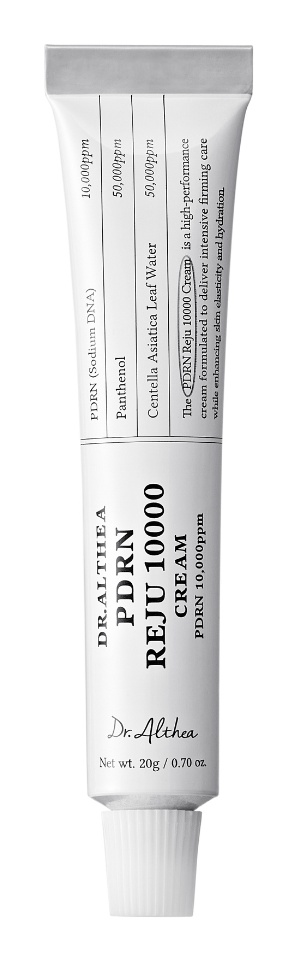
Pdrn Reju 10000 Cream
Ingredients overview
 INCI photo pending approval
Highlights
Key Ingredients
Other Ingredients
Skim through
Dr. Althea Pdrn Reju 10000 CreamIngredients explained
Good old water, aka H2O. The most common skincare ingredient of all. You can usually find it right in the very first spot of the ingredient list, meaning it’s the biggest thing out of all the stuff that makes up the product.
It’s mainly a solvent for ingredients that do not like to dissolve in oils but rather in water.
Once inside the skin, it hydrates, but not from the outside - putting pure water on the skin (hello long baths!) is drying.
One more thing: the water used in cosmetics is purified and deionized (it means that almost all of the mineral ions inside it is removed). Like this, the products can stay more stable over time.
- A natural moisturizer that’s also in our skin
- A super common, safe, effective and cheap molecule used for more than 50 years
- Not only a simple moisturizer but knows much more: keeps the skin lipids between our skin cells in a healthy (liquid crystal) state, protects against irritation, helps to restore barrier
- Effective from as low as 3% with even more benefits for dry skin at higher concentrations up to 20-40%
- High-glycerin moisturizers are awesome for treating severely dry skin
 We don't have description for this ingredient yet.
An easy-to-formulate, commonly used, nice to have ingredient that’s also called pro-vitamin B5. As you might guess from the “pro” part, it’s a precursor to vitamin B5 (whose fancy name is pantothenic acid).
Its main job in skincare products is to moisturise the skin. It’s a humectant meaning that it can help the skin to attract water and then hold onto it. There is also research showing that panthenol can help our skin to produce more lovely lipids that are important for a strong and healthy skin barrier.
Another great thing about panthenol is that it has anti-inflammatory and skin protecting abilities. A study shows that it can reduce the irritation caused by less-nice other ingredients (e.g. fragrance, preservatives or chemical sunscreens) in the product.
Research also shows that it might be useful for wound healing as it promotes fibroblast (nice type of cells in our skin that produce skin-firming collagen) proliferation.
If that wasn’t enough panthenol is also useful in nail and hair care products. A study shows that a nail treatment liquide with 2% panthenol could effectively get into the nail and significantly increase the hydration of it.
As for the hair the hydration effect is also true there. Panthenol might make your hair softer, more elastic and helps to comb your hair more easily.
Butylene glycol, or let’s just call it BG, is a multi-tasking colorless, syrupy liquid. It’s a great pick for creating a nice feeling product.
BG’s main job is usually to be a solvent for the other ingredients. Other tasks include helping the product to absorb faster and deeper into the skin (penetration enhancer), making the product spread nicely over the skin (slip agent), and attracting water (humectant) into the skin.
It’s an ingredient whose safety hasn’t been questioned so far by anyone (at least not that we know about). BG is approved by Ecocert and is also used enthusiastically in natural products. BTW, it’s also a food additive.
A clear, colorless and odorless oily liquid that works as a fast-spreading emollient with a dry skin feel.
A really multi-functional helper ingredient that can do several things in a skincare product: it can bring a soft and pleasant feel to the formula, it can act as a humectant and emollient, it can be a solvent for some other ingredients (for example it can help to stabilize perfumes in watery products) and it can also help to disperse pigments more evenly in makeup products. And that is still not all: it can also boost the antimicrobial activity of preservatives.
Propanediol is a natural alternative for the often used and often bad-mouthed propylene glycol. It's produced sustainably from corn sugar and it's Ecocert approved.
It's quite a multi-tasker: can be used to improve skin moisturization, as a solvent, to boost preservative efficacy or to influence the sensory properties of the end formula.
We don't have description for this ingredient yet.
A multi-functional, silky feeling helper ingredient that can do quite many things. It's used as an emulsion stabilizer, solvent and a broad spectrum antimicrobial. According to manufacturer info, it's also a moisturizer and helps to make the product feel great on the skin. It works synergistically with preservatives and helps to improve water-resistance of sunscreens.
We don't have description for this ingredient yet.
- It’s naturally in our skin and behaves there like a sponge
- It can bind up to 1000 times its own weight in water
- It is a big molecule from repeated subunits (polymer) so different molecular weight versions exist (unfortunately there is no way to determine MW from INCI list only)
- High-molecular-weight-HA (>500 kDa) is an excellent surface hydrator, skin protectant and can act as an osmotic pump helping water-soluble actives to penetrate deeper into the skin
- Low-molecular-weight-HA (< 500 kDa) can hydrate the skin somewhat deeper though it is still a big molecule and works mainly in the epidermis (outer layer of the skin)
- Low-molecular-weight-HA might also help the skin to repair itself by increasing its self-defense (~ 200kDa used in the study)
- Ultra-low-molecular-weight-HA (<50kDa) is a controversial ingredient and might work as a pro-inflammatory signal molecule
Hydrolyzed Hyaluronic Acid is a low molecular weight, chemically chopped up version of the naturally big molecule and current IT-moisturizer, Hyaluronic Acid (HA). The TL; DR version of HA is that it's a huge polymer (big molecule from repeated subunits) found in the skin that acts as a sponge helping the skin to retain water, making it plump and elastic. As HA is a polymer, the subunits can be repeated many times (as a high-molecular-weight version), or just a few times (as a low-molecular-weight version).
We wrote in detail at HA about how different molecular weight versions do different things both as a component of the skin and as a skincare ingredient, so click here and read about all the details. Hydrolyzed Hyaluronic Acid can also come in different molecular-weight versions with different properties:
- 100-300 kDa version: apart from moisturizing, this size might also help the skin to repair itself by increasing its self-defense. It is also claimed to boost the wound healing process and is especially helpful for sensitive skin types (acne, rosacea, inflammation-related skin diseases).
- 50k Da version: this is the size that is claimed to be able to absorb into the skin and plump up wrinkles, so it is used mainly as an "anti-aging ingredient"
- below 50k, around 10k Da version: there is a Japanese version trade named Hyalo-Oligo that has only a 10k molecular weight and is claimed to penetrate the skin very well, have a unique touch and give deep and long-lasting moisturization. Based on the Evonik-research and the natural role of LMW-HA in the body working as a pro-inflammatory signal molecule, this ultra-low molecular weight version is a controversial ingredient.
If you wanna become a real HA-and-the-skin expert, you can read much more about the topic at hyaluronic acid (including penetration-questions, differences between high and low molecular weight versions and a bunch of references to scientific literature).
It’s the - sodium form - cousin of the famous NMF, hyaluronic acid (HA). If HA does not tell you anything we have a super detailed, geeky explanation about it here. The TL; DR version of HA is that it's a huge polymer (big molecule from repeated subunits) found in the skin that acts as a sponge helping the skin to hold onto water, being plump and elastic. HA is famous for its crazy water holding capacity as it can bind up to 1000 times its own weight in water.
As far as skincare goes, sodium hyaluronate and hyaluronic acid are pretty much the same and the two names are used interchangeably. As cosmetic chemist kindofstephen writes on reddit "sodium hyaluronate disassociates into hyaluronic acid molecule and a sodium atom in solution".
In spite of this, if you search for "hyaluronic acid vs sodium hyaluronate" you will find on multiple places that sodium hyaluronate is smaller and can penetrate the skin better. Chemically, this is definitely not true, as the two forms are almost the same, both are polymers and the subunits can be repeated in both forms as much as you like. (We also checked Prospector for sodium hyaluronate versions actually used in cosmetic products and found that the most common molecular weight was 1.5-1.8 million Da that absolutely counts as high molecular weight).
What seems to be a true difference, though, is that the salt form is more stable, easier to formulate and cheaper so it pops up more often on the ingredient lists.
If you wanna become a real HA-and-the-skin expert you can read way more about the topic at hyaluronic acid (including penetration-questions, differences between high and low molecular weight versions and a bunch of references to scientific literature).
You probably know olive oil from the kitchen as a great and healthy option for salad dressing but it's also a great and healthy option to moisturize and nourish the skin, especially if it's on the dry side.
Similar to other emollient plant oils, it's loaded with nourishing fatty acids: oleic is the main component (55-83%), and also contains linoleic (3.5-20%) and palmitic acids (7-20%). It also contains antioxidant polyphenols, tocopherols (types of vitamin E) and carotenoids and it's one of the best plant sources of skin-identical emollient, Squalene.
Overall, a great option for dry skin but less so for acne-prone or damaged skin.
The golden yellow oil coming from the Macadamia nut, a native Australian nut. Similar to other plant oils, it's loaded with emollient and nourishing fatty acids. It's a high oleic acid oil (50-67% oleic acid and only 0-5% linoleic acid) that makes it very emollient and ideal for dry skin types (and less ideal for acne-prone skin).
Its unique property is that it contains high amounts of a rare fatty acid called palmitoleic acid (12-25%) that give Macadamia oil a "cushiony" feel. It's also easily absorbed and makes the skin soft and supple.
We don't have description for this ingredient yet.
The emollient plant oil coming from the kernel (the seed of the seed) of the delicious apricot fruit. Like other plant oils, it contains antioxidant vitamin E and nourishing fatty acids (mostly oleic acid 54-74%, linoleic acid 12-35%).
It's a nice general purpose emollient, has nourishing and moisturizing properties (as a high oleic oil it's ideal for dry skin types) and is quite easily absorbed into the skin.
A clear, colorless, low viscosity, volatile (does not absorb into the skin but rather evaporates from it) silicone fluid that has excellent spreadability and leaves a light, silky and smooth feel on the skin.
According to manufacturer info, its big advantage is that it's compatible both with other silicones and with natural plant oils, so it's a great ingredient to formulate products with good-sounding, consumer-pleasing vegetable oils but still maintain a cosmetically elegant, non-greasy and non-tacky feel.
A hydrocarbon-based emollient that can come in different viscosities from silky-light through satiny-smooth to luxurious, rich. It forms a non-occlusive film on the surface of the skin and brings gloss without greasiness to the formula. It's a very pure and hypoallergenic emollient that's also ideal for baby care products.
A clear, colorless, almost odorless oil that spreads nicely and easily and gives a velvet dry skin feel. It is good friends with sunscreen agents and helps to solubilize them. Also, it makes sunscreens feel lighter and spread easier.
This long-named, polymer molecule (big molecule from repeated subunits) is a helper ingredient that's good at emulsifying and stabilizing oils into water-based formulas. It also acts as a thickening and gelling agent that creates nice, non-sticky and supple textures. It works over a very wide pH range (3-12) and can be used to thicken up low-ph formulas, such as exfoliants. Its recommended used range is 0.3-3%.
A thick, high molecular weight silicone that is usually diluted in another, lighter silicone fluid (like dimethicone or cyclopentasiloxane). The dimethiconol containing silicone blends leave a silky smooth, non-greasy film on the skin.
Though its long name does not reveal it, this polymer molecule (big molecule from repeated subunits or monomers) is a relative to the super common, water-loving thickener, Carbomer. Both of them are big molecules that contain acrylic acid units, but Acrylates/C10-30 Alkyl Acrylate Crosspolymer also contains some other monomers that are hydrophobic, i.e. water-hating.
This means that our molecule is part water- and part oil-loving, so it not only works as a thickener but also as an emulsion stabilizer. It is very common in gel-type formulas that also contain an oil-phase as well as in cleansers as it also works with most cleansing agents (unlike a lot of other thickeners).
An ester that comes from Cetearyl alcohol and the fatty acids of olive oil. It often comes to the formula coupled with Sorbitan Olivate as the two together form the well-known, natural emulsifier trade named Olivem 1000.
Other than helping oil and water to blend, the main thing of Olivem 1000 is generating liquid crystal structures that are similar to the lipid structures of the stratum corneum (the outermost layer of the skin). Thanks to this, Olivem 1000 doubles as an active ingredient with significant moisturizing, barrier-repairing and soothing properties.
It also helps to deliver water-soluble actives such as caffeine more effectively, and can even boost SPF in sunscreen formulas. Its typical use level is 1-5% and has wide compatibility with other actives and oils.
Overall, a real multi-tasker with nice sensorial properties. No wonder it is so popular.
We don't have description for this ingredient yet.
An ester coming from sorbitol and the fatty acids of olive oil. It is part of the popular emulsifier trade named Olivem 1000 that is well-known for generating biomimetic liquid crystal structures. We have more info on Olivem 1000 at Cetearyl Olivate >>
Glyceryl acrylate/acrylic acid copolymer is the fancy word for a common polymer (big molecule from repeated subunits), namely polyacrylic acid (aka carbomer when it comes to cosmetics) with glycerin attached to it in some places.
The main thing of this polymer is that it forms a hydrogel (trade named Lubrajel) that can sit on top of the skin and provide moisturizing, water-soluble ingredients such as glycerin to the skin. Think of it as a very thin, wet sponge that a cosmetic manufacturer can fill with good ingredients for your skin. It also works as a thickening agent (remember, it is a carbomer type of molecule), and can provide the skin with a nice slippery feel. It can also draw water to the skin (thank you, pendant glycerol groups!), providing skin hydration.
Also, don’t let people scare you into thinking polyacrylic acid is dangerous because of the toxicity of acrylic acid. Since acrylic acid is dangerous due to its ability to absorb into the skin (since it’s small), when you chain them together into a polymer (which is big), this danger is no longer significant.
If you have spotted ethylhexylglycerin on the ingredient list, most probably you will see there also the current IT-preservative, phenoxyethanol. They are good friends because ethylhexylglycerin can boost the effectiveness of phenoxyethanol (and other preservatives) and as an added bonus it feels nice on the skin too.
Also, it's an effective deodorant and a medium spreading emollient.
It’s one of those little helper ingredients that makes sure the product stays the same over time. No color change or anything like that. It does so by neutralizing the metal ions in the formula (that usually get into there from water) that would otherwise cause some not so nice changes.
A polymeric (big molecule from repeated subunits) emulsifier that comes from Inulin, a naturally occurring polysaccharide found in the roots and rhizomes of several plants. The emulsifier is obtained by adding oil-loving chains onto inulin. The resulting copolymer can emulsify high amounts of oil and can stabilize oil droplets or non-water soluble particles so that they do not clump together in the formula.
This ingredient name is not according to the INCI-standard. :( What, why?!
- Primary fat-soluble antioxidant in our skin
- Significant photoprotection against UVB rays
- Vit C + Vit E work in synergy and provide great photoprotection
- Has emollient properties
- Easy to formulate, stable and relatively inexpensive
Sh-Oligopeptide-1 is the famous molecule, which is also called Epidermal Growth Factor or EGF. Chemically speaking, Growth Factors are largish peptides or smallish proteins, or to put it in another way, medium-length amino acid sequences (EGF consists of 53 amino acids). Biologically speaking, Growth Factors are cellular signal molecules that can stimulate cell growth, proliferation, healing and/or differentiation.
There are lots of Growth Factors and EGF is just one of them. The topic of "Growth Factors and skincare" is a big, confusing and controversial one and we will try our best to summarize the story for you, including the pros and the cons.
EGF is a special snowflake when it comes to skincare as it was the first Growth Factor that made its way into cosmetic products and it is also the most common one. The American biochemist, Stanley Cohen discovered EGF and was awarded a Noble prize in 1986 for it. As the Noble prize may signify, the molecule is significant and powerful and directly stimulates the proliferation of epidermal cells.
When it comes to Sh-Oligopeptide-1 in a cosmetic product, it has pretty well-established wound healing and skin renewal properties. It might even do more than that. According to a 2012 study on a serum containing barley bioengineered epidermal growth factor, "clinical evaluations showed statistically significant improvement in the appearance of fine lines and rhytids, skin texture, pore size, and various dyschromatic conditions apparent within the first month of use, and continuing improvement trends for the duration of the study" (which was 3 months).
This all sounds amazing, "give me some EGF Serum", we can hear you say! But as we wrote in the intro, the topic is complex and controversial so here are some of the questions that keep coming up around slathering EGF all over our face.
The first and biggest concern is that if EGF is so good at stimulating cell proliferation, how does it relate to cancer? Is the definition of cancer not "cells proliferating out of control"? Most experts agree on this answer: EGF is mitogenic (= stimulates cell proliferation) but not mutagenic (= does not alter the cell to make it cancerous). If you do not have cancer, you will not get cancer from EGF. However, if you have cancerous cells, EGF will help them to spread, just like it helps healthy cells. So if you have a lot of moles, excessive UV exposure in the past, or if you have any of the skin cancer risk factors, we suggest you should think twice about using EGF products. The same is true if you have psoriasis, a skin disease related to the abnormal growth of epidermal skin cells. You do not want to add fuel to the fire with EGF.
Other (less serious) concerns are if EGF can properly penetrate the skin (as it is a medium-sized, polar molecule, so a special delivery system is probably needed), if it can affect collagen synthesis (or just works on the surface plumping up only the upmost layers of the skin) and if it has beneficial effects at all when used in isolation versus when used in a "conditioned media" that contains lots of growth factors resembling the synergistic balance found in the skin.
Overall, our impression is that EGF is definitely a potent molecule. Some EGF products have a cult-like following adding anecdotal evidence to the clinical studies showing EGF has a beneficial effect on the skin. If you like experimenting, by all means, go ahead (unless you have psoriasis or high skin cancer risk factors), but if you are a better safe than sorry type, stick to daily SPF + a good retinoid product. This duo is still the golden standard of anti-aging.
Are you interested in Growth Factors and skincare? We have some more here:
- Human Fibroblast Conditioned Media - a growth factor cocktail used in some cosmetic products
- Insulin-like growth factor 1, aka sh-Oligopeptide -2 - a pal of EGF composed of 70 amino acids
- Vascular Endothelial Growth Factor, aka Sh-Polypeptide-9 - part of a GF cocktail trade named BIO-Placenta
We don't have description for this ingredient yet.
It's a type of glycol that - according to the manufacturer - is an extremely good replacement for other glycols like propylene or butylene glycol. Its main job is to be a solvent, but it has also very good antimicrobial properties and acts as a true preservative booster. Also helps with skin hydration without stickiness or tacky feel.
It's the chemically chopped up version of normal lecithin. Most often it's used to create liposomes and to coat and stabilize other ingredients.
It's one of the important lipids that can be found naturally in the outer layer of the skin. About 25% of the goopy stuff between our skin cells consists of cholesterol. Together with ceramides and fatty acids, they play a vital role in having a healthy skin barrier and keeping the skin hydrated.
Apart from being an important skin-identical ingredient, it's also an emollient and stabilizer.
A glycerin-derived gentle cleansing agent that is described as being skin and eye-friendly, and not leaving the skin dry or tight. It's also used as a co-emulsifier or solubilizer that helps to blend small amounts of oily things into water-based products.
We don't have description for this ingredient yet.
A common fatty acid that can be found in lots of plant oils. Its name, "oleic", means derived from olive oil, a plant oil rich in oleic acid, but avocado, macadamia and marula oils, just to name a few, are also oleic rich.
Its chemical structure is monounsaturated, meaning it has one double bond (cis-9) that makes it less kinky than polyunsaturated fatty acids with multiple double bonds. Less kinkiness means that oleic acid and OA-rich oils are a bit thicker and heavier than their LA-rich siblings.
Maybe this thickness is the reason that Oleic acid is considered comedogenic, and if you have acne-prone skin avoid OA-rich plant oils, and choose linoleic acid-rich versions instead.
The thickness of OA also means that OA-rich oils are considered more nourishing and moisturizing than their LA-rich counterparts, and are generally considered to be more suitable for dry, mature skin types.
As for oleic acid in its free form (and by free we mean that it is not bound up in a triglyceride structure like it is in oils), it mostly serves as an emulsifier or emulsion stabilizer in small amounts in regular cosmetic products. It is also quite well researched and is used in the pharmaceutical industry as a penetration enhancer.
One of the many types of ceramides that can be found naturally in the upper layer of the skin. Ceramides make up about 50% of the goopy stuff that's between our skin cells and play a super important role in having a healthy skin barrier and keeping the skin hydrated. It works even better when combined with its pal, Ceramide 1.
We wrote way more about ceramides at ceramide 1, so click here to know more.
We don't have description for this ingredient yet.
Sodium chloride is the fancy name of salt. Normal, everyday table salt.
If (similar to us) you are in the weird habit of reading the label on your shower gel while taking a shower, you might have noticed that sodium chloride is almost always on the ingredient list. The reason for this is that salt acts as a fantastic thickener in cleansing formulas created with ionic cleansing agents (aka surfactants) such as Sodium Laureth Sulfate. A couple of percents (typically 1-3%) turns a runny surfactant solution into a nice gel texture.
If you are into chemistry (if not, we understand, just skip this paragraph), the reason is that electrolytes (you know, the Na+ and Cl- ions) screen the electrostatic repulsion between the head groups of ionic surfactants and thus support the formation of long shaped micelles (instead of spherical ones) that entangle like spaghetti, and viola, a gel is formed. However, too much of it causes the phenomenon called "salting out", and the surfactant solution goes runny again.
Other than that, salt also works as an emulsion stabilizer in water-in-oil emulsions, that is when water droplets are dispersed in the outer oil (or silicone) phase. And last but not least, when salt is right at the first spot of the ingredient list (and is not dissolved), the product is usually a body scrub where salt is the physical exfoliating agent.
Quercetin is a polyphenol flavonoid found in lots of plants, such as red onions, broccoli, and blueberries. The reason it is in cosmetics is that - similar to other polyphenols - it is a strong antioxidant and has anti-inflammatory properties.
Other than that, a study also showed that adding quercetin to sunscreens helped to stabilize the otherwise not very stable chemical UV filters avobenzone and octinoxate against degradation -- and it did better than traditional stabilizers like octocrylene and vitamin E!
There are also some studies into the use of quercetin as a skin whitening agent, but after some conflicting results, the conclusion is that "quercetin is not effective in cosmetic applications as a whitening ingredient". It also shows minor cytotoxicity when compared to some of its polyphenol derivatives (such as rutin), so quercetin is a good example where more is not better.
We don't have description for this ingredient yet.
It’s a little helper ingredient that helps to set the pH of a cosmetic formulation to be just right.
We don't have description for this ingredient yet.
It's one of the most commonly used thickeners and emulsion stabilizers. If the product is too runny, a little xanthan gum will make it more gel-like. Used alone, it can make the formula sticky and it is a good team player so it is usually combined with other thickeners and so-called rheology modifiers (helper ingredients that adjust the flow and thus the feel of the formula). The typical use level of Xantha Gum is below 1%, it is usually in the 0.1-0.5% range.
Btw, Xanthan gum is all natural, a chain of sugar molecules (polysaccharide) produced from individual sugar molecules (glucose and sucrose) via fermentation. It’s approved by Ecocert and also used in the food industry (E415).
You may also want to take a look at...
| what‑it‑does | solvent |
| what‑it‑does | skin-identical ingredient | moisturizer/humectant |
| irritancy, com. | 0, 0 |
| what‑it‑does | soothing | moisturizer/humectant |
| irritancy, com. | 0, 0 |
| what‑it‑does | moisturizer/humectant | solvent |
| irritancy, com. | 0, 1 |
| what‑it‑does | emollient | solvent |
| what‑it‑does | solvent |
| what‑it‑does | solvent | moisturizer/humectant |
| what‑it‑does | viscosity controlling |
| what‑it‑does | solvent | moisturizer/humectant |
| what‑it‑does | skin-identical ingredient | moisturizer/humectant |
| what‑it‑does | moisturizer/humectant |
| what‑it‑does | skin-identical ingredient | moisturizer/humectant |
| irritancy, com. | 0, 0 |
| what‑it‑does | antioxidant | emollient |
| irritancy, com. | 0, 0-2 |
| what‑it‑does | emollient |
| what‑it‑does | antimicrobial/antibacterial | surfactant/cleansing |
| what‑it‑does | emollient |
| irritancy, com. | 0, 1-2 |
| what‑it‑does | emollient |
| what‑it‑does | emollient | perfuming | solvent |
| what‑it‑does | emollient |
| what‑it‑does | viscosity controlling |
| what‑it‑does | emollient | moisturizer/humectant |
| what‑it‑does | viscosity controlling |
| what‑it‑does | emulsifying |
| what‑it‑does | buffering |
| what‑it‑does | viscosity controlling |
| what‑it‑does | emulsifying |
| what‑it‑does | moisturizer/humectant | viscosity controlling |
| what‑it‑does | preservative |
| what‑it‑does | chelating |
| what‑it‑does | surfactant/cleansing | emulsifying |
| what‑it‑does | viscosity controlling |
| what‑it‑does | antioxidant |
| irritancy, com. | 0-3, 0-3 |
| what‑it‑does | cell-communicating ingredient |
| what‑it‑does | solvent |
| what‑it‑does | emollient | emulsifying |
| what‑it‑does | skin-identical ingredient | emollient |
| irritancy, com. | 0, 0 |
| what‑it‑does | surfactant/cleansing | emulsifying |
| what‑it‑does | soothing |
| what‑it‑does | emollient | emulsifying |
| what‑it‑does | skin-identical ingredient |
| what‑it‑does | viscosity controlling |
| what‑it‑does | antioxidant | soothing |
| what‑it‑does | buffering |
| what‑it‑does | viscosity controlling |
| what‑it‑does | buffering |
| what‑it‑does | viscosity controlling |