




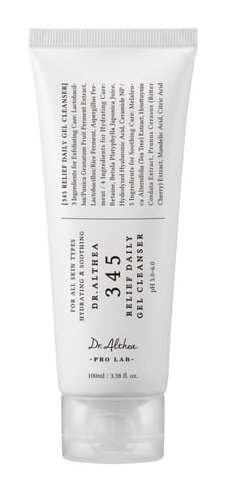
345 Relief Daily Gel Cleanser
Ingredients overview
Highlights
Key Ingredients
Other Ingredients
Skim through
Dr. Althea 345 Relief Daily Gel CleanserIngredients explained
Good old water, aka H2O. The most common skincare ingredient of all. You can usually find it right in the very first spot of the ingredient list, meaning it’s the biggest thing out of all the stuff that makes up the product.
It’s mainly a solvent for ingredients that do not like to dissolve in oils but rather in water.
Once inside the skin, it hydrates, but not from the outside - putting pure water on the skin (hello long baths!) is drying.
One more thing: the water used in cosmetics is purified and deionized (it means that almost all of the mineral ions inside it is removed). Like this, the products can stay more stable over time.
- A natural moisturizer that’s also in our skin
- A super common, safe, effective and cheap molecule used for more than 50 years
- Not only a simple moisturizer but knows much more: keeps the skin lipids between our skin cells in a healthy (liquid crystal) state, protects against irritation, helps to restore barrier
- Effective from as low as 3% with even more benefits for dry skin at higher concentrations up to 20-40%
- High-glycerin moisturizers are awesome for treating severely dry skin
 We don't have description for this ingredient yet.
A soft, mild cleansing agent with amphoteric structure meaning that its head contains both a positively and a negatively charged part (surfactants are most commonly anionic meaning their head has a negative charge). It also has great foaming abilities and is recommended for baby products and other non-irritating cleansers.
Sodium chloride is the fancy name of salt. Normal, everyday table salt.
If (similar to us) you are in the weird habit of reading the label on your shower gel while taking a shower, you might have noticed that sodium chloride is almost always on the ingredient list. The reason for this is that salt acts as a fantastic thickener in cleansing formulas created with ionic cleansing agents (aka surfactants) such as Sodium Laureth Sulfate. A couple of percents (typically 1-3%) turns a runny surfactant solution into a nice gel texture.
If you are into chemistry (if not, we understand, just skip this paragraph), the reason is that electrolytes (you know, the Na+ and Cl- ions) screen the electrostatic repulsion between the head groups of ionic surfactants and thus support the formation of long shaped micelles (instead of spherical ones) that entangle like spaghetti, and viola, a gel is formed. However, too much of it causes the phenomenon called "salting out", and the surfactant solution goes runny again.
Other than that, salt also works as an emulsion stabilizer in water-in-oil emulsions, that is when water droplets are dispersed in the outer oil (or silicone) phase. And last but not least, when salt is right at the first spot of the ingredient list (and is not dissolved), the product is usually a body scrub where salt is the physical exfoliating agent.
Similar to other glycols, it's a helper ingredient used as a solvent, or to thin out thick formulas and make them more nicely spreadable.
Hexylene Glycol is also part a preservative blend named Lexgard® HPO, where it helps the effectiveness of current IT-preservative, phenoxyethanol.
A mild and non-drying cleanser that gives skin a nice and soft after-feel. It also has great foaming properties, comes from coconuts and it's biodegradable.
We don't have description for this ingredient yet.
Though its long name does not reveal it, this polymer molecule (big molecule from repeated subunits or monomers) is a relative to the super common, water-loving thickener, Carbomer. Both of them are big molecules that contain acrylic acid units, but Acrylates/C10-30 Alkyl Acrylate Crosspolymer also contains some other monomers that are hydrophobic, i.e. water-hating.
This means that our molecule is part water- and part oil-loving, so it not only works as a thickener but also as an emulsion stabilizer. It is very common in gel-type formulas that also contain an oil-phase as well as in cleansers as it also works with most cleansing agents (unlike a lot of other thickeners).
We don't have description for this ingredient yet.
A 100% plant derived, natural (Ecocert approved) multi-functional ingredient that has emollient and moisturizing properties, can work as a co-emulsifier (meaning that next to other emulsifiers it can help water and oil to mix) and even more importantly has a strong antimicrobial activity.
Thanks to this last thing, it allows a lower percentage of traditional preservative or it might even be able to completely replace them.
A sugar beet-derived amino acid derivative with nice skin protection and moisturization properties. Betaine's special thing is being an osmolyte, a molecule that helps to control cell-water balance. It is also a natural osmoprotectant, meaning that it attracts water away from the protein surface and thus protects them from denaturation and increases their thermodynamic stability.
It also gives sensorial benefits to the formula and when used in cleansers, it helps to make them milder and gentler.
An amino-acid based cleansing agent that is described as extremely mild and having outstanding foamability. It can also reduce the harshness and leftover of stronger surfactants such as SLS or fatty acid soaps.
A vegetable origin (coconut/palm kernel oil, glucose) cleansing agent that gives moderate to high stable foam. It's also biodegradable and mild to the skin.
A cleansing agent that's claimed to be so gentle on the skin that it hardly impacts the skin barrier. It also gives a rich, creamy foam, it's based on vegetable fatty acids and is readily biodegradable.
It's an especially important and popular ingredient in "syndet bars" (or soapless soaps). Dr. Leslie Baumann says in her great Cosmetic Dermatology book that thanks to the unique molecular characteristic of Sodium Cocoyl Isethionate, it "has defined a new dimension in the mildness of cleansing bars".
A really multi-functional helper ingredient that can do several things in a skincare product: it can bring a soft and pleasant feel to the formula, it can act as a humectant and emollient, it can be a solvent for some other ingredients (for example it can help to stabilize perfumes in watery products) and it can also help to disperse pigments more evenly in makeup products. And that is still not all: it can also boost the antimicrobial activity of preservatives.
We don't have description for this ingredient yet.
Citric acid comes from citrus fruits and is an AHA. If these magic three letters don’t tell you anything, click here and read our detailed description on glycolic acid, the most famous AHA.
So citric acid is an exfoliant, that can - just like other AHAs - gently lift off the dead skin cells of your skin and make it more smooth and fresh.
There is also some research showing that citric acid with regular use (think three months and 20% concentration) can help sun-damaged skin, increase skin thickness and some nice hydrating things called glycosaminoglycans in the skin.
But according to a comparative study done in 1995, citric acid has less skin improving magic properties than glycolic or lactic acid. Probably that’s why citric acid is usually not used as an exfoliant but more as a helper ingredient in small amounts to adjust the pH of a formulation.
It’s a handy multi-tasking ingredient that gives the skin a nice, soft feel. At the same time, it also boosts the effectiveness of other preservatives, such as the nowadays super commonly used phenoxyethanol.
The blend of these two (caprylyl glycol + phenoxyethanol) is called Optiphen, which not only helps to keep your cosmetics free from nasty things for a long time but also gives a good feel to the finished product. It's a popular duo.
A super common emollient that makes your skin feel nice and smooth. It comes from coconut oil and glycerin, it’s light-textured, clear, odorless and non-greasy. It’s a nice ingredient that just feels good on the skin, is super well tolerated by every skin type and easy to formulate with. No wonder it’s popular.
It's the chemically chopped up version of normal lecithin. Most often it's used to create liposomes and to coat and stabilize other ingredients.
One of the many types of ceramides that can be found naturally in the upper layer of the skin. Ceramides make up about 50% of the goopy stuff that's between our skin cells and play a super important role in having a healthy skin barrier and keeping the skin hydrated. It works even better when combined with its pal, Ceramide 1.
We wrote way more about ceramides at ceramide 1, so click here to know more.
It’s one of those little helper ingredients that makes sure the product stays the same over time. No color change or anything like that. It does so by neutralizing the metal ions in the formula (that usually get into there from water) that would otherwise cause some not so nice changes.
Hydrolyzed Hyaluronic Acid is a low molecular weight, chemically chopped up version of the naturally big molecule and current IT-moisturizer, Hyaluronic Acid (HA). The TL; DR version of HA is that it's a huge polymer (big molecule from repeated subunits) found in the skin that acts as a sponge helping the skin to retain water, making it plump and elastic. As HA is a polymer, the subunits can be repeated many times (as a high-molecular-weight version), or just a few times (as a low-molecular-weight version).
We wrote in detail at HA about how different molecular weight versions do different things both as a component of the skin and as a skincare ingredient, so click here and read about all the details. Hydrolyzed Hyaluronic Acid can also come in different molecular-weight versions with different properties:
- 100-300 kDa version: apart from moisturizing, this size might also help the skin to repair itself by increasing its self-defense. It is also claimed to boost the wound healing process and is especially helpful for sensitive skin types (acne, rosacea, inflammation-related skin diseases).
- 50k Da version: this is the size that is claimed to be able to absorb into the skin and plump up wrinkles, so it is used mainly as an "anti-aging ingredient"
- below 50k, around 10k Da version: there is a Japanese version trade named Hyalo-Oligo that has only a 10k molecular weight and is claimed to penetrate the skin very well, have a unique touch and give deep and long-lasting moisturization. Based on the Evonik-research and the natural role of LMW-HA in the body working as a pro-inflammatory signal molecule, this ultra-low molecular weight version is a controversial ingredient.
If you wanna become a real HA-and-the-skin expert, you can read much more about the topic at hyaluronic acid (including penetration-questions, differences between high and low molecular weight versions and a bunch of references to scientific literature).
- It’s a polyhydroxy acid (PHA), that is often referred to as next generation AHA
- It gently lifts off dead skin cells form the skin surface making skin smooth and even
- In the long term it provides anti-aging benefits, like increased skin thickness and decreased wrinkles (though a tad less than even more proven superstar AHAs)
- It’s a great moisturizer and even helps to repair impaired skin barrier
- It’s antioxidant, and does not make your skin more sensitive to the sun
- It can be used even if your skin is very sensitive, rosacea prone or if you are post cosmetic procedure
We don't have description for this ingredient yet.
It's the fancy name for pomegranate enzyme that's obtained by fermenting the pomegranate fruit with Lactobacillus lactis. The fermentation process makes the desired phytochemicals readily available and selective filtration techniques are used to isolate the proteolytic fractions.
The end result is the enzyme that increases cell renewal and can be an alternative to acid exfoliation (though it is not as effective as glycolic acid even according to the manufacturer's measurements not to speak about the other benefits of glycolic acid).
It's an alternative, natural preservative that comes from radishes fermented with Leuconostoc kimchii, a lactic acid bacteria that has been used to make traditional Korean dish, kimchi. During the fermentation process, a peptide is secreted from the bacteria that has significant antimicrobial properties.
It is one of the more promising natural preservatives that can be used even alone (recommended at 2-4%), but it's not as effective as more common alternatives, like parabens or phenoxyethanol.
Houttuynia cordata is a flowering plant native to Southeast Asia. It is eaten as a leaf vegetable, and also has a long history of use in traditional Chinese medicine, including as an attempted treatment for SARS (it didn’t really work). Regarding cosmetics, however, houttuynia cordata extract has a good bit of potential!
The main active components in the plant are these fancy chemicals called flavonoids. Houttuynia cordata specifically has a good amount of polyphenolic flavonoids, four common ones being quercetin, quercitrin, hyperoside, and rutin. All of these exhibit anti-inflammatory, antioxidant, and antibacterial properties. Quercitrin has also been shown to decrease damage from UVB rays, which is an added bonus. One thing to keep in mind, though, is that the flavonoid content of this extract can depend on if the extract is taken from the roots or the leaves, as well as if it’s a water extraction or an alcohol extraction.
Another thing Houttuynia cordata extract contains are polysaccharides, i.e. big molecules from various sugar units (in this case it is galacturonic acid (29.4%), galactose (24.0%), rhamnose (17.2%), arabinose (13.5%), glucuronic acid (6.8%), glucose (5.3%), xylose (2.1%) and mannose (1.8%) ). Polysaccharides and sugars in skincare are excellent humectants and skin hydrators, meaning they help the skin to hold onto water.
Last but not least, we also found an in-vitro (made in test tubes) study showing that houttuynia cordata extract had strong anti-allergic effects and could be helpful in treating skin allergies such as eczema (atopic dermatitis).
We don't have description for this ingredient yet.
- Mandelic acid is an AHA that comes from bitter almond
- It can gently lift off dead surface skin cells and make the skin more smooth and even
- It has antibacterial properties
- It’s promising against acne and post inflammatory hyperpigmentation
- It’s light sensitive, so choose a product with opaque packaging
When it comes to Tea Tree, the essential oil is the one that steals the show with its well-documented antimicrobial and anti-acne effects. The extract is not very well defined, and it probably contains the active components of the oil in much-reduced concentrations. Manufacturers still mention soothing, antimicrobial, purifying and antiseptic properties for the tea tree extract.
We don't have description for this ingredient yet.
We don't have description for this ingredient yet.
We don't have description for this ingredient yet.
You may also want to take a look at...
| what‑it‑does | solvent |
| what‑it‑does | skin-identical ingredient | moisturizer/humectant |
| irritancy, com. | 0, 0 |
| what‑it‑does | surfactant/cleansing |
| what‑it‑does | surfactant/cleansing |
| what‑it‑does | viscosity controlling |
| what‑it‑does | solvent | emulsifying | perfuming | surfactant/cleansing |
| irritancy, com. | 0-1, 0-2 |
| what‑it‑does | surfactant/cleansing |
| what‑it‑does | surfactant/cleansing | viscosity controlling |
| what‑it‑does | viscosity controlling |
| what‑it‑does | preservative |
| what‑it‑does | moisturizer/humectant |
| what‑it‑does | surfactant/cleansing |
| what‑it‑does | surfactant/cleansing |
| what‑it‑does | surfactant/cleansing |
| what‑it‑does | solvent |
| what‑it‑does | surfactant/cleansing | emulsifying | moisturizer/humectant |
| what‑it‑does | buffering |
| what‑it‑does | moisturizer/humectant | emollient |
| what‑it‑does | emollient |
| what‑it‑does | emollient | emulsifying |
| what‑it‑does | skin-identical ingredient |
| what‑it‑does | chelating |
| what‑it‑does | moisturizer/humectant |
| what‑it‑does | exfoliant | chelating |
| what‑it‑does | exfoliant |
| what‑it‑does | exfoliant |
| what‑it‑does | antimicrobial/antibacterial | preservative |
| what‑it‑does | antioxidant | soothing |
| what‑it‑does | perfuming |
| what‑it‑does | exfoliant | antimicrobial/antibacterial |
| what‑it‑does | antimicrobial/antibacterial | perfuming |
| what‑it‑does | antioxidant | moisturizer/humectant |