




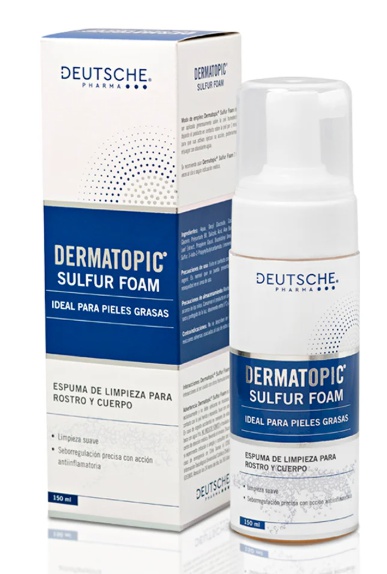
Dermatopica Sulfur Foam
Ingredients overview
Highlights
Key Ingredients
Other Ingredients
Skim through
| Ingredient name | what-it-does | irr., com. | ID-Rating |
|---|---|---|---|
| Water | solvent | ||
| Coco-Betaine | surfactant/cleansing, viscosity controlling | ||
| Decyl Glucoside | surfactant/cleansing | ||
| Cocamide DEA | surfactant/cleansing, viscosity controlling, emulsifying | icky | |
| Polysorbate 80 | emulsifying, surfactant/cleansing | 0, 0 | |
| Sulfur | anti-acne, antimicrobial/antibacterial | 0, 0-3 | goodie |
| Salicylic Acid | exfoliant, anti-acne, soothing, preservative | superstar | |
| Propylene Glycol | moisturizer/humectant, solvent | 0, 0 | |
| Diazolidinyl Urea | preservative | icky | |
| Iodopropynyl Butylcarbamate | preservative |
Deutsche Pharma Dermatopica Sulfur FoamIngredients explained
Good old water, aka H2O. The most common skincare ingredient of all. You can usually find it right in the very first spot of the ingredient list, meaning it’s the biggest thing out of all the stuff that makes up the product.
It’s mainly a solvent for ingredients that do not like to dissolve in oils but rather in water.
Once inside the skin, it hydrates, but not from the outside - putting pure water on the skin (hello long baths!) is drying.
One more thing: the water used in cosmetics is purified and deionized (it means that almost all of the mineral ions inside it is removed). Like this, the products can stay more stable over time.
 We don't have description for this ingredient yet.
A vegetable origin (coconut or palm kernel oil and glucose) cleansing agent with great foaming abilities. It's also mild to the skin and readily biodegradable.
A cleansing agent whose main thing is being a very good team player next to other (anionic) cleaning agents and working as an excellent foam booster and viscosity builder.
The downside of Cocamide DEA is that it may contain residual content of Diethanolamine, a secondary amine known to be a potential source of harmful nitrosamines. But do not panic, Cocamide DEA is considered safe as used in cosmetics, still, the cosmetic industry is actively looking at alternatives and it is used less and less often.
A common little helper ingredient that helps water and oil to mix together, aka emulsifier.
The number at the end refers to the oil-loving part and the bigger the number the more emulsifying power it has. 20 is a weak emulsifier, rather called solubilizer used commonly in toners while 60 and 80 are more common in serums and creams.
A yellowish element that smells of rotten eggs and it might be familiar to you from the periodic table (has the symbol S in there). It has a long history of medicinal use thanks to its antifungal, antibacterial and keratolytic activity. It used to be a very common ingredient in the treatment of inflammation-related skin diseases such as acne, rosacea and seborrheic dermatitis, however, due to its malodorousness, it is less popular nowadays.
Sulfur's precise mechanism of action is not known, but we do know that its effectiveness depends on its direct interaction with the skin surface, meaning the smaller the particle size, the better the effect. The United States Pharmacopeia lists two types of sulfur, sublimed and precipitated. The latter one has a smaller particle size and counts as a superior version.
Sulfur is also a team-player and works well when combined with other anti-acne agents, such as salicylic acid or sodium sulfacetamide. In fact, the combination of 10% sodium sulfacetamide and 5% sulfur is the active ingredient duo of several Rx-only anti-acne products.
As for the disadvantages, there is the rotten egg smell. Also in higher concentrations, it might cause a mild burning sensation and dry skin. If you are new to sulfur, patch testing it first is a good idea.
- It's one of the gold standard ingredients for treating problem skin
- It can exfoliate skin both on the surface and in the pores
- It's a potent anti-inflammatory agent
- It's more effective for treating blackheads than acne
- For acne combine it with antibacterial agents like benzoyl peroxide or azelaic acid
- It's a helper ingredient that improves the freeze-thaw stability of products
- It's also a solvent, humectant and to some extent a penetration enhancer
- It has a bad reputation among natural cosmetics advocates but cosmetic scientists and toxicology experts do not agree (read more in the geeky details section)
An antimicrobial preservative that helps your products not to go wrong too quickly. It works especially well against bacteria, specifically gram-negative species, yeast, and mold.
Somewhat controversial, it belongs to an infamous family of formaldehyde-releasers. That is, it slowly breaks down to form formaldehyde when it is added to a formula. We have written more about formaldehyde-releasing preservatives and the concerns around them at Dmdm Hydantoin, but do not get too scared, those are more theories than proven facts.
As for Diazolidinyl Urea itself, a study from 1990 writes that at concentrations up to 0.4%, it was a mild cumulative skin irritant, but the CIR (Cosmetic Ingredient Review) reviewed it in 2006 and found that, in concentrations of <0.5%, it is safe as used, as the amount of formaldehyde released will be smaller than the recommended limit (of less than 0.2%).
All in all, it is up to your personal decision and skin sensitivity.
It's one of those things that help your cosmetics not to go wrong too soon, aka a preservative. Its strong point is being effective against yeasts and molds, and as a nice bonus seems to be non-comedogenic as well.
It is safe in concentrations of less than 0.1% but is acutely toxic when inhaled, so it's not the proper preservative choice for aerosol formulas like hairsprays. Used at 0.1%, Iodopropynyl Butylcarbamate has an extremely low rate of skin-irritation when applied directly for 24 hours (around 0.1% of 4,883 participants) and after 48 hours that figure was 0.5%, so it counts as mild and safe unless your skin is super-duper sensitive.
You may also want to take a look at...
| what‑it‑does | solvent |
| what‑it‑does | surfactant/cleansing | viscosity controlling |
| what‑it‑does | surfactant/cleansing |
| what‑it‑does | surfactant/cleansing | viscosity controlling | emulsifying |
| what‑it‑does | emulsifying | surfactant/cleansing |
| irritancy, com. | 0, 0 |
| what‑it‑does | anti-acne | antimicrobial/antibacterial |
| irritancy, com. | 0, 0-3 |
| what‑it‑does | exfoliant | anti-acne | soothing | preservative |
| what‑it‑does | moisturizer/humectant | solvent |
| irritancy, com. | 0, 0 |
| what‑it‑does | preservative |
| what‑it‑does | preservative |