




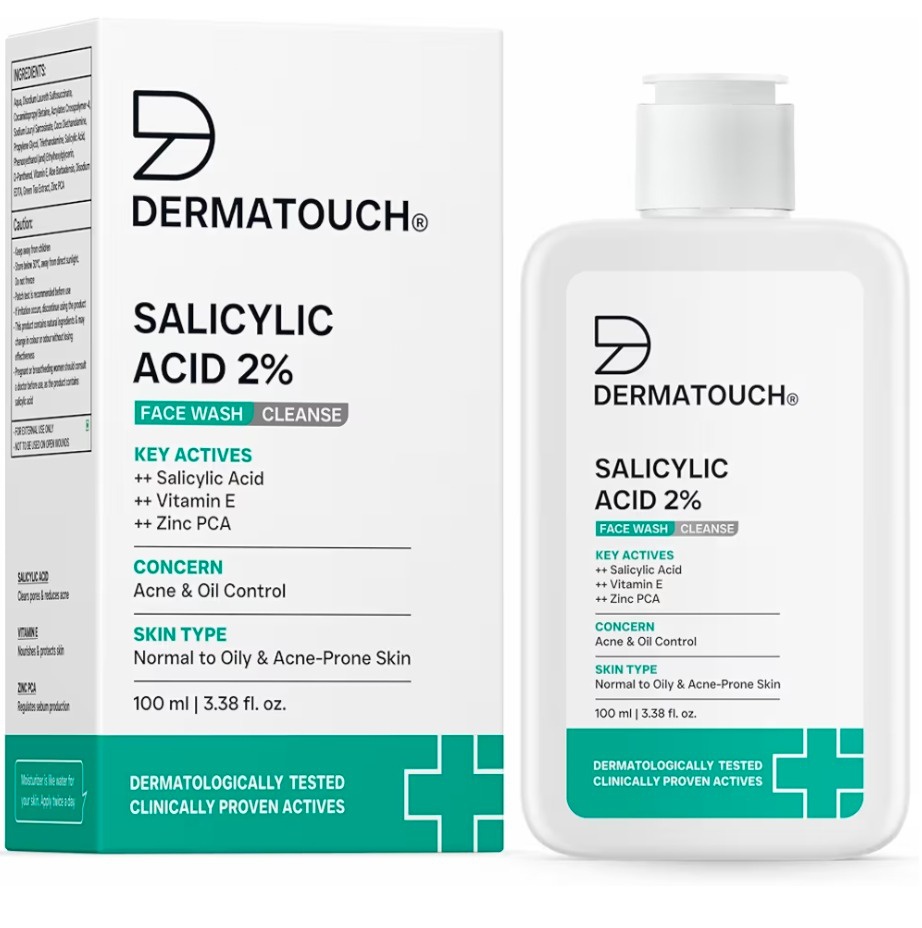
Ingredients overview
Highlights
Key Ingredients
Other Ingredients
Skim through
Dermatouch Salicylic Acid 2%Ingredients explained
Good old water, aka H2O. The most common skincare ingredient of all. You can usually find it right in the very first spot of the ingredient list, meaning it’s the biggest thing out of all the stuff that makes up the product.
It’s mainly a solvent for ingredients that do not like to dissolve in oils but rather in water.
Once inside the skin, it hydrates, but not from the outside - putting pure water on the skin (hello long baths!) is drying.
One more thing: the water used in cosmetics is purified and deionized (it means that almost all of the mineral ions inside it is removed). Like this, the products can stay more stable over time.
A mild, biodegradable cleansing agent that is also a very good team-player next to other cleaning agents. It is known for its good foam-boosing abilities while improving the mildness of the formula. Its performance is similar to Isethionates, another group of cleaning agents known for their gentleness.
Super common ingredient in all kinds of cleansing products: face and body washes, shampoos and foam baths.
Number one reason for its popularity has to do with bubbles. Everyone loves bubbles. And cocamidopropyl betaine is great at stabilizing them.
The other reason is that it’s mild and works very well combined with other cleansing agents and surfactants. The art of cleansing is usually to balance between properly cleansing but not over-cleansing and cocamidopropyl betaine is helpful in pulling off this balance right.
Oh, and one more nice thing: even though it’s synthetic it’s highly biodegradable.
More info on CAPB on Collins Beaty Pages.
A vegetable origin (coconut or palm kernel oil and glucose) cleansing agent with great foaming abilities. It's also mild to the skin and readily biodegradable.
A big polymer molecule that has a bunch of different versions and thus different uses. It can act as a film former, as a thickening agent, or it can increase the water-resistance in sunscreens. It is also used to entrap pigments/inorganic sunscreens within a micron size matrix for even coverage and easy application.
A cleansing agent whose main thing is being a very good team player next to other (anionic) cleaning agents and working as an excellent foam booster and viscosity builder.
The downside of Cocamide DEA is that it may contain residual content of Diethanolamine, a secondary amine known to be a potential source of harmful nitrosamines. But do not panic, Cocamide DEA is considered safe as used in cosmetics, still, the cosmetic industry is actively looking at alternatives and it is used less and less often.
It’s a little helper ingredient that helps to set the pH of a cosmetic formulation to be just right. It’s very alkaline (you know the opposite of being very acidic): a 1% solution has a pH of around 10.
It does not have the very best safety reputation but in general, you do not have to worry about it.
What is true is that if a product contains so-called N-nitrogenating agents (e.g.: preservatives like 2-Bromo-2-Nitropropane-1,3-Diol, 5-Bromo-5-Nitro- 1,3-Dioxane or sodium nitrate - so look out for things with nitro, nitra in the name) that together with TEA can form some not nice carcinogenic stuff (that is called nitrosamines). But with proper formulation that does not happen, TEA in itself is not a bad guy.
But let’s assume a bad combination of ingredients were used and the nitrosamines formed. :( Even in that case you are probably fine because as far as we know it cannot penetrate the skin.
But to be on the safe side, if you see Triethanolamine in an INCI and also something with nitra, nitro in the name of it just skip the product, that cannot hurt.
- It's one of the gold standard ingredients for treating problem skin
- It can exfoliate skin both on the surface and in the pores
- It's a potent anti-inflammatory agent
- It's more effective for treating blackheads than acne
- For acne combine it with antibacterial agents like benzoyl peroxide or azelaic acid
- A multi-functional skincare superstar with several proven benefits for the skin
- Great anti-aging, wrinkle smoothing ingredient used at 4-5% concentration
- Fades brown spots alone or in combination with amino sugar, acetyl glucosamine
- Increases ceramide synthesis that results in a stronger, healthier skin barrier and better skin hydration
- Can help to improve several skin conditions including acne, rosacea, and atopic dermatitis
It’s pretty much the current IT-preservative. It’s safe and gentle, but even more importantly, it’s not a feared-by-everyone-mostly-without-scientific-reason paraben.
It’s not something new: it was introduced around 1950 and today it can be used up to 1% worldwide. It can be found in nature - in green tea - but the version used in cosmetics is synthetic.
Other than having a good safety profile and being quite gentle to the skin it has some other advantages too. It can be used in many types of formulations as it has great thermal stability (can be heated up to 85°C) and works on a wide range of pH levels (ph 3-10).
It’s often used together with ethylhexylglycerin as it nicely improves the preservative activity of phenoxyethanol.
If you have spotted ethylhexylglycerin on the ingredient list, most probably you will see there also the current IT-preservative, phenoxyethanol. They are good friends because ethylhexylglycerin can boost the effectiveness of phenoxyethanol (and other preservatives) and as an added bonus it feels nice on the skin too.
Also, it's an effective deodorant and a medium spreading emollient.
- A natural moisturizer that’s also in our skin
- A super common, safe, effective and cheap molecule used for more than 50 years
- Not only a simple moisturizer but knows much more: keeps the skin lipids between our skin cells in a healthy (liquid crystal) state, protects against irritation, helps to restore barrier
- Effective from as low as 3% with even more benefits for dry skin at higher concentrations up to 20-40%
- High-glycerin moisturizers are awesome for treating severely dry skin
Good old water, aka H2O. The most common skincare ingredient of all. You can usually find it right in the very first spot of the ingredient list, meaning it’s the biggest thing out of all the stuff that makes up the product.
It’s mainly a solvent for ingredients that do not like to dissolve in oils but rather in water.
Once inside the skin, it hydrates, but not from the outside - putting pure water on the skin (hello long baths!) is drying.
One more thing: the water used in cosmetics is purified and deionized (it means that almost all of the mineral ions inside it is removed). Like this, the products can stay more stable over time.
 We don't have description for this ingredient yet.
An easy-to-formulate, commonly used, nice to have ingredient that’s also called pro-vitamin B5. As you might guess from the “pro” part, it’s a precursor to vitamin B5 (whose fancy name is pantothenic acid).
Its main job in skincare products is to moisturise the skin. It’s a humectant meaning that it can help the skin to attract water and then hold onto it. There is also research showing that panthenol can help our skin to produce more lovely lipids that are important for a strong and healthy skin barrier.
Another great thing about panthenol is that it has anti-inflammatory and skin protecting abilities. A study shows that it can reduce the irritation caused by less-nice other ingredients (e.g. fragrance, preservatives or chemical sunscreens) in the product.
Research also shows that it might be useful for wound healing as it promotes fibroblast (nice type of cells in our skin that produce skin-firming collagen) proliferation.
If that wasn’t enough panthenol is also useful in nail and hair care products. A study shows that a nail treatment liquide with 2% panthenol could effectively get into the nail and significantly increase the hydration of it.
As for the hair the hydration effect is also true there. Panthenol might make your hair softer, more elastic and helps to comb your hair more easily.
If you have oily, acne-prone skin, Zinc PCA is one of the actives to put on your "TO TRY" list.
It's a synergistic association of two great things: Zinc and L-PCA. The Zinc part is there to help normalize sebum production and limit the proliferation of evil acne-causing bacteria. L-PCA stands for pyrrolidone carboxylic acid and it's a key molecule in the skin that helps with processes of hydration and energy (it's actually an NMF, a natural moisturizing factor).
L-PCA is not only there to hydrate the skin, but it also helps to increase the efficacy and bioavailability of zinc. An in-vivo (done on real people) test done by the manufacturer shows that Zinc PCA reduces sebum production statistically significantly after 28 days of application (1% was used in the test), and in-vitro (made in the lab) measurements show that Zinc PCA has strong anti-microbial activity against P. acnes (between 0.1-0.25%) and other bacterial strains.
If that would not be enough there is also a 2011 research paper saying that based on in-vitro (made in the lab, not on real people) findings Zinc PCA might be a promising anti-aging active that helps with the production of type I collagen (and we all know more collagen = firmer skin).
All in all, definitely a goodie for oily, acne-prone skin.
Super common little helper ingredient that helps products to remain nice and stable for a longer time. It does so by neutralizing the metal ions in the formula (that usually get into there from water) that would otherwise cause some not so nice changes.
It is typically used in tiny amounts, around 0.1% or less.
It’s the most commonly used version of pure vitamin E in cosmetics. You can read all about the pure form here. This one is the so-called esterified version.
According to famous dermatologist, Leslie Baumann while tocopheryl acetate is more stable and has a longer shelf life, it’s also more poorly absorbed by the skin and may not have the same awesome photoprotective effects as pure Vit E.
You may also want to take a look at...
| what‑it‑does | solvent |
| what‑it‑does | surfactant/cleansing | emulsifying | viscosity controlling |
| what‑it‑does | surfactant/cleansing |
| what‑it‑does | surfactant/cleansing |
| what‑it‑does | viscosity controlling |
| what‑it‑does | surfactant/cleansing | viscosity controlling | emulsifying |
| what‑it‑does | buffering |
| irritancy, com. | 0, 2 |
| what‑it‑does | exfoliant | anti-acne | soothing | preservative |
| what‑it‑does | cell-communicating ingredient | skin brightening | anti-acne | moisturizer/humectant |
| what‑it‑does | preservative |
| what‑it‑does | preservative |
| what‑it‑does | skin-identical ingredient | moisturizer/humectant |
| irritancy, com. | 0, 0 |
| what‑it‑does | solvent |
| what‑it‑does | soothing | moisturizer/humectant |
| irritancy, com. | 0, 0 |
| what‑it‑does | anti-acne | moisturizer/humectant |
| what‑it‑does | chelating |
| what‑it‑does | antioxidant |
| irritancy, com. | 0, 0 |