




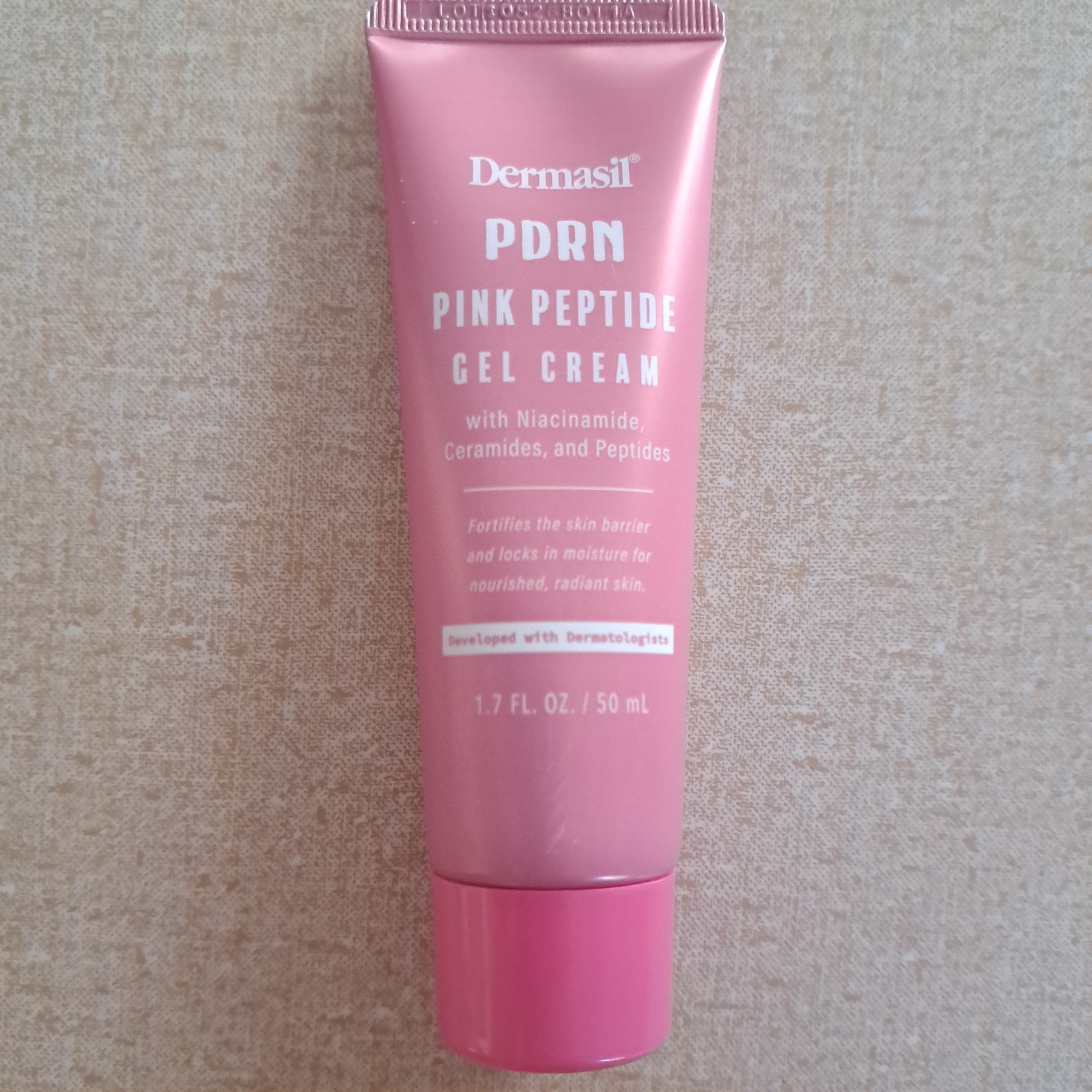
Pink Peptide Gel Cream With Niacinamide, Ceramides, And Peptide
Ingredients overview
Highlights
Key Ingredients
Other Ingredients
Skim through
Dermasil Pink Peptide Gel Cream With Niacinamide, Ceramides, And PeptideIngredients explained
Good old water, aka H2O. The most common skincare ingredient of all. You can usually find it right in the very first spot of the ingredient list, meaning it’s the biggest thing out of all the stuff that makes up the product.
It’s mainly a solvent for ingredients that do not like to dissolve in oils but rather in water.
Once inside the skin, it hydrates, but not from the outside - putting pure water on the skin (hello long baths!) is drying.
One more thing: the water used in cosmetics is purified and deionized (it means that almost all of the mineral ions inside it is removed). Like this, the products can stay more stable over time.
A light emollient ester (C8-10 fatty acids connected to C12-18 fatty alcohols) that absorbs quickly and leaves a dry but silky finish on the skin. In terms of skin feel, it is similar to Dicaprylyl Carbonate, another commonly used light emollient.
An extremely common multitasker ingredient that gives your skin a nice soft feel (emollient) and gives body to creams and lotions. It also helps to stabilize oil-water mixes (emulsions), though it does not function as an emulsifier in itself. Its typical use level in most cream type formulas is 2-3%.
It’s a so-called fatty alcohol, a mix of cetyl and stearyl alcohol, other two emollient fatty alcohols. Though chemically speaking, it is alcohol (as in, it has an -OH group in its molecule), its properties are totally different from the properties of low molecular weight or drying alcohols such as denat. alcohol. Fatty alcohols have a long oil-soluble (and thus emollient) tail part that makes them absolutely non-drying and non-irritating and are totally ok for the skin.
- A natural moisturizer that’s also in our skin
- A super common, safe, effective and cheap molecule used for more than 50 years
- Not only a simple moisturizer but knows much more: keeps the skin lipids between our skin cells in a healthy (liquid crystal) state, protects against irritation, helps to restore barrier
- Effective from as low as 3% with even more benefits for dry skin at higher concentrations up to 20-40%
- High-glycerin moisturizers are awesome for treating severely dry skin
A clear, colorless emollient ester (oily liquid from isopropyl alcohol + palmitic acid) that makes the skin nice and smooth. It has very good spreading properties and gives a silky touch to the products.
A common functional ingredient that helps to keep the oil-loving and water-loving ingredients together (emulsifier), stabilizes and thickens the products.
Chemically speaking, it is ethoxylated Cetearyl alcohol, meaning that some ethylene oxide is added to the fatty alcohol to increase the water-soluble part in the molecule. The result is that the mainly oil soluble, emollient fatty alcohol is converted to an emulsifier molecule that keeps oil and water mixed in creams. The number in the name of Ceteareth emulsifiers refers to the average number of ethylene oxide molecules added and 20 makes a good emulsifier.
- A multi-functional skincare superstar with several proven benefits for the skin
- Great anti-aging, wrinkle smoothing ingredient used at 4-5% concentration
- Fades brown spots alone or in combination with amino sugar, acetyl glucosamine
- Increases ceramide synthesis that results in a stronger, healthier skin barrier and better skin hydration
- Can help to improve several skin conditions including acne, rosacea, and atopic dermatitis
A super common, waxy, white, solid stuff that helps water and oil to mix together, gives body to creams and leaves the skin feeling soft and smooth.
Chemically speaking, it is the attachment of a glycerin molecule to the fatty acid called stearic acid. It can be produced from most vegetable oils (in oils three fatty acid molecules are attached to glycerin instead of just one like here) in a pretty simple, "green" process that is similar to soap making. It's readily biodegradable.
It also occurs naturally in our body and is used as a food additive. As cosmetic chemist Colins writes it, "its safety really is beyond any doubt".
Probably the most common silicone of all. It is a polymer (created from repeating subunits) molecule and has different molecular weight and thus different viscosity versions from water-light to thick liquid.
As for skincare, it makes the skin silky smooth, creates a subtle gloss and forms a protective barrier (aka occlusive). Also, works well to fill in fine lines and wrinkles and give skin a plump look (of course that is only temporary, but still, it's nice). There are also scar treatment gels out there using dimethicone as their base ingredient. It helps to soften scars and increase their elasticity.
As for hair care, it is a non-volatile silicone meaning that it stays on the hair rather than evaporates from it and smoothes the hair like no other thing. Depending on your hair type, it can be a bit difficult to wash out and might cause some build-up (btw, this is not true to all silicones, only the non-volatile types).
- It's a helper ingredient that improves the freeze-thaw stability of products
- It's also a solvent, humectant and to some extent a penetration enhancer
- It has a bad reputation among natural cosmetics advocates but cosmetic scientists and toxicology experts do not agree (read more in the geeky details section)
It seems to us that squalane is in fashion and there is a reason for it. Chemically speaking, it is a saturated (no double bonds) hydrocarbon (a molecule consisting only of carbon and hydrogen), meaning that it's a nice and stable oily liquid with a long shelf life.
It occurs naturally in certain fish and plant oils (e.g. olive), and in the sebum (the oily stuff our skin produces) of the human skin. As f.c. puts it in his awesome blog post, squalane's main things are "emolliency, surface occlusion, and TEWL prevention all with extreme cosmetic elegance". In other words, it's a superb moisturizer that makes your skin nice and smooth, without being heavy or greasy.
Another advantage of squalane is that it is pretty much compatible with all skin types and skin conditions. It is excellent for acne-prone skin and safe to use even if you have fungi-related skin issues, like seborrhea or fungal acne.
The unsaturated (with double bonds) and hence less stable version of Squalane is Squalene, you can read about it here >>
It’s pretty much the current IT-preservative. It’s safe and gentle, but even more importantly, it’s not a feared-by-everyone-mostly-without-scientific-reason paraben.
It’s not something new: it was introduced around 1950 and today it can be used up to 1% worldwide. It can be found in nature - in green tea - but the version used in cosmetics is synthetic.
Other than having a good safety profile and being quite gentle to the skin it has some other advantages too. It can be used in many types of formulations as it has great thermal stability (can be heated up to 85°C) and works on a wide range of pH levels (ph 3-10).
It’s often used together with ethylhexylglycerin as it nicely improves the preservative activity of phenoxyethanol.
It’s a handy multi-tasking ingredient that gives the skin a nice, soft feel. At the same time, it also boosts the effectiveness of other preservatives, such as the nowadays super commonly used phenoxyethanol.
The blend of these two (caprylyl glycol + phenoxyethanol) is called Optiphen, which not only helps to keep your cosmetics free from nasty things for a long time but also gives a good feel to the finished product. It's a popular duo.
Witch hazel is a smallish tree (up to 5m) that's native to North-America, has nice yellow flowers and is similar to the hazelnut bush (hence the name).
As for skincare, it's loaded with active components that have a bunch of magic properties, like astringent, anti-inflammatory, antioxidant and anti-bacterial. It's also a well-known vasoconstrictor (it makes the blood vessels narrower) and promotes the healing of broken skin by tightening up the skin proteins and thus creating a protective covering.
The complication, however, is that different extracts and distillates can be made from different parts of the plant (bark, twigs, and leaves are typically used) and different extraction methods from different parts produce different results. So if you see only Witch Hazel Extract or Witch Hazel Water on the ingredient list, it's a bit hard to know what you're actually getting but we will try to summarize the possibilities to give an idea.
The main biologically active components in Witch Hazel are hamamelitannin (a potent astringent and antioxidant), catechins (anti-inflammatory and antioxidant) and gallic acid (antibacterial). The bark extract contains by far the most hamamelitannin and it has the most gallic acid and catechins. The twigs contain fewer catechins, less gallic acid, and much less hamamelitannin (4.77% vs 0.18%). The leaves contain hardly any tannins (0.04%) or catechins and contain a medium amount of gallic acid (compared to the bark and twigs).
Witch Hazel also contains tiny amounts of the essential oil and fragrance component eugenol, but the amount is so small that it's probably not significant for the skin.
Apart from the differences in active components in different parts of the Witch Hazel bush, the extraction methods also vary. Witch Hazel Distillate contains 14% added alcohol according to the USP specifications and alcohol is, at best drying, and at worst skin-damaging. Luckily, there are also alcohol-free distillates, so if you prefer no alcohol check the ingredient list carefully. Witch Hazel Extracts can also be made in different ways: browsing Ulprospector, we could find hydroglycolic, hydroalcoholic and glicerine/water based extracts.
Well-known skin care expert, Paula Begoun rates witch hazel as poor and says, "depending on the form of witch hazel, you’re exposing your skin either to a sensitizing amount of alcohol or to tannins, or both." This might be the case if you are dealing with an alcoholic witch hazel bark water or extract, but looking at CosIng (the official INCI name listing of the EU), witch hazel bark water or witch hazel bark extract are not listed ingredients. Bark and leaf or bark and twig or all three are used together to create extracts, so the chance that there is too much hamamelitannin in the final cosmetic ingredient seems small. Also alcohol-free extracts and distillates exist; actually, the majority seem to be alcohol-free nowadays. So all in all, we think "Hamamelis Virginiana Extract" on the ingredient list is nothing to worry about.
We even found a German study that compared the efficacy of Hamamelis ointment to panthenol ointment for soothing the skin in children (from 27 days to 11 years old). They observed 309 children and concluded that both ointments were similarly effective but the one with Hamamelis was even better tolerated (98.2% vs. 92.3% tolerated well the ointments in the two groups).
All in all, Witch Hazel Extract is a sloppy INCI name (btw, not in the CosIng listing), and you do not really know what you're getting. Most probably though, you are getting a goody with nice astringent, soothing, antibacterial, and even antioxidant properties.
It’s the most commonly used version of pure vitamin E in cosmetics. You can read all about the pure form here. This one is the so-called esterified version.
According to famous dermatologist, Leslie Baumann while tocopheryl acetate is more stable and has a longer shelf life, it’s also more poorly absorbed by the skin and may not have the same awesome photoprotective effects as pure Vit E.
A little helper ingredient that works as a preservative. It works against bacteria and some species of fungi and yeast. It's often combined with IT-preservative, phenoxyethanol.
A big molecule created from repeated subunits (a polymer of acrylic acid) that magically converts a liquid into a nice gel formula. It usually has to be neutralized with a base (such as sodium hydroxide) for the thickening to occur and it creates viscous, clear gels that also feel nice and non-tacky on the skin. No wonder, it is a very popular and common ingredient. Typically used at 1% or less in most formulations.
The big and important protein molecule that usually comes from animal skin such as fish or bovine. The gist of the "collagen in topical skincare" subject is to know that collagen in a jar has nothing to do with wrinkles but everything to do with skin hydration. We have a shiny explanation about this at soluble collagen, so click here to read more >>
A common fatty acid that can be found in lots of plant oils. Its name, "oleic", means derived from olive oil, a plant oil rich in oleic acid, but avocado, macadamia and marula oils, just to name a few, are also oleic rich.
Its chemical structure is monounsaturated, meaning it has one double bond (cis-9) that makes it less kinky than polyunsaturated fatty acids with multiple double bonds. Less kinkiness means that oleic acid and OA-rich oils are a bit thicker and heavier than their LA-rich siblings.
Maybe this thickness is the reason that Oleic acid is considered comedogenic, and if you have acne-prone skin avoid OA-rich plant oils, and choose linoleic acid-rich versions instead.
The thickness of OA also means that OA-rich oils are considered more nourishing and moisturizing than their LA-rich counterparts, and are generally considered to be more suitable for dry, mature skin types.
As for oleic acid in its free form (and by free we mean that it is not bound up in a triglyceride structure like it is in oils), it mostly serves as an emulsifier or emulsion stabilizer in small amounts in regular cosmetic products. It is also quite well researched and is used in the pharmaceutical industry as a penetration enhancer.
It's one of the important lipids that can be found naturally in the outer layer of the skin. About 25% of the goopy stuff between our skin cells consists of cholesterol. Together with ceramides and fatty acids, they play a vital role in having a healthy skin barrier and keeping the skin hydrated.
Apart from being an important skin-identical ingredient, it's also an emollient and stabilizer.
One of the many types of ceramides that can be found naturally in the upper layer of the skin. Ceramides make up about 50% of the goopy stuff that's between our skin cells and play a super important role in having a healthy skin barrier and keeping the skin hydrated. It works even better when combined with its pal, Ceramide 1.
We wrote way more about ceramides at ceramide 1, so click here to know more.
Super common little helper ingredient that helps products to remain nice and stable for a longer time. It does so by neutralizing the metal ions in the formula (that usually get into there from water) that would otherwise cause some not so nice changes.
It is typically used in tiny amounts, around 0.1% or less.
It’s the - sodium form - cousin of the famous NMF, hyaluronic acid (HA). If HA does not tell you anything we have a super detailed, geeky explanation about it here. The TL; DR version of HA is that it's a huge polymer (big molecule from repeated subunits) found in the skin that acts as a sponge helping the skin to hold onto water, being plump and elastic. HA is famous for its crazy water holding capacity as it can bind up to 1000 times its own weight in water.
As far as skincare goes, sodium hyaluronate and hyaluronic acid are pretty much the same and the two names are used interchangeably. As cosmetic chemist kindofstephen writes on reddit "sodium hyaluronate disassociates into hyaluronic acid molecule and a sodium atom in solution".
In spite of this, if you search for "hyaluronic acid vs sodium hyaluronate" you will find on multiple places that sodium hyaluronate is smaller and can penetrate the skin better. Chemically, this is definitely not true, as the two forms are almost the same, both are polymers and the subunits can be repeated in both forms as much as you like. (We also checked Prospector for sodium hyaluronate versions actually used in cosmetic products and found that the most common molecular weight was 1.5-1.8 million Da that absolutely counts as high molecular weight).
What seems to be a true difference, though, is that the salt form is more stable, easier to formulate and cheaper so it pops up more often on the ingredient lists.
If you wanna become a real HA-and-the-skin expert you can read way more about the topic at hyaluronic acid (including penetration-questions, differences between high and low molecular weight versions and a bunch of references to scientific literature).
If you have spotted ethylhexylglycerin on the ingredient list, most probably you will see there also the current IT-preservative, phenoxyethanol. They are good friends because ethylhexylglycerin can boost the effectiveness of phenoxyethanol (and other preservatives) and as an added bonus it feels nice on the skin too.
Also, it's an effective deodorant and a medium spreading emollient.
The famous omega-6 fatty acid, the mother of all ω-6 fatty acids in our body. It is a so-called polyunsaturated fatty acid meaning it has more than one (in this case two) double bonds and a somewhat kinky structure that makes LA and LA-rich oils a thin liquid.
It is also an essential fatty acid meaning our body cannot synthesize it and has to take it from food. This is not hard at all as plenty of nuts (such as flax, poppy or sesame seeds) and vegetable oils (such as sunflower or safflower) are rich in LA. The hard thing seems to be eating enough omega-3-s, more specifically eating a healthy ratio of omega-6 to omega-3, but that is a topic for a what-is-good-to-eat-site and not for us.
As for linoleic acid and the skin, LA is a really important little guy found naturally in our skin. It is the most abundant fatty acid in the epidermis and it serves as a structural precursor for important skin lipids called ceramides. Knowing this, it will not come as a surprise that Linoleic acid has a central role in the structure and function of stratum corneum permeability, aka healthy skin barrier. LA deficiency leads to an impaired more permeable skin barrier and the topical application of LA-rich sunflower oil can fix this issue rapidly (while oleic-rich olive oil did not have the same barrier repairing effect).
LA is not only important for dry, barrier damaged skin types but also for acne-prone skin. Research shows that problem skin has lower levels of linoleic acid (and higher levels of oleic acid) than normal skin. So LA-deficiency in the skin seems to be connected not only to an impaired skin barrier but also to acne and smearing LA all over your face might help with your problem skin. A double-blind study using a 2.5% LA gel for 4 weeks found a 25% reduction in the size of microcomedones, the tiny blocked pores that can later lead to acne.
If that was not enough, we have one more thing to report about LA. It lightens hyperpigmentation (aka UVB caused sun spots) both by blocking the melanin production of melanocytes (the skin cells that make the pigment melanin) and by enhancing the desquamation of melanin pigment from the upper layers of the skin.
Overall, linoleic acid is a multi-functional skin goodie with barrier repairing, acne-reducing, and skin-lightening magic abilities. It's a nice one to spot on the ingredient list pretty much for any skin type.
The chemically chopped up version of the big protein molecule, collagen. It is often derived from fish or bovine sources and works as a nice moisturizer and humectant that helps the skin to hold onto water.
To understand a bit more what Hydrolyzed Collagen is, you have to know that proteins are large chains of amino acids connected with so-called peptide bonds. These bonds can be broken up when a water molecule is added and the resulting thing is a mix of shorter length amino acids, also called peptides. So Hydrolyzed Collagen is not really collagen, it is rather an undefined and varying mix of largish peptides. Based on a manufacturer's data, the whole, soluble collagen has an average molecular weight of 300 000 Da, while this chopped up mixture has an average MW of 12 000 Da (still pretty big).
The main thing of these largish peptides is to act as water-binding agents, and to make the skin nice and smooth (aka emollient). Hydrolyzed Collagen is also often used in cleansers as it can make harsh surfactants milder and in hair conditioners as it improves the flexibility and manageability of hair.
If you wanna know more about collagen in cosmetics, we have a shiny explanation about soluble collagen here >>
 We don't have description for this ingredient yet.
A pretty famous and better-researched peptide consisting of five amino acids (the building blocks of all proteins). It was created in a joint effort by the French ingredient supplier, Sederma and the cosmetics industry big shot, Procter&Gamble.
The amino acid sequence of the peptide is lysine–threonine–threonine–lysine–serine (KTTKS). Sometimes, it's also called collagen pentapeptide, as it's a subfragment of skin-structure-giving type I collagen. The KTTKS amino sequence is then attached for better oil solubility and skin penetration to palmitic acid and BOOM; we get Palmitoyl Pentapeptide-4.
Though most research is manufacturer sponsored, the clinical studies about Palmitoyl Pentapeptide-4 are promising. In short, it can reduce fine lines, wrinkles and improve skin texture significantly (and at crazy low concentrations, the studies were done with just 3 ppm that is 0.0003%).
There are also studies comparing Palmitoyl Pentapeptide-4 with anti-aging gold standard, retinol. One of them compared 3ppm Pal-KTTKS with 700 ppm (0.07%) retinol and found that they showed similar wrinkle improving ability with the peptide showing better skin tolerability.
Bottom line, if you are into peptides, this is a good one to try.
- GHK-Cu is a copper-peptide complex found naturally in yucky bodily fluids (plasma, saliva, and urine)
- It has unique wound healing properties by stimulating the breakdown of unhealthy, too large collagen in scar tissue and stimulating nice and healthy collagen production afterwards
- It stimulates the production of several important skin-identical ingredients (e.g. collagen, elastin, and glycosaminoglycans)
- It has significant anti-inflammatory and antioxidant effect
- There are a few promising studies showing GHK-Cu can improve skin elasticity, clarity, firmness and reduce lines and wrinkles
- It can improve hair growth by enlarging hair follicles (and bigger follicles produce longer, thicker hair)
- There are some urban legends about possible overdosing or facial hair problems (read more in geeky details)
A really famous peptide that is part of Matrixyl 3000, the most sold peptide complex in the word. Before we go and find out what the big deal with Matrixyl 3000 is, let's just focus on Palmitoyl Tripeptide-1 itself for a bit.
It's a small three amino acid (they are the building blocks of all proteins) peptide with the amino sequence of glycine-histidine-lysine, or GHK. GHK is attached to palmitic acid (a fatty acid) to increase oil solubility and skin penetration.
The GHK part is the important one as it's a type I collagen fragment. When collagen naturally breaks down in the skin, the resulting peptide fragments signal to the skin that it should get to work and create some nice, new collagen. Adding in collagen fragment peptides, like GHK, might trick the skin into thinking that collagen has broken down and it's time to create some more.
Therefore, Palmitoyl Tripeptide-1 is believed to be able to stimulate collagen production in the skin, and more collagen means fewer wrinkles and younger looking skin.
In Matrixyl 3000, Palmitoyl Tripeptide-1 is coupled with Palmitoyl Tetrapeptide-7 and the duo works in synergy to reduce wrinkles and give younger looking skin. According to the manufacturer's in-vivo (made on real people) test, applying 3% Matrixyl 3000 twice a day for 2 months resulted in all of the following things:
- 39.4% reduction in surface occupied by deep wrinkles
- 32.9% reduction in main wrinkle density
- 19.9% reduction in main wrinkle average depth
- 16% improvement in roughness
- 16.2% in lifting effect
- 5.5% improvement in elasticity
- 15.5% improvement in skin tone
Manufacturer results, of course, always have to be taken with a pinch of salt, but if you like peptides, the Matryxil 3000 duo is one of the best-proven and most well-known ones and it's something that is worth trying.
A four amino acid peptide with the amino sequence of glycine-glutamine-proline-arginine. It is attached to palmitic acid (a fatty acid) to increase oil solubility and skin penetration.
It works by reducing the production of the signal molecule, interleukin-6 (IL-6) which promotes inflammation in the skin and less inflammation means slower degradation of important things (like collagen) that results in younger looking skin for a longer time.
It works in synergy with its pal, Palmitoyl Tripeptide-1 in the famous Matrixyl 3000 complex. You can read some more about the famous duo here.
You may also want to take a look at...
| what‑it‑does | solvent |
| what‑it‑does | emollient |
| what‑it‑does | emollient | viscosity controlling | emulsifying | surfactant/cleansing |
| irritancy, com. | 1, 2 |
| what‑it‑does | skin-identical ingredient | moisturizer/humectant |
| irritancy, com. | 0, 0 |
| what‑it‑does | emollient |
| irritancy, com. | 1, 3-4 |
| what‑it‑does | emulsifying | surfactant/cleansing |
| irritancy, com. | 3, 2 |
| what‑it‑does | cell-communicating ingredient | skin brightening | anti-acne | moisturizer/humectant |
| what‑it‑does | emollient | emulsifying |
| irritancy, com. | 0, 1 |
| what‑it‑does | emollient |
| irritancy, com. | 0, 1 |
| what‑it‑does | moisturizer/humectant | solvent |
| irritancy, com. | 0, 0 |
| what‑it‑does | skin-identical ingredient | emollient |
| irritancy, com. | 0, 1 |
| what‑it‑does | preservative |
| what‑it‑does | moisturizer/humectant | emollient |
| what‑it‑does | soothing | antioxidant | antimicrobial/antibacterial |
| what‑it‑does | antioxidant |
| irritancy, com. | 0, 0 |
| what‑it‑does | preservative | antimicrobial/antibacterial |
| what‑it‑does | viscosity controlling |
| irritancy, com. | 0, 1 |
| what‑it‑does | moisturizer/humectant |
| what‑it‑does | emollient | emulsifying |
| what‑it‑does | skin-identical ingredient | emollient |
| irritancy, com. | 0, 0 |
| what‑it‑does | skin-identical ingredient |
| what‑it‑does | chelating |
| what‑it‑does | skin-identical ingredient | moisturizer/humectant |
| irritancy, com. | 0, 0 |
| what‑it‑does | preservative |
| what‑it‑does | skin-identical ingredient | emollient | surfactant/cleansing |
| what‑it‑does | emollient | moisturizer/humectant |
| what‑it‑does | cell-communicating ingredient |
| what‑it‑does | cell-communicating ingredient | soothing | antioxidant |
| what‑it‑does | cell-communicating ingredient |
| what‑it‑does | cell-communicating ingredient |