




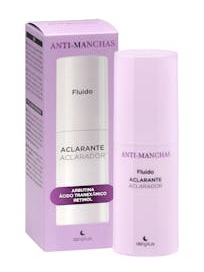
Brightening Fluid
Ingredients overview
 INCI photo pending approval
Highlights
Key Ingredients
Other Ingredients
Skim through
Deliplus Brightening FluidIngredients explained
Good old water, aka H2O. The most common skincare ingredient of all. You can usually find it right in the very first spot of the ingredient list, meaning it’s the biggest thing out of all the stuff that makes up the product.
It’s mainly a solvent for ingredients that do not like to dissolve in oils but rather in water.
Once inside the skin, it hydrates, but not from the outside - putting pure water on the skin (hello long baths!) is drying.
One more thing: the water used in cosmetics is purified and deionized (it means that almost all of the mineral ions inside it is removed). Like this, the products can stay more stable over time.
Propanediol is a natural alternative for the often used and often bad-mouthed propylene glycol. It's produced sustainably from corn sugar and it's Ecocert approved.
It's quite a multi-tasker: can be used to improve skin moisturization, as a solvent, to boost preservative efficacy or to influence the sensory properties of the end formula.
- A multi-functional skincare superstar with several proven benefits for the skin
- Great anti-aging, wrinkle smoothing ingredient used at 4-5% concentration
- Fades brown spots alone or in combination with amino sugar, acetyl glucosamine
- Increases ceramide synthesis that results in a stronger, healthier skin barrier and better skin hydration
- Can help to improve several skin conditions including acne, rosacea, and atopic dermatitis
A light emollient ester (C8-10 fatty acids connected to C12-18 fatty alcohols) that absorbs quickly and leaves a dry but silky finish on the skin. In terms of skin feel, it is similar to Dicaprylyl Carbonate, another commonly used light emollient.
Probably the most common silicone of all. It is a polymer (created from repeating subunits) molecule and has different molecular weight and thus different viscosity versions from water-light to thick liquid.
As for skincare, it makes the skin silky smooth, creates a subtle gloss and forms a protective barrier (aka occlusive). Also, works well to fill in fine lines and wrinkles and give skin a plump look (of course that is only temporary, but still, it's nice). There are also scar treatment gels out there using dimethicone as their base ingredient. It helps to soften scars and increase their elasticity.
As for hair care, it is a non-volatile silicone meaning that it stays on the hair rather than evaporates from it and smoothes the hair like no other thing. Depending on your hair type, it can be a bit difficult to wash out and might cause some build-up (btw, this is not true to all silicones, only the non-volatile types).
A vegetable-derived liquid that's described as "very substantive to skin" by the manufacturer. It gives cushion and spreadability to the formulas and functions as a pigment dispersing agent. It's great to be used in lipsticks or to create inorganic sunscreen (aka titanium dioxide/zinc oxide) dispersions.
This ingredient name is not according to the INCI-standard. :( What, why?!
A pretty well-known and often used ingredient with the magic ability to fade brown spots. It's used traditionally in Japan and can be found naturally in a couple of plants, including the leaves of pear trees, wheat and bearberry.
Arbutin seems to work its magic and hinder the pigmentation process at the second step of it. An enzyme called tyrosinase is needed to create melanin (the pigment that causes the brown spots) and while several other skin lightening agents work to inhibit the synthesis of tyrosinase itself (like vitamin C or licorice), arbutin lets tyrosinase be and rather hinders the melanin-forming activity of the enzyme. (So it might be a good idea to combine arbutin with some direct tyrosinase inhibitors for more skin lightening effect.)
All in all, arbutin is one of the better-known skin brightening agents, that's probably worth a try if pigmentation is an issue for you.
 We don't have description for this ingredient yet.
- Primary fat-soluble antioxidant in our skin
- Significant photoprotection against UVB rays
- Vit C + Vit E work in synergy and provide great photoprotection
- Has emollient properties
- Easy to formulate, stable and relatively inexpensive
It’s the - sodium form - cousin of the famous NMF, hyaluronic acid (HA). If HA does not tell you anything we have a super detailed, geeky explanation about it here. The TL; DR version of HA is that it's a huge polymer (big molecule from repeated subunits) found in the skin that acts as a sponge helping the skin to hold onto water, being plump and elastic. HA is famous for its crazy water holding capacity as it can bind up to 1000 times its own weight in water.
As far as skincare goes, sodium hyaluronate and hyaluronic acid are pretty much the same and the two names are used interchangeably. As cosmetic chemist kindofstephen writes on reddit "sodium hyaluronate disassociates into hyaluronic acid molecule and a sodium atom in solution".
In spite of this, if you search for "hyaluronic acid vs sodium hyaluronate" you will find on multiple places that sodium hyaluronate is smaller and can penetrate the skin better. Chemically, this is definitely not true, as the two forms are almost the same, both are polymers and the subunits can be repeated in both forms as much as you like. (We also checked Prospector for sodium hyaluronate versions actually used in cosmetic products and found that the most common molecular weight was 1.5-1.8 million Da that absolutely counts as high molecular weight).
What seems to be a true difference, though, is that the salt form is more stable, easier to formulate and cheaper so it pops up more often on the ingredient lists.
If you wanna become a real HA-and-the-skin expert you can read way more about the topic at hyaluronic acid (including penetration-questions, differences between high and low molecular weight versions and a bunch of references to scientific literature).
We don't have description for this ingredient yet.
We don't have description for this ingredient yet.
Sunflower does not need a big intro as you probably use it in the kitchen as cooking oil, or you munch on the seeds as a healthy snack or you adore its big, beautiful yellow flower during the summer - or you do all of these and probably even more. And by even more we mean putting it all over your face as sunflower oil is one of the most commonly used plant oils in skincare.
It’s a real oldie: expressed directly from the seeds, the oil is used not for hundreds but thousands of years. According to The National Sunflower Association, there is evidence that both the plant and its oil were used by American Indians in the area of Arizona and New Mexico about 3000 BC. Do the math: it's more than 5000 years – definitely an oldie.
Our intro did get pretty big after all (sorry for that), so let's get to the point finally: sunflower oil - similar to other plant oils - is a great emollient that makes the skin smooth and nice and helps to keep it hydrated. It also protects the surface of the skin and enhances the damaged or irritated skin barrier. Leslie Bauman notes in Cosmetic Dermatology that one application of sunflower oil significantly speeds up the recovery of the skin barrier within an hour and sustains the results 5 hours after using it.
It's also loaded with fatty acids (mostly linoleic (50-74%) and oleic (14-35%)). The unrefined version (be sure to use that on your skin!) is especially high in linoleic acid that is great even for acne-prone skin. Its comedogen index is 0, meaning that it's pretty much an all skin-type oil.
Truth be told, there are many great plant oils and sunflower oil is definitely one of them.
Though its long name does not reveal it, this polymer molecule (big molecule from repeated subunits or monomers) is a relative to the super common, water-loving thickener, Carbomer. Both of them are big molecules that contain acrylic acid units, but Acrylates/C10-30 Alkyl Acrylate Crosspolymer also contains some other monomers that are hydrophobic, i.e. water-hating.
This means that our molecule is part water- and part oil-loving, so it not only works as a thickener but also as an emulsion stabilizer. It is very common in gel-type formulas that also contain an oil-phase as well as in cleansers as it also works with most cleansing agents (unlike a lot of other thickeners).
A form of skincare superstar, vitamin C. If you do not know why vitamin C is such a big deal in skincare, we have a really detailed, geeky description that's good to read. :)
So now you know that because pure vitamin C is such a diva (very unstable and hard to formulate) the cosmetic industry is trying to come up with some derivatives that have the badass anti-aging properties of vitamin C (antioxidant protection + collagen boosting + fading hyperpigmentation) but without the disadvantages. This is a hard task, and there is not yet a derivative that is really proven to be better in every aspect, but Ascorbyl Glucoside is one of the best options when it comes to vitamin C derivatives. Let's see why:
First, it's really stable and easy to formulate, so the problems that come with pure vitamin C are solved here.
Second, in vitro (meaning made in the lab, not on real humans) studies show that ascorbyl glucoside can penetrate the skin. This is kind of important for an anti-aging ingredient to do the job, so this is good news, though in-vivo (made on real humans) studies are still needed.
Third, in-vitro studies show that after ascorbyl glucoside is absorbed into the skin it is converted to pure vitamin C (though the rate of conversion is still a question mark). It also shows all the three anti-aging benefits (antioxidant protection + collagen boosting + fading hyperpigmentation) that pure vitamin C does.
Bottom line: ascorbyl glucoside is one of the best and most promising vitamin C derivatives that shows similar benefits to that of pure vitamin C, but it's less proven (in vivo vs. in vitro studies) and the extent of the benefits are also not the same.
A handy multifunctional ingredient that works as a preservative booster, as well as an antioxidant and soothing agent.
A really multi-functional helper ingredient that can do several things in a skincare product: it can bring a soft and pleasant feel to the formula, it can act as a humectant and emollient, it can be a solvent for some other ingredients (for example it can help to stabilize perfumes in watery products) and it can also help to disperse pigments more evenly in makeup products. And that is still not all: it can also boost the antimicrobial activity of preservatives.
It’s a handy multi-tasking ingredient that gives the skin a nice, soft feel. At the same time, it also boosts the effectiveness of other preservatives, such as the nowadays super commonly used phenoxyethanol.
The blend of these two (caprylyl glycol + phenoxyethanol) is called Optiphen, which not only helps to keep your cosmetics free from nasty things for a long time but also gives a good feel to the finished product. It's a popular duo.
It's one of the most commonly used thickeners and emulsion stabilizers. If the product is too runny, a little xanthan gum will make it more gel-like. Used alone, it can make the formula sticky and it is a good team player so it is usually combined with other thickeners and so-called rheology modifiers (helper ingredients that adjust the flow and thus the feel of the formula). The typical use level of Xantha Gum is below 1%, it is usually in the 0.1-0.5% range.
Btw, Xanthan gum is all natural, a chain of sugar molecules (polysaccharide) produced from individual sugar molecules (glucose and sucrose) via fermentation. It’s approved by Ecocert and also used in the food industry (E415).
Exactly what it sounds: nice smelling stuff put into cosmetic products so that the end product also smells nice. Fragrance in the US and parfum in the EU is a generic term on the ingredient list that is made up of 30 to 50 chemicals on average (but it can have as much as 200 components!).
If you are someone who likes to know what you put on your face then fragrance is not your best friend - there's no way to know what’s really in it.
Also, if your skin is sensitive, fragrance is again not your best friend. It’s the number one cause of contact allergy to cosmetics. It’s definitely a smart thing to avoid with sensitive skin (and fragrance of any type - natural is just as allergic as synthetic, if not worse!).
Though its name says acid, it's not really an exfoliant. It's a plant extract with some antioxidant properties. Its main thing in cosmetic products is to neutralize the metal ions in the formula (that usually get into there from water) that would otherwise cause some not so nice changes. It's a natural alternative to sometimes bad-mouthed chelating agents, EDTAs.
The salt form of one of the main anti-inflammatory ingredients in the licorice plant, monoammonium glycyrrhizinate. It’s a yellowish powder with a nice sweet smell.
It’s used mainly for its soothing and anti-inflammatory properties, but according to manufacturer info, it’s also sebum regulating so it's a perfect ingredient for problem skin products.
Read more about licorice and why it's a skincare superstar here.
We don't have description for this ingredient yet.
The unfancy name for it is lye. It’s a solid white stuff that’s very alkaline and used in small amounts to adjust the pH of the product and make it just right.
For example, in case of AHA or BHA exfoliants, the right pH is super-duper important, and pH adjusters like sodium hydroxide are needed.
BTW, lye is not something new. It was already used by ancient Egyptians to help oil and fat magically turn into something else. Can you guess what? Yes, it’s soap. It still often shows up in the ingredient list of soaps and other cleansers.
Sodium hydroxide in itself is a potent skin irritant, but once it's reacted (as it is usually in skin care products, like exfoliants) it is totally harmless.
It’s pretty much the current IT-preservative. It’s safe and gentle, but even more importantly, it’s not a feared-by-everyone-mostly-without-scientific-reason paraben.
It’s not something new: it was introduced around 1950 and today it can be used up to 1% worldwide. It can be found in nature - in green tea - but the version used in cosmetics is synthetic.
Other than having a good safety profile and being quite gentle to the skin it has some other advantages too. It can be used in many types of formulations as it has great thermal stability (can be heated up to 85°C) and works on a wide range of pH levels (ph 3-10).
It’s often used together with ethylhexylglycerin as it nicely improves the preservative activity of phenoxyethanol.
You may also want to take a look at...
| what‑it‑does | solvent |
| what‑it‑does | solvent | moisturizer/humectant |
| what‑it‑does | cell-communicating ingredient | skin brightening | anti-acne | moisturizer/humectant |
| what‑it‑does | emollient |
| what‑it‑does | emollient |
| irritancy, com. | 0, 1 |
| what‑it‑does | emulsifying |
| what‑it‑does | antioxidant | skin brightening |
| what‑it‑does | antioxidant |
| irritancy, com. | 0-3, 0-3 |
| what‑it‑does | skin-identical ingredient | moisturizer/humectant |
| irritancy, com. | 0, 0 |
| what‑it‑does | emollient |
| irritancy, com. | 0, 0 |
| what‑it‑does | viscosity controlling |
| what‑it‑does | antioxidant | skin brightening |
| what‑it‑does | antioxidant | preservative |
| what‑it‑does | solvent |
| what‑it‑does | moisturizer/humectant | emollient |
| what‑it‑does | viscosity controlling |
| what‑it‑does | perfuming |
| what‑it‑does | chelating |
| what‑it‑does | soothing | moisturizer/humectant |
| what‑it‑does | buffering |
| what‑it‑does | preservative |