




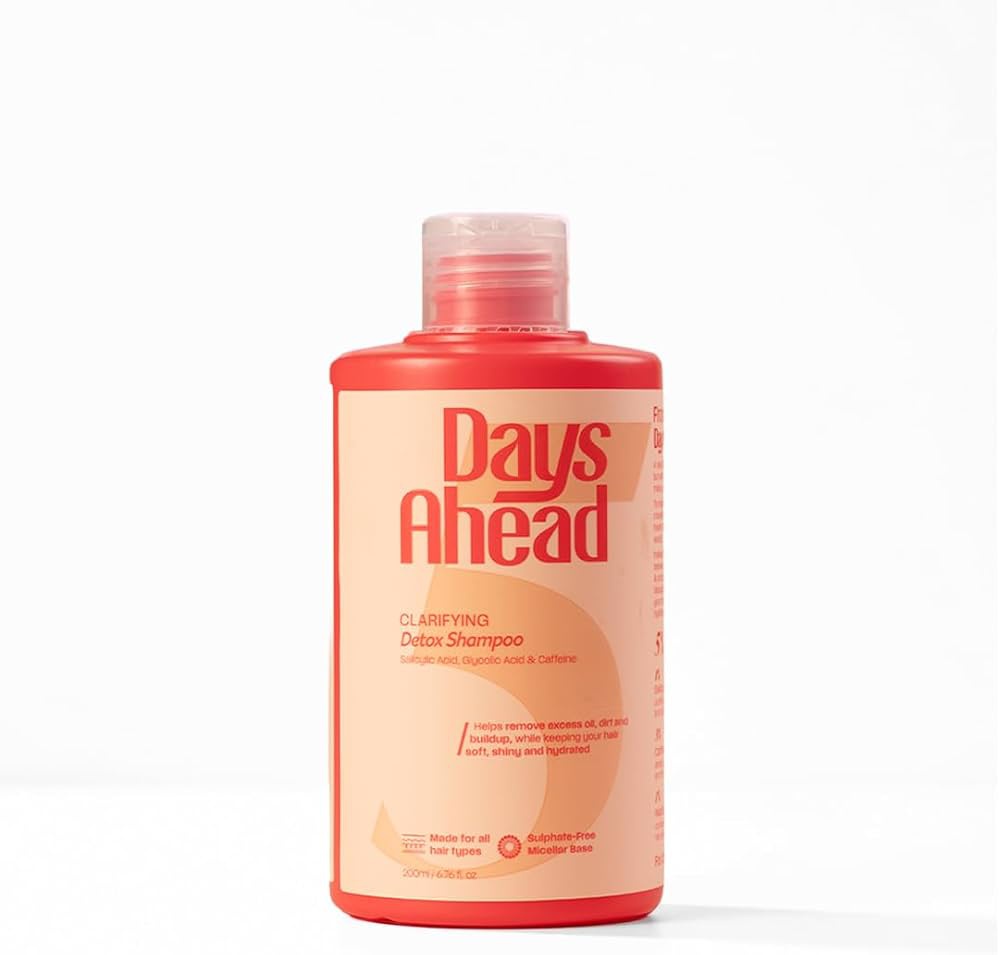
Clarifying Detox Shampoo
Ingredients overview
Highlights
Key Ingredients
Skim through
Days ahead Clarifying Detox ShampooIngredients explained
Good old water, aka H2O. The most common skincare ingredient of all. You can usually find it right in the very first spot of the ingredient list, meaning it’s the biggest thing out of all the stuff that makes up the product.
It’s mainly a solvent for ingredients that do not like to dissolve in oils but rather in water.
Once inside the skin, it hydrates, but not from the outside - putting pure water on the skin (hello long baths!) is drying.
One more thing: the water used in cosmetics is purified and deionized (it means that almost all of the mineral ions inside it is removed). Like this, the products can stay more stable over time.
A mild and non-drying cleanser that gives skin a nice and soft after-feel. It also has great foaming properties, comes from coconuts and it's biodegradable.
A vegetable origin (coconut or palm kernel oil and glucose) cleansing agent with great foaming abilities. It's also mild to the skin and readily biodegradable.
A 100% vegetable origin, biodegradable, mild cleansing agent that gives moderate to high amount of foam. It's happy to work together with other surfactants (in general, that helps to create milder formulas).
A big polymer molecule that has a bunch of different versions and thus different uses. It can act as a film former, as a thickening agent, or it can increase the water-resistance in sunscreens. It is also used to entrap pigments/inorganic sunscreens within a micron size matrix for even coverage and easy application.
Super common ingredient in all kinds of cleansing products: face and body washes, shampoos and foam baths.
Number one reason for its popularity has to do with bubbles. Everyone loves bubbles. And cocamidopropyl betaine is great at stabilizing them.
The other reason is that it’s mild and works very well combined with other cleansing agents and surfactants. The art of cleansing is usually to balance between properly cleansing but not over-cleansing and cocamidopropyl betaine is helpful in pulling off this balance right.
Oh, and one more nice thing: even though it’s synthetic it’s highly biodegradable.
More info on CAPB on Collins Beaty Pages.
- A natural moisturizer that’s also in our skin
- A super common, safe, effective and cheap molecule used for more than 50 years
- Not only a simple moisturizer but knows much more: keeps the skin lipids between our skin cells in a healthy (liquid crystal) state, protects against irritation, helps to restore barrier
- Effective from as low as 3% with even more benefits for dry skin at higher concentrations up to 20-40%
- High-glycerin moisturizers are awesome for treating severely dry skin
An easy-to-formulate, commonly used, nice to have ingredient that’s also called pro-vitamin B5. As you might guess from the “pro” part, it’s a precursor to vitamin B5 (whose fancy name is pantothenic acid).
Its main job in skincare products is to moisturise the skin. It’s a humectant meaning that it can help the skin to attract water and then hold onto it. There is also research showing that panthenol can help our skin to produce more lovely lipids that are important for a strong and healthy skin barrier.
Another great thing about panthenol is that it has anti-inflammatory and skin protecting abilities. A study shows that it can reduce the irritation caused by less-nice other ingredients (e.g. fragrance, preservatives or chemical sunscreens) in the product.
Research also shows that it might be useful for wound healing as it promotes fibroblast (nice type of cells in our skin that produce skin-firming collagen) proliferation.
If that wasn’t enough panthenol is also useful in nail and hair care products. A study shows that a nail treatment liquide with 2% panthenol could effectively get into the nail and significantly increase the hydration of it.
As for the hair the hydration effect is also true there. Panthenol might make your hair softer, more elastic and helps to comb your hair more easily.
 We don't have description for this ingredient yet.
A sugar beet-derived amino acid derivative with nice skin protection and moisturization properties. Betaine's special thing is being an osmolyte, a molecule that helps to control cell-water balance. It is also a natural osmoprotectant, meaning that it attracts water away from the protein surface and thus protects them from denaturation and increases their thermodynamic stability.
It also gives sensorial benefits to the formula and when used in cleansers, it helps to make them milder and gentler.
- It's one of the gold standard ingredients for treating problem skin
- It can exfoliate skin both on the surface and in the pores
- It's a potent anti-inflammatory agent
- It's more effective for treating blackheads than acne
- For acne combine it with antibacterial agents like benzoyl peroxide or azelaic acid
- A multi-functional skincare superstar with several proven benefits for the skin
- Great anti-aging, wrinkle smoothing ingredient used at 4-5% concentration
- Fades brown spots alone or in combination with amino sugar, acetyl glucosamine
- Increases ceramide synthesis that results in a stronger, healthier skin barrier and better skin hydration
- Can help to improve several skin conditions including acne, rosacea, and atopic dermatitis
We don't have description for this ingredient yet.
A type of sugar that's part of a moisturizing trio called Aquaxyl. You can read more about its magic properties at xylitylglucoside.
It’s pretty much the current IT-preservative. It’s safe and gentle, but even more importantly, it’s not a feared-by-everyone-mostly-without-scientific-reason paraben.
It’s not something new: it was introduced around 1950 and today it can be used up to 1% worldwide. It can be found in nature - in green tea - but the version used in cosmetics is synthetic.
Other than having a good safety profile and being quite gentle to the skin it has some other advantages too. It can be used in many types of formulations as it has great thermal stability (can be heated up to 85°C) and works on a wide range of pH levels (ph 3-10).
It’s often used together with ethylhexylglycerin as it nicely improves the preservative activity of phenoxyethanol.
A fluid silicone that reduces surface tension. It can improve oil (or silicone) in water emulsions with faster absorption, better spreading, and a lighter feel.
We don't have description for this ingredient yet.
Super common soothing ingredient. It can be found naturally in the roots & leaves of the comfrey plant, but more often than not what's in the cosmetic products is produced synthetically.
It's not only soothing but it' also skin-softening and protecting and can promote wound healing.
Usually, a glycerin or glycol based extract of honey that has similar properties to pure honey, i.e. moisturizing, soothing and antibacterial magic properties.
If you wanna know more about honey in cosmetics, we have a shiny explanation here >>
We don't have description for this ingredient yet.
Super common little helper ingredient that helps products to remain nice and stable for a longer time. It does so by neutralizing the metal ions in the formula (that usually get into there from water) that would otherwise cause some not so nice changes.
It is typically used in tiny amounts, around 0.1% or less.
The extract coming from the lovely herb, rosemary. It contains lots of chemicals, including flavonoids, phenolic acids, and diterpenes. Its main active is rosmarinic acid, a potent antioxidant, and anti-inflammatory. It has also anti-bacterial, astringent and toning properties.
The leaves contain a small amount of essential oil (1-2%) with fragrant components, so if you are allergic to fragrance, it might be better to avoid it.
Hello, our favorite molecule that helps us wake up in the morning and then keeps us going through the day. As a super well-known stimulant from coffee, tea and plenty of other soft drinks, Caffeine needs no introduction. So we will skip right to the part where we talk about what the hell it does in so-so many cosmetic products.
Looking at the research, we were surprised to find how versatile Caffeine is. It is a small, water-loving molecule with pretty good skin penetration abilties. Once in the skin, it has nice antioxidant properties, meaning that it reduces the formation of evil free radicals and it might even be useful in preventing UV-induced skin cancers.
A well-known thing about Caffeine is that it improves the microcirculation of the blood vessels. Though conventional wisdom and anecdotal evidence says that this property is helpful for dark under-eye circles and puffy eyes, we have to mention that the double-blind research we have found about a 3% caffeine gel concluded that "the overall efficacy of the selected caffeine gel in reducing puffy eyes was not significantly different from that of its gel base." But you know, the proof is in the pudding.
Another thing Caffeine is used for in body care products is its anti-cellulite effects. In theory, it can speed up the lipolysis process (the "fat burning" by our cells) and stimulate the draining lymph system that might lead to the improvement of cellulite. But here again, the evidence that it actually makes a measurable, let alone visible, improvement on actual human beings is limited (we could find only some animal skin studies or caffeine being combined with other actives).
Last, but not least, we have to write about caffeine and hair growth. The theory is that it can inhibit the activity of the 5-α-reductase enzyme that plays an important role in hair loss and allows a renewed growth phase of the hair. We have found some recent and promising research to back this up. A 2017 study compared a 0.2% caffeine liquid with a 5% Minoxidil (an FDA approved active to treat baldness) solution and found that "a caffeine-based topical liquid should be considered as not inferior to minoxidil 5% solution in men with androgenetic alopecia", or English translation means that the caffeine liquid was pretty much as good as the FDA-approved Minoxidil stuff. Not bad!
Overall, we think that caffeine is a very versatile and biologically active ingredient. Even though some of its effects are more hyped up than backed up, it is still a nice to have on many ingredient lists.
One of the many types of ceramides that can be found naturally in the upper layer of the skin. Ceramides make up about 50% of the goopy stuff that's between our skin cells and play a super important role in having a healthy skin barrier and keeping the skin hydrated. It works even better when combined with its pal, Ceramide 1.
We wrote way more about ceramides at ceramide 1, so click here to know more.
A clear, light yellow water-loving oil that comes from coconut/palm kernel oil and glycerin. It's a mild cleansing agent popular in baby washes and sensitive skin formulas.
It's also a so-called solubilizer that helps to dissolve oils and oil-soluble ingredients (e.g.essential oils or salicylic acid) in water-based formulas.
It’s pretty much the current IT-preservative. It’s safe and gentle, but even more importantly, it’s not a feared-by-everyone-mostly-without-scientific-reason paraben.
It’s not something new: it was introduced around 1950 and today it can be used up to 1% worldwide. It can be found in nature - in green tea - but the version used in cosmetics is synthetic.
Other than having a good safety profile and being quite gentle to the skin it has some other advantages too. It can be used in many types of formulations as it has great thermal stability (can be heated up to 85°C) and works on a wide range of pH levels (ph 3-10).
It’s often used together with ethylhexylglycerin as it nicely improves the preservative activity of phenoxyethanol.
- It’s the most researched AHA with the most proven skin benefits
- It gently lifts off dead skin cells to reveal newer, fresher, smoother skin
- It can help skin’s own collagen production that results in firmer, younger skin
- It can fade brown spots caused by sun damage or PIH
- Choose a product where you know the concentration and pH value because these two greatly influence effectiveness
- Don’t forget to use your sunscreen (in any case but especially so next to an AHA product)
- Slight stinging or burning with a stronger AHA product is normal
- If your skin is very sensitive, rosacea prone choose rather a BHA or PHA product
We don't have description for this ingredient yet.
Citric acid comes from citrus fruits and is an AHA. If these magic three letters don’t tell you anything, click here and read our detailed description on glycolic acid, the most famous AHA.
So citric acid is an exfoliant, that can - just like other AHAs - gently lift off the dead skin cells of your skin and make it more smooth and fresh.
There is also some research showing that citric acid with regular use (think three months and 20% concentration) can help sun-damaged skin, increase skin thickness and some nice hydrating things called glycosaminoglycans in the skin.
But according to a comparative study done in 1995, citric acid has less skin improving magic properties than glycolic or lactic acid. Probably that’s why citric acid is usually not used as an exfoliant but more as a helper ingredient in small amounts to adjust the pH of a formulation.
If you have oily, acne-prone skin, Zinc PCA is one of the actives to put on your "TO TRY" list.
It's a synergistic association of two great things: Zinc and L-PCA. The Zinc part is there to help normalize sebum production and limit the proliferation of evil acne-causing bacteria. L-PCA stands for pyrrolidone carboxylic acid and it's a key molecule in the skin that helps with processes of hydration and energy (it's actually an NMF, a natural moisturizing factor).
L-PCA is not only there to hydrate the skin, but it also helps to increase the efficacy and bioavailability of zinc. An in-vivo (done on real people) test done by the manufacturer shows that Zinc PCA reduces sebum production statistically significantly after 28 days of application (1% was used in the test), and in-vitro (made in the lab) measurements show that Zinc PCA has strong anti-microbial activity against P. acnes (between 0.1-0.25%) and other bacterial strains.
If that would not be enough there is also a 2011 research paper saying that based on in-vitro (made in the lab, not on real people) findings Zinc PCA might be a promising anti-aging active that helps with the production of type I collagen (and we all know more collagen = firmer skin).
All in all, definitely a goodie for oily, acne-prone skin.
It’s the most commonly used version of pure vitamin E in cosmetics. You can read all about the pure form here. This one is the so-called esterified version.
According to famous dermatologist, Leslie Baumann while tocopheryl acetate is more stable and has a longer shelf life, it’s also more poorly absorbed by the skin and may not have the same awesome photoprotective effects as pure Vit E.
Exactly what it sounds: nice smelling stuff put into cosmetic products so that the end product also smells nice. Fragrance in the US and parfum in the EU is a generic term on the ingredient list that is made up of 30 to 50 chemicals on average (but it can have as much as 200 components!).
If you are someone who likes to know what you put on your face then fragrance is not your best friend - there's no way to know what’s really in it.
Also, if your skin is sensitive, fragrance is again not your best friend. It’s the number one cause of contact allergy to cosmetics. It’s definitely a smart thing to avoid with sensitive skin (and fragrance of any type - natural is just as allergic as synthetic, if not worse!).
You may also want to take a look at...
| what‑it‑does | solvent |
| what‑it‑does | surfactant/cleansing |
| what‑it‑does | surfactant/cleansing |
| what‑it‑does | surfactant/cleansing |
| what‑it‑does | viscosity controlling |
| what‑it‑does | surfactant/cleansing |
| what‑it‑does | skin-identical ingredient | moisturizer/humectant |
| irritancy, com. | 0, 0 |
| what‑it‑does | soothing | moisturizer/humectant |
| irritancy, com. | 0, 0 |
| what‑it‑does | moisturizer/humectant |
| what‑it‑does | exfoliant | anti-acne | soothing | preservative |
| what‑it‑does | cell-communicating ingredient | skin brightening | anti-acne | moisturizer/humectant |
| what‑it‑does | emulsifying | surfactant/cleansing | viscosity controlling |
| irritancy, com. | 0, 2 |
| what‑it‑does | moisturizer/humectant |
| what‑it‑does | preservative |
| what‑it‑does | antimicrobial/antibacterial | preservative |
| what‑it‑does | soothing |
| irritancy, com. | 0, 0 |
| what‑it‑does | moisturizer/humectant |
| what‑it‑does | abrasive/scrub |
| what‑it‑does | chelating |
| what‑it‑does | antioxidant | soothing | antimicrobial/antibacterial |
| what‑it‑does | antioxidant | perfuming |
| what‑it‑does | skin-identical ingredient |
| what‑it‑does | emulsifying | surfactant/cleansing |
| what‑it‑does | preservative |
| what‑it‑does | exfoliant | buffering |
| what‑it‑does | buffering |
| what‑it‑does | anti-acne | moisturizer/humectant |
| what‑it‑does | antioxidant |
| irritancy, com. | 0, 0 |
| what‑it‑does | perfuming |