




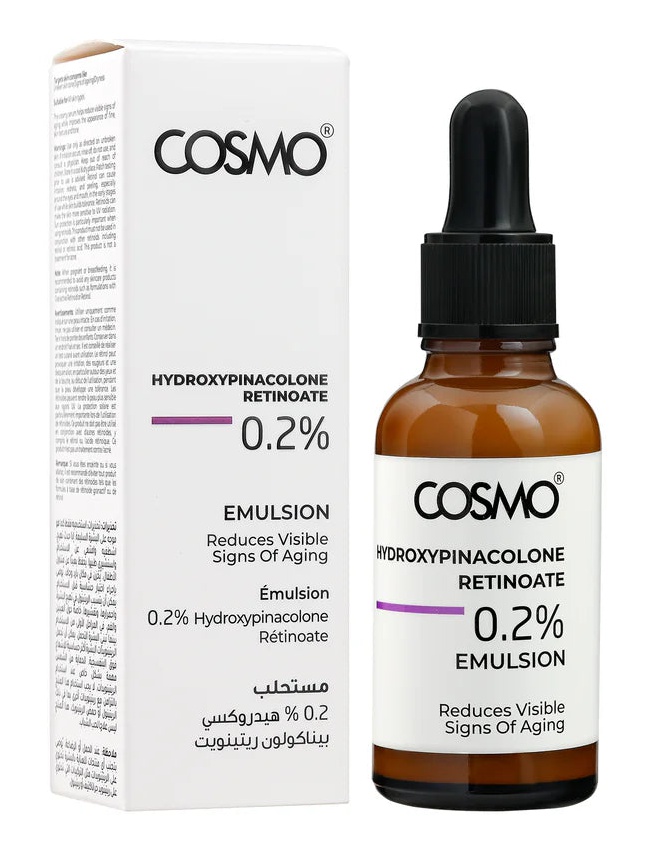
0.2% Hydroxypinacolone Retinoate Emulsion Serum
Ingredients overview
Highlights
Key Ingredients
Other Ingredients
Skim through
COSMO ADVANCED 0.2% Hydroxypinacolone Retinoate Emulsion SerumIngredients explained
Good old water, aka H2O. The most common skincare ingredient of all. You can usually find it right in the very first spot of the ingredient list, meaning it’s the biggest thing out of all the stuff that makes up the product.
It’s mainly a solvent for ingredients that do not like to dissolve in oils but rather in water.
Once inside the skin, it hydrates, but not from the outside - putting pure water on the skin (hello long baths!) is drying.
One more thing: the water used in cosmetics is purified and deionized (it means that almost all of the mineral ions inside it is removed). Like this, the products can stay more stable over time.
- A natural moisturizer that’s also in our skin
- A super common, safe, effective and cheap molecule used for more than 50 years
- Not only a simple moisturizer but knows much more: keeps the skin lipids between our skin cells in a healthy (liquid crystal) state, protects against irritation, helps to restore barrier
- Effective from as low as 3% with even more benefits for dry skin at higher concentrations up to 20-40%
- High-glycerin moisturizers are awesome for treating severely dry skin
A super common emollient that makes your skin feel nice and smooth. It comes from coconut oil and glycerin, it’s light-textured, clear, odorless and non-greasy. It’s a nice ingredient that just feels good on the skin, is super well tolerated by every skin type and easy to formulate with. No wonder it’s popular.
A little helper ingredient that can boost the performance and enhance the delivery of active ingredients in a formula. It can penetrate deep layers of the skin helping actives to do the same.
It's especially useful to help active ingredients for self-tanning (DHA), anti-acne or skin-whitening to penetrate deeper and work better.
Propanediol is a natural alternative for the often used and often bad-mouthed propylene glycol. It's produced sustainably from corn sugar and it's Ecocert approved.
It's quite a multi-tasker: can be used to improve skin moisturization, as a solvent, to boost preservative efficacy or to influence the sensory properties of the end formula.
An extremely common multitasker ingredient that gives your skin a nice soft feel (emollient) and gives body to creams and lotions. It also helps to stabilize oil-water mixes (emulsions), though it does not function as an emulsifier in itself. Its typical use level in most cream type formulas is 2-3%.
It’s a so-called fatty alcohol, a mix of cetyl and stearyl alcohol, other two emollient fatty alcohols. Though chemically speaking, it is alcohol (as in, it has an -OH group in its molecule), its properties are totally different from the properties of low molecular weight or drying alcohols such as denat. alcohol. Fatty alcohols have a long oil-soluble (and thus emollient) tail part that makes them absolutely non-drying and non-irritating and are totally ok for the skin.
 We don't have description for this ingredient yet.
A synthetic emollient oil that leaves a soft non-greasy, non-sticky feel on the skin, absorbs fast and can be emulsified (mixed with water) very easily.
It’s pretty much the current IT-preservative. It’s safe and gentle, but even more importantly, it’s not a feared-by-everyone-mostly-without-scientific-reason paraben.
It’s not something new: it was introduced around 1950 and today it can be used up to 1% worldwide. It can be found in nature - in green tea - but the version used in cosmetics is synthetic.
Other than having a good safety profile and being quite gentle to the skin it has some other advantages too. It can be used in many types of formulations as it has great thermal stability (can be heated up to 85°C) and works on a wide range of pH levels (ph 3-10).
It’s often used together with ethylhexylglycerin as it nicely improves the preservative activity of phenoxyethanol.
Hydroxypinacolone Retinoate (HPR) is the newest member of the "royal family of skincare" (see who is who on this cool retinoids family tree), the retinoid family. The queen of the family is the FDA-approved anti-aging superstar, retinoic acid, aka tretinoin and HPR seems to be a gentle but influential sister princess to the queen.
Good to know: the trade name of HPR is Granactive Retinoid. The manufacturer produces it as 10% active and 90% solvent called dimethyl isosorbide. When a product claims 2% Granactive Retinoid, it means 0.2% Hydroxypinacolone Retinoate (and 1.8% dimethyl isosorbide) on the ingredient list.
It's a so-called retinoic acid ester, meaning that it's directly related to retinoic acid. If you've already read our description about retinol or retinyl palmitate, you know that the active ingredient our skin cells can interpret is retinoic acid. Other forms of retinoids have to be converted by our metabolic machinery to do something. That's not the case with HPR. It binds directly to the retinoid receptors of the skin cells to work its skincare magic.
The big promise of HPR is that it's similarly active as retinoic acid (no conversion needed, remember) but without the irritation. According to the manufacturer's tests, 24 hours of an occlusive patch with 0.5% HPR resulted in significantly lower irritation than 0.5% retinol. Also, there was a "dramatic reduction of lines and wrinkles" after applying 0.2% HPR around the eyes twice a day for 14 days.
These results sound sooo promising that we don't blame you if you wanna run out right now and get an HPR formula to slather on your face. But, before you do, you have to know that the info we have about HPR at the moment is mainly from the manufacturer, whose tests may or may not be accurate or properly designed (such as controlled, double-blind and conducted on an appropriate number of people).
As HPR is pretty new there isn't that much independent research we could find yet. We found two Italian studies both examining the efficacy of HPR combined with other things (retinol in both cases, and papain in one of them) for the treatment of acne. Both studies found the formulas effective but they contained other things too, so it's hard to judge how well HPR did.
Regarding anti-aging, there is a pretty recent, Estee Lauder sponsored study that compared the in-vitro (not on real human beings but on skin models) collagen-boosting effectiveness of Hydroxypinacolone Retinoate, tretinoin, good old retinol and retinyl palmitate (RP). The results are pretty encouraging showing that "HPR had greater levels of gene transcription than retinol and RP (RP) at the same concentrations ... however, HPR did not achieve gene transcription levels of ATRA (tretinoin)." But, a much higher dose might be tolerated from HPR and the highest dose of HPR out-performed tretinoin. Pretty encouraging, though we are very much waiting for a study to confirm all this on real human beings.
Bottom line: We are really happy to see some innovation happening with retinoids, and we think Hydroxypinacolone Retinoate is a super promising rising star, but it’s not fully proven yet. If you are someone who likes to experiment and try out the newest things, grab your running shoes and try some HPR containing serum now (see product list below :)). If you like the tried and true, however, stick to retinol and tretinoin for now and re-examine the question in a couple of years when (hopefully) more research will be available.
Are you into Retinoids? Read our shiny description about other members of the retinoid family:
- Retinyl Propionate: the most promising retinol ester out there
- Retinyl Retinoate: a super interesting retinol-retinoic acid hybrid molecule
- Tretinoin: the FDA-proven, well-known active ingredient
- Retinol: the good old vitamin A molecule
- Retinyl Palmitate: a super common, but our least fav member of the retinoids
We don't have description for this ingredient yet.
It's one of the active parts of Chamomile that contains about 30% of bisabolol. It's a clear oily fluid that is used in skincare as a nice anti-inflammatory and soothing ingredient.
We don't have description for this ingredient yet.
Biosaccharide Gum-1 is a pretty interesting kind of sugar ingredient that is created from sorbitol via bacterial fermentation.
According to the manufacturer it’s a “S.M.A.R.T.” sugar: it has Soothing, Moisturizing, Anti-aging, Restructuring and Touch properties. Let’s look at them quickly one by one.
Soothing: the manufacturer tested out the soothing effect in vivo (meaning on humans that is always a good thing!) by measuring how 3% Biosaccharide Gum-1 decreased the tingling sensation caused by 10% lactic acid. The result was good: the tingling was decreased by 47%.
Moisturizing: Compared to famous hyaluronic acid, it turns out that the two are great together. HA has a quicker effect and provides more instant hydration (much more hydration was measured after 1h of application), while our nice sugar has a somewhat delayed effect demonstrating stronger hydration after 3h of application. After 8 hours both had similar moisturizing effect.
Anti-aging: According to ex-vivo tests (meaning not on humans, so do not trust it too much) Biosaccharide Gum-1 can stimulate a protein in our skin called sirtuin-1. This is supposed to help our skin cells to live longer, and function better.
Resurfacing: The sirtuin-1 stimulation also results in quicker cell renewal - something that happens anyway but slows down as we age. And the quicker cell renewal is good because it helps the regeneration of the barrier function. That is especially nice for fragile, sensitive skin.
Touch: our fermented sugar is not only good to the skin, but it also feels great on the skin. It gives a nice “soft touch” feeling and makes the products pleasant to use.
The bottom line is that the above info is from the manufacturer (and we could not find any relevant independent research) so obviously take it with a grain of salt. But Biosaccharide Gum-1 does look as an interesting and promising ingredient that’s why it earned our goodie rating.
At first glance, you could think that Bakuchiol is your average plant extract. It is derived from the seeds of Psoralea Corylifolia, aka Babchi, a plant important in Indian and Chinese medicine. The molecule was first isolated in 1973 and several anti-something properties are known about it: it has anti-inflammatory, antioxidant, anti-tumor, anti-bacterial and hepatoprotective magical abilities like plenty of other Ayurvedic plant extracts.
What makes Bakuchiol a special snowflake is the recent discovery that it behaves on the skin in a way very similar to well-known skincare superstar, retinol. While chemically, it has nothing to do with the vitamin-A family, aka retinoids, comparative gene expression profiling (a fancy way of saying that they compared how retinol and bakuchiol modify the way skin cells behave and produce important skin proteins such as collagen) shows that retinol and bakuchiol regulate skin cell behavior in a similar way.
To be more specific, both Bakuchiol and retinol upregulate collagen I, III and IV production and downregulate MMP, the evil collagen attacking enzyme in our skin. This means more collagen stays in our skin and we all know that more collagen equals firmer, more wrinkle-free skin. A 12-week clinical study using a 0.5% Bakuchiol formula with 17 people using it twice a day confirmed a significant improvement in lines and wrinkles, elasticity, firmness and an overall reduction in photo-damage. Also, the test formula was very well tolerated, without any retinol-like side effects.
What's more, a 2018 double-blind study with 44 people compared 0.5% Bakuchiol with 0.5% retinol cream and found that "bakuchiol is comparable to retinol in its ability to improve photoaging and is better tolerated than retinol". A super promising result after 12 weeks.
If you are not a daredevil-type who doesn't want to stop using a super well-proven retinol for a newbie like Bakuchiol, we have good news. The two also work very nicely together and Bakuchiol can actually help to stabilize the otherwise unstable and hard to formulate retinol.
And we are still not done, as Bakuchiol shows not only anti-aging properties but also nice anti-acne effects. 1% Bakuchiol seems to be very effective in itself (57% reduction in acne after 6 weeks treatment) and even better when combined with 2% salicylic acid (67% reduction in acne after 6 weeks). We like that Bakuchiol is such a good team player! The molecule works against acne in multiple ways: It downregulates 5α-reductase (a sebum-controlling enzyme), it is antibacterial (including P. acnes), anti-inflammatory and it inhibits lipid-peroxidation, an evil oxidative process that is recently thought to be a very early trigger in the acne process.
We feel that this description is becoming very long so we will just mention that Bakuchiol also seems to positively regulate hydration-related genes such as Aquaporin 3 and also shows some melanin-inhibiting properties.
Overall, we think Bakuchiol is an awesome molecule with lots of promise both for anti-aging and anti-acne. But the proof compared to the well-established superstars is far from solid, so in a skincare routine, we would rather add Bakuchiol next to retinol than straight up replace it. Unless you are a gimme-the-newest-shiny-thing-under-the-sun-type.
We don't have description for this ingredient yet.
The neutralized form of gluconic acid. It's a great ingredient to neutralize metal (especially iron and copper) ions in a cosmetic product. This helps to prevent discoloration of the formula over time or rancidity of cosmetic oils. It can also be a pH regulator and a humectant (helps skin to cling onto water).
It's also used in oral care products where it reduces the bitterness of other ingredients. And it's natural, both Ecocert and Cosmos approved. (source: manufacturer info)
It's the acronym for Butylated Hydroxy Toluene. It's a common synthetic antioxidant that's used as a preservative.
There is some controversy around BHT. It's not a new ingredient, it has been used both as a food and cosmetics additive since the 1970s. Plenty of studies tried to examine if it's a carcinogen or not. This Truth in Aging article details the situation and also writes that all these studies examine BHT when taken orally.
As for cosmetics, the CIR (Cosmetic Ingredient Review) concluded that the amount of BHT used in cosmetic products is low (usually around 0.01-0.1%), it does not penetrate skin far enough to be absorbed into the bloodstream and it is safe to use in cosmetics.
If you have spotted ethylhexylglycerin on the ingredient list, most probably you will see there also the current IT-preservative, phenoxyethanol. They are good friends because ethylhexylglycerin can boost the effectiveness of phenoxyethanol (and other preservatives) and as an added bonus it feels nice on the skin too.
Also, it's an effective deodorant and a medium spreading emollient.
- Retinol (pure Vitamin A) is probably the most proven anti-aging ingredient available OTC
- It has to be converted in the skin to retinoic acid to work its magic
- Once converted, it has the same effect as all-trans-retinoic acid, aka tretinoin
- A generally accepted ballpark number is that retinol is 10-to-20 times less potent than retinoic acid
- It makes skin less wrinkled, smoother, firmer and tighter
- It might also be helpful for acne prone skin as it normalizes keratinization and makes the pores produce less sebum
- Possible side effects and irritation are also much less than with retinoic acid
- Do not use whilst pregnant
- Primary fat-soluble antioxidant in our skin
- Significant photoprotection against UVB rays
- Vit C + Vit E work in synergy and provide great photoprotection
- Has emollient properties
- Easy to formulate, stable and relatively inexpensive
It's a little helper ingredient coming from corn, rice or potato starch that can help to keep skin mat (absorbent), to stabilise emulsions, and to keep the product together (binding).
The unfancy name for it is lye. It’s a solid white stuff that’s very alkaline and used in small amounts to adjust the pH of the product and make it just right.
For example, in case of AHA or BHA exfoliants, the right pH is super-duper important, and pH adjusters like sodium hydroxide are needed.
BTW, lye is not something new. It was already used by ancient Egyptians to help oil and fat magically turn into something else. Can you guess what? Yes, it’s soap. It still often shows up in the ingredient list of soaps and other cleansers.
Sodium hydroxide in itself is a potent skin irritant, but once it's reacted (as it is usually in skin care products, like exfoliants) it is totally harmless.
You may also want to take a look at...
| what‑it‑does | solvent |
| what‑it‑does | skin-identical ingredient | moisturizer/humectant |
| irritancy, com. | 0, 0 |
| what‑it‑does | emollient |
| what‑it‑does | solvent | viscosity controlling |
| what‑it‑does | solvent | moisturizer/humectant |
| what‑it‑does | emollient | viscosity controlling | emulsifying | surfactant/cleansing |
| irritancy, com. | 1, 2 |
| what‑it‑does | surfactant/cleansing |
| what‑it‑does | emollient |
| what‑it‑does | preservative |
| what‑it‑does | cell-communicating ingredient |
| what‑it‑does | emollient | solvent |
| what‑it‑does | soothing |
| what‑it‑does | viscosity controlling |
| what‑it‑does | soothing | moisturizer/humectant |
| what‑it‑does | cell-communicating ingredient | antioxidant | antimicrobial/antibacterial |
| what‑it‑does | emulsifying | surfactant/cleansing |
| what‑it‑does | chelating | moisturizer/humectant |
| what‑it‑does | antioxidant | preservative |
| what‑it‑does | preservative |
| what‑it‑does | cell-communicating ingredient |
| what‑it‑does | antioxidant |
| irritancy, com. | 0-3, 0-3 |
| what‑it‑does | buffering |