




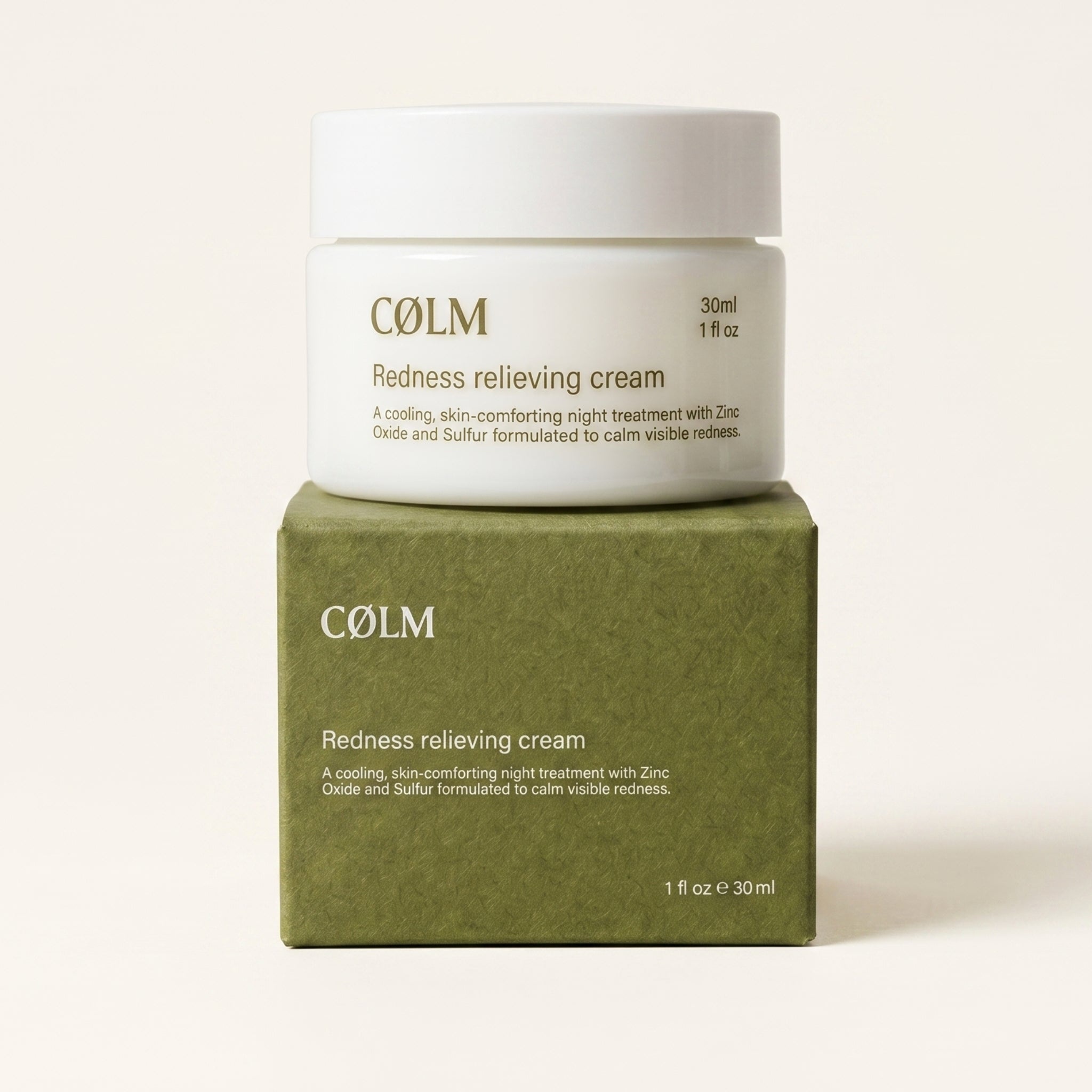
Redness Relieving Cream
Ingredients overview
Highlights
Key Ingredients
Other Ingredients
Skim through
| Ingredient name | what-it-does | irr., com. | ID-Rating |
|---|---|---|---|
| Aqua (Water) | solvent | ||
| Glycerin | skin-identical ingredient, moisturizer/humectant | 0, 0 | superstar |
| Sulfur | anti-acne, antimicrobial/antibacterial | 0, 0-3 | goodie |
| Zinc Oxide | sunscreen | 0, 1 | goodie |
| Caprylic/Capric Triglyceride | emollient | ||
| Dimethicone | emollient | 0, 1 | |
| Isononyl Isononanoate | emollient | ||
| Cetearyl Alcohol | emollient, viscosity controlling, emulsifying, surfactant/cleansing | 1, 2 | |
| Butylene Glycol | moisturizer/humectant, solvent | 0, 1 | |
| Glyceryl Stearate | emollient, emulsifying | 0, 1 | |
| Polysorbate 60 | emulsifying, surfactant/cleansing | ||
| Sorbitan Stearate | emulsifying | 1, 0 | |
| 1,2-Hexanediol | solvent | ||
| Hydroxyacetophenone | antioxidant, preservative | ||
| Menthol | soothing | icky | |
| Xanthan Gum | viscosity controlling | ||
| Silica | viscosity controlling | ||
| Sodium Hypochlorite | |||
| Salicylic Acid | exfoliant, anti-acne, soothing, preservative | superstar |
CØLM Redness Relieving CreamIngredients explained
Good old water, aka H2O. The most common skincare ingredient of all. You can usually find it right in the very first spot of the ingredient list, meaning it’s the biggest thing out of all the stuff that makes up the product.
It’s mainly a solvent for ingredients that do not like to dissolve in oils but rather in water.
Once inside the skin, it hydrates, but not from the outside - putting pure water on the skin (hello long baths!) is drying.
One more thing: the water used in cosmetics is purified and deionized (it means that almost all of the mineral ions inside it is removed). Like this, the products can stay more stable over time.
- A natural moisturizer that’s also in our skin
- A super common, safe, effective and cheap molecule used for more than 50 years
- Not only a simple moisturizer but knows much more: keeps the skin lipids between our skin cells in a healthy (liquid crystal) state, protects against irritation, helps to restore barrier
- Effective from as low as 3% with even more benefits for dry skin at higher concentrations up to 20-40%
- High-glycerin moisturizers are awesome for treating severely dry skin
A yellowish element that smells of rotten eggs and it might be familiar to you from the periodic table (has the symbol S in there). It has a long history of medicinal use thanks to its antifungal, antibacterial and keratolytic activity. It used to be a very common ingredient in the treatment of inflammation-related skin diseases such as acne, rosacea and seborrheic dermatitis, however, due to its malodorousness, it is less popular nowadays.
Sulfur's precise mechanism of action is not known, but we do know that its effectiveness depends on its direct interaction with the skin surface, meaning the smaller the particle size, the better the effect. The United States Pharmacopeia lists two types of sulfur, sublimed and precipitated. The latter one has a smaller particle size and counts as a superior version.
Sulfur is also a team-player and works well when combined with other anti-acne agents, such as salicylic acid or sodium sulfacetamide. In fact, the combination of 10% sodium sulfacetamide and 5% sulfur is the active ingredient duo of several Rx-only anti-acne products.
As for the disadvantages, there is the rotten egg smell. Also in higher concentrations, it might cause a mild burning sensation and dry skin. If you are new to sulfur, patch testing it first is a good idea.
When it comes to sunscreen agents, Zinc Oxide is pretty much in a league of its own. It's a physical (or inorganic) sunscreen that has a lot in common with fellow inorganic sunscreen Titanium Dioxide (TiO2) but a couple of things make it superior even to TiO2.
If physical sunscreens don't tell you anything, go ahead and read about the basics here. Most of what we wrote about Titanium Dioxide is also true for Zinc Oxide so we will focus here on the differences.
The first main difference is that while TiO2 gives a nice broad spectrum protection, Zinc Oxide has an even nicer and even broader spectrum protection. It protects against UVB, UVA II, and UVA I almost uniformly, and is considered to be the broadest range sunscreen available today.
It's also highly stable and non-irritating. So much so that Zinc Oxide also counts as a skin protectant and anti-irritant. It's also often used to treat skin irritations such as diaper rash.
As for the disadvantages, Zinc Oxide is also not cosmetically elegant. It leaves a disturbing whitish tint on the skin, although, according to a 2000 research paper by Dr. Pinnell, it's slightly less white than TiO2. Still, it's white and disturbing enough to use Zinc Oxide nanoparticles more and more often.
We wrote more about nanoparticles and the concerns around them here, but the gist is that if nanoparticles were absorbed into the skin that would be a reason for legitimate health concerns. But luckily, so far research shows that sunscreen nanoparticles are not absorbed but remain on the surface of the skin or in the uppermost (dead) layer of the skin. This seems to be true even if the skin is damaged, for example, sunburnt.
All in all, if you've found a Zinc Oxide sunscreen that you are happy to use every single day, that's fantastic and we suggest you stick with it. It's definitely one of the best, or probably even the best option out there for sun protection available worldwide.
A super common emollient that makes your skin feel nice and smooth. It comes from coconut oil and glycerin, it’s light-textured, clear, odorless and non-greasy. It’s a nice ingredient that just feels good on the skin, is super well tolerated by every skin type and easy to formulate with. No wonder it’s popular.
Probably the most common silicone of all. It is a polymer (created from repeating subunits) molecule and has different molecular weight and thus different viscosity versions from water-light to thick liquid.
As for skincare, it makes the skin silky smooth, creates a subtle gloss and forms a protective barrier (aka occlusive). Also, works well to fill in fine lines and wrinkles and give skin a plump look (of course that is only temporary, but still, it's nice). There are also scar treatment gels out there using dimethicone as their base ingredient. It helps to soften scars and increase their elasticity.
As for hair care, it is a non-volatile silicone meaning that it stays on the hair rather than evaporates from it and smoothes the hair like no other thing. Depending on your hair type, it can be a bit difficult to wash out and might cause some build-up (btw, this is not true to all silicones, only the non-volatile types).
An emollient ester with a rich and creamy but non-greasy skin feel. It makes skin supple and protects dry skin.
An extremely common multitasker ingredient that gives your skin a nice soft feel (emollient) and gives body to creams and lotions. It also helps to stabilize oil-water mixes (emulsions), though it does not function as an emulsifier in itself. Its typical use level in most cream type formulas is 2-3%.
It’s a so-called fatty alcohol, a mix of cetyl and stearyl alcohol, other two emollient fatty alcohols. Though chemically speaking, it is alcohol (as in, it has an -OH group in its molecule), its properties are totally different from the properties of low molecular weight or drying alcohols such as denat. alcohol. Fatty alcohols have a long oil-soluble (and thus emollient) tail part that makes them absolutely non-drying and non-irritating and are totally ok for the skin.
Butylene glycol, or let’s just call it BG, is a multi-tasking colorless, syrupy liquid. It’s a great pick for creating a nice feeling product.
BG’s main job is usually to be a solvent for the other ingredients. Other tasks include helping the product to absorb faster and deeper into the skin (penetration enhancer), making the product spread nicely over the skin (slip agent), and attracting water (humectant) into the skin.
It’s an ingredient whose safety hasn’t been questioned so far by anyone (at least not that we know about). BG is approved by Ecocert and is also used enthusiastically in natural products. BTW, it’s also a food additive.
A super common, waxy, white, solid stuff that helps water and oil to mix together, gives body to creams and leaves the skin feeling soft and smooth.
Chemically speaking, it is the attachment of a glycerin molecule to the fatty acid called stearic acid. It can be produced from most vegetable oils (in oils three fatty acid molecules are attached to glycerin instead of just one like here) in a pretty simple, "green" process that is similar to soap making. It's readily biodegradable.
It also occurs naturally in our body and is used as a food additive. As cosmetic chemist Colins writes it, "its safety really is beyond any doubt".
A common little helper ingredient that helps water and oil to mix together, aka emulsifier.
A popular, vegetable-derived oil-loving emulsifier that helps water to mix with oil. In itself, it is suitable for water-in-oil emulsions (where water droplets are dispersed in oil), but it is more often used as a co-emulsifier next to other, water-loving emulsifiers.
Chemically speaking, it comes from the attachment of sorbitan (a dehydrated sorbitol (sugar) molecule) with the fatty acid Stearic Acid, that creates a partly water (the sorbitan part) and partly oil soluble (stearic part) molecule.
A really multi-functional helper ingredient that can do several things in a skincare product: it can bring a soft and pleasant feel to the formula, it can act as a humectant and emollient, it can be a solvent for some other ingredients (for example it can help to stabilize perfumes in watery products) and it can also help to disperse pigments more evenly in makeup products. And that is still not all: it can also boost the antimicrobial activity of preservatives.
A handy multifunctional ingredient that works as a preservative booster, as well as an antioxidant and soothing agent.
Menthol needs no introduction: it's the thing that causes the cooling sensation so well-known both from cosmetic products as well as a bunch of other things like chocolate, chewing gum, toothpaste or cigarette. It's a natural compound that comes from the essential oil of Mentha species (peppermint oil contains 40-50% menthol) and it gives them their typical minty smell and flavor.
As for skincare, menthol seems to be a mixed bag. Apart from the cool cooling sensation (that might last up to 70 mins!), it also has painkilling, itch reducing, antibacterial, antifungal and even penetration enhancing properties. On the other hand, it also seems to act as a skin irritant that increases trans-epidermal water loss (the water that evaporates from the outer layer of the skin) and thus contributes to drying out the skin.
It's one of the most commonly used thickeners and emulsion stabilizers. If the product is too runny, a little xanthan gum will make it more gel-like. Used alone, it can make the formula sticky and it is a good team player so it is usually combined with other thickeners and so-called rheology modifiers (helper ingredients that adjust the flow and thus the feel of the formula). The typical use level of Xantha Gum is below 1%, it is usually in the 0.1-0.5% range.
Btw, Xanthan gum is all natural, a chain of sugar molecules (polysaccharide) produced from individual sugar molecules (glucose and sucrose) via fermentation. It’s approved by Ecocert and also used in the food industry (E415).
A white powdery thing that's the major component of glass and sand. In cosmetics, it’s often in products that are supposed to keep your skin matte as it has great oil-absorbing abilities. It’s also used as a helper ingredient to thicken up products or suspend insoluble particles.
 We don't have description for this ingredient yet.
- It's one of the gold standard ingredients for treating problem skin
- It can exfoliate skin both on the surface and in the pores
- It's a potent anti-inflammatory agent
- It's more effective for treating blackheads than acne
- For acne combine it with antibacterial agents like benzoyl peroxide or azelaic acid
You may also want to take a look at...
| what‑it‑does | solvent |
| what‑it‑does | skin-identical ingredient | moisturizer/humectant |
| irritancy, com. | 0, 0 |
| what‑it‑does | anti-acne | antimicrobial/antibacterial |
| irritancy, com. | 0, 0-3 |
| what‑it‑does | sunscreen |
| irritancy, com. | 0, 1 |
| what‑it‑does | emollient |
| what‑it‑does | emollient |
| irritancy, com. | 0, 1 |
| what‑it‑does | emollient |
| what‑it‑does | emollient | viscosity controlling | emulsifying | surfactant/cleansing |
| irritancy, com. | 1, 2 |
| what‑it‑does | moisturizer/humectant | solvent |
| irritancy, com. | 0, 1 |
| what‑it‑does | emollient | emulsifying |
| irritancy, com. | 0, 1 |
| what‑it‑does | emulsifying | surfactant/cleansing |
| what‑it‑does | emulsifying |
| irritancy, com. | 1, 0 |
| what‑it‑does | solvent |
| what‑it‑does | antioxidant | preservative |
| what‑it‑does | soothing |
| what‑it‑does | viscosity controlling |
| what‑it‑does | viscosity controlling |
| what‑it‑does | exfoliant | anti-acne | soothing | preservative |