




Highlights
Key Ingredients
Other Ingredients
Skim through
| Ingredient name | what-it-does | irr., com. | ID-Rating |
|---|---|---|---|
| Water | solvent | ||
| Glycerin | skin-identical ingredient, moisturizer/humectant | 0, 0 | superstar |
| Butylene Glycol | moisturizer/humectant, solvent | 0, 1 | |
| Benzoyl Peroxide | anti-acne | ||
| Salicylic Acid | exfoliant, anti-acne, soothing, preservative | superstar | |
| Polysorbate 20 | emulsifying, surfactant/cleansing | 0, 0 | |
| Carbomer | viscosity controlling | 0, 1 | |
| Sodium Hydroxide | buffering | ||
| Phenoxyethanol | preservative | ||
| Ethylhexylglycerin | preservative | ||
| Fragrance | perfuming | icky |
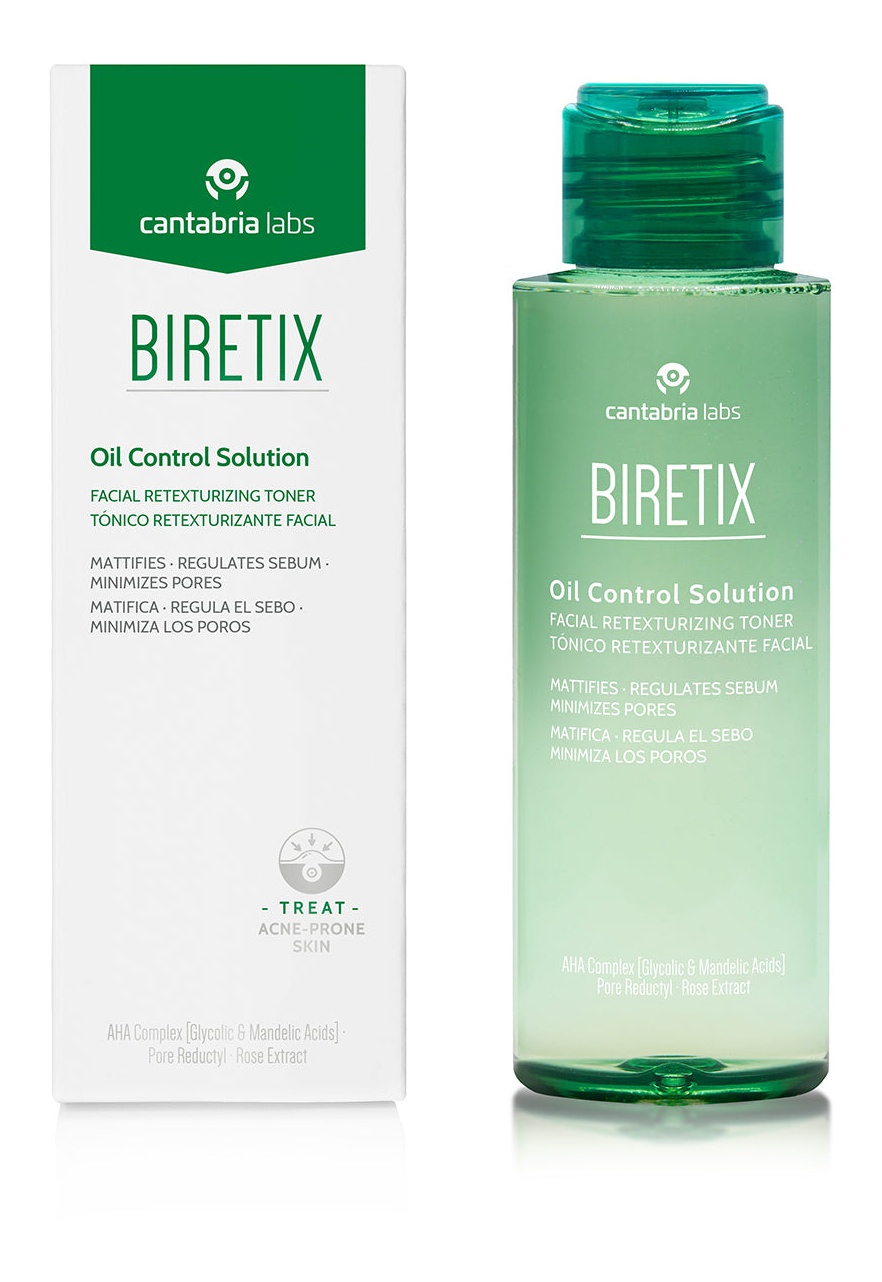
Cantabria Labs Biretix Oil Control SolutionIngredients explained
Good old water, aka H2O. The most common skincare ingredient of all. You can usually find it right in the very first spot of the ingredient list, meaning it’s the biggest thing out of all the stuff that makes up the product.
It’s mainly a solvent for ingredients that do not like to dissolve in oils but rather in water.
Once inside the skin, it hydrates, but not from the outside - putting pure water on the skin (hello long baths!) is drying.
One more thing: the water used in cosmetics is purified and deionized (it means that almost all of the mineral ions inside it is removed). Like this, the products can stay more stable over time.
- A natural moisturizer that’s also in our skin
- A super common, safe, effective and cheap molecule used for more than 50 years
- Not only a simple moisturizer but knows much more: keeps the skin lipids between our skin cells in a healthy (liquid crystal) state, protects against irritation, helps to restore barrier
- Effective from as low as 3% with even more benefits for dry skin at higher concentrations up to 20-40%
- High-glycerin moisturizers are awesome for treating severely dry skin
Butylene glycol, or let’s just call it BG, is a multi-tasking colorless, syrupy liquid. It’s a great pick for creating a nice feeling product.
BG’s main job is usually to be a solvent for the other ingredients. Other tasks include helping the product to absorb faster and deeper into the skin (penetration enhancer), making the product spread nicely over the skin (slip agent), and attracting water (humectant) into the skin.
It’s an ingredient whose safety hasn’t been questioned so far by anyone (at least not that we know about). BG is approved by Ecocert and is also used enthusiastically in natural products. BTW, it’s also a food additive.
The gold standard topical ingredient in treating acne. There is no miracle cure for acne (we do really wish for one, *sigh*), but Benzoyl Peroxide (BP) is probably the closest thing we have. But, as usual, big effects come with big side effects, so we think BP is best used as a last resort (at least, in the topical treatment field).
The good thing about BP is that it is amazingly effective against inflammatory-type acne. Not so much against blackheads or whiteheads, but against acne that is caused by the evil bacteria called Propionibacterium acnes (and that is most types of acne). Apart from being antibacterial, it is also anti-inflammatory, keratolytic and wound-healing, all of which are properties that make it so darn effective against spots.
Another big pro of BP is that there is no bacterial resistance to it, meaning if it works once it will continue to work. Antibiotics are also a common way to treat acne, but antibiotic-resistant P. acnes are increasing worldwide. BP will probably help you even if antibiotics have stopped working, and the two are also often combined for a more complex acne therapy. Btw, BP plays nice not only with antibiotics but also with retinoids.
The side-effects part? BP works its antibacterial magic by being a powerful oxidizing agent, meaning it is a pro-oxidant. As in the opposite of an antioxidant. BP literally generates evil ROS (reactive oxygen species) in the skin that kills P. acnes but also harms the surrounding skin cells. Ongoing BP-use ages your skin, which is why, we say, use it as a last resort. If you do use BP, please also use a good sunscreen and a good antioxidant serum to apologise to your skin (btw, these things are useful in any case). Use the BP treatment at night and the antioxidant serum in the morning so that they do not cancel each other out.
Another side effect of BP is that it can be very skin drying. BP is an example where more is not better. In fact, it is equally effective at concentrations of 2.5, 5.0 and 10%, but the higher the concentration the more irritating and drying side effects occur. So using BP at 2.5% percent is the ideal amount. Another side effect which is good to know is that BP can bleach bedsheets and clothes. Be careful with your expensive satin bedsheets.
Overall, Benzoyl Peroxide is a uniquely effective topical acne treatment, but it comes at a price. Use it as a last resort and for good measure (and with plenty of moisturizers, sunscreen, and antioxidant serum).
- It's one of the gold standard ingredients for treating problem skin
- It can exfoliate skin both on the surface and in the pores
- It's a potent anti-inflammatory agent
- It's more effective for treating blackheads than acne
- For acne combine it with antibacterial agents like benzoyl peroxide or azelaic acid
It's a common little helper ingredient that helps water and oil to mix together. Also, it can help to increase the solubility of some other ingredients in the formula.
A big molecule created from repeated subunits (a polymer of acrylic acid) that magically converts a liquid into a nice gel formula. It usually has to be neutralized with a base (such as sodium hydroxide) for the thickening to occur and it creates viscous, clear gels that also feel nice and non-tacky on the skin. No wonder, it is a very popular and common ingredient. Typically used at 1% or less in most formulations.
The unfancy name for it is lye. It’s a solid white stuff that’s very alkaline and used in small amounts to adjust the pH of the product and make it just right.
For example, in case of AHA or BHA exfoliants, the right pH is super-duper important, and pH adjusters like sodium hydroxide are needed.
BTW, lye is not something new. It was already used by ancient Egyptians to help oil and fat magically turn into something else. Can you guess what? Yes, it’s soap. It still often shows up in the ingredient list of soaps and other cleansers.
Sodium hydroxide in itself is a potent skin irritant, but once it's reacted (as it is usually in skin care products, like exfoliants) it is totally harmless.
It’s pretty much the current IT-preservative. It’s safe and gentle, but even more importantly, it’s not a feared-by-everyone-mostly-without-scientific-reason paraben.
It’s not something new: it was introduced around 1950 and today it can be used up to 1% worldwide. It can be found in nature - in green tea - but the version used in cosmetics is synthetic.
Other than having a good safety profile and being quite gentle to the skin it has some other advantages too. It can be used in many types of formulations as it has great thermal stability (can be heated up to 85°C) and works on a wide range of pH levels (ph 3-10).
It’s often used together with ethylhexylglycerin as it nicely improves the preservative activity of phenoxyethanol.
If you have spotted ethylhexylglycerin on the ingredient list, most probably you will see there also the current IT-preservative, phenoxyethanol. They are good friends because ethylhexylglycerin can boost the effectiveness of phenoxyethanol (and other preservatives) and as an added bonus it feels nice on the skin too.
Also, it's an effective deodorant and a medium spreading emollient.
Exactly what it sounds: nice smelling stuff put into cosmetic products so that the end product also smells nice. Fragrance in the US and parfum in the EU is a generic term on the ingredient list that is made up of 30 to 50 chemicals on average (but it can have as much as 200 components!).
If you are someone who likes to know what you put on your face then fragrance is not your best friend - there's no way to know what’s really in it.
Also, if your skin is sensitive, fragrance is again not your best friend. It’s the number one cause of contact allergy to cosmetics. It’s definitely a smart thing to avoid with sensitive skin (and fragrance of any type - natural is just as allergic as synthetic, if not worse!).
You may also want to take a look at...
| what‑it‑does | solvent |
| what‑it‑does | skin-identical ingredient | moisturizer/humectant |
| irritancy, com. | 0, 0 |
| what‑it‑does | moisturizer/humectant | solvent |
| irritancy, com. | 0, 1 |
| what‑it‑does | anti-acne |
| what‑it‑does | exfoliant | anti-acne | soothing | preservative |
| what‑it‑does | emulsifying | surfactant/cleansing |
| irritancy, com. | 0, 0 |
| what‑it‑does | viscosity controlling |
| irritancy, com. | 0, 1 |
| what‑it‑does | buffering |
| what‑it‑does | preservative |
| what‑it‑does | preservative |
| what‑it‑does | perfuming |