




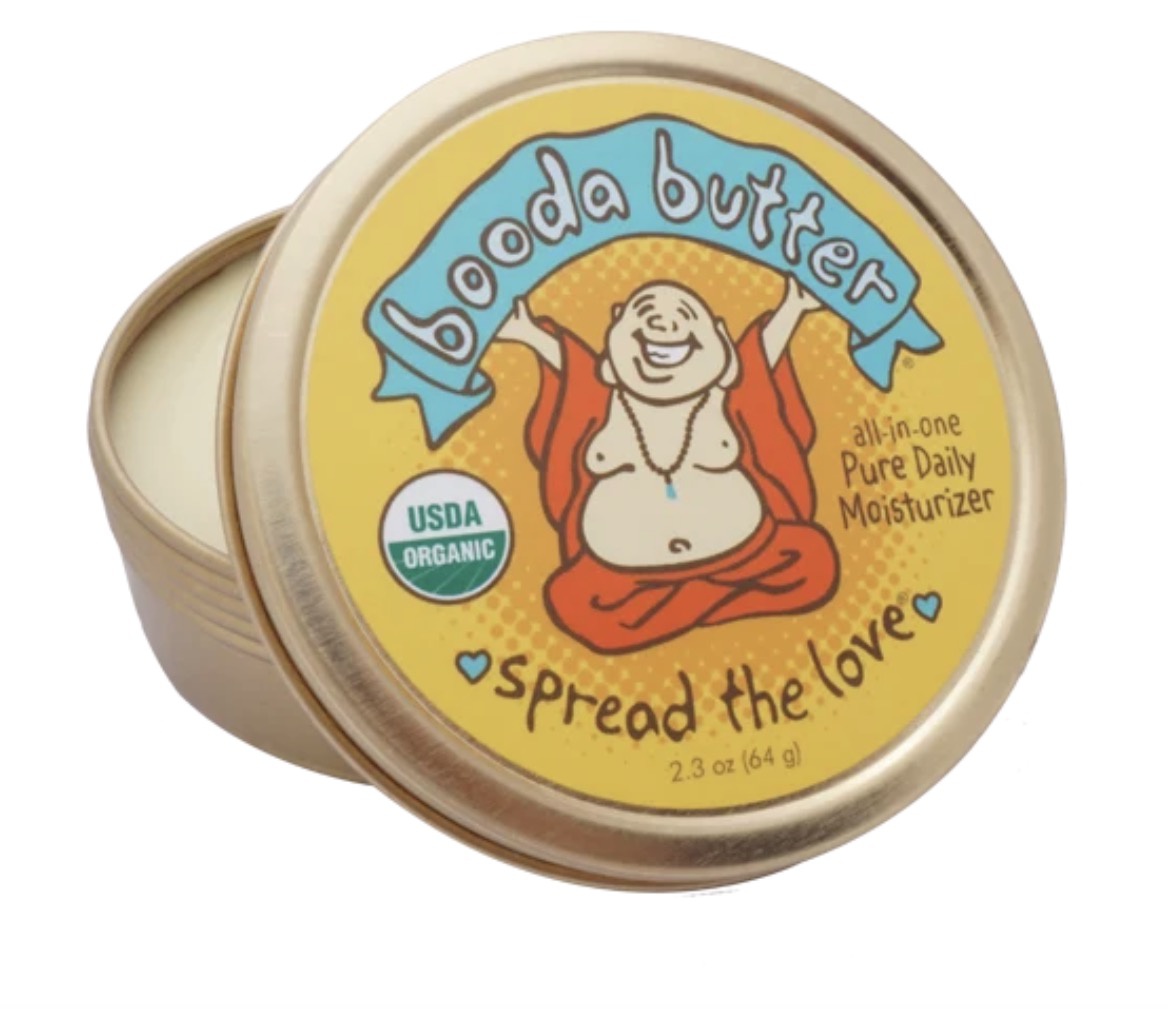
Booda Butter
Highlights
Key Ingredients
Other Ingredients
Skim through
| Ingredient name | what-it-does | irr., com. | ID-Rating |
|---|---|---|---|
| Organic Shea Butter | emollient | goodie | |
| Fair Trade Cocoa Butter* | emollient | 0, 4 | goodie |
| Coconut Oil* | emollient, perfuming | 0, 4 | goodie |
| Olive Oil* | antioxidant, emollient | 0, 0-2 | goodie |
| Jojoba Oil* | emollient | 0, 0-2 | goodie |
booda organics Booda ButterIngredients explained
Unless you live under a rock you must have heard about shea butter. It's probably the most hyped up natural butter in skincare today. It comes from the seeds of African Shea or Karite Trees and used as a magic moisturizer and emollient.
But it's not only a simple emollient, it regenerates and soothes the skin, protects it from external factors (such as UV rays or wind) and is also rich in antioxidants (among others vitamin A, E, F, quercetin and epigallocatechin gallate). If you are looking for rich emollient benefits + more, shea is hard to beat.
Theobroma means "food of the gods" in Greek though probably "treat of the people" would be more spot on. The cacao fruits and especially the seeds in it need no introduction as everyone knows them as the magical raw material of the magical sweet treat, chocolate (the flavour is composed of more than 1200(!) substances, and the exact chemical nature of it is not really understood, so it's indeed magic. :)).
As for skincare, cocoa butter counts as a rich emollient that can moisturize and nourish even the driest skin (think chapped hands or lips). It's solid at room temperature and melts nicely when you smear it on. It's loaded with good-for-the-skin things: it contains fatty acids, mainly oleic (35%), stearic (34%), and palmitic (25%) and it also has antioxidant vitamin E and polyphenols.
An ex-vivo (made on human skin but not on real people) study examined the cocoa polyphenols and found that 0.5-0.75% of them improved skin tone and elasticity and had a similarly positive impact on GAGs (important natural moisturizing factors in the skin) and collagen synthesis than a commercial high-end moisturizer (it was an Estee Lauder one).
All in all, cocoa butter is a goodie, especially for very dry skin.
There is definitely some craze going on for coconut oil both in the healthy eating space (often claimed to be the healthiest oil to cook with but this is a topic for another site) and in the skin and hair care space.
We will talk here about the latter two and see why we might want to smear it all over ourselves. Chemically speaking, coconut oil has a unique fatty acid profile. Unlike many plant oils that mostly contain unsaturated fatty acids (fatty acids with double bonds and kinky structure such as linoleic or oleic), coconut oil is mostly saturated (fatty acids with single bonds only) and its most important fatty acid is Lauric Acid (about 50%). Saturated fatty acids have a linear structure that can stack nice and tight and hence they are normally solid at room temperature. Coconut oil melts around 25 °C so it is solid in the tub but melts on contact with the skin.
The saturated nature of coconut oil also means that it is a heavy-duty-oil ideal for dry skin types. A double-blind research confirmed that extra virgin coconut oil is as effective in treating xerosis (aka very dry skin) as mineral oil. Another study found that coconut oil is more effective than mineral oil in treating mild to moderate atopic dermatitis (aka eczema) in children.
So when it comes to dry skin, coconut oil is a goodie, no question there. The question is if it is good or bad for acne-prone skin. Its main fatty acid, Lauric Acid has some research showing that it is a promising ingredient against evil acne-causing bacteria, P. acnes but at the same time, both Lauric Acid and coconut oil have a very high comedogenic rating (4 out of 5). Though comedogenic ratings are not very reliable, anecdotal evidence (i.e. people commenting in forums) shows that people have mixed experiences. While some claim that it worked wonders on their acne others say that it gave them serious blackheads and zits. Try it at your own risk.
As for hair care, coconut oil has pretty solid research showing that it can penetrate into the hair very well (better than mineral oil and sunflower oil) and it can prevent hair protein loss as well as combing damage. If you have problems with damaged hair, split ends, coconut oil is worth trying as a pre- or/and post-wash treatment. Labmuffin has an awesome blogpost explaining in more detail why coconut oil is good for your hair.
A couple of other things worth mentioning: coconut oil might help with wound healing (promising animal study), it has some antifungal activity (against dermatophytes that cause the thing known as ringworm) and it also works as an insect repellent against black flies.
Overall, coconut oil is definitely a goodie for the hair and dry skin. If that warrants for the magic oil status it enjoys, we don't know.
You probably know olive oil from the kitchen as a great and healthy option for salad dressing but it's also a great and healthy option to moisturize and nourish the skin, especially if it's on the dry side.
Similar to other emollient plant oils, it's loaded with nourishing fatty acids: oleic is the main component (55-83%), and also contains linoleic (3.5-20%) and palmitic acids (7-20%). It also contains antioxidant polyphenols, tocopherols (types of vitamin E) and carotenoids and it's one of the best plant sources of skin-identical emollient, Squalene.
Overall, a great option for dry skin but less so for acne-prone or damaged skin.
Jojoba is a drought resistant evergreen shrub native to South-western North America. It's known and grown for jojoba oil, the golden yellow liquid coming from the seeds (about 50% of the weight of the seeds will be oil).
At first glance, it seems like your average emollient plant oil: it looks like an oil and it's nourishing and moisturizing to the skin but if we dig a bit deeper, it turns out that jojoba oil is really special and unique: technically - or rather chemically - it's not an oil but a wax ester (and calling it an oil is kind of sloppy).
So what the heck is a wax ester and why is that important anyway? Well, to understand what a wax ester is, you first have to know that oils are chemically triglycerides: one glycerin + three fatty acids attached to it. The fatty acids attached to the glycerin vary and thus we have many kinds of oils, but they are all triglycerides. Mother Nature created triglycerides to be easily hydrolyzed (be broken down to a glycerin + 3 fatty acid molecules) and oxidized (the fatty acid is broken down into small parts) - this happens basically when we eat fats or oils and our body generates energy from it.
Mother Nature also created wax esters but for a totally different purpose. Chemically, a wax ester is a fatty acid + a fatty alcohol, one long molecule. Wax esters are on the outer surface of several plant leaves to give them environmental protection. 25-30% of human sebum is also wax esters to give us people environmental protection.
So being a wax ester results in a couple of unique properties: First, jojoba oil is extremely stable. Like crazy stable. Even if you heat it to 370 C (698 F) for 96 hours, it does not budge. (Many plant oils tend to go off pretty quickly). If you have some pure jojoba oil at home, you should be fine using it for years.
Second, jojoba oil is the most similar to human sebum (both being wax esters), and the two are completely miscible. Acne.org has this not fully proven theory that thanks to this, jojoba might be able to "trick" the skin into thinking it has already produced enough sebum, so it might have "skin balancing" properties for oily skin.
Third, jojoba oil moisturizes the skin through a unique dual action: on the one hand, it mixes with sebum and forms a thin, non-greasy, semi-occlusive layer; on the other hand, it absorbs into the skin through pores and hair follicles then diffuses into the intercellular spaces of the outer layer of the skin to make it soft and supple.
On balance, the point is this: in contrast to real plant oils, wax esters were designed by Mother Nature to stay on the surface and form a protective, moisturizing barrier and jojoba oil being a wax ester is uniquely excellent at doing that.
You may also want to take a look at...
| what‑it‑does | emollient |
| what‑it‑does | emollient |
| irritancy, com. | 0, 4 |
| what‑it‑does | emollient | perfuming |
| irritancy, com. | 0, 4 |
| what‑it‑does | antioxidant | emollient |
| irritancy, com. | 0, 0-2 |
| what‑it‑does | emollient |
| irritancy, com. | 0, 0-2 |