




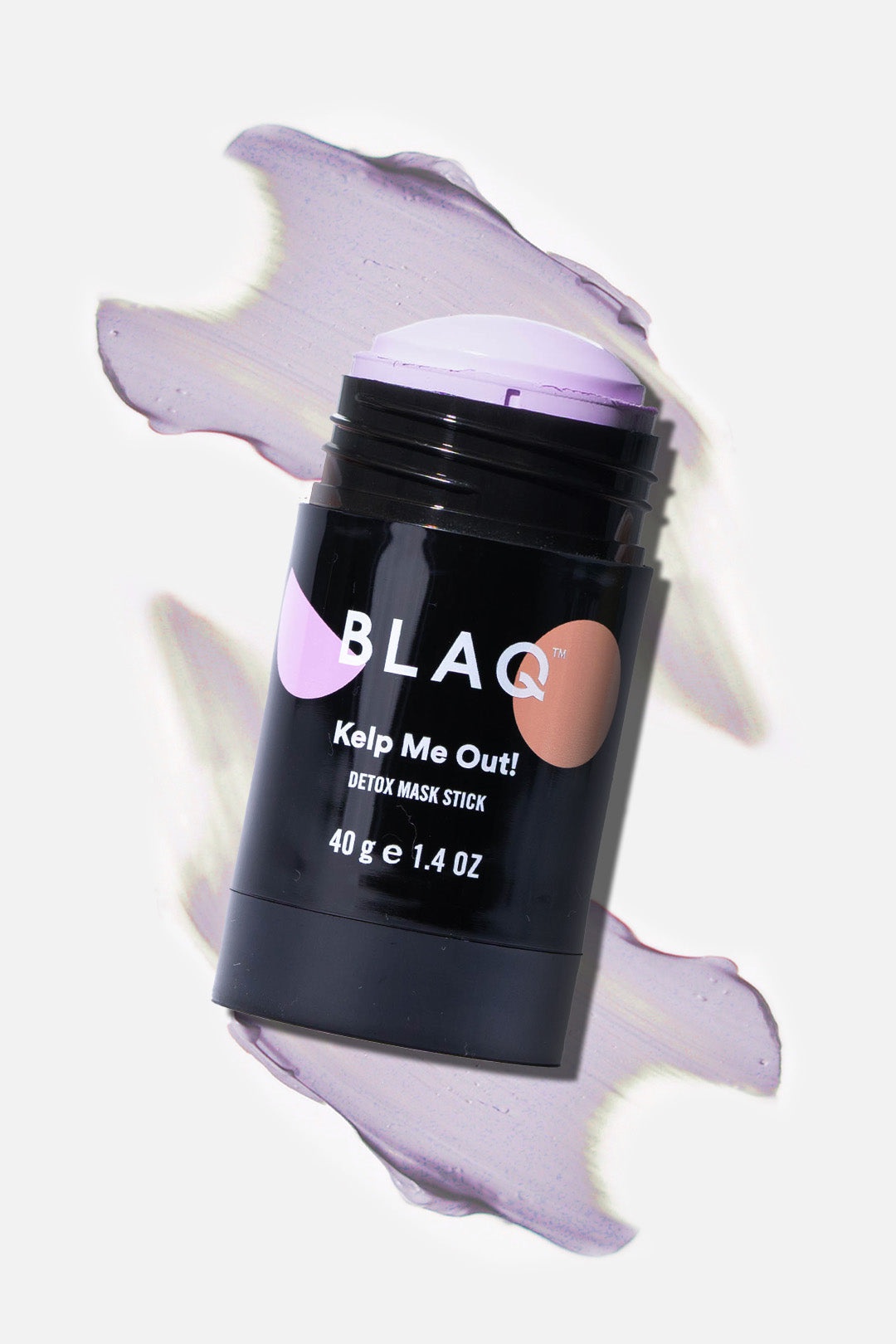
Kelp Me Out! Detox Mask Stick
Ingredients overview
Highlights
Key Ingredients
Other Ingredients
Skim through
Blaq Kelp Me Out! Detox Mask StickIngredients explained
Good old water, aka H2O. The most common skincare ingredient of all. You can usually find it right in the very first spot of the ingredient list, meaning it’s the biggest thing out of all the stuff that makes up the product.
It’s mainly a solvent for ingredients that do not like to dissolve in oils but rather in water.
Once inside the skin, it hydrates, but not from the outside - putting pure water on the skin (hello long baths!) is drying.
One more thing: the water used in cosmetics is purified and deionized (it means that almost all of the mineral ions inside it is removed). Like this, the products can stay more stable over time.
- A natural moisturizer that’s also in our skin
- A super common, safe, effective and cheap molecule used for more than 50 years
- Not only a simple moisturizer but knows much more: keeps the skin lipids between our skin cells in a healthy (liquid crystal) state, protects against irritation, helps to restore barrier
- Effective from as low as 3% with even more benefits for dry skin at higher concentrations up to 20-40%
- High-glycerin moisturizers are awesome for treating severely dry skin
- It's a helper ingredient that improves the freeze-thaw stability of products
- It's also a solvent, humectant and to some extent a penetration enhancer
- It has a bad reputation among natural cosmetics advocates but cosmetic scientists and toxicology experts do not agree (read more in the geeky details section)
Kaolin is a type of clay or to be precise, a naturally occurring hydrous aluminum silicate. When you hear clay, you probably think of a muddy greenish-black mess, but that one is bentonite, and this one is a fine, white powder. It is so white that it's also often used, in small amounts, as a helper ingredient to give opacity and whiteness to the cosmetic formulas.
As a clay, it's absorbent and can suck up excess sebum and gunk from your skin, but less so than the more aggressive bentonite. As it's less absorbent, it's also less drying and gentler on the skin, so it's ideal for dry and sensitive skin types.
A very classic, old-school cleansing agent, a soap (the sodium salt of Stearic Acid). It is known for its rich, creamy foam and being quite harsh on the skin.
If it's not in a soap bar, it can also function as an emulsifier or consistency agent.
Ci 77891 is the color code of titanium dioxide. It's a white pigment with great color consistency and dispersibility.
 We don't have description for this ingredient yet.
It’s pretty much the current IT-preservative. It’s safe and gentle, but even more importantly, it’s not a feared-by-everyone-mostly-without-scientific-reason paraben.
It’s not something new: it was introduced around 1950 and today it can be used up to 1% worldwide. It can be found in nature - in green tea - but the version used in cosmetics is synthetic.
Other than having a good safety profile and being quite gentle to the skin it has some other advantages too. It can be used in many types of formulations as it has great thermal stability (can be heated up to 85°C) and works on a wide range of pH levels (ph 3-10).
It’s often used together with ethylhexylglycerin as it nicely improves the preservative activity of phenoxyethanol.
A little helper ingredient that works as a preservative. It works against bacteria and some species of fungi and yeast. It's often combined with IT-preservative, phenoxyethanol.
We don't have description for this ingredient yet.
Officially, CosIng (the official EU ingredient database) lists Aluminum Hydroxide 's functions as opacifying (making the product white and non-transparent), as well as emollient and skin protectant.
However, with a little bit of digging, it turns out Aluminum Hyroxide often moonlights as a protective coating for UV filter superstar Titanium Dioxide. Specifically, it protects our skin from the harmful effects of nasty Reactive Oxygen Species (free radicals derived from oxygen such as Superoxide and Hydrogen Peroxide) generated when Titanium Dioxide is exposed to UV light. Btw, chlorine in swimming pool water depletes this protective coating, so one more reason to reapply your sunscreen after a dip in the pool on holiday.
Other than that, Aluminum Hydroxide also often shows up in composite pigment technologies where it is used the other way around (as the base material and not as the coating material) and helps to achieve higher color coverage with less pigment.
When it comes to sunscreen agents, Zinc Oxide is pretty much in a league of its own. It's a physical (or inorganic) sunscreen that has a lot in common with fellow inorganic sunscreen Titanium Dioxide (TiO2) but a couple of things make it superior even to TiO2.
If physical sunscreens don't tell you anything, go ahead and read about the basics here. Most of what we wrote about Titanium Dioxide is also true for Zinc Oxide so we will focus here on the differences.
The first main difference is that while TiO2 gives a nice broad spectrum protection, Zinc Oxide has an even nicer and even broader spectrum protection. It protects against UVB, UVA II, and UVA I almost uniformly, and is considered to be the broadest range sunscreen available today.
It's also highly stable and non-irritating. So much so that Zinc Oxide also counts as a skin protectant and anti-irritant. It's also often used to treat skin irritations such as diaper rash.
As for the disadvantages, Zinc Oxide is also not cosmetically elegant. It leaves a disturbing whitish tint on the skin, although, according to a 2000 research paper by Dr. Pinnell, it's slightly less white than TiO2. Still, it's white and disturbing enough to use Zinc Oxide nanoparticles more and more often.
We wrote more about nanoparticles and the concerns around them here, but the gist is that if nanoparticles were absorbed into the skin that would be a reason for legitimate health concerns. But luckily, so far research shows that sunscreen nanoparticles are not absorbed but remain on the surface of the skin or in the uppermost (dead) layer of the skin. This seems to be true even if the skin is damaged, for example, sunburnt.
All in all, if you've found a Zinc Oxide sunscreen that you are happy to use every single day, that's fantastic and we suggest you stick with it. It's definitely one of the best, or probably even the best option out there for sun protection available worldwide.
If you have spotted ethylhexylglycerin on the ingredient list, most probably you will see there also the current IT-preservative, phenoxyethanol. They are good friends because ethylhexylglycerin can boost the effectiveness of phenoxyethanol (and other preservatives) and as an added bonus it feels nice on the skin too.
Also, it's an effective deodorant and a medium spreading emollient.
Exactly what it sounds: nice smelling stuff put into cosmetic products so that the end product also smells nice. Fragrance in the US and parfum in the EU is a generic term on the ingredient list that is made up of 30 to 50 chemicals on average (but it can have as much as 200 components!).
If you are someone who likes to know what you put on your face then fragrance is not your best friend - there's no way to know what’s really in it.
Also, if your skin is sensitive, fragrance is again not your best friend. It’s the number one cause of contact allergy to cosmetics. It’s definitely a smart thing to avoid with sensitive skin (and fragrance of any type - natural is just as allergic as synthetic, if not worse!).
Butylene glycol, or let’s just call it BG, is a multi-tasking colorless, syrupy liquid. It’s a great pick for creating a nice feeling product.
BG’s main job is usually to be a solvent for the other ingredients. Other tasks include helping the product to absorb faster and deeper into the skin (penetration enhancer), making the product spread nicely over the skin (slip agent), and attracting water (humectant) into the skin.
It’s an ingredient whose safety hasn’t been questioned so far by anyone (at least not that we know about). BG is approved by Ecocert and is also used enthusiastically in natural products. BTW, it’s also a food additive.
Centella Asiatica - or sometimes also called Gotu Kola or Cica - has been used in folk medicine for hundreds of years. It’s traditionally used to improve small wounds, burns and scratches and it’s also a well known anti-inflammatory agent for eczema.
Recently science has taken an interest in Gotu Kola as well and it turns out it really has many active compounds with several benefits. Just for hard-core geeks, the main biologically active compounds are pentacyclic triterpenoid saponins called asiaticoside, madecassoside, asiatic and madecassic acid (also called centellosides).
One of the biological activities of the centellosides is to be able to stimulate GAGs (glycosaminoglycans - polysaccharides that are part of the liquidy stuff between our skin cells), and especially hyaluronic acid synthesis in our skin. This is probably one of the reasons why Centella Asiatica Extract has nice skin moisturizing properties that was confirmed by a 25 people, four weeks study along with Centella's anti-inflammatory effects.
Madecassoside can also help in burn wound healing through increasing antioxidant activity and enhancing collagen synthesis. Asiaticoside was shown to increase antioxidant levels on rats skin when applied at 0.2%.
Centella Asiatica also often shows up in products that try to treat cellulite or striae. Of course, it cannot make a miracle but it might have some effect via regulating microcirculation and normalizing the metabolism in the cells of connective tissues.
Bottom line: Gotu Kola is a great plant ingredient with proven wound healing, anti-inflammatory, and antioxidant properties. Nice to spot on any ingredient list.
We don't have description for this ingredient yet.
A traditional Chinese herbal medicine loaded with potent antioxidant and anti-inflammatory flavonoids such as baicalin, baicalein, and wogonin.
If that would not be enough, Skullcap Root is also claimed to have antimicrobial and antifungal properties (also against P.acnes and Malassezia furfur) as well as some skin-brightening activity. A multi-functional skin-goodie.
- Green tea is one of the most researched natural ingredients
- The active parts are called polyphenols, or more precisely catechins (EGCG being the most abundant and most active catechin)
- There can be huge quality differences between green tea extracts. The good ones contain 50-90% catechins (and often make the product brown and give it a distinctive smell)
- Green tea is proven to be a great antioxidant, UV protectant, anti-inflammatory, anticarcinogenic and antimicrobial
- Because of these awesome properties green tea is a great choice for anti-aging and also for skin diseases including rosacea, acne and atopic dermatitis
You might know licorice as a sweet treat from your childhood, but it's actually a legume that grows around the Mediterranean Sea, the Middle East, central and southern Russia. It's sweet and yellow and not only used for licorice all sorts but it's also a skincare superstar thanks to two magic properties:
Nr. 1 magic property is that it has skin-lightening or to say it another way depigmenting properties. The most active part is called glabridin. The topical application (meaning when you put it on your face) of 0.5% glabridin was shown to inhibit UVB caused pigmentation of guinea pigs. Another study even suggested that licorice is more effective than the gold standard skin-lightening agent hydroquinone. All in all, licorice is considered to be one of the safest skin lightening agents with the fewest side effects.
There is just one catch regarding glabridin and licorice: the amount of glabridin in commercial licorice extracts can vary a lot. We have seen extracts with only 4% glabridin as well as 40% glabridin. The latter one is a very-very expensive ingredient, so if you are after the depigmenting properties try to choose a product that boasts its high-quality licorice extract.
Nr. 2 magic property is that licorice is a potent anti-inflammatory. Glabridin has also some soothing properties but the main active anti-inflammatory component is glycyrrhizin. It’s used to treat several skin diseases that are connected to inflammation including atopic dermatitis, rosacea or eczema.
Oh, and one more thing: glabridin seems to be also an antioxidant, which is just one more reason to be happy about licorice root extract on an ingredient list.
Bottom line: Licorice is a great skincare ingredient with significant depigmenting, anti-inflammatory and even some antioxidant properties. Be happy if it's on the ingredient list. :)
Chamomile probably needs no introduction as it's one of the most widely used medicinal herbs. You probably drink it regularly as a nice, calming cup of tea and it's also a regular on skincare ingredient lists.
Cosmetic companies use it mainly for its anti-inflammatory properties. It contains the terpenoids chamazulene and bisabolol both of which show great anti-inflammatory action in animal studies. On top of that chamomile also has some antioxidant activity (thanks to some other active ingredients called matricine, apigenin and luteolin).
Though chamomile is usually a goodie for the skin, it's also not uncommon to have an allergic reaction to it.
The extract coming from the lovely herb, rosemary. It contains lots of chemicals, including flavonoids, phenolic acids, and diterpenes. Its main active is rosmarinic acid, a potent antioxidant, and anti-inflammatory. It has also anti-bacterial, astringent and toning properties.
The leaves contain a small amount of essential oil (1-2%) with fragrant components, so if you are allergic to fragrance, it might be better to avoid it.
Witch hazel is a smallish tree (up to 5m) that's native to North-America, has nice yellow flowers and is similar to the hazelnut bush (hence the name).
As for skincare, it's loaded with active components that have a bunch of magic properties, like astringent, anti-inflammatory, antioxidant and anti-bacterial. It's also a well-known vasoconstrictor (it makes the blood vessels narrower) and promotes the healing of broken skin by tightening up the skin proteins and thus creating a protective covering.
The complication, however, is that different extracts and distillates can be made from different parts of the plant (bark, twigs, and leaves are typically used) and different extraction methods from different parts produce different results. So if you see only Witch Hazel Extract or Witch Hazel Water on the ingredient list, it's a bit hard to know what you're actually getting but we will try to summarize the possibilities to give an idea.
The main biologically active components in Witch Hazel are hamamelitannin (a potent astringent and antioxidant), catechins (anti-inflammatory and antioxidant) and gallic acid (antibacterial). The bark extract contains by far the most hamamelitannin and it has the most gallic acid and catechins. The twigs contain fewer catechins, less gallic acid, and much less hamamelitannin (4.77% vs 0.18%). The leaves contain hardly any tannins (0.04%) or catechins and contain a medium amount of gallic acid (compared to the bark and twigs).
Witch Hazel also contains tiny amounts of the essential oil and fragrance component eugenol, but the amount is so small that it's probably not significant for the skin.
Apart from the differences in active components in different parts of the Witch Hazel bush, the extraction methods also vary. Witch Hazel Distillate contains 14% added alcohol according to the USP specifications and alcohol is, at best drying, and at worst skin-damaging. Luckily, there are also alcohol-free distillates, so if you prefer no alcohol check the ingredient list carefully. Witch Hazel Extracts can also be made in different ways: browsing Ulprospector, we could find hydroglycolic, hydroalcoholic and glicerine/water based extracts.
Well-known skin care expert, Paula Begoun rates witch hazel as poor and says, "depending on the form of witch hazel, you’re exposing your skin either to a sensitizing amount of alcohol or to tannins, or both." This might be the case if you are dealing with an alcoholic witch hazel bark water or extract, but looking at CosIng (the official INCI name listing of the EU), witch hazel bark water or witch hazel bark extract are not listed ingredients. Bark and leaf or bark and twig or all three are used together to create extracts, so the chance that there is too much hamamelitannin in the final cosmetic ingredient seems small. Also alcohol-free extracts and distillates exist; actually, the majority seem to be alcohol-free nowadays. So all in all, we think "Hamamelis Virginiana Extract" on the ingredient list is nothing to worry about.
We even found a German study that compared the efficacy of Hamamelis ointment to panthenol ointment for soothing the skin in children (from 27 days to 11 years old). They observed 309 children and concluded that both ointments were similarly effective but the one with Hamamelis was even better tolerated (98.2% vs. 92.3% tolerated well the ointments in the two groups).
All in all, Witch Hazel Extract is a sloppy INCI name (btw, not in the CosIng listing), and you do not really know what you're getting. Most probably though, you are getting a goody with nice astringent, soothing, antibacterial, and even antioxidant properties.
A really multi-functional helper ingredient that can do several things in a skincare product: it can bring a soft and pleasant feel to the formula, it can act as a humectant and emollient, it can be a solvent for some other ingredients (for example it can help to stabilize perfumes in watery products) and it can also help to disperse pigments more evenly in makeup products. And that is still not all: it can also boost the antimicrobial activity of preservatives.
A chelating agent that helps to preserve cosmetic products by neutralizing the metal ions (especially iron) in the formula (that usually get into there from water). Its special thing is that it also acts as a biostatic and fungistatic agent and remains active even at high pH.
It is often coupled with antimicrobial glycols (such as propanediol) to create a "preservative free preservative system" for cosmetic products.
Propanediol is a natural alternative for the often used and often bad-mouthed propylene glycol. It's produced sustainably from corn sugar and it's Ecocert approved.
It's quite a multi-tasker: can be used to improve skin moisturization, as a solvent, to boost preservative efficacy or to influence the sensory properties of the end formula.
We don't have description for this ingredient yet.
- Works best between a concentration of 5-20%
- Boosts the skin’s own collagen production
- Fades pigmentation and brown spots
- If used under sunscreen it boosts its UV protection
- Extremely unstable and oxidizes very easily in presence of light or air
- Stable in solutions with water only if pH is less than 3.5 or in waterless formulations
- Vit E + C work in synergy and provide superb photoprotection
- Ferulic acid doubles the photoprotection effect of Vit C+E and helps to stabilize Vit C
- Potent Vit. C serums might cause a slight tingling on sensitive skin
Citric acid comes from citrus fruits and is an AHA. If these magic three letters don’t tell you anything, click here and read our detailed description on glycolic acid, the most famous AHA.
So citric acid is an exfoliant, that can - just like other AHAs - gently lift off the dead skin cells of your skin and make it more smooth and fresh.
There is also some research showing that citric acid with regular use (think three months and 20% concentration) can help sun-damaged skin, increase skin thickness and some nice hydrating things called glycosaminoglycans in the skin.
But according to a comparative study done in 1995, citric acid has less skin improving magic properties than glycolic or lactic acid. Probably that’s why citric acid is usually not used as an exfoliant but more as a helper ingredient in small amounts to adjust the pH of a formulation.
We don't have description for this ingredient yet.
You may also want to take a look at...
| what‑it‑does | solvent |
| what‑it‑does | skin-identical ingredient | moisturizer/humectant |
| irritancy, com. | 0, 0 |
| what‑it‑does | moisturizer/humectant | solvent |
| irritancy, com. | 0, 0 |
| what‑it‑does | colorant | abrasive/scrub |
| irritancy, com. | 0, 0 |
| what‑it‑does | surfactant/cleansing | emulsifying | viscosity controlling |
| what‑it‑does | colorant |
| irritancy, com. | 0, 0 |
| what‑it‑does | surfactant/cleansing |
| what‑it‑does | preservative |
| what‑it‑does | preservative | antimicrobial/antibacterial |
| what‑it‑does | emollient | moisturizer/humectant | viscosity controlling |
| what‑it‑does | sunscreen |
| irritancy, com. | 0, 1 |
| what‑it‑does | preservative |
| what‑it‑does | perfuming |
| what‑it‑does | moisturizer/humectant | solvent |
| irritancy, com. | 0, 1 |
| what‑it‑does | soothing | antioxidant | moisturizer/humectant |
| what‑it‑does | antioxidant |
| what‑it‑does | soothing | antioxidant | antimicrobial/antibacterial | moisturizer/humectant |
| what‑it‑does | antioxidant | soothing |
| what‑it‑does | soothing | skin brightening |
| what‑it‑does | soothing | antioxidant |
| irritancy, com. | 0, 0 |
| what‑it‑does | antioxidant | soothing | antimicrobial/antibacterial |
| what‑it‑does | soothing | antioxidant | antimicrobial/antibacterial |
| what‑it‑does | solvent |
| what‑it‑does | chelating |
| what‑it‑does | solvent | moisturizer/humectant |
| what‑it‑does | moisturizer/humectant |
| what‑it‑does | antioxidant | skin brightening | buffering |
| what‑it‑does | buffering |
| what‑it‑does | colorant |