




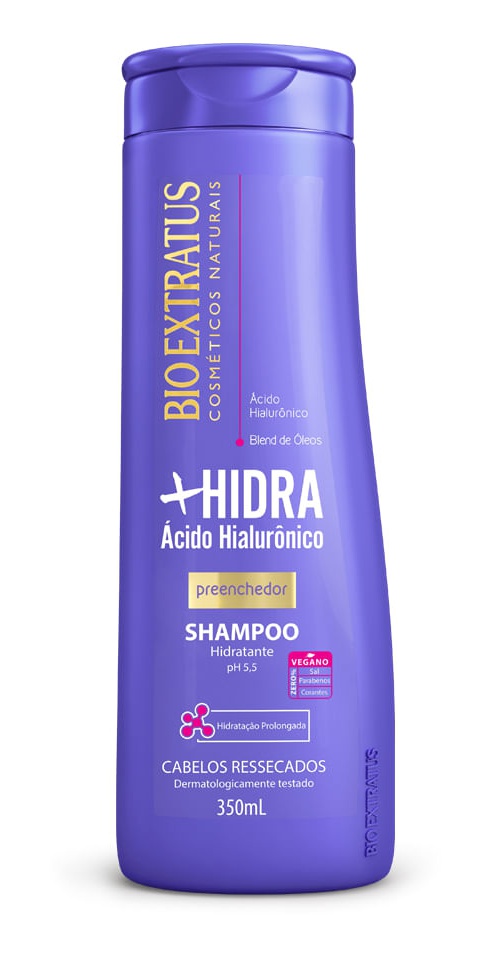
Hydra+ Shampoo
Ingredients overview
 INCI photo pending approval
Highlights
Key Ingredients
Other Ingredients
Skim through
Bioextratus Hydra+ ShampooIngredients explained
 We don't have description for this ingredient yet.
A so-called diester created from two stearic acid molecules and an ethylene glycol molecule. Its main thing is being an opacifier and pearling agent in cleansing products making them white and glossy. It can also give body to creams and emulsions.
A cleansing agent whose main thing is being a very good team player next to other (anionic) cleaning agents and working as an excellent foam booster and viscosity builder.
The downside of Cocamide DEA is that it may contain residual content of Diethanolamine, a secondary amine known to be a potential source of harmful nitrosamines. But do not panic, Cocamide DEA is considered safe as used in cosmetics, still, the cosmetic industry is actively looking at alternatives and it is used less and less often.
Good old water, aka H2O. The most common skincare ingredient of all. You can usually find it right in the very first spot of the ingredient list, meaning it’s the biggest thing out of all the stuff that makes up the product.
It’s mainly a solvent for ingredients that do not like to dissolve in oils but rather in water.
Once inside the skin, it hydrates, but not from the outside - putting pure water on the skin (hello long baths!) is drying.
One more thing: the water used in cosmetics is purified and deionized (it means that almost all of the mineral ions inside it is removed). Like this, the products can stay more stable over time.
This ingredient name is not according to the INCI-standard. :( What, why?!
We don't have description for this ingredient yet.
Exactly what it sounds: nice smelling stuff put into cosmetic products so that the end product also smells nice. Fragrance in the US and parfum in the EU is a generic term on the ingredient list that is made up of 30 to 50 chemicals on average (but it can have as much as 200 components!).
If you are someone who likes to know what you put on your face then fragrance is not your best friend - there's no way to know what’s really in it.
Also, if your skin is sensitive, fragrance is again not your best friend. It’s the number one cause of contact allergy to cosmetics. It’s definitely a smart thing to avoid with sensitive skin (and fragrance of any type - natural is just as allergic as synthetic, if not worse!).
A common fragrance ingredient that smells like jasmine. It is one of the “EU 26 fragrances” that has to be labelled separately because of allergen potential. Best to avoid if your skin is sensitive.
A super common and cheap fragrance ingredient. It's in many plants, e.g. rosemary, eucalyptus, lavender, lemongrass, peppermint and it's the main component (about 50-90%) of the peel oil of citrus fruits.
It does smell nice but the problem is that it oxidizes on air exposure and the resulting stuff is not good for the skin. Oxidized limonene can cause allergic contact dermatitis and counts as a frequent skin sensitizer.
Limonene's nr1 function is definitely being a fragrance component, but there are several studies showing that it's also a penetration enhancer, mainly for oil-loving components.
All in all, limonene has some pros and cons, but - especially if your skin is sensitive - the cons probably outweigh the pros.
Linalool is a super common fragrance ingredient. It’s kind of everywhere - both in plants and in cosmetic products. It’s part of 200 natural oils including lavender, ylang-ylang, bergamot, jasmine, geranium and it can be found in 90-95% of prestige perfumes on the market.
The problem with linalool is, that just like limonene it oxidises on air exposure and becomes allergenic. That’s why a product containing linalool that has been opened for several months is more likely to be allergenic than a fresh one.
A study made in the UK with 483 people tested the allergic reaction to 3% oxidised linalool and 2.3% had positive test results.
We don't have description for this ingredient yet.
Super common ingredient in all kinds of cleansing products: face and body washes, shampoos and foam baths.
Number one reason for its popularity has to do with bubbles. Everyone loves bubbles. And cocamidopropyl betaine is great at stabilizing them.
The other reason is that it’s mild and works very well combined with other cleansing agents and surfactants. The art of cleansing is usually to balance between properly cleansing but not over-cleansing and cocamidopropyl betaine is helpful in pulling off this balance right.
Oh, and one more nice thing: even though it’s synthetic it’s highly biodegradable.
More info on CAPB on Collins Beaty Pages.
A 100% vegetable origin, biodegradable, mild cleansing agent that gives moderate to high amount of foam. It's happy to work together with other surfactants (in general, that helps to create milder formulas).
We don't have description for this ingredient yet.
We don't have description for this ingredient yet.
We don't have description for this ingredient yet.
We don't have description for this ingredient yet.
We don't have description for this ingredient yet.
Citric acid comes from citrus fruits and is an AHA. If these magic three letters don’t tell you anything, click here and read our detailed description on glycolic acid, the most famous AHA.
So citric acid is an exfoliant, that can - just like other AHAs - gently lift off the dead skin cells of your skin and make it more smooth and fresh.
There is also some research showing that citric acid with regular use (think three months and 20% concentration) can help sun-damaged skin, increase skin thickness and some nice hydrating things called glycosaminoglycans in the skin.
But according to a comparative study done in 1995, citric acid has less skin improving magic properties than glycolic or lactic acid. Probably that’s why citric acid is usually not used as an exfoliant but more as a helper ingredient in small amounts to adjust the pH of a formulation.
There is definitely some craze going on for coconut oil both in the healthy eating space (often claimed to be the healthiest oil to cook with but this is a topic for another site) and in the skin and hair care space.
We will talk here about the latter two and see why we might want to smear it all over ourselves. Chemically speaking, coconut oil has a unique fatty acid profile. Unlike many plant oils that mostly contain unsaturated fatty acids (fatty acids with double bonds and kinky structure such as linoleic or oleic), coconut oil is mostly saturated (fatty acids with single bonds only) and its most important fatty acid is Lauric Acid (about 50%). Saturated fatty acids have a linear structure that can stack nice and tight and hence they are normally solid at room temperature. Coconut oil melts around 25 °C so it is solid in the tub but melts on contact with the skin.
The saturated nature of coconut oil also means that it is a heavy-duty-oil ideal for dry skin types. A double-blind research confirmed that extra virgin coconut oil is as effective in treating xerosis (aka very dry skin) as mineral oil. Another study found that coconut oil is more effective than mineral oil in treating mild to moderate atopic dermatitis (aka eczema) in children.
So when it comes to dry skin, coconut oil is a goodie, no question there. The question is if it is good or bad for acne-prone skin. Its main fatty acid, Lauric Acid has some research showing that it is a promising ingredient against evil acne-causing bacteria, P. acnes but at the same time, both Lauric Acid and coconut oil have a very high comedogenic rating (4 out of 5). Though comedogenic ratings are not very reliable, anecdotal evidence (i.e. people commenting in forums) shows that people have mixed experiences. While some claim that it worked wonders on their acne others say that it gave them serious blackheads and zits. Try it at your own risk.
As for hair care, coconut oil has pretty solid research showing that it can penetrate into the hair very well (better than mineral oil and sunflower oil) and it can prevent hair protein loss as well as combing damage. If you have problems with damaged hair, split ends, coconut oil is worth trying as a pre- or/and post-wash treatment. Labmuffin has an awesome blogpost explaining in more detail why coconut oil is good for your hair.
A couple of other things worth mentioning: coconut oil might help with wound healing (promising animal study), it has some antifungal activity (against dermatophytes that cause the thing known as ringworm) and it also works as an insect repellent against black flies.
Overall, coconut oil is definitely a goodie for the hair and dry skin. If that warrants for the magic oil status it enjoys, we don't know.
We don't have description for this ingredient yet.
We don't have description for this ingredient yet.
We don't have description for this ingredient yet.
It's a sweet tasting sugar substitute that helps your skin to hold onto water when used in cosmetic products. It also helps to thicken up products and give them a bit more slip.
PCA stands for Pyrrolidone Carboxylic Acid and though it might not sound like it, it is a thing that can be found naturally in our skin. The sodium salt form of PCA is an important skin-identical ingredient and great natural moisturizer that helps the skin to hold onto water and stay nicely hydrated.
This totally unpronounceable ingredient (let’s take a shortcut: MCI) is a super effective preservative with both antibacterial and antifungal effects that works at very low concentrations.
The bad news with it though is that it can sensitize the skin easily (it’s a so-called non-fragrance allergen). It’s not permitted to be used alone, but only with its BFF, methylisothiazolinone (MI), another icky preservative. Together they have a broad spectrum antimicrobial effect but are permitted to be used only in rinse-off products (under 0.0015%).
We don't have description for this ingredient yet.
Castor oil is sourced from the castor bean plant native to tropical areas in Eastern Africa and the Mediterranean Basin. It is an age-old ingredient (it’s over 4,000 years old!) with many uses including as a shoe polish, food additive and motor lubricant. You would be reasonable to think that putting shoe polish on your face wouldn’t be the best idea, but it turns out castor oil has some unique properties that make it a stalwart in thick and gloss-giving formulas (think lipsticks and highlighters).
So what is so special about it? The answer is its main fatty acid, called ricinoleic acid (85-95%). Unlike other fatty acids, ricinoleic acid has an extra water-loving part (aka -OH group) on its fatty chain that gives Castor Oil several unique properties. First, it is thicker than other oils, then its solubility is different (e.g. dissolves in alcohol but not in mineral oil), and it allows all kinds of chemical modifications other oils do not, hence the lots of Castor oil-derived ingredients. It is also more glossy than other oils, in fact, it creates the highest gloss of all natural oils when applied to the skin. Other than that, it is a very effective emollient and occlusive that reduces skin moisture loss so it is quite common in smaller amounts in moisturizers.
While it is very unlikely (and this is true for pretty much every ingredient), cases of reactions to castor oil have been reported, so if your skin is sensitive, it never hurts to patch test.
As you may guess, if something is only recommended in products that you rinse off (cleansers and shampoos), then it’s probably not the best ingredient for the skin.
Methylisothiazolinone (MI) is a preservative that' super efficient against bacteria at surprisingly low concentrations. The problem with it though is that it can also sensitize and irritate the skin quite easily when it comes in leave-on formulas.
Currently, some countries are considering to ban it entirely (like Denmark) and the permitted use level is very low (under 0.01%). Luckily there are plenty of products on the market with other preservative options so if you are a better safe than sorry type it's probably best to avoid it.
A kind of salt that's used as a thickener in cosmetic products.
We don't have description for this ingredient yet.
We don't have description for this ingredient yet.
We don't have description for this ingredient yet.
We don't have description for this ingredient yet.
We don't have description for this ingredient yet.
Hydrolyzed Hyaluronic Acid is a low molecular weight, chemically chopped up version of the naturally big molecule and current IT-moisturizer, Hyaluronic Acid (HA). The TL; DR version of HA is that it's a huge polymer (big molecule from repeated subunits) found in the skin that acts as a sponge helping the skin to retain water, making it plump and elastic. As HA is a polymer, the subunits can be repeated many times (as a high-molecular-weight version), or just a few times (as a low-molecular-weight version).
We wrote in detail at HA about how different molecular weight versions do different things both as a component of the skin and as a skincare ingredient, so click here and read about all the details. Hydrolyzed Hyaluronic Acid can also come in different molecular-weight versions with different properties:
- 100-300 kDa version: apart from moisturizing, this size might also help the skin to repair itself by increasing its self-defense. It is also claimed to boost the wound healing process and is especially helpful for sensitive skin types (acne, rosacea, inflammation-related skin diseases).
- 50k Da version: this is the size that is claimed to be able to absorb into the skin and plump up wrinkles, so it is used mainly as an "anti-aging ingredient"
- below 50k, around 10k Da version: there is a Japanese version trade named Hyalo-Oligo that has only a 10k molecular weight and is claimed to penetrate the skin very well, have a unique touch and give deep and long-lasting moisturization. Based on the Evonik-research and the natural role of LMW-HA in the body working as a pro-inflammatory signal molecule, this ultra-low molecular weight version is a controversial ingredient.
If you wanna become a real HA-and-the-skin expert, you can read much more about the topic at hyaluronic acid (including penetration-questions, differences between high and low molecular weight versions and a bunch of references to scientific literature).
You may also want to take a look at...
| what‑it‑does | colorant |
| what‑it‑does | emollient | emulsifying | viscosity controlling |
| what‑it‑does | surfactant/cleansing | viscosity controlling | emulsifying |
| what‑it‑does | solvent |
| what‑it‑does | surfactant/cleansing | emulsifying |
| what‑it‑does | perfuming |
| what‑it‑does | perfuming |
| what‑it‑does | perfuming | solvent |
| what‑it‑does | perfuming |
| what‑it‑does | surfactant/cleansing | perfuming | viscosity controlling |
| what‑it‑does | surfactant/cleansing |
| what‑it‑does | surfactant/cleansing |
| what‑it‑does | surfactant/cleansing | viscosity controlling |
| what‑it‑does | surfactant/cleansing | emulsifying |
| what‑it‑does | surfactant/cleansing |
| what‑it‑does | viscosity controlling |
| what‑it‑does | emulsifying | surfactant/cleansing | viscosity controlling |
| irritancy, com. | 0, 2 |
| what‑it‑does | buffering |
| what‑it‑does | emollient | perfuming |
| irritancy, com. | 0, 4 |
| what‑it‑does | moisturizer/humectant |
| irritancy, com. | 0, 0 |
| what‑it‑does | skin-identical ingredient | moisturizer/humectant |
| irritancy, com. | 0, 0 |
| what‑it‑does | preservative |
| what‑it‑does | emollient | perfuming |
| irritancy, com. | 0, 0-1 |
| what‑it‑does | preservative |
| what‑it‑does | viscosity controlling |
| what‑it‑does | viscosity controlling |
| what‑it‑does | viscosity controlling |
| what‑it‑does | viscosity controlling |
| what‑it‑does | moisturizer/humectant |