




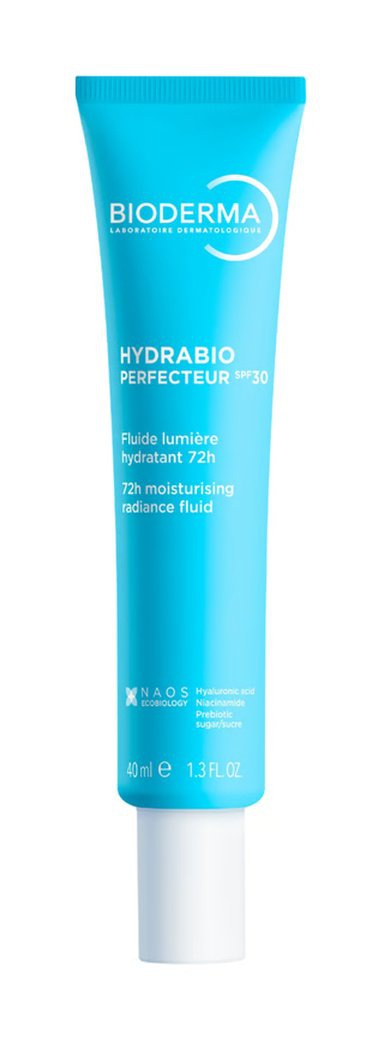
Hydrabio Perfecteur 72h Moisturising Radiance Fluid SPF 30
Ingredients overview
Highlights
Key Ingredients
Other Ingredients
Skim through
Bioderma Hydrabio Perfecteur 72h Moisturising Radiance Fluid SPF 30Ingredients explained
Good old water, aka H2O. The most common skincare ingredient of all. You can usually find it right in the very first spot of the ingredient list, meaning it’s the biggest thing out of all the stuff that makes up the product.
It’s mainly a solvent for ingredients that do not like to dissolve in oils but rather in water.
Once inside the skin, it hydrates, but not from the outside - putting pure water on the skin (hello long baths!) is drying.
One more thing: the water used in cosmetics is purified and deionized (it means that almost all of the mineral ions inside it is removed). Like this, the products can stay more stable over time.
- A natural moisturizer that’s also in our skin
- A super common, safe, effective and cheap molecule used for more than 50 years
- Not only a simple moisturizer but knows much more: keeps the skin lipids between our skin cells in a healthy (liquid crystal) state, protects against irritation, helps to restore barrier
- Effective from as low as 3% with even more benefits for dry skin at higher concentrations up to 20-40%
- High-glycerin moisturizers are awesome for treating severely dry skin
A clear, colorless, practically odorless, light liquid that works as a handy helper ingredient in sunscreen formulas. It helps to create high-SPF formulas with reduced concentrations of UV-filters and it also helps to create cosmetically elegant formulas (and that's no easy feat when it comes to sunscreens). It absorbs rapidly, makes the product easily spreadable and reduces greasiness coming from the oil-soluble sunscreen agents.
 We don't have description for this ingredient yet.
The famous Avobenzone. It is a special snowflake as it is the only globally available chemical sunscreen agent that provides proper UVA protection (in the US, new generation sunscreen agents are not approved because of impossible FDA regulations). It is the global gold standard of UVA protection and is the most used UVA sunscreen in the world.
It gives very good protection across the whole UVA range (310-400 nm that is both UVA1 and UVA2) with a peak protection at 360 nm. The problem with it, though, is that it is not photostable and degrades in the sunlight. Wikipedia says that avobenzone loses 36% of its UV-absorption capacity after just one hour of sunlight (yep, this is one of the reasons why sunscreens have to be reapplied after a few hours).
The cosmetic's industry is trying to solve the problem by combining avobenzone with other UV filters that enhance its stability (like octocrylene, Tinosorb S or Ensulizole) or by encapsulating it and while both solutions help, neither is perfect. Interestingly, the combination of avobenzone with mineral sunscreens (that is titanium dioxide and zinc oxide) is not a good idea. In the US, it is flat out prohibited as avobenzone becomes unstable when combined with mineral sunscreens.
As for safety, avobenzone has a pretty good safety profile. It counts as non-irritating, and unlike some other chemical sunscreens, it shows no estrogenic effect. The maximum concentration of avobenzone permitted is 5% in the EU and 3% in the US.
Its INCI name is a bit of a mouthful, but Bis-Ethylhexyloxyphenol Methoxyphenyl Triazine is worth recognizing it as it is one of the best sunscreen agents known today. Unfortunately, it's not FDA-approved so you will not find it in sunscreens coming from the US (not because it's not good, but because US regulations make it impossible for newer sunscreen agents to get approved), but it is widely available in other parts of the world like Europe, Australia or Asia.
It is a broad-spectrum (covers the whole UVB and UVA range, 280-400 nm) chemical sunscreen agent with peak protections at about 310 and 345 nm and unlike older UV filters, it's very photostable. It hardly deteriorates in the presence of UV light and it's also useful in stabilizing other less stable sunscreen agents, like the famous UVA protector, avobenzone.
It's a new generation sunscreen agent that was specifically designed for high SPF and good UVA protection and based on a 2007 study that compared 18 sunscreen agents available in the EU it really had the best SPF protection (they used the highest concentration allowed by EU regulations from each 18 sunscreens and Trinosorb S gave an SPF 20 all by itself).
It is an oil-soluble, slightly yellowish powder that is not absorbed into the skin too much. This is good news for a sunscreen agent as it needs to be on the surface of the skin to do its job properly. Regarding Bis-Ethylhexyloxyphenol Methoxyphenyl Triazine side effects, we have good news here as well: it has a great safety profile and unlike a couple of other chemical sunscreens, Trinosorb S (and M) does not show estrogenic activity.
Overall, we think Trinosorb S is one of the best sunscreen options available today.
Are you into sunscreen agents? We have shiny explanations (along with product lists) about others as well:
- Methylene Bis-Benzotriazolyl Tetramethylbutylphenol, aka Tinosorb M, the good buddy of our current molecule Tinosorb S
- Tris-Biphenyl Triazine, aka Tinosorb A2B, the newest addition to the Tinosorb family that protects strongly in an in-between wavelength that most other filters miss
- Ethylhexyl Triazone, aka Uvinul T 150, another new generation sunscreen agent with super-high UVB protection
- Diethylamino Hydroxybenzoyl Hexyl Benzoate, aka Uvinul A Plus, a new generation sunscreen for UVA protection
Boron Nitride is a graphite-like, crystalline material that has light-diffusing and texture improving properties. It is quite the multi-tasker as it can blur imperfections, add an exceptional creamy feel to products and act as a mattifying agent.
In powder makeup products (think blushers, highlighters), it enhances the skin feel and improves the color pay-off. In lipsticks, it gives a creamy feel and a better color on the lips.
There is definitely some craze going on for coconut oil both in the healthy eating space (often claimed to be the healthiest oil to cook with but this is a topic for another site) and in the skin and hair care space.
We will talk here about the latter two and see why we might want to smear it all over ourselves. Chemically speaking, coconut oil has a unique fatty acid profile. Unlike many plant oils that mostly contain unsaturated fatty acids (fatty acids with double bonds and kinky structure such as linoleic or oleic), coconut oil is mostly saturated (fatty acids with single bonds only) and its most important fatty acid is Lauric Acid (about 50%). Saturated fatty acids have a linear structure that can stack nice and tight and hence they are normally solid at room temperature. Coconut oil melts around 25 °C so it is solid in the tub but melts on contact with the skin.
The saturated nature of coconut oil also means that it is a heavy-duty-oil ideal for dry skin types. A double-blind research confirmed that extra virgin coconut oil is as effective in treating xerosis (aka very dry skin) as mineral oil. Another study found that coconut oil is more effective than mineral oil in treating mild to moderate atopic dermatitis (aka eczema) in children.
So when it comes to dry skin, coconut oil is a goodie, no question there. The question is if it is good or bad for acne-prone skin. Its main fatty acid, Lauric Acid has some research showing that it is a promising ingredient against evil acne-causing bacteria, P. acnes but at the same time, both Lauric Acid and coconut oil have a very high comedogenic rating (4 out of 5). Though comedogenic ratings are not very reliable, anecdotal evidence (i.e. people commenting in forums) shows that people have mixed experiences. While some claim that it worked wonders on their acne others say that it gave them serious blackheads and zits. Try it at your own risk.
As for hair care, coconut oil has pretty solid research showing that it can penetrate into the hair very well (better than mineral oil and sunflower oil) and it can prevent hair protein loss as well as combing damage. If you have problems with damaged hair, split ends, coconut oil is worth trying as a pre- or/and post-wash treatment. Labmuffin has an awesome blogpost explaining in more detail why coconut oil is good for your hair.
A couple of other things worth mentioning: coconut oil might help with wound healing (promising animal study), it has some antifungal activity (against dermatophytes that cause the thing known as ringworm) and it also works as an insect repellent against black flies.
Overall, coconut oil is definitely a goodie for the hair and dry skin. If that warrants for the magic oil status it enjoys, we don't know.
- A multi-functional skincare superstar with several proven benefits for the skin
- Great anti-aging, wrinkle smoothing ingredient used at 4-5% concentration
- Fades brown spots alone or in combination with amino sugar, acetyl glucosamine
- Increases ceramide synthesis that results in a stronger, healthier skin barrier and better skin hydration
- Can help to improve several skin conditions including acne, rosacea, and atopic dermatitis
A super versatile and common mineral powder that comes in different particle sizes. It is a multi-tasker used to improve skin feel, increase product slip, give the product light-reflecting properties, enhance skin adhesion or serve as an anti-caking agent.
It is also the most commonly used "base" material for layered composite pigments such as pearl-effect pigments. In this case, mica is coated with one or more metal oxides (most commonly titanium dioxide) to achieve pearl effect via the physical phenomenon known as interference.
Cellulose is an important component of the cell walls of green plants and it's the most abundant natural polymer (big molecule from repeated subunits) on Earth. If the polymer structure is not too big (less than 200 repeated units), cellulose becomes microcrystalline cellulose.
In skin care, it comes as a fine or less fine white powder. The less fine (bigger particle size) version is used as a gentle scrubbing agent (a nice natural, biodegradable alternative to now banned plastic polyethylene) and the ultra fine version is used as a helper ingredient that gives a super-silky, soft touch, reduces tackiness or greasiness and can also be used as a mattifying agent.
Combined with Cellulose Gum, it also works as a nice gelling agent.
A white to beige powder that is described as the golden standard emulsifier for emulsions (oil+water mixtures) that are difficult to stabilize. It is especially popular in sunscreens as it can boost SPF protection and increase the water-resistance of the formula.
Ci 77891 is the color code of titanium dioxide. It's a white pigment with great color consistency and dispersibility.
A super common emollient that makes your skin feel nice and smooth. It comes from coconut oil and glycerin, it’s light-textured, clear, odorless and non-greasy. It’s a nice ingredient that just feels good on the skin, is super well tolerated by every skin type and easy to formulate with. No wonder it’s popular.
A clear, colorless, almost odorless oil that spreads nicely and easily and gives a velvet dry skin feel. It is good friends with sunscreen agents and helps to solubilize them. Also, it makes sunscreens feel lighter and spread easier.
A really multi-functional helper ingredient that can do several things in a skincare product: it can bring a soft and pleasant feel to the formula, it can act as a humectant and emollient, it can be a solvent for some other ingredients (for example it can help to stabilize perfumes in watery products) and it can also help to disperse pigments more evenly in makeup products. And that is still not all: it can also boost the antimicrobial activity of preservatives.
A chemical sunscreen agent that gives strong protection in the UVB (280-320nm) range with its peak protection at 306 nm. Its special property is that unlike most sunscreen agents, it is not oil but water soluble, so it is ideal to create light, oily skin compatible formulas. It is also fairly photostable and can be used to protect other less stable UV filters (like famous UVA blocker, avobenzone) in the formula. It is approved worldwide and can be used up to 4% in the US and up to 8% in the EU.
- It's a helper ingredient that improves the freeze-thaw stability of products
- It's also a solvent, humectant and to some extent a penetration enhancer
- It has a bad reputation among natural cosmetics advocates but cosmetic scientists and toxicology experts do not agree (read more in the geeky details section)
A fatty alcohol (the non-drying type with a long oil loving chain of 22 carbon atoms) that is used to increase the viscosity of the formula and it also helps the oily and the watery parts to stay nicely mixed together (called emulsion stabilizing).
The combination of glycerin + behenic acid that comes either in a fine powder or waxy solid form. Together with the di- and triglyceride of behenic acid, the trio has remarkable gelling properties helping cosmetic chemists to create ultra-soft and non-tacky waterfree gels. They also have great emulsion stabilizing properties, and work as high-performance compacting agents for makeup products that come in the form of pressed powders.
It's also vegetable origin, and Ecocert certified.
A white powdery thing that's the major component of glass and sand. In cosmetics, it’s often in products that are supposed to keep your skin matte as it has great oil-absorbing abilities. It’s also used as a helper ingredient to thicken up products or suspend insoluble particles.
We don't have description for this ingredient yet.
A semi-essential (infants cannot synthesize it, but adults can) amino acid that is one of the primary building blocks of hair keratin and skin collagen. It's a natural moisturizing factor, a skin hydrator and might also help to speed up wound healing.
Arginine usually has a positive charge (cationic) that makes it substantive to skin and hair (those are more negatively charged surfaces) and an excellent film former. Thanks to the positive charge, it also creates a complex with AHAs (AHAs like to lose a hydrogen ion and be negatively charged, so the positive and the negative ions attract each other) that causes a "time-release AHA effect" and reduces the irritation associated with AHAs.
A very common ingredient that can be found in all cell membranes. In cosmetics it's quite the multi-tasker: it's an emollient and water-binding ingredient but it's also an emulsifier and can be used for stabilization purposes. It's also often used to create liposomes.
We don't have description for this ingredient yet.
We don't have description for this ingredient yet.
It’s one of those little helper ingredients that makes sure the product stays the same over time. No color change or anything like that. It does so by neutralizing the metal ions in the formula (that usually get into there from water) that would otherwise cause some not so nice changes.
It's one of the most commonly used thickeners and emulsion stabilizers. If the product is too runny, a little xanthan gum will make it more gel-like. Used alone, it can make the formula sticky and it is a good team player so it is usually combined with other thickeners and so-called rheology modifiers (helper ingredients that adjust the flow and thus the feel of the formula). The typical use level of Xantha Gum is below 1%, it is usually in the 0.1-0.5% range.
Btw, Xanthan gum is all natural, a chain of sugar molecules (polysaccharide) produced from individual sugar molecules (glucose and sucrose) via fermentation. It’s approved by Ecocert and also used in the food industry (E415).
A type of sugar molecule, that has water-binding properties and helps to keep your skin hydrated.
A type of sugar that's part of a moisturizing trio called Aquaxyl. You can read more about its magic properties at xylitylglucoside.
A yellowish oily liquid that works as a medium spreading emollient and is suitable for a wide pH range.
We don't have description for this ingredient yet.
PCA stands for Pyrrolidone Carboxylic Acid and though it might not sound like it, it is a thing that can be found naturally in our skin. The sodium salt form of PCA is an important skin-identical ingredient and great natural moisturizer that helps the skin to hold onto water and stay nicely hydrated.
Lactobacillus ferment is an interesting probiotic ingredient with some promising properties.
First, according to a 2009 Estee Lauder patent, it’s a DNA repair enzyme and it can help to protect the skin against environmental aggressors.
Second, still according to Estee Lauder research but now from 2012 the ingredient has anti-microbial and anti-inflammatory properties and holds promise in the treatment of acne and rosacea. For the former one 5% was needed to show effectiveness, but for reducing skin sensitivity already 1% showed results.
The anti-acne effect is confirmed also by US manufacturer, Barnet, that says that Lactobacillus ferment is helpful in killing harmful bacteria and creating a healthy balanced microflora. Compared to well-known anti-acne and anti-inflammatory salicylic acid the probiotic worked faster at reducing the size and redness of acne lesions.
It also goes by the trade name Leucidal Liquid SF and can serve in the formula as a natural preservative.
Bottom line: It’s not the most proven ingredient (yet) but definitely a very promising one especially if you have sensitive skin, acne or rosacea.
A bit of a sloppy ingredient name as it covers not one but three pigments: red, yellow and black iron oxide.
The trio is invaluable for "skin-colored" makeup products (think your foundation and pressed powder) as blending these three shades carefully can produce almost any shade of natural-looking flesh tones.
Citric acid comes from citrus fruits and is an AHA. If these magic three letters don’t tell you anything, click here and read our detailed description on glycolic acid, the most famous AHA.
So citric acid is an exfoliant, that can - just like other AHAs - gently lift off the dead skin cells of your skin and make it more smooth and fresh.
There is also some research showing that citric acid with regular use (think three months and 20% concentration) can help sun-damaged skin, increase skin thickness and some nice hydrating things called glycosaminoglycans in the skin.
But according to a comparative study done in 1995, citric acid has less skin improving magic properties than glycolic or lactic acid. Probably that’s why citric acid is usually not used as an exfoliant but more as a helper ingredient in small amounts to adjust the pH of a formulation.
It’s the - sodium form - cousin of the famous NMF, hyaluronic acid (HA). If HA does not tell you anything we have a super detailed, geeky explanation about it here. The TL; DR version of HA is that it's a huge polymer (big molecule from repeated subunits) found in the skin that acts as a sponge helping the skin to hold onto water, being plump and elastic. HA is famous for its crazy water holding capacity as it can bind up to 1000 times its own weight in water.
As far as skincare goes, sodium hyaluronate and hyaluronic acid are pretty much the same and the two names are used interchangeably. As cosmetic chemist kindofstephen writes on reddit "sodium hyaluronate disassociates into hyaluronic acid molecule and a sodium atom in solution".
In spite of this, if you search for "hyaluronic acid vs sodium hyaluronate" you will find on multiple places that sodium hyaluronate is smaller and can penetrate the skin better. Chemically, this is definitely not true, as the two forms are almost the same, both are polymers and the subunits can be repeated in both forms as much as you like. (We also checked Prospector for sodium hyaluronate versions actually used in cosmetic products and found that the most common molecular weight was 1.5-1.8 million Da that absolutely counts as high molecular weight).
What seems to be a true difference, though, is that the salt form is more stable, easier to formulate and cheaper so it pops up more often on the ingredient lists.
If you wanna become a real HA-and-the-skin expert you can read way more about the topic at hyaluronic acid (including penetration-questions, differences between high and low molecular weight versions and a bunch of references to scientific literature).
A 100% natural and plant-derived moisturizer that mimics the natural carbohydrate fraction found in the upper layer of the skin. Its special magic power is to bind to the skin stronger and longer than other moisturizer ingredients do so it can keep the skin hydrated longer than usual.
- Primary fat-soluble antioxidant in our skin
- Significant photoprotection against UVB rays
- Vit C + Vit E work in synergy and provide great photoprotection
- Has emollient properties
- Easy to formulate, stable and relatively inexpensive
Sunflower does not need a big intro as you probably use it in the kitchen as cooking oil, or you munch on the seeds as a healthy snack or you adore its big, beautiful yellow flower during the summer - or you do all of these and probably even more. And by even more we mean putting it all over your face as sunflower oil is one of the most commonly used plant oils in skincare.
It’s a real oldie: expressed directly from the seeds, the oil is used not for hundreds but thousands of years. According to The National Sunflower Association, there is evidence that both the plant and its oil were used by American Indians in the area of Arizona and New Mexico about 3000 BC. Do the math: it's more than 5000 years – definitely an oldie.
Our intro did get pretty big after all (sorry for that), so let's get to the point finally: sunflower oil - similar to other plant oils - is a great emollient that makes the skin smooth and nice and helps to keep it hydrated. It also protects the surface of the skin and enhances the damaged or irritated skin barrier. Leslie Bauman notes in Cosmetic Dermatology that one application of sunflower oil significantly speeds up the recovery of the skin barrier within an hour and sustains the results 5 hours after using it.
It's also loaded with fatty acids (mostly linoleic (50-74%) and oleic (14-35%)). The unrefined version (be sure to use that on your skin!) is especially high in linoleic acid that is great even for acne-prone skin. Its comedogen index is 0, meaning that it's pretty much an all skin-type oil.
Truth be told, there are many great plant oils and sunflower oil is definitely one of them.
We don't have description for this ingredient yet.
We don't have description for this ingredient yet.
Exactly what it sounds: nice smelling stuff put into cosmetic products so that the end product also smells nice. Fragrance in the US and parfum in the EU is a generic term on the ingredient list that is made up of 30 to 50 chemicals on average (but it can have as much as 200 components!).
If you are someone who likes to know what you put on your face then fragrance is not your best friend - there's no way to know what’s really in it.
Also, if your skin is sensitive, fragrance is again not your best friend. It’s the number one cause of contact allergy to cosmetics. It’s definitely a smart thing to avoid with sensitive skin (and fragrance of any type - natural is just as allergic as synthetic, if not worse!).
You may also want to take a look at...
| what‑it‑does | solvent |
| what‑it‑does | skin-identical ingredient | moisturizer/humectant |
| irritancy, com. | 0, 0 |
| what‑it‑does | emollient | solvent |
| what‑it‑does | sunscreen |
| what‑it‑does | sunscreen |
| what‑it‑does | emollient | perfuming |
| irritancy, com. | 0, 4 |
| what‑it‑does | cell-communicating ingredient | skin brightening | anti-acne | moisturizer/humectant |
| what‑it‑does | colorant |
| what‑it‑does | viscosity controlling |
| what‑it‑does | emulsifying | surfactant/cleansing |
| what‑it‑does | colorant |
| irritancy, com. | 0, 0 |
| what‑it‑does | emollient |
| what‑it‑does | emollient |
| what‑it‑does | solvent |
| what‑it‑does | sunscreen |
| what‑it‑does | moisturizer/humectant | solvent |
| irritancy, com. | 0, 0 |
| what‑it‑does | emollient | viscosity controlling |
| what‑it‑does | emollient | emulsifying |
| what‑it‑does | viscosity controlling |
| what‑it‑does | emulsifying | surfactant/cleansing |
| what‑it‑does | skin-identical ingredient |
| what‑it‑does | emollient | emulsifying |
| what‑it‑does | emollient | surfactant/cleansing |
| what‑it‑does | moisturizer/humectant |
| what‑it‑does | chelating |
| what‑it‑does | viscosity controlling |
| what‑it‑does | moisturizer/humectant |
| what‑it‑does | moisturizer/humectant |
| what‑it‑does | emollient |
| what‑it‑does | preservative | antimicrobial/antibacterial |
| what‑it‑does | moisturizer/humectant |
| what‑it‑does | skin-identical ingredient | moisturizer/humectant |
| irritancy, com. | 0, 0 |
| what‑it‑does | soothing | preservative |
| what‑it‑does | colorant |
| irritancy, com. | 0, 0 |
| what‑it‑does | buffering |
| what‑it‑does | skin-identical ingredient | moisturizer/humectant |
| irritancy, com. | 0, 0 |
| what‑it‑does | moisturizer/humectant |
| what‑it‑does | antioxidant |
| irritancy, com. | 0-3, 0-3 |
| what‑it‑does | emollient |
| irritancy, com. | 0, 0 |
| what‑it‑does | emollient |
| what‑it‑does | perfuming |