




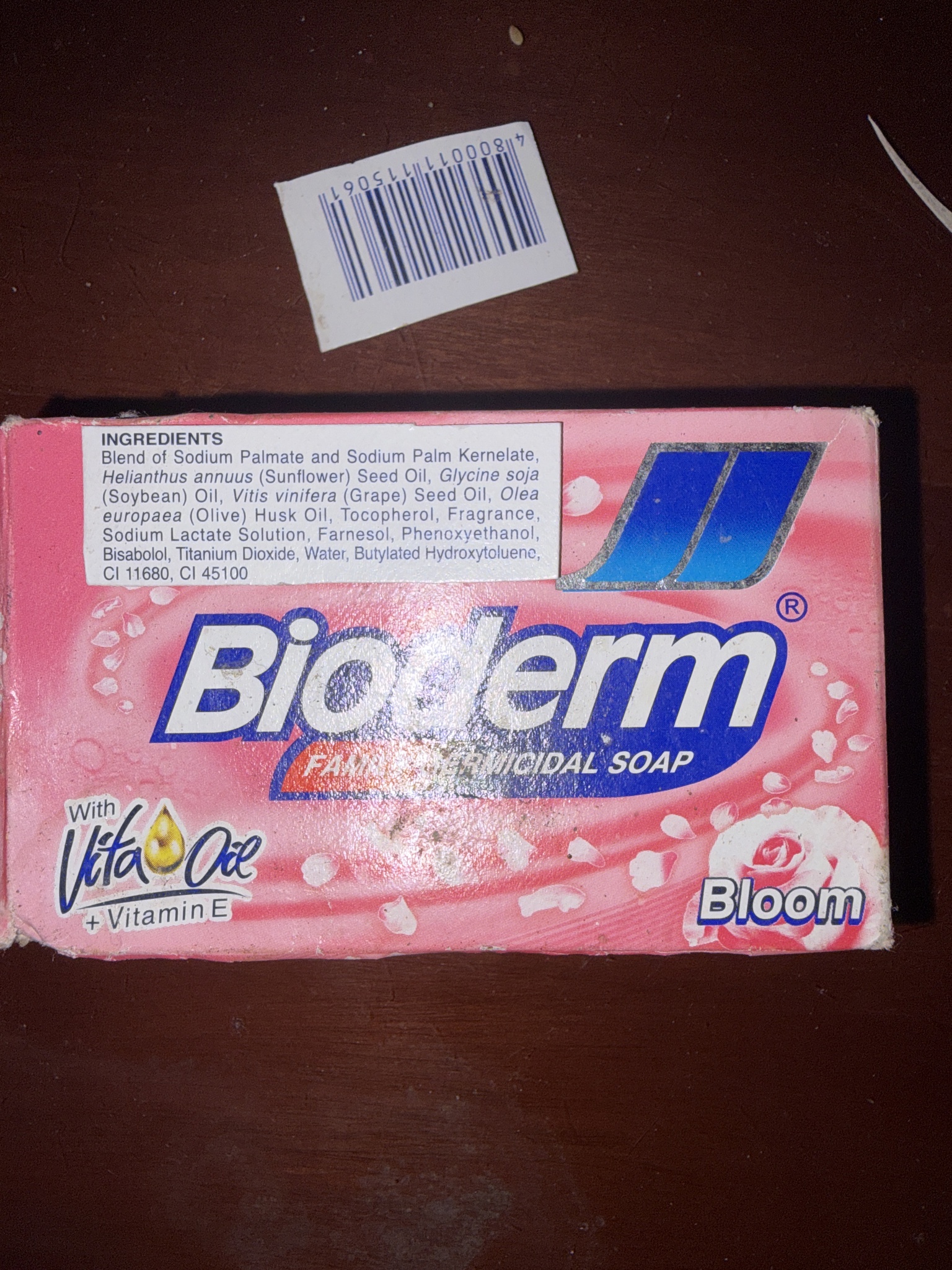
Family Germicidal Soap
Ingredients overview
 INCI photo pending approval
Highlights
Key Ingredients
Skim through
| Ingredient name | what-it-does | irr., com. | ID-Rating |
|---|---|---|---|
| Sodium Palm Kernelate | emulsifying, surfactant/cleansing, viscosity controlling | ||
| Helianthus Annuus (Sunflower) Seed Oil | emollient | 0, 0 | goodie |
| Glycine Soja (Soybean) Oil | emollient, perfuming | 0, 3 | goodie |
| Vitis Vinifera (Grape) Seed Oil | antioxidant, emollient | goodie | |
| Olea Europaea (Olive) Husk Oil | |||
| Tocopherol | antioxidant | 0-3, 0-3 | goodie |
| Fragrance | perfuming | icky | |
| Sodium Lactate Solution | |||
| Farnesol | perfuming | icky | |
| Phenoxyethanol | preservative | ||
| Bisabolol | soothing | goodie | |
| Titanium Dioxide | sunscreen, colorant | goodie | |
| Water | solvent | ||
| Butylated Hydroxytoluene | antioxidant, preservative | ||
| Ci 11680 | colorant | ||
| Ci 45100 | colorant |
Bioderm Family Germicidal SoapIngredients explained
 We don't have description for this ingredient yet.
Sunflower does not need a big intro as you probably use it in the kitchen as cooking oil, or you munch on the seeds as a healthy snack or you adore its big, beautiful yellow flower during the summer - or you do all of these and probably even more. And by even more we mean putting it all over your face as sunflower oil is one of the most commonly used plant oils in skincare.
It’s a real oldie: expressed directly from the seeds, the oil is used not for hundreds but thousands of years. According to The National Sunflower Association, there is evidence that both the plant and its oil were used by American Indians in the area of Arizona and New Mexico about 3000 BC. Do the math: it's more than 5000 years – definitely an oldie.
Our intro did get pretty big after all (sorry for that), so let's get to the point finally: sunflower oil - similar to other plant oils - is a great emollient that makes the skin smooth and nice and helps to keep it hydrated. It also protects the surface of the skin and enhances the damaged or irritated skin barrier. Leslie Bauman notes in Cosmetic Dermatology that one application of sunflower oil significantly speeds up the recovery of the skin barrier within an hour and sustains the results 5 hours after using it.
It's also loaded with fatty acids (mostly linoleic (50-74%) and oleic (14-35%)). The unrefined version (be sure to use that on your skin!) is especially high in linoleic acid that is great even for acne-prone skin. Its comedogen index is 0, meaning that it's pretty much an all skin-type oil.
Truth be told, there are many great plant oils and sunflower oil is definitely one of them.
The emollient plant oil coming from the soybean. It is considered to be a nice, cost-effective base oil with moisturizing properties. As for its fatty acid profile, it contains 48-59% barrier-repairing linoleic acid, 17-30% nourishing oleic acid and also some (4.5-11%) potentially anti-inflammatory linolenic acid.
A goodie plant oil coming from the polyphenol-rich seeds of the grape. It's a light emollient oil that makes your skin feel smooth and nice and also contains a bunch of good-for-the-skin stuff. It's a great source of antioxidant polyphenols, barrier repair fatty acid linoleic acid (about 55-77%, while oleic acid is about 12-27%) and antioxidant, skin-protectant vitamin E.
We don't have description for this ingredient yet.
- Primary fat-soluble antioxidant in our skin
- Significant photoprotection against UVB rays
- Vit C + Vit E work in synergy and provide great photoprotection
- Has emollient properties
- Easy to formulate, stable and relatively inexpensive
Exactly what it sounds: nice smelling stuff put into cosmetic products so that the end product also smells nice. Fragrance in the US and parfum in the EU is a generic term on the ingredient list that is made up of 30 to 50 chemicals on average (but it can have as much as 200 components!).
If you are someone who likes to know what you put on your face then fragrance is not your best friend - there's no way to know what’s really in it.
Also, if your skin is sensitive, fragrance is again not your best friend. It’s the number one cause of contact allergy to cosmetics. It’s definitely a smart thing to avoid with sensitive skin (and fragrance of any type - natural is just as allergic as synthetic, if not worse!).
This ingredient name is not according to the INCI-standard. :( What, why?!
With a sweet, light and floral scent, Farnesol is a popular fragrancing ingredient to make your cosmetics that bit nicer to use. It starts its life as a colorless liquid that can either be synthetically created or extracted from loads of plants like citronella, neroli, ylang-ylang, and tuberose.
The reason we list it as icky is because Farnesol is one of the “EU 26 fragrances” that has to be labeled separately (and cannot be simply included in the term “fragrance/perfume” on the label) because of allergen potential, so it is best avoided if you have super sensitive skin.
It’s pretty much the current IT-preservative. It’s safe and gentle, but even more importantly, it’s not a feared-by-everyone-mostly-without-scientific-reason paraben.
It’s not something new: it was introduced around 1950 and today it can be used up to 1% worldwide. It can be found in nature - in green tea - but the version used in cosmetics is synthetic.
Other than having a good safety profile and being quite gentle to the skin it has some other advantages too. It can be used in many types of formulations as it has great thermal stability (can be heated up to 85°C) and works on a wide range of pH levels (ph 3-10).
It’s often used together with ethylhexylglycerin as it nicely improves the preservative activity of phenoxyethanol.
It's one of the active parts of Chamomile that contains about 30% of bisabolol. It's a clear oily fluid that is used in skincare as a nice anti-inflammatory and soothing ingredient.
Titanium Dioxide is one of the two members of the elite sunscreen group called physical sunscreens (or inorganic sunscreens if you’re a science geek and want to be precise).
Traditionally, UV-filters are categorized as either chemical or physical. The big difference is supposed to be that chemical agents absorb UV-light while physical agents reflect it like a bunch of mini umbrellas on top of the skin. While this categorization is easy and logical it turns out it's not true. A recent, 2016 study shows that inorganic sunscreens work mostly by absorption, just like chemical filters, and only a little bit by reflection (they do reflect the light in the visible spectrum, but mostly absorb in the UV spectrum).
Anyway, it doesn't matter if it reflects or absorbs, Titanium Dioxide is a pretty awesome sunscreen agent for two main reasons: it gives a nice broad spectrum coverage and it's highly stable. Its protection is very good between 290 - 350 nm (UVB and UVA II range), and less good at 350-400 nm (UVA I) range. Regular sized Titanium Dioxide also has a great safety profile, it's non-irritating and is pretty much free from any health concerns (like estrogenic effect worries with some chemical filters).
The disadvantage of Titanium Dioxide is that it's not cosmetically elegant, meaning it's a white, "unspreadable" mess. Sunscreens containing Titanium Dioxide are often hard to spread on the skin and they leave a disturbing whitish tint. The cosmetic industry is, of course, really trying to solve this problem and the best solution so far is using nanoparticles. The itsy-bitsy Nano-sized particles improve both spreadability and reduce the whitish tint a lot, but unfortunately, it also introduces new health concerns.
The main concern with nanoparticles is that they are so tiny that they are absorbed into the skin more than we want them (ideally sunscreen should remain on the surface of the skin). Once absorbed they might form unwanted complexes with proteins and they might promote the formation of evil free radicals. But do not panic, these are concerns under investigation. A 2009 review article about the safety of nanoparticles summarizes this, "to date, in-vivo and in-vitro studies have not demonstrated percutaneous penetration of nanosized particles in titanium dioxide and zinc oxide sunscreens". The English translation is, so far it looks like sunscreens with nanoparticles do stay on the surface of the skin where they should be.
All in all, Titanium Dioxide is a famous sunscreen agent and for good reason, it gives broad spectrum UV protection (best at UVB and UVA II), it's highly stable, and it has a good safety profile. It's definitely one of the best UV-filter agents we have today, especially in the US where new-generation Tinosorb filters are not (yet) approved.
Good old water, aka H2O. The most common skincare ingredient of all. You can usually find it right in the very first spot of the ingredient list, meaning it’s the biggest thing out of all the stuff that makes up the product.
It’s mainly a solvent for ingredients that do not like to dissolve in oils but rather in water.
Once inside the skin, it hydrates, but not from the outside - putting pure water on the skin (hello long baths!) is drying.
One more thing: the water used in cosmetics is purified and deionized (it means that almost all of the mineral ions inside it is removed). Like this, the products can stay more stable over time.
It's the acronym for Butylated Hydroxy Toluene. It's a common synthetic antioxidant that's used as a preservative.
There is some controversy around BHT. It's not a new ingredient, it has been used both as a food and cosmetics additive since the 1970s. Plenty of studies tried to examine if it's a carcinogen or not. This Truth in Aging article details the situation and also writes that all these studies examine BHT when taken orally.
As for cosmetics, the CIR (Cosmetic Ingredient Review) concluded that the amount of BHT used in cosmetic products is low (usually around 0.01-0.1%), it does not penetrate skin far enough to be absorbed into the bloodstream and it is safe to use in cosmetics.
You may also want to take a look at...
| what‑it‑does | emulsifying | surfactant/cleansing | viscosity controlling |
| what‑it‑does | emollient |
| irritancy, com. | 0, 0 |
| what‑it‑does | emollient | perfuming |
| irritancy, com. | 0, 3 |
| what‑it‑does | antioxidant | emollient |
| what‑it‑does | antioxidant |
| irritancy, com. | 0-3, 0-3 |
| what‑it‑does | perfuming |
| what‑it‑does | perfuming |
| what‑it‑does | preservative |
| what‑it‑does | soothing |
| what‑it‑does | sunscreen | colorant |
| what‑it‑does | solvent |
| what‑it‑does | antioxidant | preservative |
| what‑it‑does | colorant |
| what‑it‑does | colorant |