




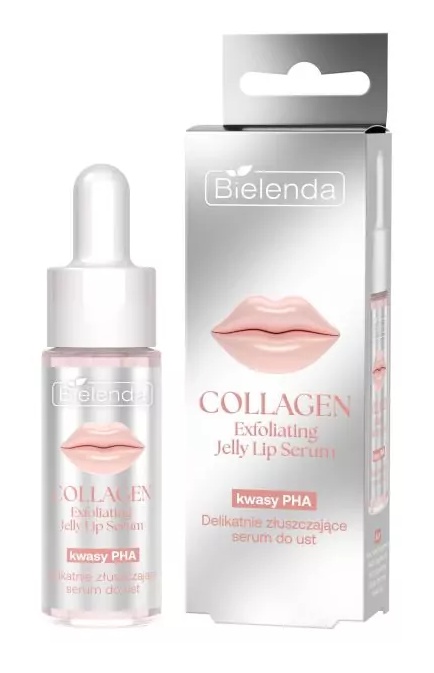
Collagen Exfoliating Jelly Lip Serum
Highlights
Other Ingredients
Skim through
| Ingredient name | what-it-does | irr., com. | ID-Rating |
|---|---|---|---|
| Glycerin | skin-identical ingredient, moisturizer/humectant | 0, 0 | superstar |
| Aqua (Water) | solvent | ||
| Gluconolactone | exfoliant, chelating | superstar | |
| Propanediol | solvent, moisturizer/humectant | ||
| Potassium Hydroxide | buffering | ||
| Succinic Acid | buffering | ||
| 1,2-Hexanediol | solvent | ||
| Glyceryl Glucoside | moisturizer/humectant | ||
| Lactobionic Acid | exfoliant, buffering | superstar | |
| Hydrolyzed Collagen | emollient, moisturizer/humectant | goodie | |
| Xanthan Gum | viscosity controlling | ||
| Raspberry Ketone | perfuming | ||
| Sodium Saccharin |
Bielenda Collagen Exfoliating Jelly Lip SerumIngredients explained
- A natural moisturizer that’s also in our skin
- A super common, safe, effective and cheap molecule used for more than 50 years
- Not only a simple moisturizer but knows much more: keeps the skin lipids between our skin cells in a healthy (liquid crystal) state, protects against irritation, helps to restore barrier
- Effective from as low as 3% with even more benefits for dry skin at higher concentrations up to 20-40%
- High-glycerin moisturizers are awesome for treating severely dry skin
Good old water, aka H2O. The most common skincare ingredient of all. You can usually find it right in the very first spot of the ingredient list, meaning it’s the biggest thing out of all the stuff that makes up the product.
It’s mainly a solvent for ingredients that do not like to dissolve in oils but rather in water.
Once inside the skin, it hydrates, but not from the outside - putting pure water on the skin (hello long baths!) is drying.
One more thing: the water used in cosmetics is purified and deionized (it means that almost all of the mineral ions inside it is removed). Like this, the products can stay more stable over time.
- It’s a polyhydroxy acid (PHA), that is often referred to as next generation AHA
- It gently lifts off dead skin cells form the skin surface making skin smooth and even
- In the long term it provides anti-aging benefits, like increased skin thickness and decreased wrinkles (though a tad less than even more proven superstar AHAs)
- It’s a great moisturizer and even helps to repair impaired skin barrier
- It’s antioxidant, and does not make your skin more sensitive to the sun
- It can be used even if your skin is very sensitive, rosacea prone or if you are post cosmetic procedure
Propanediol is a natural alternative for the often used and often bad-mouthed propylene glycol. It's produced sustainably from corn sugar and it's Ecocert approved.
It's quite a multi-tasker: can be used to improve skin moisturization, as a solvent, to boost preservative efficacy or to influence the sensory properties of the end formula.
It's a very alkaline stuff that helps to set the pH of the cosmetic formula to be just right. It's similar to the more often used sodium hydroxide and pretty much the same of what we wrote there applies here too.
A really multi-functional helper ingredient that can do several things in a skincare product: it can bring a soft and pleasant feel to the formula, it can act as a humectant and emollient, it can be a solvent for some other ingredients (for example it can help to stabilize perfumes in watery products) and it can also help to disperse pigments more evenly in makeup products. And that is still not all: it can also boost the antimicrobial activity of preservatives.
 We don't have description for this ingredient yet.
Lactobionic acid is the brother or maybe the sister of gluconolactone. Usually, it’s called a PHA, though some studies call it bionic acid or aldobionic acid. Not that this matters too much. What matters is that it’s similarly awesome to gluconolactone. So go read about gluconolactone to get the idea.
In a nutshell, it’s a next generation AHA, with almost all the benefits and more and without the irritation. It gently lifts off dead skin cells and makes your skin smooth and even. It moisturizes and helps the skin barrier. Can be used on sensitive skin too or post cosmetic procedure. In the long run, it has anti-aging benefits (though a tad less than AHAs), and it’s even an antioxidant.
Must try, just like the other AHAs.
The chemically chopped up version of the big protein molecule, collagen. It is often derived from fish or bovine sources and works as a nice moisturizer and humectant that helps the skin to hold onto water.
To understand a bit more what Hydrolyzed Collagen is, you have to know that proteins are large chains of amino acids connected with so-called peptide bonds. These bonds can be broken up when a water molecule is added and the resulting thing is a mix of shorter length amino acids, also called peptides. So Hydrolyzed Collagen is not really collagen, it is rather an undefined and varying mix of largish peptides. Based on a manufacturer's data, the whole, soluble collagen has an average molecular weight of 300 000 Da, while this chopped up mixture has an average MW of 12 000 Da (still pretty big).
The main thing of these largish peptides is to act as water-binding agents, and to make the skin nice and smooth (aka emollient). Hydrolyzed Collagen is also often used in cleansers as it can make harsh surfactants milder and in hair conditioners as it improves the flexibility and manageability of hair.
If you wanna know more about collagen in cosmetics, we have a shiny explanation about soluble collagen here >>
It's one of the most commonly used thickeners and emulsion stabilizers. If the product is too runny, a little xanthan gum will make it more gel-like. Used alone, it can make the formula sticky and it is a good team player so it is usually combined with other thickeners and so-called rheology modifiers (helper ingredients that adjust the flow and thus the feel of the formula). The typical use level of Xantha Gum is below 1%, it is usually in the 0.1-0.5% range.
Btw, Xanthan gum is all natural, a chain of sugar molecules (polysaccharide) produced from individual sugar molecules (glucose and sucrose) via fermentation. It’s approved by Ecocert and also used in the food industry (E415).
It is the main aroma compound of red raspberries and has a sweet, floral, berry or jam-like raspberry scent. It's used to make cosmetic products smell nice. The molecule used in cosmetics is created synthetically, as the natural one costs a fortune (20 000 $/kg, wow, according to Wikipedia).
We don't have description for this ingredient yet.
You may also want to take a look at...
| what‑it‑does | skin-identical ingredient | moisturizer/humectant |
| irritancy, com. | 0, 0 |
| what‑it‑does | solvent |
| what‑it‑does | exfoliant | chelating |
| what‑it‑does | solvent | moisturizer/humectant |
| what‑it‑does | buffering |
| what‑it‑does | buffering |
| what‑it‑does | solvent |
| what‑it‑does | moisturizer/humectant |
| what‑it‑does | exfoliant | buffering |
| what‑it‑does | emollient | moisturizer/humectant |
| what‑it‑does | viscosity controlling |
| what‑it‑does | perfuming |