




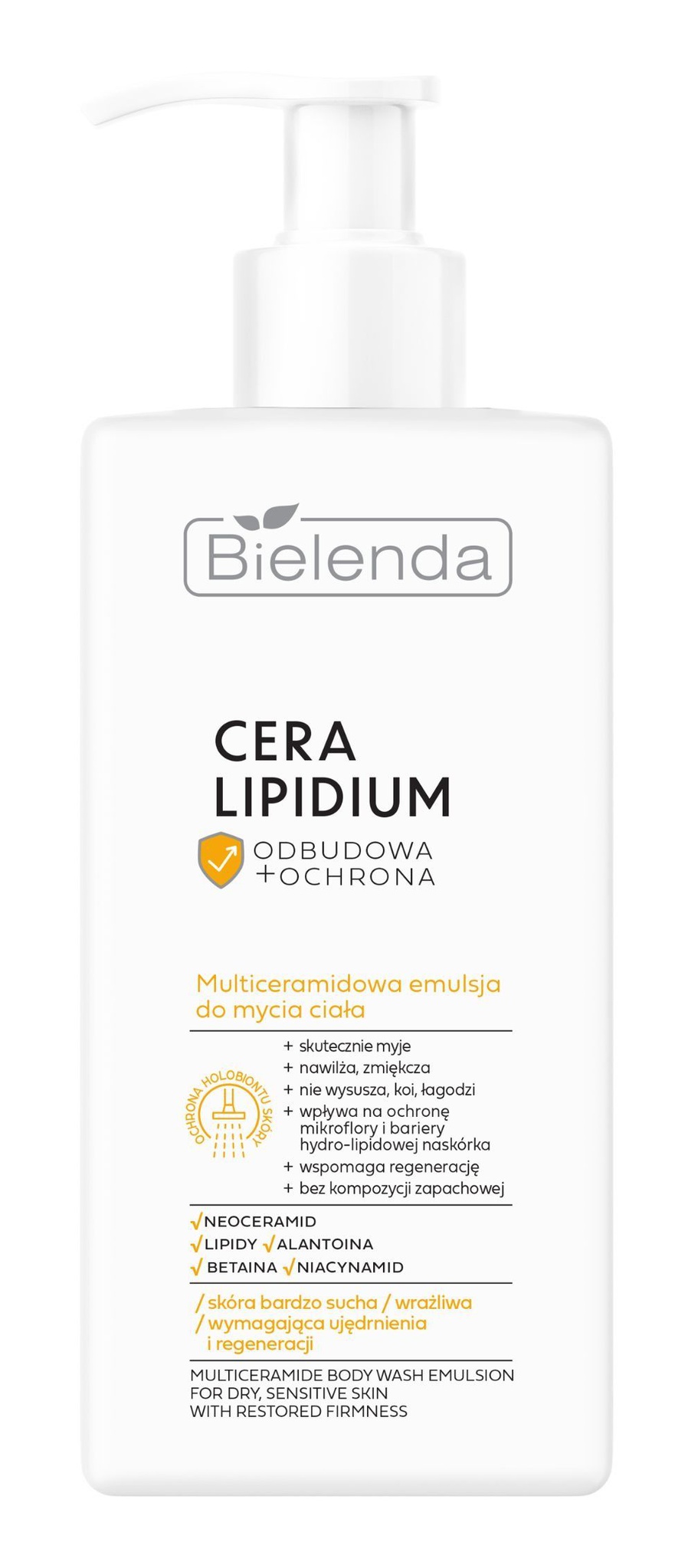
Cera Lipidium Multiceramide Body Wash Emulsion
Ingredients overview
Highlights
Key Ingredients
Other Ingredients
Skim through
Bielenda Cera Lipidium Multiceramide Body Wash EmulsionIngredients explained
Good old water, aka H2O. The most common skincare ingredient of all. You can usually find it right in the very first spot of the ingredient list, meaning it’s the biggest thing out of all the stuff that makes up the product.
It’s mainly a solvent for ingredients that do not like to dissolve in oils but rather in water.
Once inside the skin, it hydrates, but not from the outside - putting pure water on the skin (hello long baths!) is drying.
One more thing: the water used in cosmetics is purified and deionized (it means that almost all of the mineral ions inside it is removed). Like this, the products can stay more stable over time.
A cleansing agent that's claimed to be so gentle on the skin that it hardly impacts the skin barrier. It also gives a rich, creamy foam, it's based on vegetable fatty acids and is readily biodegradable.
It's an especially important and popular ingredient in "syndet bars" (or soapless soaps). Dr. Leslie Baumann says in her great Cosmetic Dermatology book that thanks to the unique molecular characteristic of Sodium Cocoyl Isethionate, it "has defined a new dimension in the mildness of cleansing bars".
The emollient plant oil that comes from almonds. Similar to other plant oils, it is loaded with skin-nourishing fatty acids (oleic acid - 55-86% and linoleic acid 7-35%) and contains several other skin goodies such as antioxidant vitamin E and vitamin B versions.
It's a nice, basic oil that is often used due to its great smoothing, softening and moisturizing properties. It's also particularly good at treating dry brittle nails (source).
A big molecule created from repeated subunits (a polymer of acrylic acid) that magically converts a liquid into a nice gel formula. It usually has to be neutralized with a base (such as sodium hydroxide) for the thickening to occur and it creates viscous, clear gels that also feel nice and non-tacky on the skin. No wonder, it is a very popular and common ingredient. Typically used at 1% or less in most formulations.
Super common ingredient in all kinds of cleansing products: face and body washes, shampoos and foam baths.
Number one reason for its popularity has to do with bubbles. Everyone loves bubbles. And cocamidopropyl betaine is great at stabilizing them.
The other reason is that it’s mild and works very well combined with other cleansing agents and surfactants. The art of cleansing is usually to balance between properly cleansing but not over-cleansing and cocamidopropyl betaine is helpful in pulling off this balance right.
Oh, and one more nice thing: even though it’s synthetic it’s highly biodegradable.
More info on CAPB on Collins Beaty Pages.
- A multi-functional skincare superstar with several proven benefits for the skin
- Great anti-aging, wrinkle smoothing ingredient used at 4-5% concentration
- Fades brown spots alone or in combination with amino sugar, acetyl glucosamine
- Increases ceramide synthesis that results in a stronger, healthier skin barrier and better skin hydration
- Can help to improve several skin conditions including acne, rosacea, and atopic dermatitis
 We don't have description for this ingredient yet.
Super common soothing ingredient. It can be found naturally in the roots & leaves of the comfrey plant, but more often than not what's in the cosmetic products is produced synthetically.
It's not only soothing but it' also skin-softening and protecting and can promote wound healing.
Yes, it's the thing that can be found naturally in pee. And in the skin. It is an awesome natural moisturizing factor, aka NMF. NMFs are important components that help the skin to hold onto water and keep it plump, elastic and hydrated. Urea makes up about 7% of NMFs next to other things such as amino acids (40%), PCA (12%) or Lactate (12%).
What makes urea special, is that it is not only a simple moisturizer, but it is thought to be a "small-molecule regulator of epidermal structure and function" meaning that it has a bunch of extra biological activities. It acts as a mild keratolytic agent (some of its moisturizing action is thought to come from urea's ability to break down bonds in the protein called filaggrin and thus freeing up amino acids in the skin), enhances antimicrobial peptide expression and improves skin barrier function.
Being a mild keratolytic agent and strong moisturizer means that high-percentage (10-40%) urea treatments are found effective in a bunch of skin disorders connected to excessive dryness and malfunctioning skin barrier such as ichthyosis, xerosis, psoriasis, eczema and seborrheic dermatitis.
Overall, just like glycerin, urea is a real oldie but a goodie, a nice ingredient in any moisturizer.
Butylene glycol, or let’s just call it BG, is a multi-tasking colorless, syrupy liquid. It’s a great pick for creating a nice feeling product.
BG’s main job is usually to be a solvent for the other ingredients. Other tasks include helping the product to absorb faster and deeper into the skin (penetration enhancer), making the product spread nicely over the skin (slip agent), and attracting water (humectant) into the skin.
It’s an ingredient whose safety hasn’t been questioned so far by anyone (at least not that we know about). BG is approved by Ecocert and is also used enthusiastically in natural products. BTW, it’s also a food additive.
We don't have description for this ingredient yet.
We don't have description for this ingredient yet.
The oil-soluble extract coming from the edible, orange part of the carrot. It is created by macerating the carrot root in a carrier oil such as sunflower or olive oil, and the resulting thing (base oil + carrot root extract) is often called carrot oil or carrot root oil. (Not to be confused with carrot seed oil, that can be fixed or essential and comes from the seeds.)
The root extract is known for containing the orange pigment beta-carotene, aka provitamin A. It is a famous molecule for being a potent antioxidant, suntan accelerator and having skin-regenerative abilities. Carrot oil also contains vitamin E and some fatty acids that give the oil further antioxidant and barrier repairing properties.
We don't have description for this ingredient yet.
A common fatty acid that can be found in lots of plant oils. Its name, "oleic", means derived from olive oil, a plant oil rich in oleic acid, but avocado, macadamia and marula oils, just to name a few, are also oleic rich.
Its chemical structure is monounsaturated, meaning it has one double bond (cis-9) that makes it less kinky than polyunsaturated fatty acids with multiple double bonds. Less kinkiness means that oleic acid and OA-rich oils are a bit thicker and heavier than their LA-rich siblings.
Maybe this thickness is the reason that Oleic acid is considered comedogenic, and if you have acne-prone skin avoid OA-rich plant oils, and choose linoleic acid-rich versions instead.
The thickness of OA also means that OA-rich oils are considered more nourishing and moisturizing than their LA-rich counterparts, and are generally considered to be more suitable for dry, mature skin types.
As for oleic acid in its free form (and by free we mean that it is not bound up in a triglyceride structure like it is in oils), it mostly serves as an emulsifier or emulsion stabilizer in small amounts in regular cosmetic products. It is also quite well researched and is used in the pharmaceutical industry as a penetration enhancer.
Serine is an amino acid that most often comes to the formula as part of a moisturizing complex. It's a non-essential amino acid (meaning that our body can synthesize it) and serves as a water-binding ingredient.
In general, amino acids are great skincare ingredients that play an important role in proper skin hydration but there is not much info out there about what specifically serine can do for the skin.
One of the many types of ceramides that can be found naturally in the upper layer of the skin. Ceramides make up about 50% of the goopy stuff that's between our skin cells and play a super important role in having a healthy skin barrier and keeping the skin hydrated. It works even better when combined with its pal, Ceramide 1.
We wrote way more about ceramides at ceramide 1, so click here to know more.
Lactobacillus ferment is an interesting probiotic ingredient with some promising properties.
First, according to a 2009 Estee Lauder patent, it’s a DNA repair enzyme and it can help to protect the skin against environmental aggressors.
Second, still according to Estee Lauder research but now from 2012 the ingredient has anti-microbial and anti-inflammatory properties and holds promise in the treatment of acne and rosacea. For the former one 5% was needed to show effectiveness, but for reducing skin sensitivity already 1% showed results.
The anti-acne effect is confirmed also by US manufacturer, Barnet, that says that Lactobacillus ferment is helpful in killing harmful bacteria and creating a healthy balanced microflora. Compared to well-known anti-acne and anti-inflammatory salicylic acid the probiotic worked faster at reducing the size and redness of acne lesions.
It also goes by the trade name Leucidal Liquid SF and can serve in the formula as a natural preservative.
Bottom line: It’s not the most proven ingredient (yet) but definitely a very promising one especially if you have sensitive skin, acne or rosacea.
A type of ceramide that can be found naturally in the upper layer of the skin. Ceramides make up 50% of the goopy stuff that's between our skin cells and play a super important role in having a healthy skin barrier and keeping the skin hydrated.
We have written way more about ceramides at ceramide 1, so click here to know more.
It's a type of lipid, a so-called sphingoid base that can be found naturally in the upper layer of the skin. It's found both in "free-form" and as part of famous skin lipids, ceramides.
There is emerging research about Phytosphingosine that shows that it has antimicrobial and cell-communicating properties and is considered part of the skin's natural defense system.
A 2007 study showed that Phytosphingosine even works against evil acne-causing bacteria, Propionibacterium acnes and shows promise as a complementing active ingredient in treating acne-prone skin thanks to its anti-inflammatory and antimicrobial activities.
A nice one to spot in the ingredient list. :)
It's one of the important lipids that can be found naturally in the outer layer of the skin. About 25% of the goopy stuff between our skin cells consists of cholesterol. Together with ceramides and fatty acids, they play a vital role in having a healthy skin barrier and keeping the skin hydrated.
Apart from being an important skin-identical ingredient, it's also an emollient and stabilizer.
Ceramides get quite a lot of hype recently and good news: there is a reason for that. But before we go into the details, let's just quickly define what the heck ceramides are:
They are waxy lipids that can be found naturally in the outer layer of the skin (called stratum corneum - SC). And they are there in big amounts! The goopy stuff between our skin cells is called extracellular matrix that consists mainly of lipids. And ceramides are about 50% of those lipids (the other important ones are cholesterol with 25% and fatty acids with 15%).
Ok, so now we know what ceramides are, let's see what they do in our skin: research shows clearly that they play a super important role in keeping the skin barrier healthy and the skin hydrated. If ceramides in the skin are decreased, more water can evaporate from the skin and there is less water remaining in the skin. So ceramides form kind of a "water-proof" protecting layer and make sure that our skin remains nice and hydrated.
Now the question is only this: If we put ceramides all over our face do they work as well as ceramides already naturally in our skin? Well, the answer is probably a no, but they do work to some extent. The BeautyBrains blog made a fantastic article about ceramides and they have listed a couple of examples about studies showing that ceramides - especially when used in certain ratios with cholesterol and fatty acids - do hydrate the skin and can help to repair the skin barrier.
So far we were writing about ceramides in plural. It's because there are lots of different ceramides, a 2014 article writes that currently 12 base classes of ceramides are known with over 340 specific species. Chemically speaking, ceramides are the connection of a fatty acid and a sphingoid base and both parts can have different variations that result in the different types of ceramides.
Our current one, Ceramide 1, or more recently called Ceramide EOP, was the first one that was identified in 1982 and it's a special snowflake. It contains the essential fatty acid, linoleic acid and has a unique structure. It's believed that ceramide 1 plays a "binding role" in the lipid layers of the extracellular matrix. Along with ceramides 4 and 7, they also play a vital role in epidermal integrity and serve as the main storage areas for linoleic acid (a fatty acid that's also very important for barrier repair).
Oh, and one more thing: alkaline pH inhibits enzymes that help ceramide synthesis in our skin. So if you use a soap and you notice your skin is becoming dry, now you know why.
A fancy name for sugar. Luckily when you put it on your skin it's good for you not like when you eat it. :) It has water-binding properties, which means that it helps to keep your skin nice and hydrated.
We don't have description for this ingredient yet.
- A natural moisturizer that’s also in our skin
- A super common, safe, effective and cheap molecule used for more than 50 years
- Not only a simple moisturizer but knows much more: keeps the skin lipids between our skin cells in a healthy (liquid crystal) state, protects against irritation, helps to restore barrier
- Effective from as low as 3% with even more benefits for dry skin at higher concentrations up to 20-40%
- High-glycerin moisturizers are awesome for treating severely dry skin
PCA stands for Pyrrolidone Carboxylic Acid and though it might not sound like it, it is a thing that can be found naturally in our skin. The sodium salt form of PCA is an important skin-identical ingredient and great natural moisturizer that helps the skin to hold onto water and stay nicely hydrated.
Sunflower does not need a big intro as you probably use it in the kitchen as cooking oil, or you munch on the seeds as a healthy snack or you adore its big, beautiful yellow flower during the summer - or you do all of these and probably even more. And by even more we mean putting it all over your face as sunflower oil is one of the most commonly used plant oils in skincare.
It’s a real oldie: expressed directly from the seeds, the oil is used not for hundreds but thousands of years. According to The National Sunflower Association, there is evidence that both the plant and its oil were used by American Indians in the area of Arizona and New Mexico about 3000 BC. Do the math: it's more than 5000 years – definitely an oldie.
Our intro did get pretty big after all (sorry for that), so let's get to the point finally: sunflower oil - similar to other plant oils - is a great emollient that makes the skin smooth and nice and helps to keep it hydrated. It also protects the surface of the skin and enhances the damaged or irritated skin barrier. Leslie Bauman notes in Cosmetic Dermatology that one application of sunflower oil significantly speeds up the recovery of the skin barrier within an hour and sustains the results 5 hours after using it.
It's also loaded with fatty acids (mostly linoleic (50-74%) and oleic (14-35%)). The unrefined version (be sure to use that on your skin!) is especially high in linoleic acid that is great even for acne-prone skin. Its comedogen index is 0, meaning that it's pretty much an all skin-type oil.
Truth be told, there are many great plant oils and sunflower oil is definitely one of them.
The emollient plant oil coming from the soybean. It is considered to be a nice, cost-effective base oil with moisturizing properties. As for its fatty acid profile, it contains 48-59% barrier-repairing linoleic acid, 17-30% nourishing oleic acid and also some (4.5-11%) potentially anti-inflammatory linolenic acid.
The oil coming from the seeds of the carrot, the orange root vegetable we all know and eat regularly. This oil is a really tricky one, as it can refer to two types of oil that can both be extracted from the carrot seeds: the essential oil (about 0.83% yield) and the fixed oil (about 7.84% yield).
The two seed oils are very different and to make matters even worse these two oils are also very different from carrot root oil, or carrot oil, that is basically carrot root extract macerated in a carrier oil such as sunflower or olive oil and is the one that contains the vitamin A precursor, carotene.
Let's start with the fixed oil: it's a nice emollient plant oil that is loaded with moisturizing fatty acids (petroselinic acid - 60% and linoleic acid - 12% are the main ones). Other important components are carotol (30%) and daucol (12%) that give the seed oil antifungal and antioxidant properties. Browsing cosmetic manufacturer info, the oil is also often described as revitalizing, toning and stimulating.
As for the essential oil, it is a light yellow colored oil with a rich, spicy and earthy fragrance. Its main component is carotol (about 65%) but similar to other essential oils, it is a chemically complex mixture with lots of compounds in small amounts. The essential oil also has antifungal and antioxidant properties but also contains fragrant components that might irritate sensitive skin types.
A super common emollient that makes your skin feel nice and smooth. It comes from coconut oil and glycerin, it’s light-textured, clear, odorless and non-greasy. It’s a nice ingredient that just feels good on the skin, is super well tolerated by every skin type and easy to formulate with. No wonder it’s popular.
Squalene is an oily liquid that originally comes from shark liver but luckily it can also be found in a couple of plant oils. Olive (0.6%), peanut (0.1%) and pumpkin (0.35%) oils contain it, though not in huge amounts.
What contains more of it, is the sebum (the oily stuff) that our skin produces. About 13% of human sebum is squalene, which means that it’s an important skin-identical ingredient and NMF (natural moisturizing factor).
Chemically speaking, it is an unsaturated (has double bonds) hydrocarbon (contains only carbon and hydrogen) molecule, that can undergo oxidation. On the pro side, this means that squalene can act as an antioxidant (while its no-double-bond version sister, squalane cannot), but on the con side, squalene is less stable and has a shorter shelf life.
This is probably the main reason why its no-double bond and hence more stable sister, squalane shows up more often on ingredient lists. Read about squalane here >>
A polymeric (big molecule from repeated subunits) emulsifier that comes from Inulin, a naturally occurring polysaccharide found in the roots and rhizomes of several plants. The emulsifier is obtained by adding oil-loving chains onto inulin. The resulting copolymer can emulsify high amounts of oil and can stabilize oil droplets or non-water soluble particles so that they do not clump together in the formula.
A helper ingredient that's used as a co-emulsifier (meaning next to other emulsifiers in the formula it helps water and oil to mix) and as a stabilization agent for foams. Also, has some antimicrobial activity so it can help to boost the effectiveness of the preservative system.
It's a very alkaline stuff that helps to set the pH of the cosmetic formula to be just right. It's similar to the more often used sodium hydroxide and pretty much the same of what we wrote there applies here too.
A form of skincare superstar, vitamin C. Even though we are massive vitamin C fans, Ascorbyl Palmitate (AP) is our least favorite. (Btw, if you do not know what the big deal with vitamin C is then you are missing out. You must go and read our geeky details about it.)
So, AP is one of the attempts by the cosmetics industry to solve the stability issues with vitamin C while preserving its benefits, but it seems to fall short on several things.
What's the problem?
Firstly, it's stability is only similar to that of pure ascorbic acid (AA), which means it is not really stable. A great study in the Journal of Cosmetic Dermatology compared a bunch of vitamin C derivatives and this derivative was the only one where the study said in terms of stability that it's "similar to AA". Not really that good.
Second, a study that examined the skin absorption of vitamin C found that ascorbyl palmitate did not increase the skin levels of AA. This does not mean that ascorbyl palmitate cannot penetrate the skin (because it can, it's oil soluble and the skin likes to absorb oil soluble things) but this means that it's questionable if ascorbyl palmitate can be converted into pure Vit C in the skin. Even if it can be converted, the palmitate part of the molecule is more than the half of it, so the efficacy will not be good and we have never seen a serum that contains a decent (and proudly disclosed) amount of AP. We are highly skeptical what effect a tiny amount of AP has in a formula.
Third, another study that wanted to examine the antioxidant properties of AP was surprised to find that even though AP does have nice antioxidant properties; following UVB radiation (the same one that comes from the sun) it also promotes lipid peroxidation and cytotoxicity. It was only an in-vitro study meaning that it was done on cell cultures and not on real people, but still, this also does not support the use of AP too much.
The only good thing we can write about Ascorbyl Palmitate is that there is an in-vitro (made in the lab, not on real people) study showing that it might be able to boost collagen production.
Regarding the skin-brightening properties of pure vitamin C, this is another magic property AP does not have, or at least there is no data, not even in-vitro, about it.
Overall, Ascorbyl Palmitate is our least favorite vitamin C derivative. It is there in lots of products in tiny amounts (honestly, we do not really understand why), however, we do not know about any vitamin C serum featuring AP in high amounts. That is probably no coincidence. If you are into vitamin C, you can take a look at more promising derivatives here.
- Primary fat-soluble antioxidant in our skin
- Significant photoprotection against UVB rays
- Vit C + Vit E work in synergy and provide great photoprotection
- Has emollient properties
- Easy to formulate, stable and relatively inexpensive
We don't have description for this ingredient yet.
A multi-functional, silky feeling helper ingredient that can do quite many things. It's used as an emulsion stabilizer, solvent and a broad spectrum antimicrobial. According to manufacturer info, it's also a moisturizer and helps to make the product feel great on the skin. It works synergistically with preservatives and helps to improve water-resistance of sunscreens.
A large sugar molecule (aka polysaccharide) that's used as a gelling agent and comes from brown seaweed.
Combined with calcium salts, it forms a rigid gel used in "rubber masks".
A natural polymer (big molecules from repeated subunits) that is harvested from the Acacia tree in the sub-Saharan region in Africa. It's a great thickening and binding agent. Often coupled with xanthan gum, as it helps to reduce its unpleasant stickiness.
It's one of the most commonly used thickeners and emulsion stabilizers. If the product is too runny, a little xanthan gum will make it more gel-like. Used alone, it can make the formula sticky and it is a good team player so it is usually combined with other thickeners and so-called rheology modifiers (helper ingredients that adjust the flow and thus the feel of the formula). The typical use level of Xantha Gum is below 1%, it is usually in the 0.1-0.5% range.
Btw, Xanthan gum is all natural, a chain of sugar molecules (polysaccharide) produced from individual sugar molecules (glucose and sucrose) via fermentation. It’s approved by Ecocert and also used in the food industry (E415).
A handy helper ingredient that has photostabilizer properties. It is useful both for color-protecting products so that they do not change color for a long time as well as for stabilizing unstable sunscreen agents, such as famous UVA filter avobenzone.
DESM can also increase critical wavelength (the higher value means more UVA protection) in sunscreens and it can boost SPF by about 5 units in high-SPF products.
It’s pretty much the current IT-preservative. It’s safe and gentle, but even more importantly, it’s not a feared-by-everyone-mostly-without-scientific-reason paraben.
It’s not something new: it was introduced around 1950 and today it can be used up to 1% worldwide. It can be found in nature - in green tea - but the version used in cosmetics is synthetic.
Other than having a good safety profile and being quite gentle to the skin it has some other advantages too. It can be used in many types of formulations as it has great thermal stability (can be heated up to 85°C) and works on a wide range of pH levels (ph 3-10).
It’s often used together with ethylhexylglycerin as it nicely improves the preservative activity of phenoxyethanol.
If you have spotted ethylhexylglycerin on the ingredient list, most probably you will see there also the current IT-preservative, phenoxyethanol. They are good friends because ethylhexylglycerin can boost the effectiveness of phenoxyethanol (and other preservatives) and as an added bonus it feels nice on the skin too.
Also, it's an effective deodorant and a medium spreading emollient.
You may also want to take a look at...
| what‑it‑does | solvent |
| what‑it‑does | surfactant/cleansing |
| what‑it‑does | emollient |
| irritancy, com. | 0, 1-3 |
| what‑it‑does | viscosity controlling |
| irritancy, com. | 0, 1 |
| what‑it‑does | surfactant/cleansing |
| what‑it‑does | cell-communicating ingredient | skin brightening | anti-acne | moisturizer/humectant |
| what‑it‑does | soothing |
| irritancy, com. | 0, 0 |
| what‑it‑does | moisturizer/humectant |
| what‑it‑does | skin-identical ingredient | moisturizer/humectant |
| what‑it‑does | moisturizer/humectant | solvent |
| irritancy, com. | 0, 1 |
| what‑it‑does | moisturizer/humectant |
| what‑it‑does | antioxidant | emollient |
| what‑it‑does | moisturizer/humectant |
| what‑it‑does | moisturizer/humectant |
| what‑it‑does | emollient | emulsifying |
| what‑it‑does | skin-identical ingredient |
| what‑it‑does | skin-identical ingredient |
| what‑it‑does | soothing | preservative |
| what‑it‑does | skin-identical ingredient |
| what‑it‑does | skin-identical ingredient | cell-communicating ingredient | anti-acne | antimicrobial/antibacterial |
| what‑it‑does | skin-identical ingredient | emollient |
| irritancy, com. | 0, 0 |
| what‑it‑does | skin-identical ingredient |
| what‑it‑does | moisturizer/humectant |
| what‑it‑does | moisturizer/humectant |
| what‑it‑does | skin-identical ingredient | moisturizer/humectant |
| irritancy, com. | 0, 0 |
| what‑it‑does | skin-identical ingredient | moisturizer/humectant |
| irritancy, com. | 0, 0 |
| what‑it‑does | emollient |
| irritancy, com. | 0, 0 |
| what‑it‑does | emollient | perfuming |
| irritancy, com. | 0, 3 |
| what‑it‑does | emollient |
| what‑it‑does | emollient |
| what‑it‑does | skin-identical ingredient | antioxidant | emollient |
| what‑it‑does | surfactant/cleansing | emulsifying |
| what‑it‑does | emulsifying |
| what‑it‑does | buffering |
| what‑it‑does | antioxidant |
| irritancy, com. | 0, 2 |
| what‑it‑does | antioxidant |
| irritancy, com. | 0-3, 0-3 |
| what‑it‑does | buffering |
| what‑it‑does | solvent | moisturizer/humectant |
| what‑it‑does | viscosity controlling |
| irritancy, com. | 4, 4 |
| what‑it‑does | viscosity controlling |
| what‑it‑does | preservative |
| what‑it‑does | preservative |