




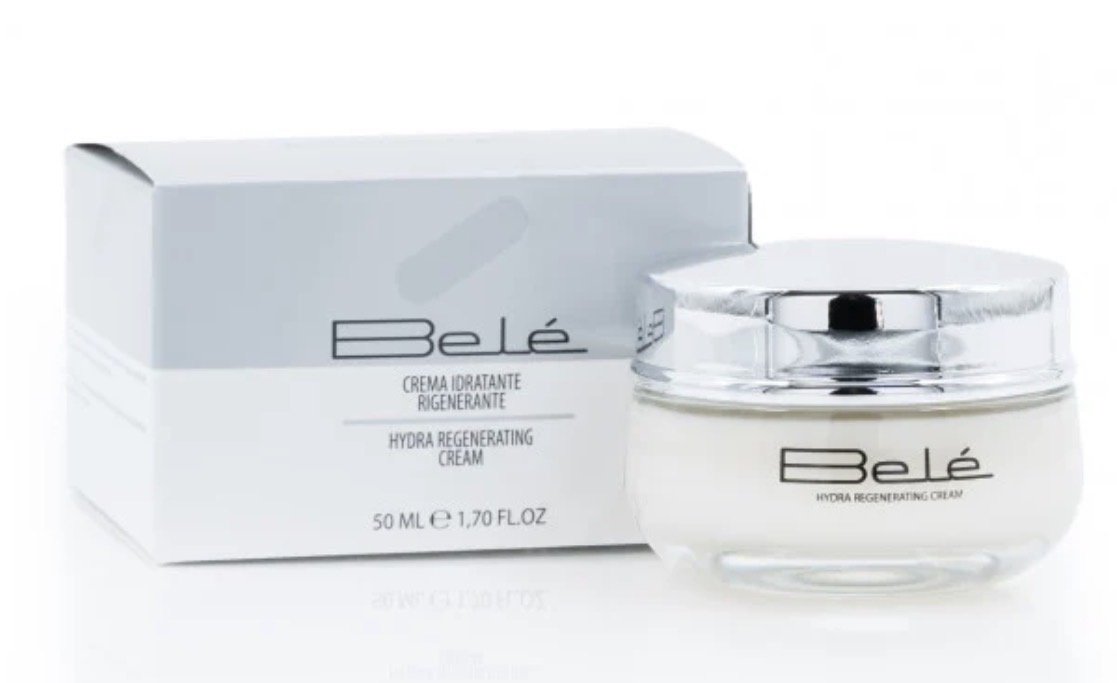
Hydra Regenerating Cream
Ingredients overview
Highlights
Key Ingredients
Skim through
| Ingredient name | what-it-does | irr., com. | ID-Rating |
|---|---|---|---|
| Aqua | solvent | ||
| Propylheptyl Caprylate | emollient | ||
| Glycerin | skin-identical ingredient, moisturizer/humectant | 0, 0 | superstar |
| Prunus Amygdalus Dulcis Oil | emollient | 0, 1-3 | goodie |
| Methyl Glucose Sesquistearate | emollient, emulsifying | ||
| Simmondsia Chinensis Seed Oil | emollient | 0, 0-2 | goodie |
| Argania Spinosa Kernel Oil | antioxidant, emollient | goodie | |
| Olea Europea Fruit Oil | antioxidant, emollient | 0, 0-2 | goodie |
| Cetyl Palmitate | emollient | 0, 0 | |
| Sorbitol | moisturizer/humectant | 0, 0 | |
| Laminaria Digitata Extract | |||
| Retinyl Palmitate | cell-communicating ingredient | 1-3, 1-3 | |
| Butyrospermum Parkii (Shea) Butter | emollient | goodie | |
| Lecithin | emollient, emulsifying | goodie | |
| Diatomaceous Earth | abrasive/scrub | ||
| Allantoin | soothing | 0, 0 | goodie |
| Sodium Hyaluronate | skin-identical ingredient, moisturizer/humectant | 0, 0 | goodie |
| Tocopherol | antioxidant | 0-3, 0-3 | goodie |
| Sodium Hydroxide | buffering |
Belé Hydra Regenerating CreamIngredients explained
Good old water, aka H2O. The most common skincare ingredient of all. You can usually find it right in the very first spot of the ingredient list, meaning it’s the biggest thing out of all the stuff that makes up the product.
It’s mainly a solvent for ingredients that do not like to dissolve in oils but rather in water.
Once inside the skin, it hydrates, but not from the outside - putting pure water on the skin (hello long baths!) is drying.
One more thing: the water used in cosmetics is purified and deionized (it means that almost all of the mineral ions inside it is removed). Like this, the products can stay more stable over time.
A crystal clear, oily liquid that makes your skin nice and smooth, aka emollient. It is fast-spreading and leaves a luxurious, silky-soft after-feel. It is also ideal for sunscreen products as it can enhance the solubility of crystalline UV filters.
- A natural moisturizer that’s also in our skin
- A super common, safe, effective and cheap molecule used for more than 50 years
- Not only a simple moisturizer but knows much more: keeps the skin lipids between our skin cells in a healthy (liquid crystal) state, protects against irritation, helps to restore barrier
- Effective from as low as 3% with even more benefits for dry skin at higher concentrations up to 20-40%
- High-glycerin moisturizers are awesome for treating severely dry skin
The emollient plant oil that comes from almonds. Similar to other plant oils, it is loaded with skin-nourishing fatty acids (oleic acid - 55-86% and linoleic acid 7-35%) and contains several other skin goodies such as antioxidant vitamin E and vitamin B versions.
It's a nice, basic oil that is often used due to its great smoothing, softening and moisturizing properties. It's also particularly good at treating dry brittle nails (source).
A mild, corn-sugar derived, oil-loving emulsifier that helps oil and water to mix nicely together. It is safe for sensitive skin or eye-care formulations and gives a light, satiny after-feel. It is often used together with its water-loving buddy Peg-20 Methyl Glucose Sesquistearate.
Jojoba is a drought resistant evergreen shrub native to South-western North America. It's known and grown for jojoba oil, the golden yellow liquid coming from the seeds (about 50% of the weight of the seeds will be oil).
At first glance, it seems like your average emollient plant oil: it looks like an oil and it's nourishing and moisturizing to the skin but if we dig a bit deeper, it turns out that jojoba oil is really special and unique: technically - or rather chemically - it's not an oil but a wax ester (and calling it an oil is kind of sloppy).
So what the heck is a wax ester and why is that important anyway? Well, to understand what a wax ester is, you first have to know that oils are chemically triglycerides: one glycerin + three fatty acids attached to it. The fatty acids attached to the glycerin vary and thus we have many kinds of oils, but they are all triglycerides. Mother Nature created triglycerides to be easily hydrolyzed (be broken down to a glycerin + 3 fatty acid molecules) and oxidized (the fatty acid is broken down into small parts) - this happens basically when we eat fats or oils and our body generates energy from it.
Mother Nature also created wax esters but for a totally different purpose. Chemically, a wax ester is a fatty acid + a fatty alcohol, one long molecule. Wax esters are on the outer surface of several plant leaves to give them environmental protection. 25-30% of human sebum is also wax esters to give us people environmental protection.
So being a wax ester results in a couple of unique properties: First, jojoba oil is extremely stable. Like crazy stable. Even if you heat it to 370 C (698 F) for 96 hours, it does not budge. (Many plant oils tend to go off pretty quickly). If you have some pure jojoba oil at home, you should be fine using it for years.
Second, jojoba oil is the most similar to human sebum (both being wax esters), and the two are completely miscible. Acne.org has this not fully proven theory that thanks to this, jojoba might be able to "trick" the skin into thinking it has already produced enough sebum, so it might have "skin balancing" properties for oily skin.
Third, jojoba oil moisturizes the skin through a unique dual action: on the one hand, it mixes with sebum and forms a thin, non-greasy, semi-occlusive layer; on the other hand, it absorbs into the skin through pores and hair follicles then diffuses into the intercellular spaces of the outer layer of the skin to make it soft and supple.
On balance, the point is this: in contrast to real plant oils, wax esters were designed by Mother Nature to stay on the surface and form a protective, moisturizing barrier and jojoba oil being a wax ester is uniquely excellent at doing that.
When it comes to cosmetic oils and hype, argan oil is for sure leading the way. Dubbed as the "liquid gold of Morocco", we have to admit we have some trouble determining why this oil enjoys such a special miracle status. Not that it's not good, it is good, even great but reading the research about argan and a bunch of other plant oils we just do not see the big, unique differentiating factor (though that might be our fault not reading enough, obvs.)
So, argan oil comes from the kernel of the argan fruit that comes from the argan tree that grows only in Morocco. The tree is slow growing and getting the oil is a hard job. The traditional process is that the ripe argan fruits fall from the tree, then goats eat them up and poop out the seeds. The seeds are collected and smashed with a stone to get the kernels inside. This part is the hard one as the seeds have extremely hard shells. Once the kernels are obtained, the oil is pressed out from them (the kernels contain about 50% oil).
As for skincare, argan oil is loaded with lots of skin goodies (but so are many other plant oils): it contains 80% nourishing and moisturizing unsaturated fatty acids, mainly oleic (38-50%), linoleic (28-38%) and palmitic (10-18%). It also contains a relatively large amount of antioxidant vitamin E (600-900 mg/kg, about twice as much as olive), small amounts of antioxidant phenols (including caffeic acid, ferulic acid, and epicatechin), as well as some rare sterols with soothing and anti-inflammatory properties.
Thanks to all the above goodness in argan oil, it can greatly nourish and moisturize the skin and hair. It's also claimed to be able to neutralize collagen-damaging free radicals, help reduce scars, and revitalize and improve skin elasticity. You can even read that argan might help acne-prone skin, but being a high oleic oil, we would be careful with that.
All in all, argan oil is a real goodie but we do not fully understand the special miracle status it enjoys.
You probably know olive oil from the kitchen as a great and healthy option for salad dressing but it's also a great and healthy option to moisturize and nourish the skin, especially if it's on the dry side.
Similar to other emollient plant oils, it's loaded with nourishing fatty acids: oleic is the main component (55-83%), and also contains linoleic (3.5-20%) and palmitic acids (7-20%). It also contains antioxidant polyphenols, tocopherols (types of vitamin E) and carotenoids and it's one of the best plant sources of skin-identical emollient, Squalene.
Overall, a great option for dry skin but less so for acne-prone or damaged skin.
A white, waxy emollient that gives "body" to skincare formulas. Comes from coconut or palm kernel oil.
It's a sweet tasting sugar substitute that helps your skin to hold onto water when used in cosmetic products. It also helps to thicken up products and give them a bit more slip.
 We don't have description for this ingredient yet.
It's an ester form of vitamin A (retinol + palmitic acid) that belongs to the "retinoid family". The retinoid family is pretty much the royal family of skincare, with the king being the FDA-approved anti-aging ingredient tretinoin. Retinol is also a very famous member of the family, but it's like Prince George, two steps away from the throne. Retinyl palmitate will be then Prince Charlotte (George's little sister), quite far (3 steps) away from the throne.
By steps, we mean metabolic steps. Tretinoin, aka retinoic acid, is the active ingredient our skin cells can understand and retinyl palmitate (RP) has to be converted by our metabolic machinery to actually do something. The conversion is a 3 step one and looks like this:
retinyl palmitate --> retinol -- > retinaldehyde --> all-trans-retinoic acid
As we wrote in our lengthy retinol description the problem is that the conversion is not terribly effective. The evidence that RP is still an effective anti-aging ingredient is not very strong, in fact, it's weak. Dr. Leslie Baumann in her fantastic Cosmetic Dermatology book writes that RP is topically ineffective.
What's more, the anti-aging effectiveness is not the only questionable thing about RP. It also exibits questionable behaviour in the presence of UV light and was the center of a debate between the non-profit group, EWG (whose intentions are no doubt good, but its credibility is often questioned by scientists) and a group of scientists and dermatologists lead by Steven Q. Wang, MD, director of dermatologic surgery at Memorial-Sloan Kettering Cancer Centre.
Dr. Leslie Baumann wrote a great review of the debate and summarized the research available about retinyl palmitate here. It seems that there is a study showing RP being photo protective against UVB rays but there is also a study showing RP causing DNA damage and cytotoxicity in association with UVA.
We think that the truth lies somewhere in the middle, and we agree with Dr. Baumann's conclusion: "sufficient evidence to establish a causal link between RP and skin cancer has not been produced. Nor, I’m afraid, are there any good reasons to recommend the use of RP". We would add especially during the day!
Bottom line: If you wanna get serious about retinoids, RP is not your ingredient (retinol or tretinoin is!). However, if you use a product that you like and it also contains RP, there is no reason to throw it away. If possible use it at night, just to be on the safe side.
Unless you live under a rock you must have heard about shea butter. It's probably the most hyped up natural butter in skincare today. It comes from the seeds of African Shea or Karite Trees and used as a magic moisturizer and emollient.
But it's not only a simple emollient, it regenerates and soothes the skin, protects it from external factors (such as UV rays or wind) and is also rich in antioxidants (among others vitamin A, E, F, quercetin and epigallocatechin gallate). If you are looking for rich emollient benefits + more, shea is hard to beat.
A very common ingredient that can be found in all cell membranes. In cosmetics it's quite the multi-tasker: it's an emollient and water-binding ingredient but it's also an emulsifier and can be used for stabilization purposes. It's also often used to create liposomes.
Super common soothing ingredient. It can be found naturally in the roots & leaves of the comfrey plant, but more often than not what's in the cosmetic products is produced synthetically.
It's not only soothing but it' also skin-softening and protecting and can promote wound healing.
It’s the - sodium form - cousin of the famous NMF, hyaluronic acid (HA). If HA does not tell you anything we have a super detailed, geeky explanation about it here. The TL; DR version of HA is that it's a huge polymer (big molecule from repeated subunits) found in the skin that acts as a sponge helping the skin to hold onto water, being plump and elastic. HA is famous for its crazy water holding capacity as it can bind up to 1000 times its own weight in water.
As far as skincare goes, sodium hyaluronate and hyaluronic acid are pretty much the same and the two names are used interchangeably. As cosmetic chemist kindofstephen writes on reddit "sodium hyaluronate disassociates into hyaluronic acid molecule and a sodium atom in solution".
In spite of this, if you search for "hyaluronic acid vs sodium hyaluronate" you will find on multiple places that sodium hyaluronate is smaller and can penetrate the skin better. Chemically, this is definitely not true, as the two forms are almost the same, both are polymers and the subunits can be repeated in both forms as much as you like. (We also checked Prospector for sodium hyaluronate versions actually used in cosmetic products and found that the most common molecular weight was 1.5-1.8 million Da that absolutely counts as high molecular weight).
What seems to be a true difference, though, is that the salt form is more stable, easier to formulate and cheaper so it pops up more often on the ingredient lists.
If you wanna become a real HA-and-the-skin expert you can read way more about the topic at hyaluronic acid (including penetration-questions, differences between high and low molecular weight versions and a bunch of references to scientific literature).
- Primary fat-soluble antioxidant in our skin
- Significant photoprotection against UVB rays
- Vit C + Vit E work in synergy and provide great photoprotection
- Has emollient properties
- Easy to formulate, stable and relatively inexpensive
The unfancy name for it is lye. It’s a solid white stuff that’s very alkaline and used in small amounts to adjust the pH of the product and make it just right.
For example, in case of AHA or BHA exfoliants, the right pH is super-duper important, and pH adjusters like sodium hydroxide are needed.
BTW, lye is not something new. It was already used by ancient Egyptians to help oil and fat magically turn into something else. Can you guess what? Yes, it’s soap. It still often shows up in the ingredient list of soaps and other cleansers.
Sodium hydroxide in itself is a potent skin irritant, but once it's reacted (as it is usually in skin care products, like exfoliants) it is totally harmless.
You may also want to take a look at...
| what‑it‑does | solvent |
| what‑it‑does | emollient |
| what‑it‑does | skin-identical ingredient | moisturizer/humectant |
| irritancy, com. | 0, 0 |
| what‑it‑does | emollient |
| irritancy, com. | 0, 1-3 |
| what‑it‑does | emollient | emulsifying |
| what‑it‑does | emollient |
| irritancy, com. | 0, 0-2 |
| what‑it‑does | antioxidant | emollient |
| what‑it‑does | antioxidant | emollient |
| irritancy, com. | 0, 0-2 |
| what‑it‑does | emollient |
| irritancy, com. | 0, 0 |
| what‑it‑does | moisturizer/humectant |
| irritancy, com. | 0, 0 |
| what‑it‑does | cell-communicating ingredient |
| irritancy, com. | 1-3, 1-3 |
| what‑it‑does | emollient |
| what‑it‑does | emollient | emulsifying |
| what‑it‑does | abrasive/scrub |
| what‑it‑does | soothing |
| irritancy, com. | 0, 0 |
| what‑it‑does | skin-identical ingredient | moisturizer/humectant |
| irritancy, com. | 0, 0 |
| what‑it‑does | antioxidant |
| irritancy, com. | 0-3, 0-3 |
| what‑it‑does | buffering |