




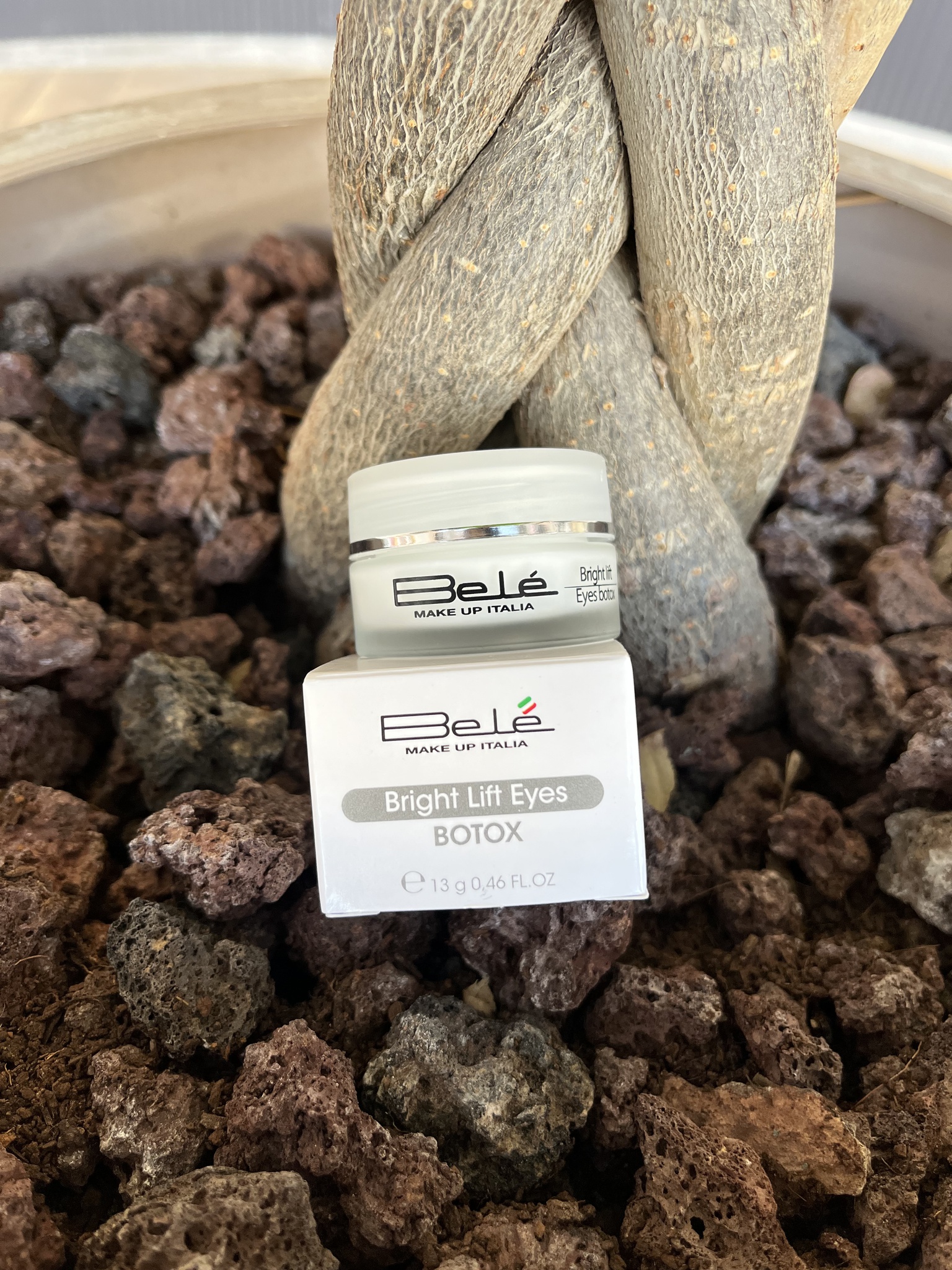
Bright Lift Eyes Botox
Ingredients overview
 INCI photo pending approval
Highlights
Key Ingredients
Other Ingredients
Skim through
Belé Bright Lift Eyes BotoxIngredients explained
Good old water, aka H2O. The most common skincare ingredient of all. You can usually find it right in the very first spot of the ingredient list, meaning it’s the biggest thing out of all the stuff that makes up the product.
It’s mainly a solvent for ingredients that do not like to dissolve in oils but rather in water.
Once inside the skin, it hydrates, but not from the outside - putting pure water on the skin (hello long baths!) is drying.
One more thing: the water used in cosmetics is purified and deionized (it means that almost all of the mineral ions inside it is removed). Like this, the products can stay more stable over time.
- A natural moisturizer that’s also in our skin
- A super common, safe, effective and cheap molecule used for more than 50 years
- Not only a simple moisturizer but knows much more: keeps the skin lipids between our skin cells in a healthy (liquid crystal) state, protects against irritation, helps to restore barrier
- Effective from as low as 3% with even more benefits for dry skin at higher concentrations up to 20-40%
- High-glycerin moisturizers are awesome for treating severely dry skin
A mild, corn-sugar derived, oil-loving emulsifier that helps oil and water to mix nicely together. It is safe for sensitive skin or eye-care formulations and gives a light, satiny after-feel. It is often used together with its water-loving buddy Peg-20 Methyl Glucose Sesquistearate.
Hello, our favorite molecule that helps us wake up in the morning and then keeps us going through the day. As a super well-known stimulant from coffee, tea and plenty of other soft drinks, Caffeine needs no introduction. So we will skip right to the part where we talk about what the hell it does in so-so many cosmetic products.
Looking at the research, we were surprised to find how versatile Caffeine is. It is a small, water-loving molecule with pretty good skin penetration abilties. Once in the skin, it has nice antioxidant properties, meaning that it reduces the formation of evil free radicals and it might even be useful in preventing UV-induced skin cancers.
A well-known thing about Caffeine is that it improves the microcirculation of the blood vessels. Though conventional wisdom and anecdotal evidence says that this property is helpful for dark under-eye circles and puffy eyes, we have to mention that the double-blind research we have found about a 3% caffeine gel concluded that "the overall efficacy of the selected caffeine gel in reducing puffy eyes was not significantly different from that of its gel base." But you know, the proof is in the pudding.
Another thing Caffeine is used for in body care products is its anti-cellulite effects. In theory, it can speed up the lipolysis process (the "fat burning" by our cells) and stimulate the draining lymph system that might lead to the improvement of cellulite. But here again, the evidence that it actually makes a measurable, let alone visible, improvement on actual human beings is limited (we could find only some animal skin studies or caffeine being combined with other actives).
Last, but not least, we have to write about caffeine and hair growth. The theory is that it can inhibit the activity of the 5-α-reductase enzyme that plays an important role in hair loss and allows a renewed growth phase of the hair. We have found some recent and promising research to back this up. A 2017 study compared a 0.2% caffeine liquid with a 5% Minoxidil (an FDA approved active to treat baldness) solution and found that "a caffeine-based topical liquid should be considered as not inferior to minoxidil 5% solution in men with androgenetic alopecia", or English translation means that the caffeine liquid was pretty much as good as the FDA-approved Minoxidil stuff. Not bad!
Overall, we think that caffeine is a very versatile and biologically active ingredient. Even though some of its effects are more hyped up than backed up, it is still a nice to have on many ingredient lists.
When it comes to cosmetic oils and hype, argan oil is for sure leading the way. Dubbed as the "liquid gold of Morocco", we have to admit we have some trouble determining why this oil enjoys such a special miracle status. Not that it's not good, it is good, even great but reading the research about argan and a bunch of other plant oils we just do not see the big, unique differentiating factor (though that might be our fault not reading enough, obvs.)
So, argan oil comes from the kernel of the argan fruit that comes from the argan tree that grows only in Morocco. The tree is slow growing and getting the oil is a hard job. The traditional process is that the ripe argan fruits fall from the tree, then goats eat them up and poop out the seeds. The seeds are collected and smashed with a stone to get the kernels inside. This part is the hard one as the seeds have extremely hard shells. Once the kernels are obtained, the oil is pressed out from them (the kernels contain about 50% oil).
As for skincare, argan oil is loaded with lots of skin goodies (but so are many other plant oils): it contains 80% nourishing and moisturizing unsaturated fatty acids, mainly oleic (38-50%), linoleic (28-38%) and palmitic (10-18%). It also contains a relatively large amount of antioxidant vitamin E (600-900 mg/kg, about twice as much as olive), small amounts of antioxidant phenols (including caffeic acid, ferulic acid, and epicatechin), as well as some rare sterols with soothing and anti-inflammatory properties.
Thanks to all the above goodness in argan oil, it can greatly nourish and moisturize the skin and hair. It's also claimed to be able to neutralize collagen-damaging free radicals, help reduce scars, and revitalize and improve skin elasticity. You can even read that argan might help acne-prone skin, but being a high oleic oil, we would be careful with that.
All in all, argan oil is a real goodie but we do not fully understand the special miracle status it enjoys.
 We don't have description for this ingredient yet.
A clear, almost colorless (or slightly yellowish) oily liquid (an ester to be precise) that's used as a medium spreading emollient. It gives skin a nice and smooth after-feel and it's very good at reducing oiliness or greasiness coming from other heavier oils in the formula.
A crystal clear, oily liquid that makes your skin nice and smooth, aka emollient. It is fast-spreading and leaves a luxurious, silky-soft after-feel. It is also ideal for sunscreen products as it can enhance the solubility of crystalline UV filters.
A white, waxy emollient that gives "body" to skincare formulas. Comes from coconut or palm kernel oil.
An extremely common multitasker ingredient that gives your skin a nice soft feel (emollient) and gives body to creams and lotions. It also helps to stabilize oil-water mixes (emulsions), though it does not function as an emulsifier in itself. Its typical use level in most cream type formulas is 2-3%.
It’s a so-called fatty alcohol, a mix of cetyl and stearyl alcohol, other two emollient fatty alcohols. Though chemically speaking, it is alcohol (as in, it has an -OH group in its molecule), its properties are totally different from the properties of low molecular weight or drying alcohols such as denat. alcohol. Fatty alcohols have a long oil-soluble (and thus emollient) tail part that makes them absolutely non-drying and non-irritating and are totally ok for the skin.
An easy-to-formulate, commonly used, nice to have ingredient that’s also called pro-vitamin B5. As you might guess from the “pro” part, it’s a precursor to vitamin B5 (whose fancy name is pantothenic acid).
Its main job in skincare products is to moisturise the skin. It’s a humectant meaning that it can help the skin to attract water and then hold onto it. There is also research showing that panthenol can help our skin to produce more lovely lipids that are important for a strong and healthy skin barrier.
Another great thing about panthenol is that it has anti-inflammatory and skin protecting abilities. A study shows that it can reduce the irritation caused by less-nice other ingredients (e.g. fragrance, preservatives or chemical sunscreens) in the product.
Research also shows that it might be useful for wound healing as it promotes fibroblast (nice type of cells in our skin that produce skin-firming collagen) proliferation.
If that wasn’t enough panthenol is also useful in nail and hair care products. A study shows that a nail treatment liquide with 2% panthenol could effectively get into the nail and significantly increase the hydration of it.
As for the hair the hydration effect is also true there. Panthenol might make your hair softer, more elastic and helps to comb your hair more easily.
Theobroma means "food of the gods" in Greek though probably "treat of the people" would be more spot on. The cacao fruits and especially the seeds in it need no introduction as everyone knows them as the magical raw material of the magical sweet treat, chocolate (the flavour is composed of more than 1200(!) substances, and the exact chemical nature of it is not really understood, so it's indeed magic. :)).
As for skincare, cocoa butter counts as a rich emollient that can moisturize and nourish even the driest skin (think chapped hands or lips). It's solid at room temperature and melts nicely when you smear it on. It's loaded with good-for-the-skin things: it contains fatty acids, mainly oleic (35%), stearic (34%), and palmitic (25%) and it also has antioxidant vitamin E and polyphenols.
An ex-vivo (made on human skin but not on real people) study examined the cocoa polyphenols and found that 0.5-0.75% of them improved skin tone and elasticity and had a similarly positive impact on GAGs (important natural moisturizing factors in the skin) and collagen synthesis than a commercial high-end moisturizer (it was an Estee Lauder one).
All in all, cocoa butter is a goodie, especially for very dry skin.
Unless you live under a rock you must have heard about shea butter. It's probably the most hyped up natural butter in skincare today. It comes from the seeds of African Shea or Karite Trees and used as a magic moisturizer and emollient.
But it's not only a simple emollient, it regenerates and soothes the skin, protects it from external factors (such as UV rays or wind) and is also rich in antioxidants (among others vitamin A, E, F, quercetin and epigallocatechin gallate). If you are looking for rich emollient benefits + more, shea is hard to beat.
We don't have description for this ingredient yet.
The oil coming from the pulp of one of the most nutritious fruits in the world, the avocado. It's loaded with the nourishing and moisturizing fatty acid, oleic (70%) and contains some others including palmitic (10%) and linoleic acid (8%). It also contains a bunch of minerals and vitamins A, E and D.
Avocado oil has extraordinary skin penetration abilities and can nourish different skin layers. It's a very rich, highly moisturizing emollient oil that makes the skin smooth and nourished. Thanks to its vitamin E content it also has some antioxidant properties. As a high-oleic plant oil, it is recommended for dry skin.
It’s the - sodium form - cousin of the famous NMF, hyaluronic acid (HA). If HA does not tell you anything we have a super detailed, geeky explanation about it here. The TL; DR version of HA is that it's a huge polymer (big molecule from repeated subunits) found in the skin that acts as a sponge helping the skin to hold onto water, being plump and elastic. HA is famous for its crazy water holding capacity as it can bind up to 1000 times its own weight in water.
As far as skincare goes, sodium hyaluronate and hyaluronic acid are pretty much the same and the two names are used interchangeably. As cosmetic chemist kindofstephen writes on reddit "sodium hyaluronate disassociates into hyaluronic acid molecule and a sodium atom in solution".
In spite of this, if you search for "hyaluronic acid vs sodium hyaluronate" you will find on multiple places that sodium hyaluronate is smaller and can penetrate the skin better. Chemically, this is definitely not true, as the two forms are almost the same, both are polymers and the subunits can be repeated in both forms as much as you like. (We also checked Prospector for sodium hyaluronate versions actually used in cosmetic products and found that the most common molecular weight was 1.5-1.8 million Da that absolutely counts as high molecular weight).
What seems to be a true difference, though, is that the salt form is more stable, easier to formulate and cheaper so it pops up more often on the ingredient lists.
If you wanna become a real HA-and-the-skin expert you can read way more about the topic at hyaluronic acid (including penetration-questions, differences between high and low molecular weight versions and a bunch of references to scientific literature).
Thanks to Nivea, Q10 is a pretty well-known ingredient and the fame and Beiersdorf's (the parent company of Nivea) obsession with it are not for no reason. It's an antioxidant found naturally in human cells where it plays a big role in energy production.
In fact, it's so important for energy production that if taken as an oral supplement it has a caffeine-like effect and if taken at night you will probably not sleep very well (so you should take it in the morning). Q10 supplementation is not a bad idea: it not only gives you energy but research also shows that oral Q10 increases the Q10 level of the skin (of course, it decreases with age like pretty much every good thing in the skin) and may help to reduce wrinkles. If you are not for supplements, dietary sources include fish, spinach, and nuts.
As for skincare, Q10 comes in the form of a yellow, oil-soluble powder that's shown to absorb into the upper layer of the skin and act there like an awesome antioxidant. It not only has preventative effects but might also be able to reduce the depth of wrinkles, though 0.3% Q10 was used in the study that counts as really high (products containing that much should be very yellow!).
It's a type of lipid, a so-called sphingoid base that can be found naturally in the upper layer of the skin. It's found both in "free-form" and as part of famous skin lipids, ceramides.
There is emerging research about Phytosphingosine that shows that it has antimicrobial and cell-communicating properties and is considered part of the skin's natural defense system.
A 2007 study showed that Phytosphingosine even works against evil acne-causing bacteria, Propionibacterium acnes and shows promise as a complementing active ingredient in treating acne-prone skin thanks to its anti-inflammatory and antimicrobial activities.
A nice one to spot in the ingredient list. :)
It's one of the important lipids that can be found naturally in the outer layer of the skin. About 25% of the goopy stuff between our skin cells consists of cholesterol. Together with ceramides and fatty acids, they play a vital role in having a healthy skin barrier and keeping the skin hydrated.
Apart from being an important skin-identical ingredient, it's also an emollient and stabilizer.
A helper ingredient that's used as a co-emulsifier (meaning next to other emulsifiers in the formula it helps water and oil to mix) and as a stabilization agent for foams. Also, has some antimicrobial activity so it can help to boost the effectiveness of the preservative system.
A Botox-mimicking peptide (kind of like the famous Argireline) that is supposed to relax the mimic facial wrinkles such as crow's feet or thinker's wrinkles. It is obviously not as effective as real Botox, but according to the manufacturer's data, 5% of the BoNT-L peptide liquid (the diluted, sold version of the peptide) can reduce mimic wrinkles by 38% in 28 days (tested on 15 volunteers).
One of the many types of ceramides that can be found naturally in the upper layer of the skin. Ceramides make up about 50% of the goopy stuff that's between our skin cells and play a super important role in having a healthy skin barrier and keeping the skin hydrated. It works even better when combined with its pal, Ceramide 1.
We wrote way more about ceramides at ceramide 1, so click here to know more.
A type of ceramide that can be found naturally in the upper layer of the skin. Ceramides make up 50% of the goopy stuff that's between our skin cells and play a super important role in having a healthy skin barrier and keeping the skin hydrated.
We have written way more about ceramides at ceramide 1, so click here to know more.
Ceramides get quite a lot of hype recently and good news: there is a reason for that. But before we go into the details, let's just quickly define what the heck ceramides are:
They are waxy lipids that can be found naturally in the outer layer of the skin (called stratum corneum - SC). And they are there in big amounts! The goopy stuff between our skin cells is called extracellular matrix that consists mainly of lipids. And ceramides are about 50% of those lipids (the other important ones are cholesterol with 25% and fatty acids with 15%).
Ok, so now we know what ceramides are, let's see what they do in our skin: research shows clearly that they play a super important role in keeping the skin barrier healthy and the skin hydrated. If ceramides in the skin are decreased, more water can evaporate from the skin and there is less water remaining in the skin. So ceramides form kind of a "water-proof" protecting layer and make sure that our skin remains nice and hydrated.
Now the question is only this: If we put ceramides all over our face do they work as well as ceramides already naturally in our skin? Well, the answer is probably a no, but they do work to some extent. The BeautyBrains blog made a fantastic article about ceramides and they have listed a couple of examples about studies showing that ceramides - especially when used in certain ratios with cholesterol and fatty acids - do hydrate the skin and can help to repair the skin barrier.
So far we were writing about ceramides in plural. It's because there are lots of different ceramides, a 2014 article writes that currently 12 base classes of ceramides are known with over 340 specific species. Chemically speaking, ceramides are the connection of a fatty acid and a sphingoid base and both parts can have different variations that result in the different types of ceramides.
Our current one, Ceramide 1, or more recently called Ceramide EOP, was the first one that was identified in 1982 and it's a special snowflake. It contains the essential fatty acid, linoleic acid and has a unique structure. It's believed that ceramide 1 plays a "binding role" in the lipid layers of the extracellular matrix. Along with ceramides 4 and 7, they also play a vital role in epidermal integrity and serve as the main storage areas for linoleic acid (a fatty acid that's also very important for barrier repair).
Oh, and one more thing: alkaline pH inhibits enzymes that help ceramide synthesis in our skin. So if you use a soap and you notice your skin is becoming dry, now you know why.
We don't have description for this ingredient yet.
The chemically chopped up version of the big protein molecule, collagen. It is often derived from fish or bovine sources and works as a nice moisturizer and humectant that helps the skin to hold onto water.
To understand a bit more what Hydrolyzed Collagen is, you have to know that proteins are large chains of amino acids connected with so-called peptide bonds. These bonds can be broken up when a water molecule is added and the resulting thing is a mix of shorter length amino acids, also called peptides. So Hydrolyzed Collagen is not really collagen, it is rather an undefined and varying mix of largish peptides. Based on a manufacturer's data, the whole, soluble collagen has an average molecular weight of 300 000 Da, while this chopped up mixture has an average MW of 12 000 Da (still pretty big).
The main thing of these largish peptides is to act as water-binding agents, and to make the skin nice and smooth (aka emollient). Hydrolyzed Collagen is also often used in cleansers as it can make harsh surfactants milder and in hair conditioners as it improves the flexibility and manageability of hair.
If you wanna know more about collagen in cosmetics, we have a shiny explanation about soluble collagen here >>
Alpha-Lipoic Acid (ALA) is a great antioxidant that's also part of the body's natural antioxidant system. It's soluble both in water-rich and lipid-rich environments so it's versatile and can interact with many types of evil oxidants as well as other nice antioxidants.
ALA seems to be a great choice for topical use as studies show it can penetrate the skin rapidly where it's converted to DHLA (dihydrolipoic acid), an even more potent antioxidant molecule. A nicely designed (we mean double-blind, placebo-controlled) 12-week study from 2003 confirmed that 5% ALA cream can decrease skin roughness and improve general signs of photoaging statistically significantly. A slight catch, though, is that burning and warmth in the skin was quite a common side effect, especially in the first 4 weeks.
All in all, ALA is definitely a research-proven, great antioxidant but if your skin is sensitive higher concentrations might not be for you.
A very common ingredient that can be found in all cell membranes. In cosmetics it's quite the multi-tasker: it's an emollient and water-binding ingredient but it's also an emulsifier and can be used for stabilization purposes. It's also often used to create liposomes.
- Primary fat-soluble antioxidant in our skin
- Significant photoprotection against UVB rays
- Vit C + Vit E work in synergy and provide great photoprotection
- Has emollient properties
- Easy to formulate, stable and relatively inexpensive
It's one of the most commonly used thickeners and emulsion stabilizers. If the product is too runny, a little xanthan gum will make it more gel-like. Used alone, it can make the formula sticky and it is a good team player so it is usually combined with other thickeners and so-called rheology modifiers (helper ingredients that adjust the flow and thus the feel of the formula). The typical use level of Xantha Gum is below 1%, it is usually in the 0.1-0.5% range.
Btw, Xanthan gum is all natural, a chain of sugar molecules (polysaccharide) produced from individual sugar molecules (glucose and sucrose) via fermentation. It’s approved by Ecocert and also used in the food industry (E415).
Exactly what it sounds: nice smelling stuff put into cosmetic products so that the end product also smells nice. Fragrance in the US and parfum in the EU is a generic term on the ingredient list that is made up of 30 to 50 chemicals on average (but it can have as much as 200 components!).
If you are someone who likes to know what you put on your face then fragrance is not your best friend - there's no way to know what’s really in it.
Also, if your skin is sensitive, fragrance is again not your best friend. It’s the number one cause of contact allergy to cosmetics. It’s definitely a smart thing to avoid with sensitive skin (and fragrance of any type - natural is just as allergic as synthetic, if not worse!).
A big molecule created from repeated subunits (a polymer of acrylic acid) that magically converts a liquid into a nice gel formula. It usually has to be neutralized with a base (such as sodium hydroxide) for the thickening to occur and it creates viscous, clear gels that also feel nice and non-tacky on the skin. No wonder, it is a very popular and common ingredient. Typically used at 1% or less in most formulations.
It's one of those things that help your cosmetics not to go wrong too soon, aka a preservative. It can be naturally found in fruits and teas but can also be made synthetically.
No matter the origin, in small amounts (up to 1%) it’s a nice, gentle preservative. Has to be combined with some other nice preservatives, like potassium sorbate to be broad spectrum enough.
In high amounts, it can be a skin irritant, but don’t worry, it’s never used in high amounts.
A helper ingredient that helps to make the products stay nice longer, aka preservative. It works mainly against fungi and has only milder effect against bacteria.
It is Ecocert and Cosmos approved, works quite well at low concentrations (0.1-0.6%) and is popular in natural products.
The unfancy name for it is lye. It’s a solid white stuff that’s very alkaline and used in small amounts to adjust the pH of the product and make it just right.
For example, in case of AHA or BHA exfoliants, the right pH is super-duper important, and pH adjusters like sodium hydroxide are needed.
BTW, lye is not something new. It was already used by ancient Egyptians to help oil and fat magically turn into something else. Can you guess what? Yes, it’s soap. It still often shows up in the ingredient list of soaps and other cleansers.
Sodium hydroxide in itself is a potent skin irritant, but once it's reacted (as it is usually in skin care products, like exfoliants) it is totally harmless.
You may also want to take a look at...
| what‑it‑does | solvent |
| what‑it‑does | skin-identical ingredient | moisturizer/humectant |
| irritancy, com. | 0, 0 |
| what‑it‑does | emollient | emulsifying |
| what‑it‑does | antioxidant | perfuming |
| what‑it‑does | antioxidant | emollient |
| what‑it‑does | emollient |
| what‑it‑does | emollient |
| what‑it‑does | emollient |
| irritancy, com. | 0, 0 |
| what‑it‑does | emollient | viscosity controlling | emulsifying | surfactant/cleansing |
| irritancy, com. | 1, 2 |
| what‑it‑does | soothing | moisturizer/humectant |
| irritancy, com. | 0, 0 |
| what‑it‑does | emollient |
| irritancy, com. | 0, 4 |
| what‑it‑does | emollient |
| what‑it‑does | emollient |
| what‑it‑does | emollient |
| what‑it‑does | antioxidant | emollient |
| irritancy, com. | 0, 0-3 |
| what‑it‑does | skin-identical ingredient | moisturizer/humectant |
| irritancy, com. | 0, 0 |
| what‑it‑does | antioxidant |
| what‑it‑does | skin-identical ingredient | cell-communicating ingredient | anti-acne | antimicrobial/antibacterial |
| what‑it‑does | skin-identical ingredient | emollient |
| irritancy, com. | 0, 0 |
| what‑it‑does | emulsifying |
| what‑it‑does | cell-communicating ingredient |
| what‑it‑does | skin-identical ingredient |
| what‑it‑does | skin-identical ingredient |
| what‑it‑does | skin-identical ingredient |
| what‑it‑does | moisturizer/humectant |
| what‑it‑does | emollient | moisturizer/humectant |
| what‑it‑does | antioxidant |
| what‑it‑does | emollient | emulsifying |
| what‑it‑does | antioxidant |
| irritancy, com. | 0-3, 0-3 |
| what‑it‑does | viscosity controlling |
| what‑it‑does | perfuming |
| what‑it‑does | viscosity controlling |
| irritancy, com. | 0, 1 |
| what‑it‑does | preservative | perfuming | solvent | viscosity controlling |
| what‑it‑does | preservative |
| what‑it‑does | buffering |