




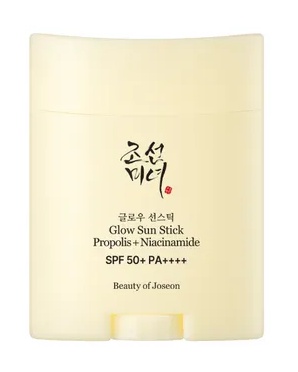
Glow Sun Stick Propolis + Niacinamide SPF 50+ PA++++
Ingredients overview
Highlights
Key Ingredients
Other Ingredients
Skim through
Beauty of Joseon Glow Sun Stick Propolis + Niacinamide SPF 50+ PA++++Ingredients explained
A clear, slightly yellow, odorless oil that's a very common, medium-spreading emollient. It makes the skin feel nice and smooth and works in a wide range of formulas.
 We don't have description for this ingredient yet.
An oil-soluble chemical sunscreen agent that protects the skin from UVB (295-315 nm) with a peak protection at 306 nm. Homosalate is not a strong UV filter in and of itself (gives only SPF 4.3 protection at max. allowed 10% concentration) and it is not photostable (looses 10% of its SPF protection in 45 mins) so it always has to be combined with other sunscreens for proper protection. Its big advantage, though, is that it is a liquid and is excellent for dissolving other hard to solubilize powder sunscreen agents, like the famous Avobenzone.
Regarding Homosalate's safety profile, we do not have the best news. In-vitro (made in the labs) studies have shown that it might have some estrogenic activity. Do not panic, these studies were not conducted on real humans under real world conditions. Still, if you are a 'better safe than sorry' type, be careful when using Homosalate containing sunscreens long-term and full-body.
As of 2020, Homosalate is permitted to be used up to 10% in the EU and 15% in the US, but the EU is currently considering restricting it to only 1.4% (probably taking effect from 2022).
An oil-soluble chemical sunscreen agent that protects skin in the UVB and somewhat in the UVA II range with a peak absorption of 304 nm. Its protection is not strong enough on its own but it is quite photostable (loses 10% of SPF protection in 95 mins) and is often used to stabilize other photo-unstable UV-filters, for example, Avobenzone. It is also often used to improve the water resistance of the products.
Octocrylene's safety profile is generally quite good, though a review study in Contact Dermatitis reports an "increasing number of patients with photo contact allergy to octocrylene." Mainly adults with ketoprofen-sensitivity and children with sensitive skin are affected, so if you have a small kid, it is probably better to use octocrylene-free sunscreens.
An amino acid ( L-Glutamic acid) based oil gelling agent that magically turns liquid oils into nice gels.
We don't have description for this ingredient yet.
A colorless to light yellowish oily liquid that works as a UVB (280-320nm) sunscreen filter with a peak absorbance at 306 nm. It's not a strong filter in itself, it's always used in combination with other sunscreen agents to further enhance the SPF and to solubilize other solid UV filters.
It has a good safety profile and is allowed to be used at a max concentration of 5% both in the US and in Europe (10% is allowed in Japan).
An amino acid (L-Glutamic acid) based oil gelling agent that magically turns liquid oils into nice gels. Often used togeather with fellow amino-acid based oil gelling agent, Dibutyl Lauroyl Glutamide.
An often used emollient with a light and silky feel. It's very mild to both skin and eyes and spreads nicely and easily. It's often used in sunscreens as it's also an excellent solvent for sunscreen agents.
A nice, multi-functional helper ingredient that's especially useful in sunscreens. It can solubilize some commonly used UV-filters like Oxybenzone or Avobenzone and it can also help to increase the SPF rating of sunscreens. It's also cosmetically elegant, has excellent spreadability and a pleasant, moisturizing skin feel. Oh, and according to Wikipedia, it even helps to stabilize famously unstable UVA-filter, Avobenzone.
The famous Avobenzone. It is a special snowflake as it is the only globally available chemical sunscreen agent that provides proper UVA protection (in the US, new generation sunscreen agents are not approved because of impossible FDA regulations). It is the global gold standard of UVA protection and is the most used UVA sunscreen in the world.
It gives very good protection across the whole UVA range (310-400 nm that is both UVA1 and UVA2) with a peak protection at 360 nm. The problem with it, though, is that it is not photostable and degrades in the sunlight. Wikipedia says that avobenzone loses 36% of its UV-absorption capacity after just one hour of sunlight (yep, this is one of the reasons why sunscreens have to be reapplied after a few hours).
The cosmetic's industry is trying to solve the problem by combining avobenzone with other UV filters that enhance its stability (like octocrylene, Tinosorb S or Ensulizole) or by encapsulating it and while both solutions help, neither is perfect. Interestingly, the combination of avobenzone with mineral sunscreens (that is titanium dioxide and zinc oxide) is not a good idea. In the US, it is flat out prohibited as avobenzone becomes unstable when combined with mineral sunscreens.
As for safety, avobenzone has a pretty good safety profile. It counts as non-irritating, and unlike some other chemical sunscreens, it shows no estrogenic effect. The maximum concentration of avobenzone permitted is 5% in the EU and 3% in the US.
We don't have description for this ingredient yet.
- A multi-functional skincare superstar with several proven benefits for the skin
- Great anti-aging, wrinkle smoothing ingredient used at 4-5% concentration
- Fades brown spots alone or in combination with amino sugar, acetyl glucosamine
- Increases ceramide synthesis that results in a stronger, healthier skin barrier and better skin hydration
- Can help to improve several skin conditions including acne, rosacea, and atopic dermatitis
Good old water, aka H2O. The most common skincare ingredient of all. You can usually find it right in the very first spot of the ingredient list, meaning it’s the biggest thing out of all the stuff that makes up the product.
It’s mainly a solvent for ingredients that do not like to dissolve in oils but rather in water.
Once inside the skin, it hydrates, but not from the outside - putting pure water on the skin (hello long baths!) is drying.
One more thing: the water used in cosmetics is purified and deionized (it means that almost all of the mineral ions inside it is removed). Like this, the products can stay more stable over time.
We don't have description for this ingredient yet.
Butylene glycol, or let’s just call it BG, is a multi-tasking colorless, syrupy liquid. It’s a great pick for creating a nice feeling product.
BG’s main job is usually to be a solvent for the other ingredients. Other tasks include helping the product to absorb faster and deeper into the skin (penetration enhancer), making the product spread nicely over the skin (slip agent), and attracting water (humectant) into the skin.
It’s an ingredient whose safety hasn’t been questioned so far by anyone (at least not that we know about). BG is approved by Ecocert and is also used enthusiastically in natural products. BTW, it’s also a food additive.
A really multi-functional helper ingredient that can do several things in a skincare product: it can bring a soft and pleasant feel to the formula, it can act as a humectant and emollient, it can be a solvent for some other ingredients (for example it can help to stabilize perfumes in watery products) and it can also help to disperse pigments more evenly in makeup products. And that is still not all: it can also boost the antimicrobial activity of preservatives.
If you have spotted ethylhexylglycerin on the ingredient list, most probably you will see there also the current IT-preservative, phenoxyethanol. They are good friends because ethylhexylglycerin can boost the effectiveness of phenoxyethanol (and other preservatives) and as an added bonus it feels nice on the skin too.
Also, it's an effective deodorant and a medium spreading emollient.
You may also want to take a look at...
| what‑it‑does | emollient | perfuming |
| what‑it‑does | emollient |
| what‑it‑does | sunscreen |
| what‑it‑does | sunscreen |
| what‑it‑does | viscosity controlling |
| what‑it‑does | emollient | surfactant/cleansing |
| what‑it‑does | sunscreen |
| irritancy, com. | 0, 0 |
| what‑it‑does | viscosity controlling |
| what‑it‑does | emollient | antimicrobial/antibacterial |
| what‑it‑does | solvent |
| what‑it‑does | sunscreen |
| what‑it‑does | emulsifying | surfactant/cleansing |
| what‑it‑does | cell-communicating ingredient | skin brightening | anti-acne | moisturizer/humectant |
| what‑it‑does | solvent |
| what‑it‑does | moisturizer/humectant | solvent |
| irritancy, com. | 0, 1 |
| what‑it‑does | solvent |
| what‑it‑does | preservative |