




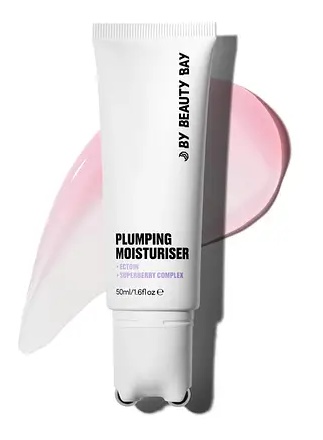
Plumping Moisturiser Ectoin + Superberry Complex
Ingredients overview
Highlights
Key Ingredients
Other Ingredients
Skim through
Beauty Bay Plumping Moisturiser Ectoin + Superberry ComplexIngredients explained
Good old water, aka H2O. The most common skincare ingredient of all. You can usually find it right in the very first spot of the ingredient list, meaning it’s the biggest thing out of all the stuff that makes up the product.
It’s mainly a solvent for ingredients that do not like to dissolve in oils but rather in water.
Once inside the skin, it hydrates, but not from the outside - putting pure water on the skin (hello long baths!) is drying.
One more thing: the water used in cosmetics is purified and deionized (it means that almost all of the mineral ions inside it is removed). Like this, the products can stay more stable over time.
- A natural moisturizer that’s also in our skin
- A super common, safe, effective and cheap molecule used for more than 50 years
- Not only a simple moisturizer but knows much more: keeps the skin lipids between our skin cells in a healthy (liquid crystal) state, protects against irritation, helps to restore barrier
- Effective from as low as 3% with even more benefits for dry skin at higher concentrations up to 20-40%
- High-glycerin moisturizers are awesome for treating severely dry skin
 We don't have description for this ingredient yet.
Ectoin is a surprisingly well-researched, multi-functional active that can do from pollution & light protection to skin hydration, soothing, and barrier repair, several things to your skin.
It is an extremolyte, a small stress-protection molecule that protects microorganisms living under extreme conditions such as salt lakes, hot springs, arctic ice, the deep sea, or deserts. It was discovered in 1985 in a microorganism living in a salt lake in the Egyptian desert.
The key skill of Ectoin is protection that applies also to the skin. Its main mode of action is binding water molecules (aka kosmotropic) and creating hydro complexes. These complexes then surround important biomolecules (e.g. cells, proteins, enzymes) and form a stabilizing hydration shell around them.
This protection mechanism means good things when it comes to our skin: Ectoin has antioxidant, anti-inflammatory, pollution& light protecting, skin hydrating, barrier repairing as well as anti-aging properties.
A placebo-controlled 10-person study examined a four-week treatment with 0.5% Ectoin in the crow's feet area and found a significant anti-wrinkle effect (-19% mean wrinkle depth) in 100% of the participants. Another double-blind, placebo-controlled clinical study with 24 participants used a 2% Ectoin cream twice a day for 4 weeks and found an improvement in all of the measured parameters, such as wrinkle volume, skin scaling, roughness, and elasticity.
Another remarkable property of Ectoin is protecting the epidermal immune cells called Langerhans cells from UV damage. 0.3% and 0.5% Ectoin cream was used twice a day for 14 days on the forearm and then irradiated with 1.5 MED UV (one and a half times the UV dose that causes detectable redness). While the untreated, UV-stressed area showed a 40% decrease in viable Langerhans cells, 0.5% Ectoin showed 100% protection (and 0.3% showed ~95% protection).
The soothing efficacy is also backed up by multiple in-vivo studies. A 20-person study compared 1% Ectoin cream to 0.25% hydrocortisone treatment on surfactant irritated skin and found similar effectiveness in reducing skin redness. Another study with 23 females with sensitive skin found that a 1% Ectoin cream helped to tolerate a 0.5% or 1% retinol treatment much better.
A tiny, 5-person study examined the long-term (7 days) skin hydration effect of 1% Ectoin. During the study, hydration levels increased up to 200% compared to placebo, and even 7 days after stopping the treatment hydration status was largely preserved. Higher concentration (5-7%) Ectoin treatments are also used as OTC medical products for the treatment of eczema or atopic skin.
The anti-pollution magic properties are also well-established and Ectoin is currently the only anti-pollution active ingredient approved for use in medical products (e.g. inhalation solutions) in Europe. Clinical studies showed a reduction of inflammations in human lungs of patients with COPD (a pulmonary disease) and pollution-induced asthma. But coming back to the skin, Ectoin protects both from PMs (Particulate Matters, including ultrafine) as well as PAHs (Polycyclic Aromatic Hydrocarbons) and heavy metals.
If that weren't enough, Ectoin is also shown to protect the skin from blue and visible light, and pigmentation resulting from environmental stress (think UV, pollution, oxidative stress).
All in all, we think Ectoin is one of those under-the-radar actives that deserves more hype than it is currently getting. As an amazing all-around skin protectant, it is a useful addition to any skincare routine.
Butylene glycol, or let’s just call it BG, is a multi-tasking colorless, syrupy liquid. It’s a great pick for creating a nice feeling product.
BG’s main job is usually to be a solvent for the other ingredients. Other tasks include helping the product to absorb faster and deeper into the skin (penetration enhancer), making the product spread nicely over the skin (slip agent), and attracting water (humectant) into the skin.
It’s an ingredient whose safety hasn’t been questioned so far by anyone (at least not that we know about). BG is approved by Ecocert and is also used enthusiastically in natural products. BTW, it’s also a food additive.
We don't have description for this ingredient yet.
We don't have description for this ingredient yet.
We don't have description for this ingredient yet.
We don't have description for this ingredient yet.
Tasmanian Pepper is a nice shrub living under hard conditions in the mountains of the Southeastern lands of Australia. It has small, round, purple-black berries that when dried, look like black pepper. Hence the name.
As for skincare, the berries contain a couple of great actives. The primary one is called polygodial that has potent anti-inflammatory, anti-allergic and antimicrobial activity. According to the manufacturers in-vivo (made on real people) tests, Tasmanian Pepper Extract can relieve itching and burning sensation to a great extent (79% and 58% decrease) almost instantly (after only 5 mins).
It also contains anthocyanins, that are well-known antioxidants. The berries are claimed to have an antioxidant power 3x greater than blueberries. A third active in the berries is called rutin, an anti-inflammatory agent that can strengthen capillaries. Thanks to this, Tasmanian Pepper might be able to help reduce dark undereye circles.
All in all, an interesting plant extract with soothing and antioxidant activity.
It’s pretty much the current IT-preservative. It’s safe and gentle, but even more importantly, it’s not a feared-by-everyone-mostly-without-scientific-reason paraben.
It’s not something new: it was introduced around 1950 and today it can be used up to 1% worldwide. It can be found in nature - in green tea - but the version used in cosmetics is synthetic.
Other than having a good safety profile and being quite gentle to the skin it has some other advantages too. It can be used in many types of formulations as it has great thermal stability (can be heated up to 85°C) and works on a wide range of pH levels (ph 3-10).
It’s often used together with ethylhexylglycerin as it nicely improves the preservative activity of phenoxyethanol.
A handy multifunctional ingredient that works as a preservative booster, as well as an antioxidant and soothing agent.
A multi-functional, silky feeling helper ingredient that can do quite many things. It's used as an emulsion stabilizer, solvent and a broad spectrum antimicrobial. According to manufacturer info, it's also a moisturizer and helps to make the product feel great on the skin. It works synergistically with preservatives and helps to improve water-resistance of sunscreens.
A very common ingredient that can be found in all cell membranes. In cosmetics it's quite the multi-tasker: it's an emollient and water-binding ingredient but it's also an emulsifier and can be used for stabilization purposes. It's also often used to create liposomes.
Propanediol is a natural alternative for the often used and often bad-mouthed propylene glycol. It's produced sustainably from corn sugar and it's Ecocert approved.
It's quite a multi-tasker: can be used to improve skin moisturization, as a solvent, to boost preservative efficacy or to influence the sensory properties of the end formula.
It’s a handy multi-tasking ingredient that gives the skin a nice, soft feel. At the same time, it also boosts the effectiveness of other preservatives, such as the nowadays super commonly used phenoxyethanol.
The blend of these two (caprylyl glycol + phenoxyethanol) is called Optiphen, which not only helps to keep your cosmetics free from nasty things for a long time but also gives a good feel to the finished product. It's a popular duo.
Exactly what it sounds: nice smelling stuff put into cosmetic products so that the end product also smells nice. Fragrance in the US and parfum in the EU is a generic term on the ingredient list that is made up of 30 to 50 chemicals on average (but it can have as much as 200 components!).
If you are someone who likes to know what you put on your face then fragrance is not your best friend - there's no way to know what’s really in it.
Also, if your skin is sensitive, fragrance is again not your best friend. It’s the number one cause of contact allergy to cosmetics. It’s definitely a smart thing to avoid with sensitive skin (and fragrance of any type - natural is just as allergic as synthetic, if not worse!).
If you have spotted ethylhexylglycerin on the ingredient list, most probably you will see there also the current IT-preservative, phenoxyethanol. They are good friends because ethylhexylglycerin can boost the effectiveness of phenoxyethanol (and other preservatives) and as an added bonus it feels nice on the skin too.
Also, it's an effective deodorant and a medium spreading emollient.
We don't have description for this ingredient yet.
A super common and cheap fragrance ingredient. It's in many plants, e.g. rosemary, eucalyptus, lavender, lemongrass, peppermint and it's the main component (about 50-90%) of the peel oil of citrus fruits.
It does smell nice but the problem is that it oxidizes on air exposure and the resulting stuff is not good for the skin. Oxidized limonene can cause allergic contact dermatitis and counts as a frequent skin sensitizer.
Limonene's nr1 function is definitely being a fragrance component, but there are several studies showing that it's also a penetration enhancer, mainly for oil-loving components.
All in all, limonene has some pros and cons, but - especially if your skin is sensitive - the cons probably outweigh the pros.
A common fragrance ingredient that has a sweet scent somewhere between lily and fruity melon. Can be found in essential oils, such as lavender oil, orange flower oil or ylang-ylang.
In cosmetics, it can be used up to 1%. It’s one of the “EU 26 fragrances” that has to be labelled separately (and cannot be simply included in the term “fragrance/perfume” on the label) because of allergen potential. Best to avoid if your skin is sensitive.
You may also want to take a look at...
| what‑it‑does | solvent |
| what‑it‑does | skin-identical ingredient | moisturizer/humectant |
| irritancy, com. | 0, 0 |
| what‑it‑does | viscosity controlling |
| what‑it‑does | antioxidant | soothing | moisturizer/humectant |
| what‑it‑does | moisturizer/humectant | solvent |
| irritancy, com. | 0, 1 |
| what‑it‑does | moisturizer/humectant |
| what‑it‑does | moisturizer/humectant |
| what‑it‑does | moisturizer/humectant |
| what‑it‑does | antioxidant | soothing |
| what‑it‑does | preservative |
| what‑it‑does | antioxidant | preservative |
| what‑it‑does | solvent | moisturizer/humectant |
| what‑it‑does | emollient | emulsifying |
| what‑it‑does | solvent | moisturizer/humectant |
| what‑it‑does | moisturizer/humectant | emollient |
| what‑it‑does | perfuming |
| what‑it‑does | preservative |
| what‑it‑does | perfuming | solvent |
| what‑it‑does | perfuming |
| what‑it‑does | perfuming |